



Leading Off
MO Redistricting, MO Ballot
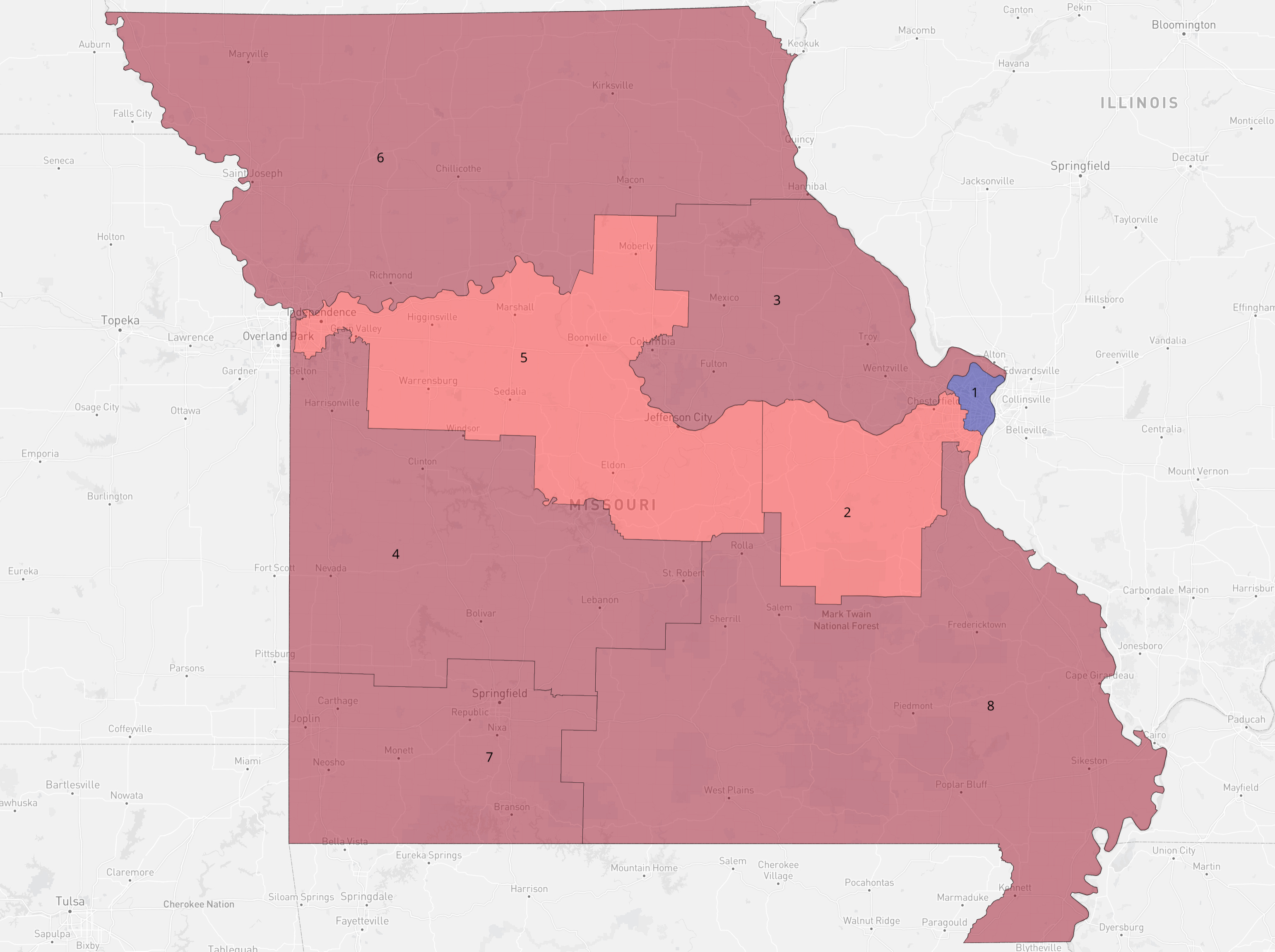
Republican Gov. Mike Kehoe has summoned lawmakers for a special session beginning on Wednesday, during which he wants them to adopt a new congressional gerrymander that would flip Missouri's 5th District from blue to red. Democrats, however, have more than one way of thwarting the GOP's aims.
Kehoe also wants the Republican-dominated legislature to adopt a new constitutional amendment that would make it much harder for citizens to pass amendments of their own in the future—a dream the Missouri GOP has long pursued without success. Even if the proposal does make it to the ballot, though, it would still have to earn voter approval before becoming law.
Depending on how Democrats respond, the new map could also go before voters. The redrawn lines would radically overhaul the western part of the state by splitting up Kansas City, which has long formed the heart of the 5th District and ensured its status as a reliably blue bastion.
Instead, the city would get chopped up between three different districts, all of which would be solidly red. The revamped 5th would stretch almost from the state border with Kansas deep into rural central Missouri some 200 miles away, with a stop in the capital of Jefferson City along the way.
Kehoe, who issued his summons just before the holiday weekend, has made it difficult to examine the proposed map because he provided only a PDF of the new districts rather than standard data files. Consequently, the Downballot's Daniel Donner recreated the map in Dave's Redistricting App by hand. (Given the poor quality of the PDF, there may be some minor incongruities.)
Based on 2024 election results uploaded by DRA users, Donald Trump would have carried the new-look 5th by a 58-40 margin; four years earlier, he would have won it by a similar 56-42 spread. Two neighboring districts would also ingest parts of Kansas City but still would have gone for Trump last year: the 4th by a 60-39 margin and the 6th by an even wider 63-36 spread.
The plan would also make the 2nd District in the St. Louis suburbs a few points redder, shifting it from 53-45 for Trump to 55-43. There, Republican Rep. Ann Wagner faces a potential challenge from billionaire businessman Bob Clark.
As for the 5th District's longtime representative, Democrat Emanuel Cleaver previously indicated to Punchbowl that he'd run for a 12th term no matter what Republicans do, but he was less absolute in a statement he released in response to the new map.
"President Trump's unprecedented directive to redraw our maps in the middle of the decade and without an updated census is not an act of democracy – it is an unconstitutional attack against it," Cleaver said. "This attempt to gerrymander Missouri will not simply change district lines, it will silence voices. It will deny representation."
"Should this effort move forward, we will not concede," he added, though when asked by reporters whether he was committed to running in the 5th, Cleaver, who is 80, responded, "I'm committed to going to federal court."
The state courts, though, are likely the better option. While the Missouri Supreme Court is dominated by Republican appointees, it has acted as a check on GOP power grabs in recent years. Most notably, it thwarted a Republican effort to prevent citizens from placing an amendment on the ballot last year to enshrine abortion rights into the state constitution. (It ultimately passed.)
As state constitutional law expert Quinn Yeargain notes, the court might be amenable to claims that partisan gerrymandering violates the state constitution, which mandates that "all elections shall be free and open."
In addition, opponents of the new map could seek to qualify a "veto referendum" for the ballot. Under this process, organizers would collect signatures to place a measure before voters asking whether they approve of the map. Should they gather enough signatures, the map would be suspended until an election could be held; should the "no" side prevail, it would be repealed.
Labor unions launched a successful veto referendum in 2018 to undo a "right-to-work" law the legislature had passed, prevailing at the ballot box by a 2-to-1 margin. And in 1922, as cataloged by Ballotpedia, Missouri voters rejected a congressional map advanced by lawmakers in a 62-38 landslide.
Ohio Democrats are also considering a similar move to block a new GOP gerrymander in their state, though in both states, Republicans could engage in parliamentary maneuvering that could insulate their maps from veto referendums.

Kehoe's amendment to make future amendments harder to pass, meanwhile, would place a number of new restrictions on activists. The biggest hurdle, though, would be a new requirement that measures could only be adopted if they win a majority of the vote both statewide and in every congressional district—effectively gerrymandering the ballot initiative process.
Such a rule, however, potentially runs afoul of the Constitutional doctrine of "one person, one vote" by making certain voters' ballots count more depending on where they live. It also appears that Kehoe's plan would apply only to voter-backed initiatives and not to amendments referred by the legislature, such as a measure passed by Republicans in May seeking to repeal last year's abortion rights amendment.
David Nir here, publisher of The Downballot! We just celebrated our site’s first anniversary, but unfortunately, we lost a lot of subscribers at the one-year mark, since some folks choose not to renew and others simply don’t have up-to-date credit card info on file.
We’d be incredibly grateful if you could help us recover from this dip by upgrading to a paid subscription today. Not only will you be supporting independent media, but you’ll also unlock exclusive features and content available only to paid subscribers. Thank you so much!
Redistricting Roundup
AL Redistricting
Alabama Republicans have appealed a recent ruling by a federal judge ordering the state to redraw its Senate map on the grounds that it discriminates against Black voters in violation of the Voting Rights Act. The appeal will be heard by the 11th Circuit Court of Appeals.
Republicans have also asked U.S. District Judge Anna Manasco to stay her own ruling while the Supreme Court hears a different case out of Louisiana that could spell the end of the VRA.
CA Redistricting
Both sides have launched their opening ads for the expensive Nov. 4 special election that will decide whether California replaces its current congressional map with a new one aimed at countering the GOP's newly passed gerrymander in Texas. The Republican-led "no" campaign, though, starts with a large financial advantage thanks to one committed megadonor.
AdImpact reports that the effort to defeat Proposition 50 has spent or reserved just under $10 million in ad time, compared to $3.6 million for the "yes" side. Almost all of the "no" campaign's funding comes from the $20 million it has received from Charles Munger, a wealthy Republican who helped finance the successful 2010 effort to put congressional redistricting in the hands of an independent commission.
The spending disparity may not last, however.
A committee created by Democratic Gov. Gavin Newsom to pass Proposition 50 took in over $13 million from Aug. 11 through the end of the month. The largest contributions come from House Majority PAC, which is the main pro-Democratic outside group involved in House campaigns, and the California Teachers Association. Netflix founder Reed Hastings has also donated $2 million to the effort.
Newsom's side debuted its first two ads Monday, and both frame the contest as California's chance to stand up to Donald Trump.
"Following the dictator's playbook, Donald Trump has unleashed a blitzkrieg, arresting people without warrants, targeting the free press, attacking universities," the narrator warns in one spot. "Now he's coming directly for our democracy with a scheme to rig the next election. You have the power to stop him."
The other stars Sara Sadhwani, who was a member of the state's redistricting commission and argues that Proposition 50 "will put the election back on a level playing field by giving the people the power to approve emergency maps to counter Trump's power grab." Sadhwani also reassures the audience that "Prop. 50 is temporary, reaffirming California's commitment to independent non-partisan redistricting for the long term."
Munger's side, by contrast, avoids mentioning Trump or GOP gerrymandering in other states in its opening commercial. It features a kettlebell labeled "Prop 50" smashing up a carefully made wooden carving spelling out "Fair Elections." The narrator goes on to quote critics warning that the ballot measure is "a direct attack on democracy" and "tears away the power of choice."
TX Redistricting
Gov. Greg Abbott finally signed Texas' new congressional gerrymander just before the holiday weekend, a week after the state's Republican-dominated legislature passed it.
Civil rights groups have already filed legal challenges to the map, alleging that it violates the Voting Rights Act by diminishing the voting power of Black and Latino voters. A three-judge federal panel that had already been hearing a dispute over Texas' previous map has scheduled eight days of hearings to begin on Oct. 1.

Senate
IA-Sen, IA-02
Rep. Ashley Hinson announced she would run for Iowa's open Senate seat on Tuesday, kicking off her bid just hours after Sen. Joni Ernst, a fellow Republican, confirmed earlier reports she would not seek reelection next year.

Hinson previously worked as an anchor for Cedar Rapids' ABC affiliate before she was elected to the state legislature in 2016. She went on to win a promotion in 2020 by narrowly unseating Democratic Rep. Abby Finkenauer in a closely-watched race for what was then numbered the 1st District in the northeastern corner of the state.
Hinson, whose constituency was renumbered the 2nd District following the 2020 census, convincingly turned back Democratic state Sen. Liz Mathis in 2022, and she had no trouble securing her third term last year. Several Democrats, though, were challenging Hinson this cycle, and Republicans will now need to find a new candidate to defend her House seat.
Hinson joins a Senate primary that already features former state Sen. Jim Carlin, who was waging a poorly funded challenge against Ernst, but she may not be the only well-connected Republican who enters this race.
NBC reported last week that Matt Whitaker, an ardent Trumpist who currently serves as ambassador to NATO, "would also consider running" to replace Ernst. Whitaker, who became acting attorney general following Jeff Sessions' forced resignation in 2018, hasn't said anything publicly.
Whitaker and Ernst both competed in the packed 2014 primary for this same seat, but Ernst left her competition in the dust after debuting her instantly infamous "Squeal" ad that featured her comparing cutting wasteful spending to castrating hogs. Ernst, who was a state senator at the time, beat her nearest opponent 56-18 as Whitaker took fourth with just 8%.
The Associated Press' Seung Min Kim also writes there's "chatter" that Attorney General Brenna Bird, who decided in July not to campaign for the open governorship, could run for Senate. Bird has also yet to indicate if she's interested in this race, though she was also mentioned as a possible challenge to Ernst late last year when the senator briefly resisted Pete Hegseth's nomination as defense secretary.
Rep. Zach Nunn, however, will not be seeking a promotion, a member of his team tells Punchbowl News' Ally Mutnick. Nunn, like Bird, considered running to succeed retiring GOP Gov. Kim Reynolds, but Donald Trump reportedly pressured him to defend his seat in the swingy 3rd District instead.
Four notable Democratic candidates—Des Moines School Board Chair Jackie Norris, military veteran Nathan Sage, state Rep. Josh Turek, and state Sen. Zach Wahls— entered the race back when Ernst was still acting like she planned to run again, and no other major names have shown any obvious interest in running now that they know she won't be on the ballot.
Iowa spent decades as one of America's perennial swing states, but Ernst's unexpectedly wide 52-44 victory over Democratic Rep. Bruce Braley in the 2014 race to succeed retiring Democratic Sen. Tom Harkin marked the start of a new era of GOP dominance. That win made Ernst the first woman combat veteran to ever serve in the upper chamber, as well as the first woman to represent Iowa in Congress.
At the time, most observers attributed Ernst's showing in large part to her strong campaign, Braley's mistakes, and the poor political climate for Democrats nationwide, rather than as an omen that Iowa was no longer a purple state. Trump's easy 2016 win, however, marked a definitive sign that things had changed.
Democrats hoped the state would swing back in 2020, but Ernst instead defeated businesswoman Theresa Greenfield 52-45 as Trump was again taking Iowa's six electoral votes. Trump's 56-43 victory here last year gave Hawkeye State Democrats little to be optimistic about as they rang in 2025.
However, their huge overperformance in four special legislative elections—including Catelin Drey's decisive victory last week in a conservative state Senate district—gives Democrats reason to hope that 2026 will be different. A victory in the race to succeed Ernst would give Democrats a chance to overcome a tough Senate map, as well as the opportunity to turn the page from the tough political era her 2014 win ushered in.
LA-Sen
St. Tammany Parish Council member Kathy Seiden told the Shreveport Times last week that she's considering challenging Louisiana Sen. Bill Cassidy in next year's Republican primary and would make an announcement "very soon." Seiden is one of 14 members of the governing body for St. Tammany Parish, a longtime Republican bastion located north of New Orleans.
TX-Sen
Allies of Republican Sen. John Cornyn have launched the first barrage of attack ads targeting Attorney General Ken Paxton since the challenger kicked off his Senate bid in April, highlighting the many scandals surrounding Paxton.
"His staff reported him for corruption and quit," says the narrator for the pro-Cornyn Texans for a Conservative Majority. "His wife left him on 'biblical grounds.'" The group is spending at least $1.5 million for its opening buy, according to FEC filings.
Cornyn has benefited from millions in outside spending to boost his image, while Punchbowl News notes that Paxton and his allies have yet to run ads. The GOP primary is scheduled for March 3.
Governors
AZ-Gov
Arizona Gov. Katie Hobbs holds small leads over both of her likely Republican rivals in next year's gubernatorial race in a new survey, but large numbers of undecideds remain.
According to Noble Predictive Insights, Hobbs has a 40-38 edge over businesswoman Karrin Taylor Robson and a similar 39-37 advantage over Rep. Andy Biggs. That's almost identical to what the firm found in May—the last time we saw data on this race from any outfit.
In the GOP primary, meanwhile, Robson leads Biggs 37-27, with 36% undecided. It's Noble's first look at the battle for the Republican nomination and also the first poll to show Robson ahead. Both candidates have Donald Trump's endorsement—and yes, it's been exactly as awkward as you'd expect.
FL-Gov
Former state House Speaker Paul Renner is "close to" entering the Republican primary for governor, Florida Politics reports. Renner would take Rep. Byron Donalds, who has been running since February without any serious intra-party opposition.
KS-Gov
Financial services executive Philip Sarnecki on Tuesday joined the busy Republican primary for governor of Kansas and is "expected to have considerable resources at his disposal," according to the Cook Political Report's Matthew Klein. Sarnecki is running to succeed Democratic Gov. Laura Kelly, who is termed out.
Sarnecki, who is seeking office for the first time, pitched himself as an alternative to the "career politicians [who] continue to lose to liberal democrats." The GOP field includes several better-established candidates, including former Gov. Jeff Colyer, state Senate President Ty Masterson, Insurance Commissioner Vicki Schmidt, and Secretary of State Scott Schwab.
NJ-Gov
Republican Jack Ciattarelli has launched his first ad buy of the fall general election for New Jersey's open governorship, which the New Jersey Globe says will air for two weeks and is backed by a $1.8 million buy.
"New Jersey's a mess, and all Mikie Sherrill wants to talk about is President Trump," Ciattarelli complains. "What does the president have to do with rising property taxes and higher electricity bills? New Jersey's a mess because out-of-touch politicians like Phil Murphy and Mikie Sherrill care more about pronouns and sanctuary cities than they do solving our problems."
Democrats, though, were quick to note that when he was still seeking the GOP nomination, Ciattarelli was only too happy to talk about Trump.
"Only one candidate for governor earned President Trump's endorsement: Jack Ciattarelli," declared a narrator in a 15-second spot that aired before the primary. "President Trump called Jack a winner who will fight tirelessly for New Jersey. Jack Ciattarelli: the Trump choice for governor."
Ciattarelli is still playing catch-up with Sherrill in more ways than one. Late last month, AdImpact reported that Sherrill and her allies had booked more than $17 million in ad time from Labor Day onward while Ciattarelli's side had yet to reserve any. Sherrill has also been receiving serious help from third-party groups, but Republican organizations have yet to step up on their candidate's behalf.
SC-Gov
South Carolina Lt. Gov. Pamela Evette has launched a $1 million opening ad buy that will last for a month, her team tells the Associated Press.
The ad campaign, which comes over nine months before next June's Republican primary for governor, touts Evette as an ardent Donald Trump ally who "stood by him every time." The lieutenant governor also criticizes her main intraparty rivals—Attorney General Alan Wilson and Reps. Nancy Mace and Ralph Norman—for having "turned their backs" on Trump.
House
AL-01
Former Rep. Jerry Carl has publicized an internal poll that shows him leading state Rep. Rhett Marques 29-5 in next May's Republican primary for Alabama's open 1st District as Army Special Forces veteran Joshua McKee takes just 2%.
This survey from Cygnal, though, still shows Carl far below the majority he'd need to avert a runoff.
CA-38
Los Angeles County Supervisor Hilda Solis announced Friday that she'll run for the proposed 38th District if California voters approve a new Democratic-backed congressional map this November.
Democratic Rep. Linda Sanchez represents the existing 38th, but the Los Angeles Times says she's "likely" to instead seek the proposed 41st District, another reliably blue seat that includes almost half of her current constituency.
Solis, a Democrat who has the support of Los Angeles Mayor Karen Bass, is seeking to return to the House after what would be an 18-year absence. She was first elected in 2000 to represent part of the Los Angeles area but resigned in 2009 to become Barack Obama's first labor secretary.
Solis left the cabinet after Obama's first term but soon won a 2014 race to join the Los Angeles County Board of Supervisors, the powerful five-member body that runs America's most populous county. She cannot, however, seek a fourth term in her current position.
NY-12
Longtime Rep. Jerry Nadler, a progressive stalwart known for his advocacy for liberal causes, announced Monday evening that he's decided not to seek reelection in New York's 12th District, a safely Democratic seat based in Manhattan.
While Nadler, 78, had previously sounded ready to run again, he told the New York Times, "Watching the Biden thing really said something about the necessity for generational change in the party, and I think I want to respect that."
Nonprofit executive Liam Elkind, 26, had already launched a primary campaign against Nadler in late July by calling for the incumbent to step aside and "build a bridge to the future." Elkind got what he wanted this week, and his early launch gives him a head start in what could be a packed nomination battle.
Assemblymember Micah Lasher, a former Nadler aide, has long been talked about as the congressman's preferred successor. Lasher quickly confirmed his interest in running to succeed his old boss.
Assemblymember Alex Bores and New York City Council Members Erik Bottcher and Keith Powers each told Politico that they’re considering running. Politico says that another member of the Assembly, Tony Simone, is also interested.
Politico and City & State also mention several other Democrats as possibilities, including attorney Tali Farhadian Weinstein; author Molly Jong-Fast; former Federal Trade Commission Chair Lina Khan; City Council Member Julie Menin; and actress Cynthia Nixon.
Former City Comptroller Scott Stringer, however, told Gothamist he won't run. State Sen. Liz Krueger likewise told the Times in a text message, "I will be one of the few residents NOT forming an exploratory committee for this seat."
Two other local lawmakers are also noes. State Sen. Brad Hoylman-Sigal, who is on a glide path to become Manhattan borough president following his primary victory over Powers earlier this summer, told Politico he's not interested. Assemblymember Linda Rosenthal, likewise, said she'd run to succeed Hoylman-Sigal in the state Senate rather than take a shot at Nadler's seat.
Whoever does run will compete in the first open-seat race in this area in decades.
The two main neighborhoods that make up the 12th District—Manhattan's Upper East Side and Upper West Side—were united for the first time in 150 years when a court-appointed expert drew a new map following the 2020 census. Neither neighborhood has seen an open race for the House since the late 1970s, when the West Side's Bella Abzug unsuccessfully ran for Senate and the East Side's Ed Koch became mayor.
Nadler himself won a promotion from the state Assembly to Congress in 1992 after longtime Rep. Ted Weiss died one day before he was about to easily win renomination in what was then the 17th District. Party leaders chose Nadler over several other candidates, including Abzug, to be their nominee in both the special election for the final months of Weiss' term and for a spot in the new Congress, and he easily won both campaigns.
Nadler's only tough reelection came in 2022 after New York's highest court approved a map that set off a primary confrontation between him and fellow Rep. Carolyn Maloney.
But while Maloney represented considerably more of the new 12th District, her unimpressive victories over businessman Suraj Patel during her prior two primaries underscored her weak standing. Nadler beat his colleague 55-24, with Patel taking 19%, and he had no opposition last year in what turned out to be his final primary.
PA-08
Scranton Mayor Paige Cognetti on Tuesday became the first prominent Democrat to announce a campaign against Republican Rep. Rob Bresnahan, using a launch video to highlight the string of negative headlines Bresnahan has attracted during his first months in office.
"Rob ran for Congress on a promise to ban stock trades," Cognetti tells the audience. "This year, he's already made 600 trades." The mayor continues by faulting her opponent for having "[s]old Chinese stocks the week of a tariff, buys missile stocks before a war, buys jet stocks before a big contract, overseas crypto—buys crypto stocks before a vote."
Cognetti further accuses Bresnahan of voting to cut Medicaid right after he "sold Medicaid provider stocks … profiting off of Pennsylvania's loss." She also highlights what NOTUS characterizes as Bresnahan's "secret helicopter" and declares she's running because "people here deserve a lot better than a rich kid disrespecting our hard work and proud legacy."
Cognetti begins her race for the 8th District with endorsements from former Rep. Matt Cartwright, who lost a close race to Bresnahan last year, and Lt. Gov. Austin Davis. She also has Rep. Chris Deluzio, who represents the 17th District on the other side of the state, and EMILYs List in her corner.
The pro-Democratic House Majority PAC greeted Cognetti's entry by releasing an internal poll showing her edging out Bresnahan 45-43 in a constituency Donald Trump carried 54-45 last year. The survey, which was conducted by Public Policy Polling, did not mention any other potential Democratic contenders.
It's not clear yet, though, whether Cognetti will face any serious opposition in next year's primary.
State Rep. Bridget Kosierowski told the Times-Tribune late last month that she was considering a bid, though WVIA reports that it was unable to contact her in response to Cognetti's launch. The outlet says it also didn't hear back from former prosecutor Drew McLaughlin, another potential candidate.
Pittston Mayor Michael Lombardo, however, said last month he was unlikely to run but hadn't ruled it out yet. WVIA now writes that Lombardo "confirmed recently that he will not run," though there's no quote from him.
TN-06
Brad Gaines, a former Vanderbilt University football player who is the father of the anti-trans activist Riley Gaines, filed paperwork last week for a potential campaign for Tennessee's open 6th District.
The elder Gaines, though, has said essentially nothing about his interest in succeeding Rep. John Rose, a fellow Republican who is leaving to run for governor. Gaines has a campaign site that consists of only a logo and a donation button. WTVF also writes that "[w]hen it comes to Gaines' digital footprint, we found it's essentially nonexistent."
TX-33
As a trio of Democratic incumbents gingerly eye Texas' redrawn 33rd District, former state Rep. Domingo Garcia tells CBS News that he's formed "an exploratory committee to look at running if the maps stay as they are."
Garcia ran against one of those members of Congress in 2012, when the 33rd was newly created thanks to reapportionment. Though the district was predominantly Latino, higher turnout among Black voters powered then-state Rep. Marc Veasey, who is African American, to a 53-47 victory in a primary runoff.
The new-look 33rd, however, sheds all of Veasey's base in Fort Worth, confining itself entirely to Dallas. For that reason, Garcia, who went on to lead the Latino civil rights organization LULAC, sounds disinclined to defer to Veasey or anyone else. He argued instead that neither the congressman nor Rep. Julie Johnson lives in the district. (Rep. Jasmine Crockett is also looking at the race.)
Veasey, meanwhile, is taking his time.
"I'm not ready to come right out and say anything right now," Veasey told CBS. "I think it's too early, and I've just been really urging everyone in the delegation to let's just wait and see." Texas' candidate filing deadline is Dec. 8, with primaries in March and a runoff if needed in May.
TX-34
Activist Fred Hinojosa, whose brother is state Sen. Adam Hinojosa, has joined the Republican primary to take on Democratic Rep. Vicente Gonzales in Texas' 34th District.
Already seeking the nod are Army veteran Eric Flores and former Rep. Mayra Flores (the two appear to be of no relation). Under the GOP's new gerrymander, the 34th, which is based in the eastern Rio Grande Valley and the Corpus Christi area, is now several points redder than in its prior iteration.
Utah
Should Utah find itself with a new congressional map next year, reporter Bryan Schott says at his site Utah Political Watch that former Democratic Rep. Ben McAdams could wage a comeback.
In a huge upset in 2018, McAdams unseated Republican Rep. Mia Love in the previous version of the 4th District by just 694 votes, but two years later, he lost his bid for a second term to Republican Burgess Owens 48-47.
The GOP responded by extensively gerrymandering the already conservative 4th District to make it much redder. However, under a new court ruling ordering Utah to redraw its map, the state could wind up with a solidly blue seat in the Salt Lake City area—one that could be enticing to Democrats like McAdams.
VA-01
Henrico County Commonwealth's Attorney Shannon Taylor, who's been considering a bid against Republican Rep. Rob Wittman in Virginia's 1st Congressional District, has now filed paperwork with the FEC ahead of a possible campaign.
Judges
WI Supreme Court
Wisconsin conservatives have largely been slow to express interest in running for the Supreme Court seat held by Justice Rebecca Bradley, who backtracked on earlier plans to run for another 10-year term when she announced her retirement on Friday.
So far, the only potential candidate to emerge is Court of Appeals Judge Maria Lazar, who says she's "seriously considering" and will decide "in the next few weeks." Lazar came up as a possible candidate for the Supreme Court race earlier this year, but she ultimately deferred to former state Attorney General Brad Schimel, who wound up losing to liberal Judge Susan Crawford in a 55-45 blowout.
And that's about it, according to the Milwaukee Journal Sentinel. Two of Lazar's colleagues on the Court of Appeals appear to be nos, with Judge Gregory Gill telling the paper, "Not at this juncture" and Judge Mark Gundrum "not in a position right now to take on a statewide campaign," according to unnamed sources. No other names appear to be circulating.
Liberals long ago rallied around another Appeals Court judge, Chris Taylor, who launched a campaign against Bradley in May. A spokesperson for Taylor told the Journal Sentinel that her campaign has already brought in more than $1 million; Bradley had raised nothing before dropping out.
CA Ballot
A long-running battle over one of the most expensive ballot measures in American history has concluded after California lawmakers struck an agreement with ride-hailing companies that would allow drivers to join labor unions.
Uber, Lyft, and other gig-based companies spent more than $200 million in 2020 to support Proposition 22, which classified workers as independent contractors rather than employees. The measure passed by a wide 59-41 margin and was ultimately upheld in 2024 by the California Supreme Court following years of litigation.
That ruling, however, left open the possibility of further regulation by the legislature. Under the deal, Uber and Lyft will see their insurance obligations reduced in exchange for allowing workers to engage in collective bargaining while still being regarded as independent contractors. Lawmakers are reportedly expected to pass the package later this month.
Legislatures
MI State Senate
Democratic Gov. Gretchen Whitmer has finally called a special election for Michigan's long-vacant 35th Senate District, a race that could determine how power is wielded in the upper chamber.
The seat will remain unfilled for a good while longer, however: Primaries will take place on Feb. 3, with a general election not until May 5. Candidates must file by Sept. 30.
The district, located at the crook between the state's Thumb and the rest of its "mitten," has been without representation since January, when Democrat Kristen McDonald Rivet stepped down after winning a bid for Congress. Since then, Democrats have held just a 19-18 advantage in the Senate, opening up the possibility that the GOP could force a tie by flipping this swingy seat.
According to calculations from The Downballot based on unofficial returns, Kamala Harris carried the 35th District by just a 50-49 margin, a touch closer than Joe Biden's 51-48 win here four years ago. And when McDonald Rivet first won this seat in 2022, the race was also tight: She defeated Republican Annette Glenn, then a member of the state House, 53-47.
Whitmer never publicly discussed her long delay in scheduling the election, though it's possible Democrats were afraid of jeopardizing their majority. Republicans, however, didn't appear to be in any rush either, perhaps mindful of the fact that Democrats have been performing extremely well in special elections across the country this year.
Whitmer finally took action a few weeks after a group of voters filed a lawsuit asking a judge to order her to set an election. Just a day before issuing her call, Whitmer's lawyers filed a brief arguing that the courts lacked the power to compel her to schedule an election, though that suit is now presumably moot.
Mayors & County Leaders
New York, NY Mayor
Attorney Jim Walden, whose independent bid for mayor was mired at 1% in the polls, dropped out of the race to lead New York City on Tuesday. Walden called on other candidates to follow suit in the hopes of presenting a united front against Democratic primary winner Zohran Mamdani, but similar pleas he's made in the past have gone ignored.
Obituaries
Duke Cunningham
Former Rep. Randall Harold Cunningham, the California Republican best known as "Duke" who resigned in 2005 following a high-profile bribery scandal, died Wednesday at the age of 83.
The departure of Cunningham, who used official congressional stationery to draw up a literal "bribe menu," set off a closely watched special election the following year in what was then numbered the 50th District. But while Republican Brian Bilbray defended that San Diego-area seat, Democrats nationwide successfully highlighted Cunningham and the "culture of corruption" he exemplified as they won control of the House for the first time in 12 years.

The San Diego Union-Tribune's Jeff McDonald has much more on Cunningham's long career, his fall, and subsequent eight-and-a-half-year stint in prison, in his obituary. And if you've never read about his hot tub, don't say we didn't warn you.
Correction: We incorrectly stated that New Jersey Democrat Mikie Sherrill had started advertising for her general election campaign in August. She began advertising this week.
"What does the president have to do with rising property taxes and higher electricity bills?" lolol that's a good one, Jack Ciattarelli.
The most disgusting thing about Duke Cunningham isn't the hot tub, it's that he apparently ate "very well done" filet mignon. They should've dropped the corruption charges and sought the death penalty for that.