



Leading Off
TX Redistricting
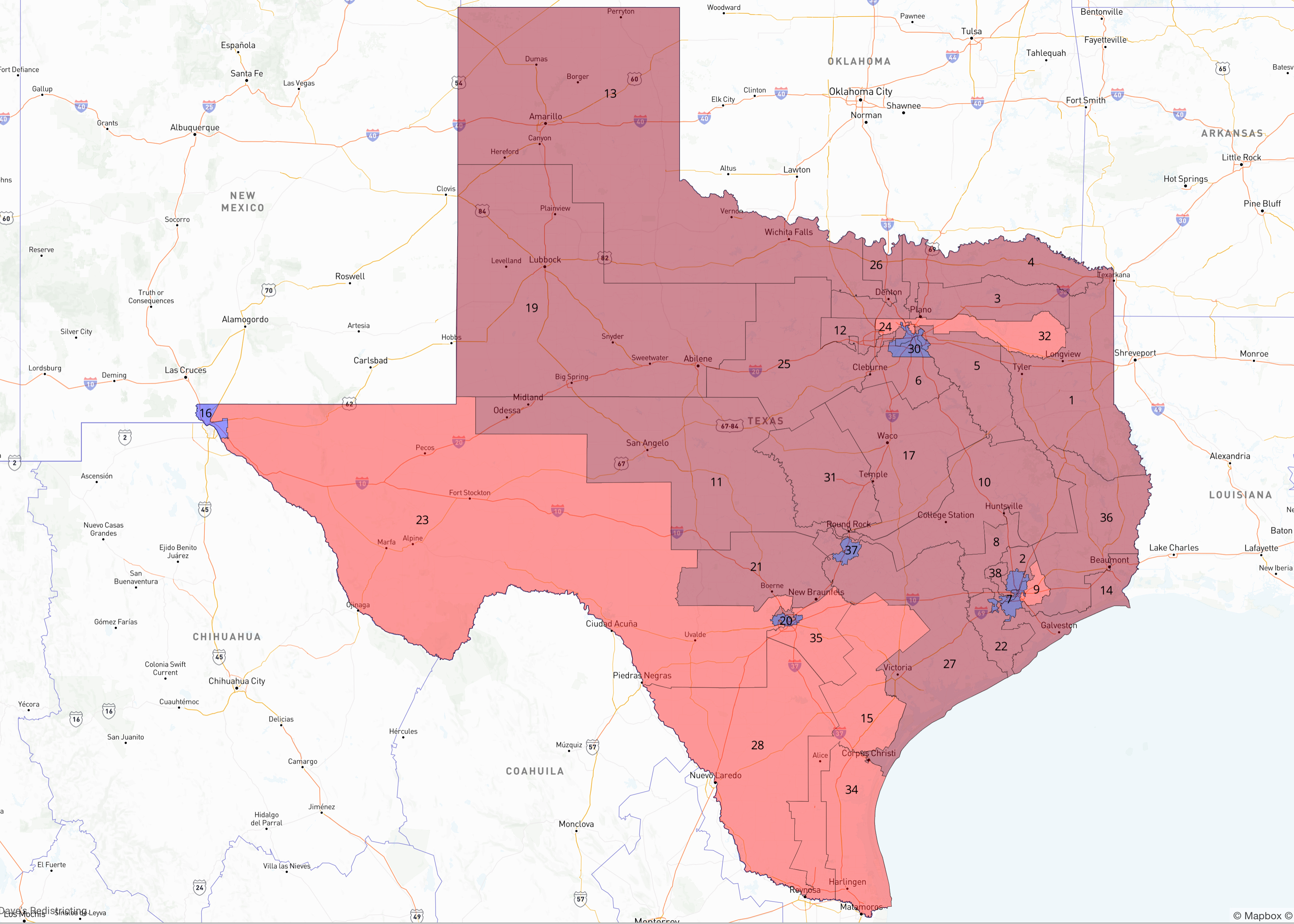
Texas Republicans unveiled a congressional redistricting proposal on Wednesday that would, as Donald Trump asked, further gerrymander the state's map by making five Democratic-held seats more likely to flip in next year's elections.
The plan, which could change prior to passage, seeks to undermine Democrats by diluting the voting strength of Black and Latino voters, potentially in violation of the Voting Rights Act. It makes radical changes to do so, moving more than a third of Texans into new constituencies. Of the state's 38 districts, only one, the Lubbock-area 19th, would remain untouched.
Below, we outline the most important changes to the five districts Republicans are targeting. In each case, we've also included data showing how each current district voted in the 2024 and 2020 presidential elections, as calculated by The Downballot, and how each proposed district would have voted in those same elections, according to Dave's Redistricting App and the Redistricting Data Hub (for 2024) and VEST (for 2020).
Notably, the proposal in no way resembles a "dummymander"—an overly aggressive map that winds up backfiring on the party it was meant to favor, which was a possibility some had forecast (or wished for). Republicans may not pick up all five of the seats they have their sights on should they adopt these new boundaries, but they've been careful not to weaken any of the districts they currently hold.
To help our readers make sense of these new developments, we've also assembled links to several resources:
An interactive version of the new Republican map on DRA, as well as one of the current map
A table prepared by The Downballot showing how much of the population in each new district comes from each old district and vice-versa, plus a piece explaining how to read it
The data files from the Texas Legislative Council that were used to create the resources above
We are also indebted to Jacob Hernandez, a Texas native and member of The Downballot community who contributed extensively to this analysis. Jacob and fellow community members engaged in a very enlightening discussion of the new map after its release on The Downballot's Discord server, which you can join by becoming a paid subscriber.
TX-09: Al Green
Current map: 71-27 Harris (2024), 76-23 Biden (2020)
New map: 57-42 Trump (2024), 52-47 Trump (2020)
The 9th District, based in the south-central part of Harris County—home of Houston—would be altered to an almost unrecognizable degree: Just 3% of residents in the revamped version live in the current district, which is home to roughly equal numbers of Black and Latino residents (around 40% each).
The transmogrified district would instead teleport to the eastern reaches of Harris County, taking in many deep-red and GOP-trending areas. It would also become majority Latino while losing most of its Black population. But even though just a quarter of the district would be white, its typically low Latino turnout would push it firmly into Trump's column.
The end result would be an eye-popping net swing of almost 60 points when looking at the most recent presidential election—by far the largest anywhere on the new map.
TX-28: Henry Cuellar
Current map: 53-46 Trump (2024), 53-46 Biden (2020)
New map: 55-44 Trump (2024), 54-45 Biden (2020)
In its present iteration, the predominantly Latino 28th District stretches some 250 miles from north to south, from the Lower Rio Grande Valley to the San Antonio suburbs, taking in Laredo in between. Once a Democratic stronghold, voters in the area have increasingly embraced the GOP, particularly Trump.
The new-look district would shed its holdings around San Antonio in Bexar County. In exchange, it would add a sizable chunk of the neighboring 15th District in Hidalgo County (including the southern parts of the city of McAllen), just to the southwest along the Rio Grande—an area that moved sharply to the right in 2024.
As a consequence, this swap would help make the 28th a few points redder looking at 2024 (though, interestingly, it would get slightly bluer based on the 2020 presidential results), and about half its population would be new. Cuellar, though, ran well ahead of the top of the ticket last year, despite being under indictment on federal corruption charges.
TX-32: Julie Johnson
Current map: 61-37 Harris (2024), 66-32 Biden (2020)
New map: 58-40 Trump (2024), 54-44 Trump (2020)
Republicans previously drew the 32nd District to pack in as many Democratic voters as possible in the northern and eastern parts of Dallas. The once-compact district would instead balloon massively, dropping the East Dallas region and sending a long corridor more than 100 miles westward, deep into rural Texas.
Today home to a Latino plurality of a little more than a third of residents, whites would make up nearly a majority of the new constituency at 49%, and only about 40% would have lived in the old district.
The approach Republicans are using here is similar to one they deployed to shore up potentially vulnerable GOP incumbents during the normal, once-a-decade round of redistricting following the release of data from the 2020 census.
In this case, though, instead of being used in service of a defensive gerrymander, the technique is being weaponized to transform a district from deep blue to solidly red—a shift of more than 40 points using the 2024 presidential race as a baseline.
TX-34: Vicente Gonzalez
Current map: 52-47 Trump (2024), 57-42 Biden (2020)
New map: 55-44 Trump (2024), 51-48 Biden (2020)
Like the 28th District, the 34th is another heavily Latino constituency that has shifted decidedly to the right in recent years. To grow redder still, it would give up eastern Hidalgo County to the 15th District next door and instead march up the Gulf Coast to take in redder turf in the southern portions of Nueces County, where turnout among GOP-friendly voters is comparatively higher.
It would stop just short, however, of the still-blue downtown of the county seat, Corpus Christi, which would remain buried in the deep-red 27th District. The changes would be less dramatic than many of those in other parts of the state, though the district would become several points redder, and about 40% of its inhabitants would be new.
TX-35: Greg Casar
Current map: 66-32 Harris (2024), 72-26 Biden (2020)
New map: 55-44 Trump (2024), 50-48 Trump (2020)
In a map replete with wild modifications, the metamorphosis of the 35th District might be the most breathtaking. The district's present incarnation was already one of the most notorious aspects of the GOP's last gerrymander, a deliberate Democratic vote sink extending from the heart of San Antonio along a narrow strip hugging Interstate 35 to gobble up key portions of Austin some 80 miles away.
The district would sever its appendage to the state capital and instead wrap around San Antonio, picking up the portions of Bexar County dropped by the 28th. It would also hoover up bits and pieces of several other surrounding districts, including three deep-red counties taken largely from the 15th.
Ultimately, the 35th District would, like the 32nd, shift more than 40 points rightward in terms of 2024 presidential results, and fewer than 10% of its current inhabitants would still live in the overhauled district.
Democrats have limited tools at their disposal to halt the new GOP gerrymander. The National Redistricting Foundation, a Democratic group, promised "fierce legal challenges," but federal courts have largely grown hostile to lawsuits brought under the Voting Rights Act, and a suit against the current map remains unresolved, almost four years after it was first filed.
Democratic lawmakers could potentially stage a walkout to deny the legislature a quorum, but such a move also faces many practical difficulties—not least the fact that legislators would have to leave the state indefinitely. It remains an option, though: The Texas Democratic Party released a statement on Wednesday saying, "Nothing is off the table."
If you appreciate our deep dives into redistricting, we hope you’ll become a paid subscriber to support our continued work!
The Downballot Podcast
Texas Chainsaw Gerrymander
On this week's episode of The Downballot podcast, Ally Mutnick, a senior congressional reporter for Punchbowl, joins us to run down the ins and outs of mid-decade redistricting. We go through the Texas GOP's newly proposed map district by district to see how Republicans are targeting five Democratic seats—and discuss how Democrats might try to block the plan by breaking quorum in the state legislature.
Then we look at the many other states where Democrats have suggested they might engage in an eye-for-an-eye response, with a particular focus on California. Mutnick also shares her thoughts on key Senate races across the country, including messy GOP primaries in Texas and Georgia; a matchup in North Carolina that already looks set; and a big outstanding question in Maine.
The Downballot podcast comes out every Thursday morning everywhere you listen to podcasts. Click here to subscribe and to find a complete transcript!
Senate
ME-Sen
Democratic Gov. Janet Mills told Maine Public Radio on Tuesday that she remains interested in running for the Senate in an interview that came three months after she said she was "not planning to run for anything."
But while Mills sounds more open to taking on Republican Sen. Susan Collins than she did earlier this year, she still said she was making up her mind and had no timeline for deciding.
"I mean, look, I wasn't born with a burning desire to be in Washington, D.C.," she told reporter Steve Mistler. "And what's going on there is a bit chaotic. It's not something anybody would want to jump into and be a part of automatically."
Senate Democrats remain hopeful that they can recruit Mills, who is prohibited from seeking a third term as governor. NOTUS' Alex Roarty wrote earlier this week that, according to an unnamed source, Mills "has signaled a greater openness to a bid" and that national Democrats are "growing more optimistic" that she'll take on Collins.
For now, though, former congressional staffer Jordan Wood is the only notable Democrat campaigning to flip this seat. Several other Pine Tree State Democrats have expressed interest, but it remains to be seen whether any of them will enter the race before they learn Mills' plans.

State House Speaker Ryan Fecteau indicated he'll wait on the governor. He recently told the Bangor Daily News, "If she decides not to run, I would need to consider whether or not Maine is ready for a new voice."
Governors
CA-Gov
Kamala Harris said Wednesday that she would not run for governor of California, an announcement that answers one of the most talked-about questions of the 2026 election cycle.
The former vice president and presidential nominee would have instantly become the frontrunner to succeed termed-out Gov. Gavin Newsom as leader of the nation's most populous state, and several of her fellow Democrats would have dropped out of next year's top-two primary rather than face her.
Some Democratic candidates, though, said they'd keep running no matter what. Republicans had also insisted that, while they'd have little chance to beat Harris in this loyally blue state, her presence on the ballot would have made it easier for them to turn out conservative voters for more winnable races further down the ticket.
But while we'll never know what would have happened if Harris had sought the governor's office—though we're sure there will be some interesting scenarios exploring an alternate history—there's a crowded and unpredictable race underway here in this timeline.
No fewer than seven current or former elected officials were already running on the Democratic side:
Former state Senate leader Toni Atkins
Former U.S. Secretary of Health and Human Services Xavier Becerra
Lt. Gov. Eleni Kounalakis
Former Rep. Katie Porter
Superintendent of Public Instruction Tony Thurmond
Former state Comptroller Betty Yee
Former Los Angeles Mayor Antonio Villaraigosa
Wealthy businessman Stephen Cloobeck is also in, but he's attracted less attention than his intra-party rivals.
The main Republican candidates are Riverside County Sheriff Chad Bianco and former Fox host Steve Hilton.
California's candidate filing deadline isn't until March of next year, though don't expect the field to expand much. Successful statewide candidates need massive sums of money and as many allies as they can gather, things that few latecomers other than Harris would have sufficient time to amass.
All the candidates will compete on one ballot next June rather than in separate party primaries. The top two vote-getters, regardless of party, will advance to the general election.
TN-Gov
Endlessly beleaguered Defense Secretary Pete Hegseth might have at last encountered two problems that Donald Trump can't save him from: the Tennessee state constitution and the Gregorian calendar.
NBC reported Tuesday evening that Hegseth has discussed running next year to succeed termed-out Gov. Bill Lee, a fellow Republican, though some sources insist he's not actually interested.
The point may be moot, however, because the state's governing document requires the governor to "have been a citizen of this State seven years next before his election." Hegseth, the story notes, only moved to the Volunteer State three years ago.
Rep. John Rose has spent the last four months as the only serious GOP candidate in the race, but that may finally be about to change. A source tells NBC that Sen. Marsha Blackburn, who said back in March that she "intend[s] to run," will announce her plans in August.
If Blackburn successfully claims the governor's office, she'd be able to choose her successor in the Senate. The federal Constitution mandates only that members of Congress be "an Inhabitant" of their state when they're elected (or selected), so Hegseth, who waged an abortive Senate campaign in 2012 in Minnesota, would be eligible for this post.
House
CT-01
Former Hartford Mayor Luke Bronin announced on Wednesday that he would oppose longtime Rep. John Larson in the Democratic primary. Bronin, who led Connecticut's capital city from 2016 until the start of last year, is Larson's most prominent challenger, but hardly his only one.
Hartford Board of Education member Ruth Fortune began running earlier this month and was soon joined by Southington Town Councilman Jack Perry, who has pledged to self-fund $500,000. State Rep. Jillian Gilchrest has also expressed interest in joining the race.

Bronin, 46, did not mention Larson, who turned 77 this month, in his launch video, but he did argue it was time for change.
"I've got three kids, and I'm scared for their future and for our country, and I'm worried about our Democratic Party, too," he tells the audience. "If we're going to win back what we lost to Donald Trump, we need a party that makes sense to people, that's not trying to defend the system that's broken, but trying to fix it."
Larson, for his part, has repeatedly said he'll seek a 15th term, and his team reiterated that after Bronin joined the race.
"Congressman Larson is running for re-election and looks forward to formally launching his campaign later this month," his campaign told Axios in a statement. "The decision voters make will ultimately be about who is delivering for them and who has a plan for the future. John is standing up for the residents of Connecticut's First District to take on Donald Trump every day."
HI-01
State Sen. Jarrett Keohokalole filed FEC paperwork this week for a potential Democratic primary campaign against Rep. Ed Case in Hawaii's 1st District. Keohokalole first expressed interest earlier this month in opposing Case, who has long been one of the more conservative members of the Democratic caucus.
NH-01
State Rep. Heath Howard on Wednesday joined the busy Democratic primary in New Hampshire's open and competitive 1st District.
Howard, who is 25, was first elected in 2022 to the 400-member state House. The new candidate, whose back was badly injured when he was a teenager, told WMUR he wants to advocate for other disabled people in Congress.
NY-12
Nonprofit executive Liam Elkind announced Wednesday that he'd challenge longtime Rep. Jerry Nadler in the Democratic primary, and he begins the race with a well-heeled ally. Elkind, CNN's Edward-Isaac Dovere reports, has the support of LinkedIn co-founder Reid Hoffman, a prominent Democratic donor.
Elkind, who is 26, argued that the 78-year-old incumbent was no longer the best person to serve New York's 12th District, a safely Democratic constituency in Manhattan.
"There has to be a way of both honoring the 49-year-political career of someone like Jerry Nadler while asking him to build a bridge to the future," Elkind said.
Nadler's team, unsurprisingly, has a different take on the race. A spokesperson declared, "Congressman Nadler will stake his record of accomplishments against anyone. Unfortunately, with this individual, I don't think there's any record to speak of."
OK-04
Republican Rep. Tom Cole tells NOTUS' Em Luetkemeyer that he plans to seek a 13th term in Oklahoma's dark red 4th District, though he didn't quite commit to running again.
Cole, who is 76, instead said he'd make up his mind sometime between January and the close of candidate filing on April 3. But the incumbent, who heads the powerful Appropriations Committee, hinted that he was already close to a decision, telling Luetkemeyer, "I like to work."
Cole last year won renomination 65-26 after an expensive battle against businessman Paul Bondar in this southern Oklahoma constituency. The challenger, who poured over $5 million of his fortune into his failed bid, used his election night party to announce he'd run again, and his website is soliciting donations for 2026.
It's not clear, though, if that's still the plan. Bondar no longer appears to be using any of his campaign's social media accounts, nor has he generated any news this year.
VA-02
Marine veteran Michael Williamson this week entered the Democratic primary to face Republican Rep. Jen Kiggans in Virginia's swingy 2nd District.
"Jen Kiggans lied to us," Williamson said in his launch video. "She voted to cut billions from veterans' care and blow up our deficit to give handouts to her rich donors."
Williamson, who highlighted his "six tours overseas," joined the contest a few weeks after Navy Reserve veteran James Osyf became the first notable Democrat to enter the race.

The 2nd District, which includes Virginia Beach and nearby communities around Hampton Roads, is one of the most competitive in the nation. According to calculations by The Downballot, Donald Trump carried this constituency by an extremely slender 49.5 to 49.3 margin, four years after Joe Biden won it by a not-much-bigger 50-48 spread.
Correction: This Digest incorrectly described Liam Elkind as a businessman. He is a nonprofit executive.
Trouble in Bergerland, ie Phil Berger's death grip of power in the NC legislature may be loosening.
https://www.theassemblync.com/politics/phil-berger-senate-primary-2026/
I truly despise this man, Tim Moore and Destin Hall for what they've done to our state and doing the bidding for the likes of Art Pope and Americans for Prosperity.
Didn't Beto O'Rourke win 3 of the 5 districts in the new map back in 2018? Perhaps this could open the door for Democrats finding strong candidates to run. With Trump's job approval tanking after only 7 months, imagine where we'll be in 15 months. Primary season starts in March, 2026.