



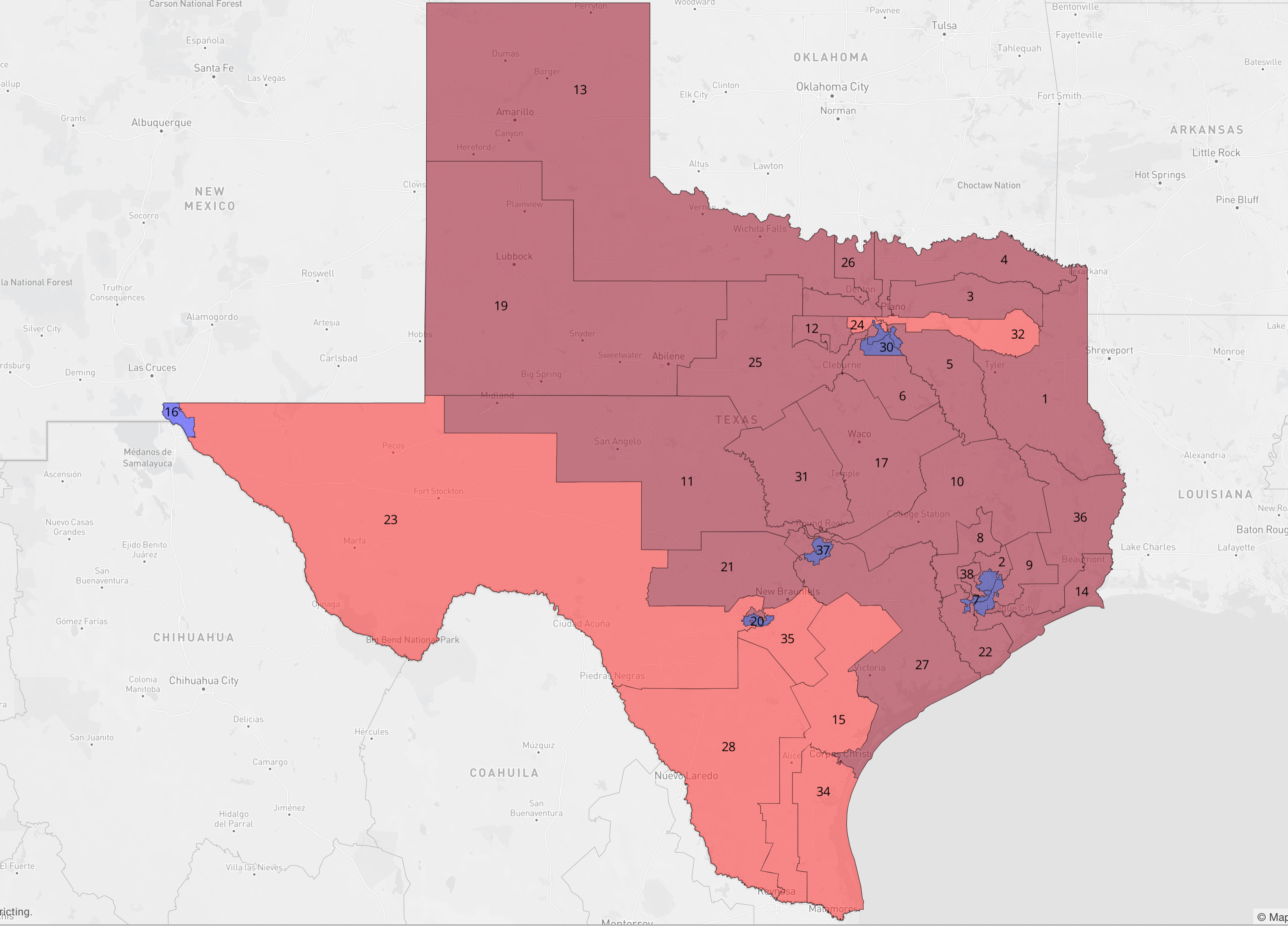
Both chambers of Texas' Republican-dominated legislature have passed a congressional redistricting plan that would, as Donald Trump asked, further gerrymander the state's map by making five Democratic-held seats more likely to flip in next year's elections.
The plan seeks to undermine Democrats by diluting the voting strength of Black and Latino voters, potentially in violation of the Voting Rights Act. It makes radical changes to do so, moving more than a third of Texans into new constituencies.
Below, we outline the most important changes to the five districts Republicans are targeting. In each case, we've also included data showing how each current district voted in the 2024 and 2020 presidential elections, as calculated by The Downballot, and how each proposed district would have voted in those same elections, according to Dave's Redistricting App and the Redistricting Data Hub (for 2024) and VEST (for 2020).
Notably, the proposal in no way resembles a "dummymander"—an overly aggressive map that winds up backfiring on the party it was meant to favor, which was a possibility some had forecast (or wished for). Republicans may not pick up all five of the seats they have their sights on should they adopt these new boundaries, but they've been careful not to weaken any of the districts they currently hold.
To help our readers make sense of these new developments, we've also assembled links to several resources:
An interactive version of the new Republican map on Dave's Redistricting App, as well as one of the prior map
A table prepared by The Downballot showing how much of the population in each new district comes from each old district and vice-versa, plus a piece explaining how to read it
The data files from the Texas Legislative Council that were used to create the resources above
We are also indebted to Jacob Hernandez, a Texas native and member of The Downballot community who contributed extensively to this analysis.
TX-09: Al Green (D)
Current map: 71-27 Harris (2024), 76-23 Biden (2020)
New map: 59-40 Trump (2024), 54-45 Trump (2020)
The 9th District, based in the south-central part of Harris County—home of Houston—would be altered to an almost unrecognizable degree: Just 3% of residents in the revamped version live in the current district, which is home to roughly equal numbers of Black and Latino residents (around 40% each).
The transmogrified district would instead teleport to the eastern reaches of Harris County, taking in many deep-red and GOP-trending areas. It would also become majority Latino while losing most of its Black population. But even though just a quarter of the district would be white, its typically low Latino turnout would push it firmly into Trump's column.
The end result would be an eye-popping net swing of more than 60 points when looking at the most recent presidential election—by far the largest anywhere on the new map.
In the final version of the GOP's map, Republicans made the 9th even redder than in the proposal they first introduced by adding in Liberty County, which voted for Trump by more than 60 points last year.
TX-28: Henry Cuellar (D)
Current map: 53-46 Trump (2024), 53-46 Biden (2020)
New map: 55-44 Trump (2024), 54-45 Biden (2020)
In its present iteration, the predominantly Latino 28th District stretches some 250 miles from north to south, from the Lower Rio Grande Valley to the San Antonio suburbs, taking in Laredo in between. Once a Democratic stronghold, voters in the area have increasingly embraced the GOP, particularly Trump.
The new-look district would shed its holdings around San Antonio in Bexar County. In exchange, it would add a sizable chunk of the neighboring 15th District in Hidalgo County (including the southern parts of the city of McAllen), just to the southwest along the Rio Grande—an area that moved sharply to the right in 2024.
As a consequence, this swap would help make the 28th a few points redder looking at 2024 (though, interestingly, it would get slightly bluer based on the 2020 presidential results), and about half its population would be new. Cuellar, though, ran well ahead of the top of the ticket last year, despite being under indictment on federal corruption charges.
TX-32: Julie Johnson (D)
Current map: 61-37 Harris (2024), 66-32 Biden (2020)
New map: 58-40 Trump (2024), 54-44 Trump (2020)
Republicans previously drew the 32nd District to pack in as many Democratic voters as possible in the northern and eastern parts of Dallas. The once-compact district would instead balloon massively, dropping the East Dallas region and sending a long corridor more than 100 miles westward, deep into rural Texas.
Today home to a Latino plurality of a little more than a third of residents, whites would make up nearly a majority of the new constituency at 49%, and only about 40% would have lived in the old district.
The approach Republicans are using here is similar to one they deployed to shore up potentially vulnerable GOP incumbents during the normal, once-a-decade round of redistricting following the release of data from the 2020 census.
In this case, though, instead of being used in service of a defensive gerrymander, the technique is being weaponized to transform a district from deep blue to solidly red—a shift of more than 40 points using the 2024 presidential race as a baseline.
TX-34: Vicente Gonzalez (D)
Current map: 52-47 Trump (2024), 57-42 Biden (2020)
New map: 55-44 Trump (2024), 51-48 Biden (2020)
Like the 28th District, the 34th is another heavily Latino constituency that has shifted decidedly to the right in recent years. To grow redder still, it would give up eastern Hidalgo County to the 15th District next door and instead march up the Gulf Coast to take in redder turf in the southern portions of Nueces County, where turnout among GOP-friendly voters is comparatively higher.
It would stop just short, however, of the still-blue downtown of the county seat, Corpus Christi, which would remain buried in the deep-red 27th District. The changes would be less dramatic than many of those in other parts of the state, though the district would become several points redder, and about 40% of its inhabitants would be new.
TX-35: Greg Casar (D)
Current map: 66-32 Harris (2024), 72-26 Biden (2020)
New map: 55-44 Trump (2024), 50-48 Trump (2020)
In a map replete with wild modifications, the metamorphosis of the 35th District might be the most breathtaking. The district's present incarnation was already one of the most notorious aspects of the GOP's last gerrymander, a deliberate Democratic vote sink extending from the heart of San Antonio along a narrow strip hugging Interstate 35 to gobble up key portions of Austin some 80 miles away.
The district would sever its appendage to the state capital and instead wrap around San Antonio, picking up the portions of Bexar County dropped by the 28th. It would also hoover up bits and pieces of several other surrounding districts, including three deep-red counties taken largely from the 15th.
Ultimately, the 35th District would, like the 32nd, shift more than 40 points rightward in terms of 2024 presidential results, and fewer than 10% of its current inhabitants would still live in the overhauled district.
Democrats have limited tools at their disposal to halt the new GOP gerrymander. The National Redistricting Foundation, a Democratic group, promised "fierce legal challenges," but federal courts have largely grown hostile to lawsuits brought under the Voting Rights Act, and a suit against the current map remains unresolved, almost four years after it was first filed.