



Leading Off
IA-Sen
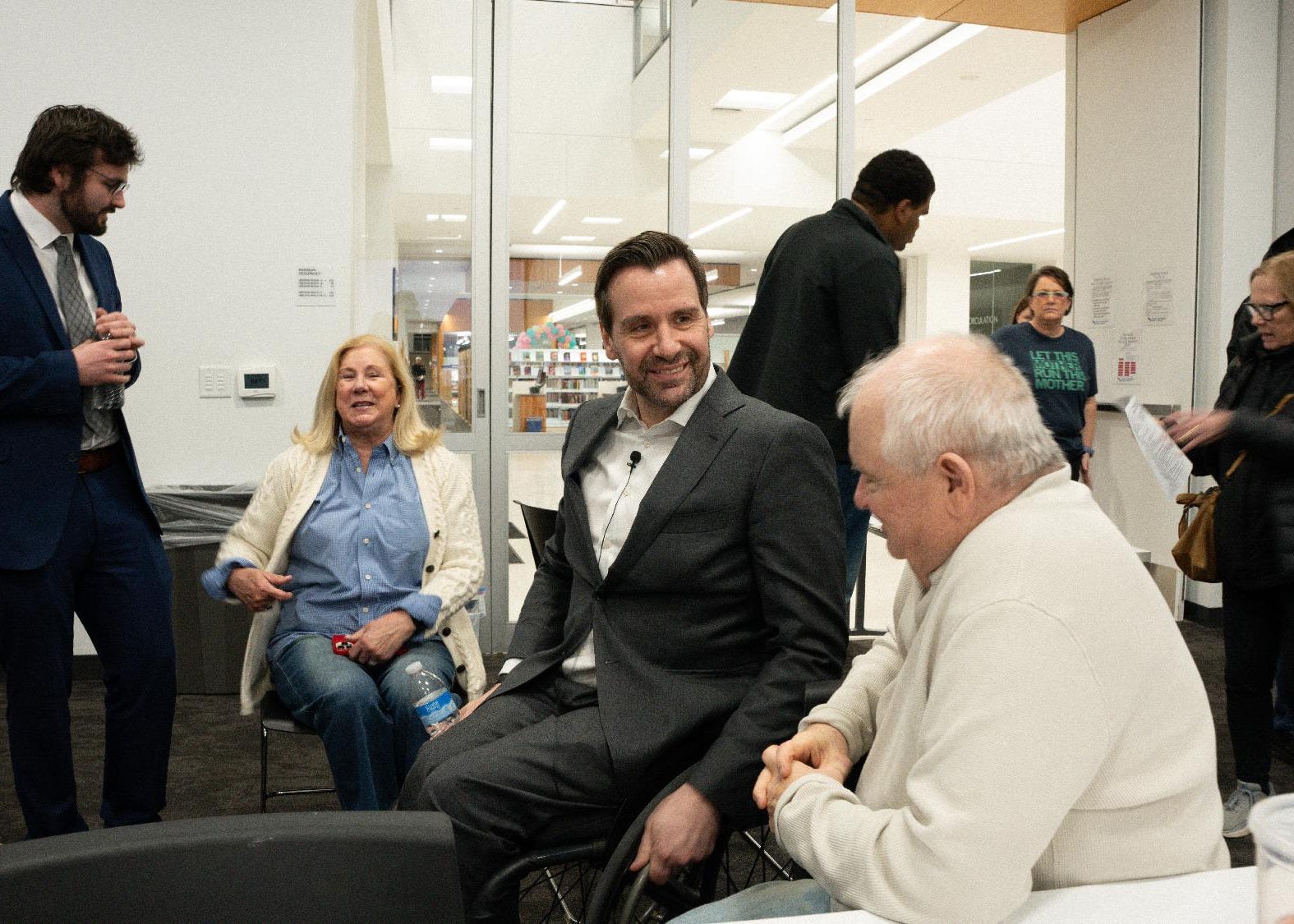
Democratic state Rep. Josh Turek will face Republican Rep. Ashley Hinson in what will be a closely watched general election for Iowa’s open U.S. Senate seat.
Turek, who benefited from $10 million in support from VoteVets, defeated state Sen. Zach Wahls 63-37 in Tuesday’s primary. Hinson, whom Donald Trump and Senate Republicans consolidated behind after Republican Sen. Joni Ernst announced her retirement last September, fended off former state Sen. Jim Carlin 74-26.
Given Iowa’s rightward march over the last decade-plus, Hinson should have been the favorite to replace Ernst, whose unexpectedly wide victory in 2014 marked the start of a new era of GOP dominance in what had been a longtime swing state.
But even though Trump carried the Hawkeye State in all three of his campaigns—culminating with his 56-43 victory during his final race—2026 is shaping up very differently.
Ad reservations tell one part of the story.
In April, the top GOP super PAC involved in Senate races, the Senate Leadership Fund, announced it had booked $29 million in fall TV time—a sign Republicans were concerned about defending Ernst’s seat.
Democrats, meanwhile, responded by reserving $13 million to aid the party’s eventual nominee—resources that can now help Turek, who won two gold medals and a bronze as a wheelchair basketball player at the Paralympics. They’re also running strong candidates to flip the open governorship and three U.S. House seats.
Both parties have good reason to think Iowa may be in for a course correction. Democratic candidates outperformed Kamala Harris by double digits in each of the six legislative special elections the state hosted last year, including in two races where they flipped Republican-held seats and consequently broke the GOP’s supermajority in the state Senate. (The state hasn’t hosted any specials this year.)
Notably, these contests predated Trump’s decision to wage war on Iran, a move that has proved politically disastrous. Hinson herself acknowledged last week that the conflict could harm her and the rest of the GOP this fall.
“I do hope we can get this done by the next couple of weeks,” the congresswoman told voters in comments first shared Tuesday by Politico. “If it drags on beyond that, it’s a political liability for us too, because we’ve lost Iowa soldiers.”
Iowa’s Senate primaries, though, were by no means the only major contests on the single largest primary night of the year. Below is a state-by-state summary of where things stood as of early Wednesday in all of the other major races in Iowa, as well as those in California, Montana, New Jersey, New Mexico, and South Dakota.
All race calls and estimates of the proportion of the vote that’s been tabulated come from the Associated Press unless otherwise noted. You can also check out our cheat-sheet that summarizes the outcomes in every key race.
Election Recaps
California
All candidates running for Congress and for state office compete on one ballot rather than in separate party primaries; the top two vote-getters, regardless of party, advance to the Nov. 3 general election. Candidates cannot win outright in June by taking a majority of the vote, except in special elections and some officially nonpartisan races.
Many key contests remain uncalled. Vote-counting takes some time thanks to the security measures needed to verify the large number of mail ballots. Counties must certify results between June 26 and July 2.
CA-Gov (58-38 Harris)
California Democrats have almost certainly avoided the top-two lockout they long dreaded, but with only 58% of the estimated vote in, the Associated Press has yet to project which candidates will occupy either of the two general election spots.
Republican Steve Hilton, a former Fox News host and Donald Trump’s endorsed candidate, leads with 28%, with two Democrats behind him. Former state Attorney General Xavier Becerra, who went on to serve in Joe Biden’s cabinet, holds a 25-20 lead over billionaire environmentalist Tom Steyer.
Riverside County Sheriff Chad Bianco, the other leading Republican, is a distant fourth with 11%.
CA-01 (special) (61-36 Trump)
Republican Assemblyman James Gallagher secured the majority of the vote necessary to avoid a second round of voting on Aug. 4. Gallagher will replace GOP Rep. Doug LaMalfa, who died in January, for the final seven months of LaMalfa’s term representing the old and safely Republican version of the 1st Congressional District in northeastern California.
With 55% of the estimated vote tallied, Gallagher leads with 63% of the vote. A pair of Democrats, state Sen. Mike McGuire and agriculture consultant Audrey Denney, trail well behind with about 18% each.
CA-01 (54-42 Harris)
Gallagher, however, will be in for a tough fight against McGuire to hold the new version of the 1st District, a constituency that McGuire and his colleagues in the Democratic-led legislature dramatically overhauled and made much bluer.
Gallagher leads with 47% of the vote as of Wednesday morning, while McGuire holds a 38-13 lead over Denney. Only 50% of the estimated vote has been tabulated, but while the margins may shift, the AP has called the two general election spots for Gallagher and McGuire.
CA-03 (53-43 Harris)
Democratic Rep. Ami Bera will face Republican Robb Tucker, a member of the Nevada County Board of Supervisors, in the general election instead of one of the three Democrats who challenged the incumbent.
This matchup makes Bera, who currently represents a little more than a third of the residents of the new 3rd District (he holds the old 6th District), the favorite to win an eighth term in the Sacramento area.
CA-04 (56-41 Harris)
Rep. Mike Thompson will be in the general election, but the 14-term incumbent is waiting to learn whether his opponent will be a well-funded fellow Democrat or a little-known Republican.
Thompson leads with 37% as of Wednesday morning, while Republican Ray Riehle holds a 24-21 edge over Democrat Eric Jones, a venture capitalist who has raised and self-funded millions. The AP estimates that only 50% of the vote has been tabulated in this constituency, which includes part of California’s wine country and other communities like the college town of Davis.
CA-06 (53-44 Harris)
Only 48% of the estimated vote has been counted in this Sacramento-area seat as of Wednesday morning, and it remains to be seen who will occupy either general election spot.
Rep. Kevin Kiley, a member of the Republican caucus running as an independent, leads with 27%. A little-known Republican named Michael Stansfield holds a slim 22-21 edge over former state Sen. Richard Pan, the leading Democrat. Sacramento County District Attorney Thien Ho, another Democratic candidate, is in fourth with 11%.
CA-07 (55-42 Harris)
Veteran Rep. Doris Matsui is in front with 31% while Sacramento City Councilmember Mai Vang, her fellow Democrat, holds a 24.9 to 24.1 edge over Republican Zachariah Wooden. The AP estimates only 47% of the vote has been counted, and it has not called either of the general election spots.
CA-11 (82-14 Harris)
State Sen. Scott Wiener and San Francisco Supervisor Connie Chan will compete in an all-Democratic general election to succeed Speaker Emerita Nancy Pelosi, who is retiring after nearly four decades in Congress.
With 50% of the estimated vote in, Wiener leads with 41%. Chan, who has Pelosi’s endorsement, holds a 29-15 advantage over Saikat Chakrabarti, a wealthy political activist.
CA-14 (65-31 Harris)
Democratic state Sen. Aisha Wahab will be in the general election for the East Bay seat that Democrat Eric Swalwell resigned from in disgrace, but with only 47% of the estimated vote in, the race for second place remains undecided.
Wahab leads with 34% as BART board president Melissa Hernandez, her fellow Democrat, holds a tiny 16.1 to 16.0 edge against Republican Wendy Huang. Dena Maldonado, another Republican, is just behind with 14.8%, followed by wealthy businesswoman Rakhi Israni, a Democrat who is at 11.5%.
All five of these candidates, plus six others, are running in the June 16 special election for the remainder of Swalwell’s term. A runoff would take place on Aug. 18 if no one wins a majority of the vote.
CA-22 (50-48 Trump)
Democrats are waiting to learn which of their two candidates will go up against Republican Rep. David Valadao in the general election for this swingy seat in the Central Valley.
Valadao leads with 45%, while school board trustee Randy Villegas holds a 30-26 edge against Assemblymember Jasmeet Bains. The AP estimates 56% of the vote is in.
CA-32 (61-36 Harris)
Democratic Rep. Brad Sherman will compete against a Republican in the fall race to represent this safely blue seat in the San Fernando Valley rather than go through an expensive general election against a fellow Democrat.
Republican Larry Thompson leads with 37% as of Wednesday morning, while Sherman is outpacing Jake Levine, a former member of the Biden administration, 36-13. The AP, which has called both general election spots, estimates 62% of the vote has been tabulated.
CA-34 (73-22 Harris)
Democratic Rep. Jimmy Gomez had no trouble advancing to the general election in California’s safely blue 34th District on Tuesday, but earlier that same day, CNN reported that the House Ethics Committee is investigating him for sexual misconduct.
The panel is reportedly looking into a New York Post story from April that alleged Gomez, who is married, was seen kissing an aide to another representative at a party in 2023. The congressman’s team told the tabloid the encounter “didn’t happen.”
Gomez, though, seemingly reversed himself in a statement to CNN for its new story, saying, “Years ago, I made personal mistakes outside my marriage that have caused real pain to my wife and family.”
“Although my actions were consensual in nature and haven’t violated the law or House ethics rules,” he continued, “that doesn’t diminish the impact that these mistakes have made on those I care about the most.”
The news broke too late to impact many votes in the top-two primary, but Gomez could be in for a tougher fight in November if a fellow Democrat advances to the general.
With an estimated 59% of the vote tallied, Gomez is in first with 46% as community activist Angela Gonzales-Torres leads Republican Calvin Lee 26-18 for second. The AP has not called the second general election spot in this constituency, which includes Downtown Los Angeles and nearby neighborhoods.
CA-38 (55-42 Harris)
Los Angeles County Supervisor Hilda Solis, a Democrat who resigned from the House in 2009 to become Barack Obama’s first labor secretary, is now all but assured to return to Congress.
Solis leads with 44%, while Republican Pedro Antonio Casas holds a wide 40-12 advantage over Pico Rivera Councilmember Monica Sanchez, a Democrat who hoped to emerge as the alternative to Solis. An estimated 70% of the vote has been counted in this seat, where no incumbent sought reelection.
CA-40 (55-42 Trump)
Rep. Ken Calvert has lived to fight another day, but he doesn’t yet know if his next battle will be against a Republican colleague or a Democratic challenger.
Calvert is in first with 36%, while fellow GOP Rep. Young Kim holds a 22-16 lead over Democrat Esther Kim Varet, the owner of a chain of art galleries. An estimated 53% of the vote has been tabulated for this constituency, which includes about half of Calvert’s old 41st District in the Inland Empire and about a third of Kim’s 40th District in Orange County.
CA-41 (56-41 Harris)
Rep. Linda Sanchez is on a glide path to win a 13th term representing part of Los Angeles County now that she’ll face a Republican in the fall instead of a fellow Democrat.
That Republican is Mitch Clemmons, a plumbing contractor who leads with 41%. Sanchez enjoys a wide 36-13 advantage over former Assemblymember Hector De La Torre, a fellow Democrat who almost defeated her in 2002. An estimated 67% of the vote has been tabulated for the 41st District, which is home to just under half of the residents of Sanchez’s old 38th District.
CA-48 (50-47 Harris)
Republican Jim Desmond and Democrat Marni von Wilpert will compete in the general election to succeed GOP Rep. Darrell Issa, who ended his reelection campaign in March rather than fight for a seat that became significantly more Democratic following redistricting.
With an estimated 58% of the vote in, Desmond, a member of the San Diego County Board of Supervisors, is in first place with 42%. Von Wilpert, who holds a seat on the San Diego City Council, enjoys a 20-10 advantage over Navy Reserve officer Ammar Campa-Najjar, a fellow Democrat.
Los Angeles Mayor (70-27 Harris)
Democratic Mayor Karen Bass will be in the general election, while the race to take her on remains up in the air.
Bass is in front with 35% in this nonpartisan primary. Former reality TV star Spencer Pratt, the most prominent Republican in the race, holds a 30-22 edge over City Councilmember Nithya Raman, whose 2020 win made her the first councilmember elected with the backing of the Democratic Socialists of America. The AP estimates 63% of the vote is reporting.
Orange County Board of Supervisors
Republican Assemblywoman Diane Dixon leads Democratic incumbent Katrina Foley 49-45 with just over 122,000 ballots tabulated as of Wednesday morning in the 5th District of the Board of Supervisors in Orange County.
Dixon and Foley would advance to the Nov. 3 general election unless one of them finishes with a majority after all the ballots are tabulated in this officially nonpartisan race. Foley, who is part of the 3-2 Democratic majority, is defending a constituency in the southern part of the county that backed Kamala Harris just 49-48.
The contest to succeed Supervisor Doug Chaffee, a termed-out Democrat who is often at odds with his party, almost certainly will be settled with a second round.
County Board of Education member Tim Shaw, who is the choice of the local GOP, holds a 34-31 edge over Buena Park Mayor Connor Traut, the leading Democrat, with 70,000 ballots counted in District 4.
Fullerton Mayor Fred Jung, a former Democrat who became an independent last year and has the support of the Lincoln Club, is in third with 19%. The balance goes to La Habra City Councilwoman Rose Espinoza, who ran for the state Assembly in 2022 as a Democrat. Harris prevailed 52-45 here.
Democrats need to hold both seats to keep the historic 1-seat majority they secured four years ago.
Iowa
IA-Gov (R) (56-43 Trump)
Wealthy businessman Zach Lahn narrowly upset Rep. Randy Feenstra to win the GOP nomination for Iowa’s open governor’s race, a victory that came despite Donald Trump’s last-minute intervention on behalf of the congressman.
Feenstra conceded the primary on Tuesday night even before the race was called. As of Wednesday morning, Lahn led 37.8 to 37.0. He’ll go on to face state Auditor Rob Sand, who won the Democratic nod without opposition.
IA-02 (R & D) (54-44 Trump)
Democratic state Rep. Lindsay James will square off against former Republican state Rep. Joe Mitchell in the race for Iowa’s 2nd District, which GOP Rep. Ashley Hinson gave up to run for Senate.
Both James, who is also an ordained Presbyterian pastor, and Mitchell, who had Donald Trump’s endorsement, easily won their respective primaries.
Montana
MT-Sen (D) (58-38 Trump)
Air Force veteran Alani Bankhead defeated former state Rep. Reilly Neill in the Democratic primary for Montana’s open Senate race 44-33, but the question now is whether she’ll forge on to the general election or defer to independent Seth Bodnar.
Both Bankhead and Neill repeatedly said they would not drop out to give Bodnar a clear shot in November, an approach advocated by former Democratic Sen. Jon Tester. But a super PAC linked to a Tester ally spent heavily to support Bankhead’s candidacy, while Republicans unsuccessfully sought to boost Neill, likely because she’d expressed the greatest hostility toward Bodnar.
Republicans, meanwhile, nominated former U.S. Attorney Kurt Alme, who handily won the GOP nod after collaborating with Sen. Steve Daines to arrange a last-second switcheroo right before the filing deadline. Thanks to their scheming, other serious candidates were unable to enter the race, leaving Alme to steamroll two minor foes.
MT-01 (R & D) (54-43 Trump)
Conservative radio host Aaron Flint easily won the GOP nomination to replace retiring Rep. Ryan Zinke, who joined Donald Trump and other prominent Republicans in supporting Flint. The GOP nominee, though, will need to wait a little longer to learn which Democrat he’ll face in the general election to succeed Zinke, who announced his retirement just two days before the filing deadline in March.
Smokejumper Sam Forstag, a member of an elite smokejumping team that fights wildfires, holds a 37-33 lead over Ryan Busse, a gun manufacturer turned gun safety activist who unsuccessfully ran for governor in 2024, with an estimated 95% of the vote tabulated.
New Jersey
NJ-07 (D) (50-48 Trump)
Navy veteran Rebecca Bennett won the Democratic primary for New Jersey’s competitive 7th District, earning the right to take on Republican Rep. Tom Kean—we think.
Bennett overcame a Republican meddling campaign by dominating the four-person field, defeating her nearest rival, physician Tina Shah, 46-20. But Kean’s inexplicable disappearance—he vanished from public view three months ago—has alarmed fellow Republicans, who already had reason to worry about his reelection chances.
A few hours before polls closed on Tuesday, Kean’s campaign released a new statement attributed to the congressman that was unlikely to calm any nerves.
“Right now I am focused on my recovery and under the advice of healthcare professionals, I will transition from virtual work to in person work within a matter of weeks,” he said. “At that time I will be completely transparent as to the nature of my medical condition.”
NJ-08 (D) (61-37 Harris)
Democratic Rep. Rob Menendez comfortably turned back a primary challenge from Mussab Ali, a former president of the Jersey City Board of Education, and is the heavy favorite to win a third term.
NJ-09 (R) (49-48 Trump)
Clifton City Councilwoman Rosie Pino holds a small 51.4 to 48.6 lead against attorney Tiffany Burress, with an estimated 89% of the vote tabulated in the Republican primary. The AP has not projected a winner in this contest.
The eventual GOP nominee will have a difficult time defeating Democratic Rep. Nellie Pou in New Jersey’s 9th District, a longtime Democratic stronghold that swung hard to the right in 2024 only to quickly zoom back to the left in last year’s race for governor.
NJ-12 (D) (61-37 Harris)
Physician Adam Hamawy, a former Army surgeon who helped save the life of future Illinois Sen. Tammy Duckworth in 2004, turned back a dozen opponents to secure the Democratic nomination for New Jersey’s open 12th District. He defeated his closest rival, East Brunswick Mayor Brad Cohen, 28-15, and he should have no trouble winning the race to succeed retiring Rep. Bonnie Watson Coleman in the fall.
New Mexico
NM-Gov (D & R) (52-46 Harris)
Former Interior Secretary Deb Haaland romped to victory in Tuesday’s Democratic primary and will face former Rio Rancho Mayor Gregg Hull in the general election for New Mexico’s open governorship.
Haaland, who would be the first Native American woman to lead any state, dispatched her more moderate opponent, Bernalillo County District Attorney Sam Bregman, in a 72-28 blowout. Hull, meanwhile, won a tighter race, defeating businessman Doug Turner 47-37.
Haaland will be the favorite to succeed term-limited Democratic Gov. Michelle Lujan Grisham in November, as Republicans have not won a statewide race in New Mexico since 2016.
NM-Sen (R), Auditor (R), Treasurer (R) (52-46 Harris)
In the end, New Mexico Republicans will have names on the November ballot in a trio of races for which they’d failed to qualify any candidates at the filing deadline months ago.
Under state law, though, if a write-in earns enough votes in a primary—at least 2,351 votes, or 2% of the number of registered Republicans who cast a ballot in the most recent gubernatorial election—they can earn a spot in the general election.
Republicans managed that in all three races: for U.S. Senate, state auditor, and state treasurer. However, Democratic incumbents in each of these contests, including Sen. Ben Ray Lujan, are still heavy favorites to win another term.
South Dakota
SD-Gov (R) (63-34 Trump)
Wealthy businessman Toby Doeden has secured a spot in South Dakota’s first-ever primary runoff, while the Associated Press has not yet called the race for second place.
Doeden leads with 31% of the vote in the contest for governor, a few points short of the 35% necessary to avoid a second round of voting on July 28. Gov. Larry Rhoden, who was elevated from lieutenant governor to the top job early last year when Kristi Noem resigned for her ill-fated stint in Trump’s cabinet, leads Rep. Dusty Johnson 25-23 for the other runoff spot.
The AP estimates 99% of the vote is tabulated, though Johnson has not conceded as of early Wednesday.
Whoever secures the Republican runoff next month will be the favorite against former state Rep. Dan Ahlers, who won the Democratic nomination without opposition, for a post Republicans have controlled nonstop since the 1978 election.
Redistricting Roundup
NY Redistricting
New York Democrats unveiled a proposed constitutional amendment late on Monday that would allow lawmakers to redraw the state’s congressional map in time for the 2028 elections, should voters ultimately approve it.
Redistricting for both Congress and the state legislature is currently handled by a bipartisan commission, thanks to a previous amendment voters passed by a 57-43 margin in 2014.
That commission would remain under the new proposal, but it would have only one chance to produce a map, rather than the current two. Most importantly, lawmakers would be able to reject any maps with just a simple majority and substitute their own, essentially rendering the commission merely advisory in nature.
In addition, the new amendment would delete most of the requirements that maps were subject to under the current setup. These include mandates to create compact districts and minimize the splitting of counties and cities, and, most importantly, a ban on partisan gerrymandering. The amendment also explicitly permits mid-decade redraws.
Before it can become law, the amendment must pass the legislature twice, both before and after an election. Politico reported on Monday that lawmakers plan to hold a vote before their current session concludes on Thursday. A second vote could then be held early next year, with the amendment appearing on the ballot in November of 2027.
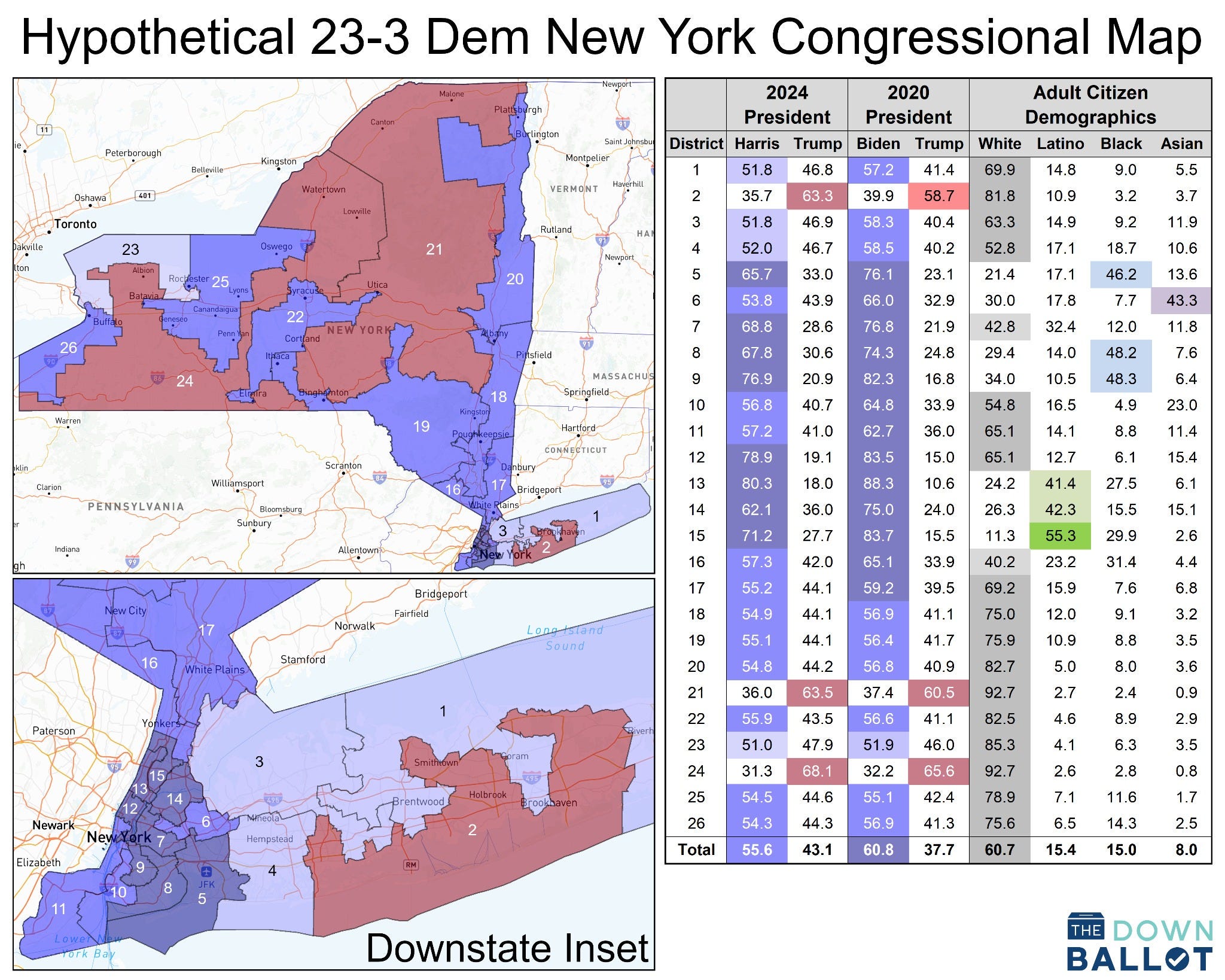
Democrats currently hold 19 of the state’s congressional seats versus seven for Republicans, but a new map could be much more favorable. One hypothetical plan drawn by The Downballot’s Stephen Wolf would be likely to elect 23 Democrats and just three Republicans, giving Democrats a net gain of four seats.
Governors
MN-Gov
House Speaker Lisa DeMuth submitted paperwork just before Tuesday’s deadline to run in Minnesota’s August primary despite originally saying she’d drop out if she failed to win the GOP’s endorsement at the party’s convention last weekend.
DeMuth will face two notable opponents: businessman Kendall Qualls, who defeated DeMuth after a marathon 10-round vote at the convention, and pillow salesman/conspiracy theorist Mike Lindell.
She issued her about-face after complaining about problems with the electronic voting system used at the convention—a complaint that received some support from state party chair Alex Plechash.
In a statement released Monday, Plechash acknowledged the “confusion and concern” over a disruption in the voting that led to an extended delay. As a consequence, he said that “any gubernatorial candidate who agreed to abide by the endorsement”—that is, quite the race if they didn’t receive it—”should not be treated as bound by that pledge.”
Still, he said the GOP “stands behind” its endorsement of Qualls, pledging he would “receive the full support, resources, and organizational backing of the state party.”
Democrats, meanwhile, have rallied around Sen. Amy Klobuchar, who faces minimal opposition for her party’s nod.
House
ME-02
In an unusual move, state Sen. Joe Baldacci is teaming up with the DCCC and the House Majority PAC to run a joint ad attacking state Auditor Matt Dunlap, one of his rivals in next week’s Democratic primary for Maine’s 2nd District. Punchbowl News, which first reported the commercial, says the trio is spending $157,000 to air the message.
“Dunlap’s anti-abortion voting record earned him a 100% rating from Maine Right to Life,” the narrator says of the state auditor. That score came in 2003 after Dunlap, who was a member of the legislature at the time, supported a bill to require doctors to inform women seeking abortions about “risks” and “alternatives.”
The ad continues, “Now, a mystery group tied to Republicans is meddling with $300,000 to elect Dunlap. Vote for a Democrat we can trust with a 100% voting record from Planned Parenthood, Joe Baldacci.”
As the spot alludes, a shadowy outside group called Real Change PAC recently began airing ads declaring that Baldacci “stands with Trump.” Baldacci, however, quickly accused the outfit, which also ran ads in Tuesday’s primary for New Jersey’s 7th District (see our NJ-07 item above), of meddling in the Maine contest as well.
Axios’ Andrew Solender subsequently discovered that Real Change is connected to a firm run by Josh Holmes, a prominent Republican who once served as chief of staff to Mitch McConnell.
Baldacci faces Dunlap and two other Democrats, former congressional staffer Jordan Wood and social worker Paige Loud, on a ranked-choice ballot. The winner will face former Gov. Paul LePage, who has no opposition in his Republican primary, in the general election to replace retiring Rep. Jared Golden, a centrist Democrat who is not seeking reelection.
NV-02
The far-right Club for Growth has given its backing to Air Force veteran David Flippo for Nevada’s open 2nd Congressional District and says it will spend $400,000 on a new ad campaign touting Donald Trump’s recent endorsement of Flippo.
Flippo’s main opponent in next week’s GOP primary is former state Sen. James Settelmeyer, who has the support of both retiring Rep. Mark Amodei and Gov. Joe Lombardo.
WI-01
Iron worker Randy Bryce, who’d raised very little in his second bid for Wisconsin’s 1st Congressional District, ended his campaign when he failed to submit signatures to election officials by Monday’s filing deadline.
Bryce sought the same seat once before in 2018 and raised huge sums by virtue of running against then-Speaker Paul Ryan. But after Ryan opted against seeking reelection, Bryce struggled to gain traction against his replacement, Republican Bryan Steil, and lost 55-42.
Several other Democrats, however, are hoping to take on Steil, and the deep-pocketed House Majority PAC has reserved $2 million in fall TV ad time for the Milwaukee media market that could be used to target him.
Poll Pile
AL-Sen (R): The Alabama Poll:
Jared Hudson: 49, Barry Moore: 39.
MI-Sen (D): Lake Research Partners for Abdul El-Sayed:
Abdul El-Sayed: 34, Haley Stevens: 31, Mallory McMorrow: 19.
MA-Gov (R): Suffolk University:
Michael Minogue: 45, Brian Shortsleeve: 13.
ME-02: Pan Atlantic Research for Joe Baldacci:
Joe Baldacci (D): 49, Paul LePage (R): 41.
The release did not include general election numbers testing the other Democrats running in next week’s primary.
Obvi take it with a grain of salt but I found it interesting that, not only did Dems outvote Reps in both IA-01 and IA-02, but the D-R margin was larger in IA-02 than IA-01.
Obvi Ashley Hinson running for Senate could nullify this in November but it's possible that Dems' good geography in Iowa + a strong year could lead to a repeat of 2018 and give them 3 out of 4 House seats next Congress.
Fox News poll Sherrod Brown by 8 https://x.com/polltracker2024/status/2062296289778208794?s=61&t=5copDbz1aPl7ASsRCUclLg