



Leading Off
NH Redistricting
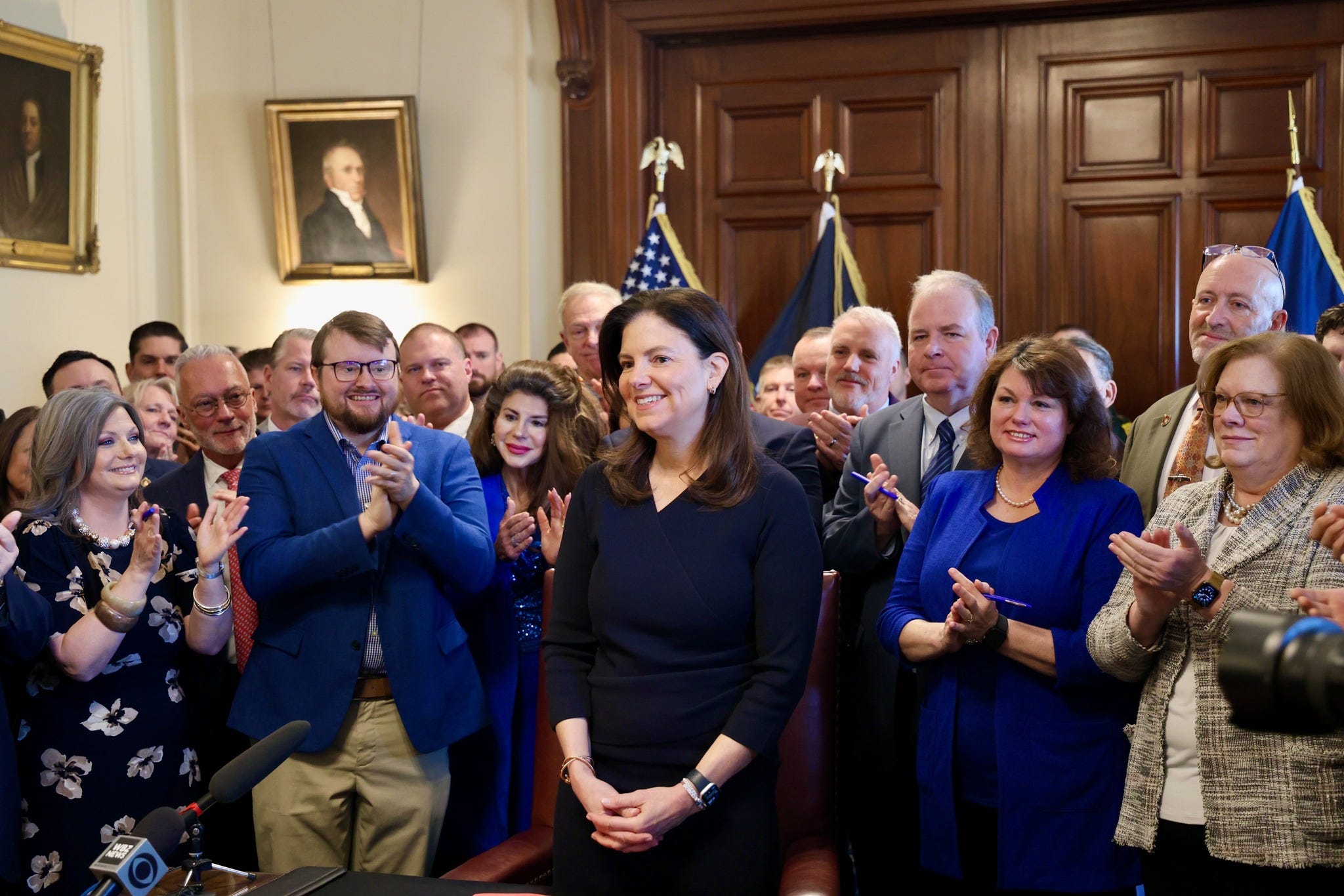
The latest state that the White House is trying to browbeat into gerrymandering its congressional map is New Hampshire, where Republican Gov. Kelly Ayotte has been cool to the idea. Whichever path she chooses, though, could be fraught.
Last month, Ayotte told WMUR that, in terms of a redraw, "the timing is off for this because we are literally in the middle of the census period."
But an unnamed source who spoke with Politico this week says that Trump isn't taking no for an answer. The publication says that "Trump's team doesn’t plan to back off New Hampshire," adding that "the White House is prepared to use a take-no-prisoners approach"—though what that approach might look like is left unsaid.
New Hampshire's congressional map has been remarkably stable since 1882, when the state dropped from three districts to two. Ever since, the 1st District has always hugged the state's southeast corner, including its short Atlantic coastline, while the 2nd has run the length of the Vermont border from Massachusetts in the south to Canada in the north.
According to the Almanac of American Politics, Republicans originally adopted those boundaries to separate the state's two largest cities, Manchester and Nashua, thereby splitting the vote of Catholic Democrats.
In more recent years, however, they've resulted in two blue-tilting districts that are both represented by Democrats, though Republicans have occasionally won them as well. But after the 2020 elections, when the GOP won full control of New Hampshire's state government, Republicans in the legislature sought to upend that long tradition and instead proposed a variety of gerrymanders attacking the 1st District.
One radical redraw would have had the 2nd District entirely engulf the 1st by running it along the state's entire border with not only Vermont but also Maine until it touched the Atlantic Ocean. It also would have shifted hundreds of thousands of residents, all in an effort to target Democratic Rep. Chris Pappas by making the 1st District considerably redder.
Those hopes ultimately ran aground because Ayotte's predecessor, Republican Chris Sununu, threatened to veto a gerrymandered map.
"We're a purple state," he told WMUR. "From a political standpoint, I think Republicans can definitely win in CD2. Why would you concede that?"
In the end, the state Supreme Court wound up making minor adjustments to New Hampshire's map to accommodate population shifts, moving fewer than 9,000 people from the 1st District to the 2nd. Pappas (who is now running for Senate) went on to win reelection in both 2022 and 2024, while Democrats also held on to the state's other seat.
Now, though, some Granite State Republicans want to revive the idea of revamping the lines—among them state Sen. Dan Innis, who is one of Pappas' would-be opponents in next year's open Senate race.
Ayotte, however, still stands in the way, but now she must decide whether to court Trump's wrath—or that of voters.
Last year, after Sununu announced his retirement, Ayotte comfortably won both the GOP primary and the general election to succeed him. But unlike every state apart from next-door neighbor Vermont, New Hampshire awards governors a term that lasts just two years, meaning Ayotte will be on the ballot again in 2026.
If Trump is indeed determined to "take no prisoners," he could threaten Ayotte—or her allies—with a primary challenge. But if she buckles under, that could light a fire under Democratic efforts to oust her next year.
Yet even if Republicans move forward with a new gerrymander, there's only so much they can do given New Hampshire's small size. Even under the extreme proposal described above, Trump would have carried the 1st District by just a 52-46 margin last year. With the pendulum once again swinging against Trump, Democrats would have every chance of holding such a district in the midterms.
Free speech is under attack—and it isn’t free. The Downballot relies on our readers to fund our operations. It’s become impossible to trust major news organizations anymore, which is why independent media matters more than ever. But to keep publishing, we need help from people like you. Please consider upgrading to a paid subscription if you haven’t yet taken the plunge.

Redistricting Roundup
MD Redistricting
Despite the GOP's headlong rush to gerrymander everywhere they can, a top Democrat in Maryland is throwing cold water on the idea that his state could retaliate.
"It's too early at the moment to make a decision whether … we are or not," state Senate President Bill Ferguson told Maryland Matters in a new interview. "I think—what I've said from the beginning—is it should be the absolute last option on the table."
"I hope there is a path that allows us to avoid this mutually assured destruction that is every two years redistricting, state by state, based on each election," he added.
At the moment, there is no such path. On Thursday, congressional Democrats reintroduced a bill called the Redistricting Reform Act, which would ban mid-decade redistricting nationwide and mandate that every state adopt an independent redistricting commission. With Republicans in power, however, the bill stands no chance of passage.
Senate
ME-Sen
Daira Smith-Rodriguez, a civilian contracting officer in the Air Force, announced Thursday that she was joining the Democratic primary to face Republican Sen. Susan Collins.
"The oligarchy is not a thousand miles away," Smith-Rodriguez says in her launch video, "it's right here. They're taking a cut, they're making a profit, and millions of Americans are surrounded by food they can't eat. And Big Food owns Congress."
Smith-Rodriguez joins brewery company owner Dan Kleban, oyster farmer Graham Platner, and former congressional aide Jordan Wood in the June 9 Democratic primary, which will be conducted using ranked-choice rules. Maine Gov. Janet Mills, by contrast, has yet to say if she'll join the race, though the AP recently reported that she's "taking steps" toward a bid.

NH-Sen
Democratic Rep. Chris Pappas holds a small 46-43 advantage over former Republican Sen. John Sununu in a hypothetical general election, the Republican pollster co/efficient finds. Sununu has said he'll decide by the end of next month if he'll run for his old seat.
Co/efficient, which says that its survey was "[n]ot sponsored by any candidate or candidate's committee," also shows Pappas doing considerably better against the two Republicans who are running. The Democrat beats former Massachusetts Sen. Scott Brown 50-40, while he outpaces state Sen. Dan Innis 49-37.
The poll, finally, gives Sununu a 40-23 advantage over Brown in a hypothetical GOP primary, with Innis taking just 8%.
TX-Sen
Texas Rep. Wesley Hunt's allies have publicized an internal poll arguing that he'd have a path to victory if he enters the March 3 Republican primary for Senate, which comes after Sen. John Cornyn's backers have publicly tried to deter Hunt from running.
The survey from Stratus Intelligence, which an unidentified pro-Hunt group first shared with Punchbowl News, shows Attorney General Ken Paxton taking 38% as Cornyn edges out Hunt just 28-23 for the second spot in a potential runoff. (Candidates need a majority to avert a second round of voting on May 26.)
The poll also finds Hunt with a tiny 39-38 edge against Paxton when they're the only choices, while the congressman enjoys a larger 46-37 in a one-on-one against Cornyn.
While Hunt has not committed to running for the Senate, Punchbowl writes that he's "inching closer" to getting in. That would be unwelcome news for the National Republican Senatorial Committee, which recently urged Hunt's campaign contributors to "stop wasting donor resources on Senate posturing."
The Lone Star State's candidate filing deadline is Dec. 8.
Governors
FL-Gov
Florida Lt. Gov. Jay Collins tells Politico he'll decide sometime later this year if he'll seek the Republican nomination for governor, adding that an announcement could come next month or in November.
Collins, a former state senator whom outgoing Gov. Ron DeSantis appointed lieutenant governor last month, would have a challenging task in a primary against Rep. Byron Donalds. A recent poll showed Donalds, who has Donald Trump's endorsement, taking 40% as both Collins and former state House Speaker Paul Renner took a mere 2% apiece. (Renner entered the race earlier this month.)
Collins, who has never been elected statewide, would also need to overcome an ominous historical pattern. Collins is the 13th person to serve as lieutenant governor since the post, which was abolished in 1889, was reestablished in 1968. None of his predecessors, however, went on to win statewide office.
Collins, however, dispelled speculation that he could instead challenge Democratic Rep. Kathy Castor next year if the GOP makes her 14th District more conservative.
"That ship has sailed," he informed Politico. "I’m not running for Congress."
VA-Gov, VA-LG, VA-AG
Democrat Abigail Spanberger holds a 52-40 lead over Republican Winsome Earle-Sears, according to a new poll from Christopher Newport University of the Nov. 4 race for governor of Virginia.
The school also shows Democrat Ghazala Hashmi with a similar 48-37 advantage over Republican John Reid in the open-seat race for lieutenant governor, while Democrat Jay Jones outpaces Republican Attorney General Jason Miyares 48-41.
Earle-Sears' fellow Republicans have long been pessimistic about her chances, but they're hoping they can prevent Old Dominion Democrats from sweeping all three offices. That sort of split decision last happened in 2005, when Democrat Tim Kaine was elected governor as Republicans narrowly won the races for lieutenant governor and attorney general.
GOP donors have largely focused on giving Miyares, who is the only incumbent defending a statewide office, the resources he needs to outrun his ticketmates. Miyares' side, according to new data from AdImpact, has reserved $5.4 million in ads for the remainder of the campaign, compared to $2.4 million for Jones.
Reid, by contrast, has tried to persuade his party that he is their best bet to avoid a Democratic sweep. His campaign sent donors a memo on Aug. 29 saying that his polling showed him tied with Hashmi as Earle-Sears and Miyares trailed by 11 and 6 points, respectively.
Reid's pitch, though, did not immediately persuade well-heeled Republicans to invest in him. He instead finished last month with just over $300,000 in his campaign account, which was about one-seventh the size of Hashmi's $2.2 million war chest.
WI-Gov, WI-07
Republican Rep. Tom Tiffany says he has "a very special event" planned for Wednesday, which comes as multiple reporters anticipate he'll join the race for Wisconsin's open governorship. Tiffany would face businessman Bill Berrien and Washington County Executive Josh Schoemann in next August's primary.
Such a decision would also set off an open-seat race to succeed Tiffany in the 7th Congressional District, a conservative constituency based in the northwestern part of the state. Donald Trump carried the district 61-38, according to calculations by The Downballot.
House
NE-02
Former congressional staffer James Leuschen announced Thursday that he was entering the Democratic primary for Nebraska's swingy 2nd District, where Republican Rep. Don Bacon is not seeking reelection.
Leuschen, who worked for Maryland Rep. Steny Hoyer during his time as House majority leader, said in his launch video, "No one in this race has the experience I do to hold the Trump administration accountable."
Leuschen joins a busy primary field that includes former Veterans Department official Kishla Askins, state Sen. John Cavanaugh, political strategist Denise Powell, and Douglas County District Court Clerk Crystal Rhoades. The two main GOP candidates are Omaha City Councilman Brinker Harding and former state Sen. Brett Lindstrom.
NY-12
Gun safety activist Cameron Kasky, who survived the 2018 Marjory Stoneman Douglas High School shooting in Florida, tells Politico he's "aggressively," "intensely" and "bombastically" considering entering the Democratic primary for New York's open 12th District. Kasky, who co-founded March for Our Lives, currently co-hosts a podcast for The Bulwark.
Washington, D.C. Delegate
Councilmember Robert White announced Thursday that he would challenge Del. Eleanor Holmes Norton, a fellow Democrat whom he once worked for, to become the nonvoting advocate for Washington, D.C.
"For so many decades, we have been protected by our lion on the Hill, Congresswoman Eleanor Holmes Norton," White tells the audience in his launch video. The challenger, though, argues that the nation's capital needs "our strongest fighters" to stand up to the Trump administration's attacks.
Norton, 88, has repeatedly insisted she'll run again despite reports that she has struggled to answer questions in public and recognize people she knows.
The delegate attracted further scrutiny this summer for seldom appearing in public as other local elected officials have held events decrying Donald Trump's decision to deploy the National Guard and seize control of the district's police force. She got more unwelcome attention last week when the New York Times published a story headlined, "Norton Says Little as Bills to Clamp Down on D.C. Advance."
But while White is the first prominent challenger to announce, he's not the only former Norton ally who believes it's time for her to leave office.
"She is no longer the dynamo she once was, at a time when D.C. needs the kind of energetic representation in Congress she provided for decades," former Democratic National Committee chair Donna Brazile wrote earlier this week in a piece for the Washington Post.
Brazile, who was Norton's campaign manager when she was first elected in 1990, described the incumbent as "like a second mother to me." However, she added, "It’s in her best interest, and the interest of D.C., for her to serve her current term but then end her extraordinary service in Congress and not seek reelection next year."
Norton, though, was not persuaded. When Fox News asked her Thursday morning if she would retire, she responded, "No, No!" White, who announced his campaign hours later, told the Post he still hoped Norton would recognize "that it is time" for her to step aside.
White, who was first elected in 2016 to an at-large seat on the Council of the District of Columbia, sought a promotion in 2022 when he opposed Mayor Muriel Bowser for renomination. Bowser prevailed 49-41, though White went on to easily win another four-year council term in 2024.
But while White had sounded likely to run for mayor again next year, he informed the Post that the GOP's attacks on his constituents from the federal government led him to reconsider.
"This pivot was not something I expected, but it has become very clear that this is our biggest vulnerability," he said. "If we want to continue to have an elected mayor and council, we’re going to have to turn back the tide that’s happening."
The Democratic primary for the position of delegate will be on June 16, and the winner will have no trouble in the general election in this bluest of cities. Candidates have until March 18 to file.
Next year's primaries and general election will be conducted using ranked choice voting for the first time, so a busy field of opponents wouldn't allow Norton to win with just a plurality of the vote.
This change came about because voters last year overwhelmingly approved a ballot measure to introduce ranked-choice voting. After a long delay, the Council finally agreed to provide the necessary funding to implement the new system this summer.
The Council, though, did not fund a separate provision allowing independents to participate in party primaries, so the contest will remain open only to registered Democrats.
Mayors & County Leaders
Seattle, WA Mayor
Washington's powerful MLK Labor coalition voted Wednesday to endorse both Seattle Mayor Bruce Harrell and progressive organizer Katie Wilson, a shift from its earlier decision to give its sole backing to Harrell in May.
The mayor appeared to be on track to secure a second term when the labor group issued its original endorsement, but he's now the underdog going into the Nov. 4 general election. Wilson outpaced Harrell, a fellow Democrat, by a wide 51-41 margin in last month's top-two primary, a showing that instantly established her as the new frontrunner.


Prosecutors & Sheriffs
Hennepin County, MN Attorney
Hao Nguyen, a senior prosecutor in Ramsey County, announced Wednesday that he would run to become county attorney for neighboring Hennepin County. Nguyen is campaigning to succeed incumbent Mary Moriarty, who said last month that she would not seek a second term.
Nguyen entered the race with endorsements from Hennepin County Sheriff Dawanna Witt and Ramsey County Attorney John Choi. Minnesota Attorney General Keith Ellison, who is one of the most prominent Democrats in the state, is supporting both Nguyen and state Rep. Cedrick Frazier, who is the only other notable candidate thus far.
While Nguyen declined to criticize Moriarty, who is a prominent criminal justice reformer, the Minnesota Star Tribune interpreted his promise to make decisions "based on the law and what the law requires" as a way to contrast himself with the incumbent.
Frazier, for his part, co-chaired Moriarty's transition team following her win in 2022. The lawmaker told the paper last month that he shares an outlook with the incumbent, though he added he's not "Mary 2.0."
All candidates will face off on a single ballot next August, with the top two vote-getters advancing to a fall general election. The next attorney for Hennepin County, a solidly blue community that includes Minneapolis, is likely to be a Democrat.
https://nypost.com/2025/09/18/us-news/powerful-ny-democratic-party-chair-jay-jacobs-refuses-to-back-zohran-mamdani-could-step-down-over-hochuls-shock-endorsement-sources/
NYPost reports that Jay Jacobs is likely to step down or be kicked out.
NH is one state where Republicans would almost certainly pay a huge price in 2026 if they were seen as kowtowing to Trump’s demands. Ayotte knows this.