



Leading Off
KS Redistricting
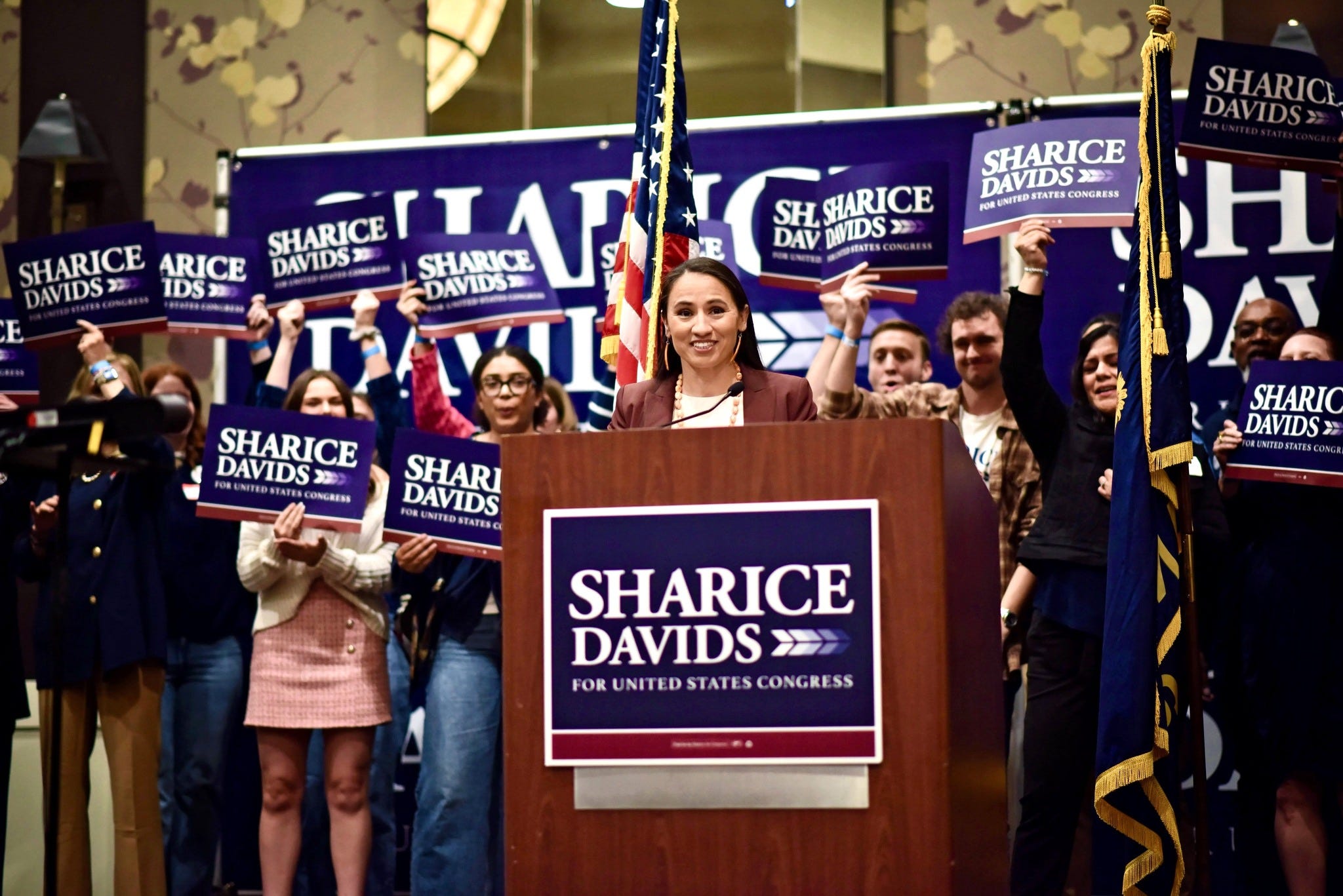
Republicans in Kansas are the latest to embrace Donald Trump's push for fresh congressional gerrymanders to benefit the GOP, but they face serious obstacles—both political and legal—in their quest to unhorse the state's lone Democrat in the House.
State Senate President Ty Masterson is leading the charge. In a new statement, he said he would entertain the possibility of a redraw "as a part of the bigger battle for the heart and soul of the country."
Like Republicans elsewhere, Masterson was open about his partisan aims.
"It is crucial that President Trump can continue working with a Republican Congress to keep delivering on his agenda and ushering in America’s comeback," he said.
Masterson, it should be noted, is also running for governor to succeed Democrat Laura Kelly, who is termed out. Other Republicans seeking higher office elsewhere—such as Rep. Ralph Norman in South Carolina and state Sen. Dan Innis in New Hampshire—have also called for mid-decade redistricting to target Democratic seats, at least in part to endear themselves with primary voters.
But Masterson may wind up without much to show for his efforts.
The Kansas legislature adjourned in April and won't reconvene until January, at which point it may be too late in the cycle to consider new maps. To get around that obstacle, lawmakers could call themselves into a special session sooner if two-thirds of the members of each chamber agree.
That would require near-unanimity among Republicans, who hold supermajorities in both the Senate and House, since Kelly—who also has the power to order a special session—would have no interest in helping out the GOP.
That same unity would also need to hold fast when it comes to the actual passage of any new map, because Kelly would veto any Republican gerrymander. It would likewise take a two-thirds vote to override a veto, something Republicans have not always been able to muster.
Even then, the coast would not necessarily be clear. Three years ago, the Kansas Supreme Court greenlit the GOP's previous attempt to gerrymander Democratic Rep. Sharice Davids' 3rd District, but it did so on a closely divided 4-3 vote.
The court's composition has since changed. Earlier this year, Kelly appointed attorney Larkin Walsh to replace one of the justices who signed onto the majority opinion in that case, Evelyn Wilson. There's no telling how Walsh might vote should another legal challenge make its way back to the Supreme Court (Wilson was also a Kelly appointee), but her biography on her law firm's website describes her as "[p]assionate about holding powerful institutions accountable."
Then there's Davids herself. After she flipped a GOP-held seat in 2018, Republicans sought to stuff the genie back in the bottle by carving up the leftward-trending suburbs in the Kansas City area to make her district redder.
It didn't work. Despite facing the same opponent she had two years earlier, Davids handily won her third term by an even larger margin. In the following cycle, major GOP groups didn't spend a dollar to contest her seat, which Kamala Harris carried by a 51-47 margin—the same as Joe Biden's in 2020.
To further gerrymander the 3rd District would require radical surgery, likely by splitting apart blue-tilting Johnson County—the largest in the state, and one that Republicans declined to fracture the last time they targeted Davis. And to keep surrounding districts safely red, they'd likely need to extend a tendril deep into the rural western reaches of the state.
Even then, Davids, a former MMA fighter and one of the first two Native American women ever elected to Congress, could prove tough to beat—just as she has in the past.

David Nir here, publisher of The Downballot. If you haven’t checked it out yet, I want to encourage you to take a look at our continually updated redistricting tracker, where we’re keeping very close tabs on the latest redistricting news from every state.

To unlock the full thing—which I highly recommend doing—you just need to upgrade to a paid subscription. It’s just $7 a month or a steeply discounted $60 a year.
Redistricting Roundup
UT Redistricting
A Utah judge has given lawmakers a little more time to draw a new congressional map after ruling that the current districts violate a voter-approved measure cracking down on gerrymandering.
Judge Dianna Gibson originally told the GOP-dominated legislature to pass a new map by Sept. 24. Now, it has until Oct. 6, though it must first publish any proposals by Sept. 25. Republicans, however, have indicated they may enact a non-compliant map and might also appeal to the state Supreme Court.
Senate
AL-Sen
Bruce Pearl, the coach of Auburn University's men's basketball team, says he's still open to seeking the seat that Alabama Sen. Tommy Tuberville is giving up to run for governor—even as Tuberville continues to try to dissuade his fellow Republican from trying to replace him.
"It’s certainly something that I had considered," Pearl told reporters on Thursday in comments shared by AL.com. "It’s something I thought a great deal about, but obviously I’m here today and I’m in practice and I’ve got practice tomorrow."
Pearl, though, may not be leading practice much longer. He told CBS Sports that same day that he didn't believe he'd be at Auburn for "that much longer."
But Tuberville, who made his reputation coaching Auburn's football team, would prefer Pearl to stay exactly where he is.
"[T]here's 36 million reasons why I told him he shouldn’t run," Tuberville told CNN on Tuesday. "That's how much his contract is."
Pearl would enter a GOP Senate primary that currently features Navy SEAL veteran Jared Hudson, Attorney General Steve Marshall, and Rep. Barry Moore. Tuberville, for his part, faces no serious opposition in his campaign to succeed termed-out Gov. Kay Ivey.
FL-Sen, FL-23
Democratic Rep. Jared Moskowitz is threatening to challenge Republican Sen. Ashley Moody if Florida Republicans pass a new gerrymander that makes his 23rd District unwinnable.
"I’m not looking at it—I’m looking at reelection," Moskowitz told former Meet the Press host Chuck Todd when asked about a Senate bid on Todd's podcast. "But if for some reason Republicans decide to do all the gerrymandering and decide to set me free from my district, perhaps then I would look at it."
"I'm absolutely going to get targeted" by GOP mapmakers, the congressman added. "[M]y district's the closest in the state." (In 2024, Moskowitz's 5-point margin of victory was indeed the narrowest of any Florida incumbent.)

Moody, whom Gov. Ron DeSantis appointed in January to replace Marco Rubio, currently doesn't face any serious Democratic opposition. A few potential candidates have expressed interest in running, though, including former National Security Council advisor Alexander Vindman and former Brevard County school board member Jennifer Jenkins.
Republicans were hoping to flip Moskowitz's 23rd District, which is based in the coastal Fort Lauderdale area, even before they began talking about implementing a new map. Calculations from The Downballot show that this constituency backed Kamala Harris by just a slim 51-49 margin, likewise making it the tightest district in Florida on the presidential level.
IA-Sen
Rep. Ashley Hinson received Donald Trump's endorsement on Friday evening for her campaign for Iowa's open Senate seat.
Trump took sides just hours after Hinson secured the backing of Senate Majority Leader John Thune, National Republican Senatorial Committee Chair Tim Scott, and the powerful Senate Leadership Fund for her campaign to replace retiring Sen. Joni Ernst, a fellow Republican.
This show of force makes it likely that Hinson, who launched her campaign Tuesday by pledging to be "President Trump’s top ally in the United States Senate," will avoid any serious intraparty opposition. Her only notable primary foe so far is former state Sen. Jim Carlin, who was waging a poorly funded challenge against Ernst.
NBC reported late last month that Matt Whitaker, who works in Belgium as Trump's ambassador to NATO, might consider running if the incumbent stepped aside, but he didn't show any public interest even before his boss endorsed Hinson.
Attorney General Brenna Bird, who had also been mentioned as a possible Senate candidate, told reporters Thursday she'd continue to seek reelection to her current post, Bleeding Heartland's Laura Belin relays.
ME-Sen
Businessman Dan Kleban now says he'll continue seeking the Democratic nomination for Senate even if Maine Gov. Janet Mills also decides to challenge GOP Sen. Susan Collins.
"I’m 100% in this race," he tells Semafor. "I don’t really care who gets in."
Kleban had sounded less certain in a New York Times interview he conducted just before announcing his campaign on Wednesday, saying, "I don’t know what Gov. Mills is going to do, and I’m not going to commit to doing one thing or the other. We’ll cross that bridge when we get there."

Military veteran Graham Platner and former congressional aide Jordan Wood have both previously said that they wouldn't defer to Mills, whom Democratic leaders are still trying hard to recruit.
TX-Sen
State Rep. James Talarico will reportedly enter the Democratic primary for Senate on Tuesday, a development that comes as the Senate GOP's campaign arm is publicly pressuring Rep. Wesley Hunt to remain in the lower chamber.
Talarico, Politico's Adam Wren says, is about to launch his campaign for the seat that Republican Sen. John Cornyn is defending. The lawmaker would join former Rep. Colin Allred, who unsuccessfully sought Texas' other Senate seat last year, in the March 3 Democratic primary. Candidates need to win a majority of the vote to avoid a runoff on May 26.
Cornyn's allies at the National Republican Senate Committee, meanwhile, are urging Hunt's campaign contributors to tell him to "stop wasting donor resources on Senate posturing."
The NRSC's memo, which was first shared by The Hill's Julia Manchester, calls Hunt's prospective campaign a "vanity project" that could cost his party the upper chamber. Hunt and his allies have spent millions on ads to boost his name recognition as he considers whether to run.
The NRSC believes Hunt's long deliberations are hurting Cornyn at a crucial time. The memo highlights recent primary polls showing the senator doing better against Attorney General Ken Paxton than the double-digit deficit that most surveys found earlier in the year.
While almost all of these recent polls still show Paxton ahead—he leads by an average of 4% in the surveys the NRSC included in its memo—the committee argues that Cornyn is making progress and can now move on to attacking Paxton's many scandals.
That plan, though, could be complicated if Hunt keeps talking about waging his own campaign.
"The deficit is gone, but Wesley Hunt continues to cling to the false narrative he pushed as a justification for his own ambitions," the NRSC declares. (A 4-point deficit is still a deficit.) "There never was, and never will be, a tenable pathway for Hunt."
Governors
GA-Gov, GA-Sen, GA-SoS
Secretary of State Brad Raffensperger intends to seek the Republican nomination for Georgia's open governorship, the Atlanta Journal-Constitution reports, saying his plans have "been an open secret for months." Raffensperger himself said over the weekend that "I will be seeking higher office," though he didn’t say which one.
Raffensperger has talked about running either to replace termed-out Gov. Brian Kemp or against Democratic Sen. Jon Ossoff, but he hasn't publicly indicated an obvious preference for either race.
He'd already looked unlikely to seek a third term as secretary of state, though, even before Gabriel Sterling, who served as Raffensperger's top deputy for years, launched his campaign to succeed him on Thursday. Raffensperger’s statement this weekend confirmed that he will not be defending his current post.
But much of the GOP base would be more than happy if Raffensperger, who publicly opposed Donald Trump's attempts to steal the state's electoral votes in 2020, isn't on next year's ballot for any office.
The secretary of state got a loud, albeit merely symbolic, reminder of how much fellow Republicans despise him at a party convention in June. At that gathering, delegates passed a resolution forbidding the state GOP from "allow[ing] Brad Raffensperger to qualify as a Republican or run for any elected office." (Not long after, though, GOP chair Josh McKoon told the AJC he wouldn't actually try to keep Raffensperger from running.)
In the primary for governor, Raffensperger would face Lt. Gov. Burt Jones, who has Trump's endorsement, and Attorney General Chris Carr. Candidates need to win a majority to avert a runoff.
House
IA-02
State Sen. Charlie McClintock on Thursday became the first notable Republican to run to replace Rep. Ashley Hinson, who is seeking the GOP nod for Senate. But McClintock, who touted himself as "one of Iowa’s first endorsers of President Trump and supporters for his reelection campaign," is likely to face a familiar name in next year's primary.
Former Rep. Rod Blum will announce a campaign this week for the 2nd District, Inside Elections' Jacob Rubashkin reports. State Rep. Shannon Lundgren is also talking about running.
PA-10
Dauphin County Commissioner Justin Douglas has set up a fundraising committee for a potential campaign against far-right Rep. Scott Perry in Pennsylvania's 10th District. Douglas would face former TV anchor Janelle Stelson, who is running again after narrowly losing to Perry last year, in the Democratic primary.
VA-01
Henrico County Commonwealth's Attorney Shannon Taylor announced Monday that she would challenge Republican Rep. Rob Wittman in Virginia's 1st District, a longtime conservative stronghold outside Richmond that Democrats are looking to flip.
Taylor, who lost a tight primary for attorney general earlier this summer, begins her new campaign with endorsements from Sen. Tim Kaine as well as Reps. Don Beyer, Suhas Subramanyam, and Eugene Vindman, who represent districts in Northern Virginia.
The pro-Democratic House Majority PAC also released an internal poll Monday showing Wittman edging out Taylor 41-40. This survey from Public Policy Polling was conducted Aug. 8-9.
Taylor is the most prominent elected official to enter what was already a packed Democratic primary. (The Virginia Public Access Project lists eight candidates who were running before Taylor launched her campaign.) She first won elective office in 2011 when she ended the GOP's 24-year hold over the post of commonwealth's attorney in Henrico County, which is home to about a quarter of Wittman's constituents.
Taylor, who continues to serve as the top prosecutor for this suburban Richmond community over a decade later, sought a promotion this year when she campaigned to face Republican Attorney General Jason Miyares.
She lost an expensive primary to former Del. Jay Jones 51-49, but she performed considerably better in the 1st District: J. Miles Coleman at Sabato's Crystal Ball calculates that Taylor prevailed 54-46, which was her best showing in any of Virginia's 11 congressional districts.
Wittman, who first won this seat in a 2007 special election, has never failed to win at least 55% of the vote in any of his congressional campaigns. The sheer number of opponents running this time, however, indicates that local Democrats believe he could be in for his first tough race in the 1st, which includes the western Chesapeake Bay and suburbs north and west of Richmond.
There's a reason for such optimism. According to calculations from The Downballot, the 1st District voted for Donald Trump 52-47 in November after supporting him 52-46 four years earlier, making it one of just 19 districts in the nation that moved to the left in 2024.
Washington, D.C. Delegate
Delegate Eleanor Holmes Norton has once again said she'll seek reelection—only this time, she wasn't immediately contradicted by her staff.
"I say that my seniority is what is very important, and I am not going to step aside," Norton, 88, informed Axios on Thursday. A spokesperson merely responded, "We don't have anything to add."
Norton, a Democrat who was first elected in 1990 to serve as the nonvoting advocate for Washington, D.C., twice told reporters this year that she'd run again only for aides to quickly say that she hadn't actually made up her mind. Those incidents drew attention to reports that the delegate has struggled to answer questions in public and recognize people she knows.
Norton has attracted further scrutiny over the past month for seldom appearing in public as other local elected officials have held events decrying Donald Trump's decision to deploy the National Guard and seize control of the district's police force.
On Wednesday, in what a local CBS affiliate described as a "rare public appearance," Norton denounced the administration's actions. But while she lambasted Trump for using "D.C. residents as props in a political play to showcase his own power," her words were overshadowed by footage showing her struggling to walk to the microphones without help.
If Norton goes through with her plan to run next year, her main test will be in the June 16 Democratic primary—a contest that is tantamount to election in this loyally blue community. The candidate filing deadline is March 18.
Mayors & County Leaders
Boston, MA Mayor
Boston Mayor Michelle Wu holds a gigantic 72-22 lead over former nonprofit head Josh Kraft, according to a new poll from Emerson College. That's a huge shift in Wu's favor from her 43-29 advantage in the school's February survey.
Wu and Kraft, who both identify as Democrats, will face off Tuesday in the city's officially nonpartisan primary, which is known locally as the "preliminary election." There's little question that the pair will advance to the Nov. 4 general election—candidates cannot win outright by taking a majority of the vote—but observers will still be watching to see how well they do.
Kraft, who is the son of New England Patriots owner Robert Kraft, was not projecting confidence even before Emerson released its new poll. The candidate, who has self-funded about $5.5 million, announced Wednesday he was "mutually parting ways" with two senior campaign advisors.
New York, NY Mayor
New York City Mayor Eric Adams shot down reports that he might drop his bid for reelection in exchange for a job with the Trump administration at a press conference on Friday evening, saying he would remain in the race even as polls show him badly trailing frontrunner Zohran Mamdani.
"I want to be clear with you: Andrew Cuomo is a snake and a liar," Adams told reporters. "I'm in this race, and I'm the only one that can beat Mamdani."
The Trump picked idiot angling to replace Thom Tillis in the US Senate says that there should be no separation between church and state.
https://www.wral.com/story/gop-senate-candidate-whatley-we-don-t-need-separation-of-church-and-state/22151351/
It’s a bridge too far here in North Carolina.
Chokwe Pitchford, the Berrien County Commission that Haley Stevens falsely claimed to have endorsed her, has instead endorsed Mallory McMorrow.
https://x.com/ComPitchford/status/1965021147797540925