



Leading Off
UT Ballot
A Republican-backed ballot measure aimed at repealing Utah’s anti-gerrymandering laws failed to qualify for the November ballot on Thursday after opponents successfully persuaded enough voters to withdraw their signatures.
The development, which was first reported by the Deseret News, ends the GOP’s hopes—for this year, at least—of rolling back Proposition 4, an initiative voters narrowly approved in 2018 to reform the state’s redistricting process.
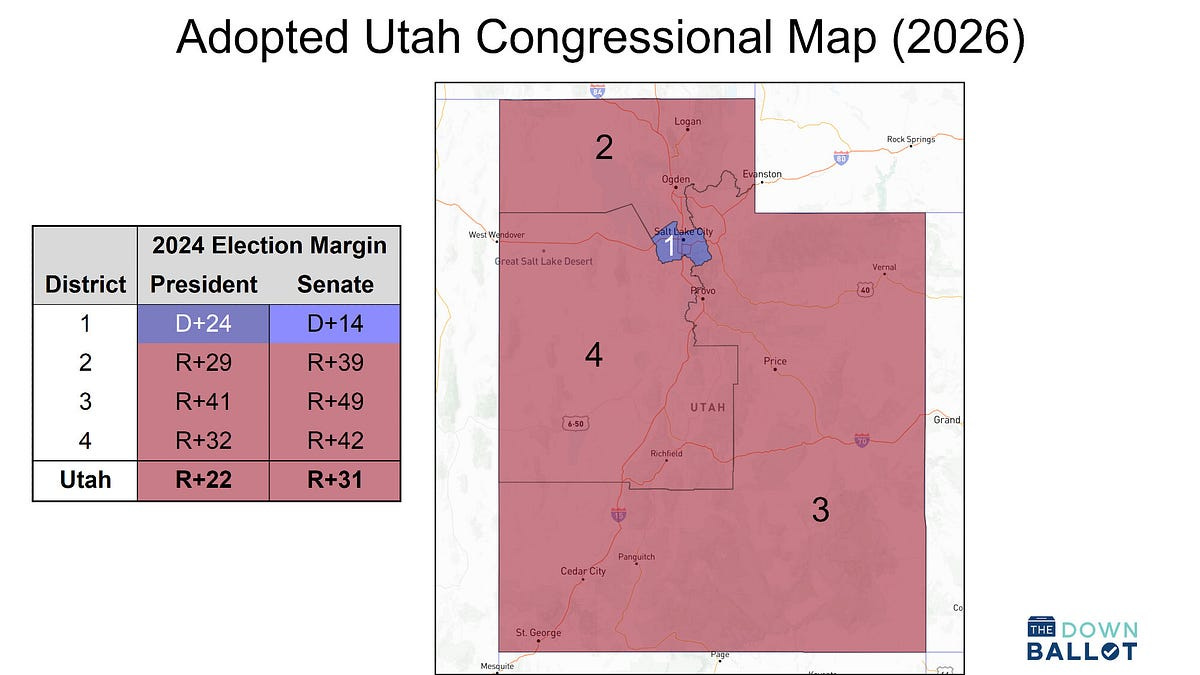
That initiative ultimately led to a state court imposing new congressional districts late last year, replacing a gerrymandered map that Republicans had drawn to ensure that all four of the state’s seats in the House would remain in their hands. The new map, by contrast, created a compact district around Salt Lake City that Democrats are all but assured of winning.
Despite the failure of the GOP’s proposal, Rob Axson, the chair of the state Republican Party, insisted that the repeal effort would continue.
“Whether now or in the future, by litigation or initiative, we will Repeal Prop 4,” he said in a statement to Deseret News. “This fight is not over but just beginning.”
The courts, though, have sided against Republicans at every turn.
Utah’s GOP-dominated legislature initially responded to the passage of Proposition 4 by passing legislation to gut it, believing it could do so because the initiative was statutory in nature.
Republicans then enacted a congressional map that split Salt Lake County—the main bastion of Democratic support in deep-red Utah—four different ways. The GOP easily won all four districts in subsequent elections.
But reformers, led by a group called Better Boundaries, were undeterred, filing a lawsuit charging that lawmakers had acted in defiance of the state Constitution. After a long delay, the state Supreme Court unanimously ruled in 2024 that the challenge could proceed.
Finally, more than three years after plaintiffs first brought their case, District Court Judge Dianna Gibson sided with them last August. Gibson concluded that lawmakers had violated the rights of voters when they sought to overwrite Proposition 4.
“Because legislative power is shared co-equally and co-extensively between the Legislature and the people, and because redistricting is legislative, the people have the fundamental constitution[al] right and authority to propose redistricting legislation that is binding on the Legislature,” she wrote.
Three months later, she ordered that the state’s GOP-drawn congressional lines be replaced with a new map that complied with Proposition 4’s anti-gerrymandering rules.
Enraged Republicans responded by appealing to the state Supreme Court, which rejected their case. They also filed a suit in federal court, which was likewise turned aside.
But even before Gibson imposed the new map, Republicans announced they would collect signatures to place their own initiative on the ballot that would repeal Proposition 4.
That proved to be a difficult task. Republicans not only had to gather nearly 141,000 signatures by Feb. 15—an amount equal to 8% of all registered voters—but they also had to hit that same target in at least 26 of the state’s 29 Senate districts.
It was that geographic distribution requirement that led to the GOP’s undoing, thanks to a state law that allows voters to withdraw their names after they’re verified by election officials.
Republicans met their statewide target, saying they submitted more than 200,000 signatures overall. But Better Boundaries mounted an aggressive campaign that urged voters—some of whom said they’d been deceived into signing petitions in the first place—to pull their names.
According to the Deseret News, some 7,000 did so. That doomed the measure in the 15th Senate District southeast of Salt Lake City, one of just six seats in the chamber held by Democrats. There, Republicans needed 4,596 signatures, but thanks to withdrawals, they fell below that number.
Since they’d already fallen below the mark in three other Democratic districts, that spelled the end of the campaign. Even if the repeal measure had passed, it could not have undone the new court-ordered map this year, but it could have in time for 2028.
Now, explains Bryan Schott of Utah Political Watch, Republicans cannot get their measure on the ballot before 2030, thanks to a state law requiring organizers to wait two years to propose an initiative that is “identical or substantially similar” to one that didn’t qualify.
Given their fury, though, Republicans are certain to continue their war on Proposition 4. One likely possibility, according to Schott, is for lawmakers to refer an amendment to the ballot that would expressly give them the power to repeal initiatives approved by voters. Such efforts to strip voters of their power have generally fared very poorly elsewhere, though, including in many red states.
For now, Proposition 4 has withstood all assaults, and as a result, when Utahns head to the polls this year, they’ll cast votes to elect their members of Congress free of gerrymandered electoral districts.
If you appreciate the intense effort we put into the Morning Digest each weekday, then we hope you’ll consider becoming a paid subscriber if you haven’t already done so. There really is no other publication quite like ours, but we can only become financially viable with your support. We ask just $7 a month or a steeply discounted $60 a year, which works out to just $5 per month. Thank you so much.

Senate
AL-Sen
An affiliate of the radical anti-tax Club for Growth is spending almost $1.3 million on ads attacking Alabama Attorney General Steve Marshall and praising Rep. Barry Moore ahead of the May 19 Republican primary for Senate.
One commercial from Alabama Freedom Fund focuses on Marshall’s past as a Democrat. While Marshall switched parties in 2011 and hasn’t looked back, the narrator asks why Republicans should nominate someone who “spent most of his life as a soft-on-crime Democrat.”
The group’s other spot touts how Moore has Donald Trump’s endorsement and praises the congressman as “completely and totally MAGA.”
Governors
GA-Gov
Allies of Secretary of State Brad Raffensperger are spending $1 million on an opening round of commercials saying he will “stop men from competing in women’s sports,” the Atlanta Journal-Constitution reports.
The transphobic spots from this group, known as Hardworking Georgia Families, do not mention any of the other Republicans running to replace termed-out Gov. Brian Kemp.
The ad campaign comes at a time when Raffensperger’s campaign has largely been overshadowed by the expensive and nasty clash between the two frontrunners in the GOP primary, Lt. Gov. Burt Jones and healthcare executive Rick Jackson.
The AJC said last week that Jackson had already spent $39 million on commercials ahead of the May 19 primary, which was about three times as much as Jones. There was little activity yet in support of Raffensperger, Attorney General Chris Carr, or any of the other four Republicans on the ballot.
Recent polls show Jones, who has Donald Trump’s endorsement, and Jackson securing both spots in a likely June 16 runoff, with Raffensperger taking a distant third place.
House
OK-01
Businessman Nathan Butterfield and former congressional aide Jed Cochran both announced Thursday that they would campaign to replace Rep. Kevin Hern, a fellow Republican who is giving up Oklahoma’s safely red 1st District around Tulsa to run for the Senate.
Butterfield, who had been seeking a seat in the state House, began his new race with the support of Tulsa County Sheriff Vic Regalado.
Dan Rooney, an Air Force veteran who went on to found a nonprofit, also tells News On 6 that he’s interested in running here, while several other Republicans previously kicked off bids. Oklahoma’s candidate filing deadline is April 3.
RI-02
Oral surgeon Stephen Skoly, whose medical practice was temporarily shut down by Rhode Island regulators during the pandemic after he refused to get a COVID vaccine, announced Wednesday that he would seek the Republican nomination to oppose Democratic Rep. Seth Magaziner in the 2nd District.
Magaziner won a difficult open-seat race in 2022, defeating a high-profile opponent, former Cranston Mayor Allan Fung, by a close 50-47 margin. The next cycle, though, he turned back an unheralded Republican with a much more comfortable 58-42 win, running well ahead of Kamala Harris’ 52-46 performance in the district.
Judges
WI Supreme Court
Well-heeled conservatives are doing just about nothing to help Judge Maria Lazar defend an open seat on the Wisconsin Supreme Court next month.
WisPolitics’ JR Ross reports that progressive-backed Judge Chris Taylor and her allies have spent $8.9 million on ads ahead of the officially nonpartisan April 7 election, while Lazar and her supporters have deployed less than $400,000. The winner will replace incumbent Rebecca Bradley, a conservative who decided not to seek reelection.
The campaign takes place one year after Elon Musk and his network spent $25 million in an attempt to erase the 4-3 majority that liberals won in 2023 and restore conservatives to majority status.
But progressive Susan Crawford’s double-digit victory in that campaign, which saw $115 million in spending, appears to have left deep-pocketed conservative interests pessimistic that Lazar can prevail.
Taylor is using her massive financial advantage to air ads framing the race as a choice between a supporter of abortion rights and an ardent opponent, a message that helped liberals win crucial races in both 2023 and 2025.
One of her commercials features a nurse warning the audience, “Maria Lazar boasts about her support from radical anti-abortion extremists who oppose giving emergency contraception to survivors of sexual assault.”
A victory for Taylor would expand the progressive majority to 5-2. It would also mean that the soonest conservatives could win back control would be 2030.
Liberals, though, could push back that timeline another three years if they win the 2027 race to replace Justice Annette Ziegler, another conservative who announced that she would not run again earlier this month.
Prosecutors & Sheriffs
Hennepin County, MN Attorney
Minneapolis Mayor Jacob Frey on Thursday endorsed Anders Folk, who served as acting U.S. attorney for the state of Minnesota during the early months of the Biden administration, in the crowded race to become the top prosecutor for the state’s largest county.
Folk is one of six notable candidates running to succeed Hennepin County Attorney Mary Moriarty, a prominent criminal justice reformer who is not seeking a second term. While there’s no obvious frontrunner in this busy contest, a few other candidates have earned high-profile endorsements.
State Rep. Cedrick Frazier has the support of both Rep. Ilhan Omar, a nationally prominent progressive who represents Minneapolis in Congress, and Lt. Gov. Peggy Flanagan, the frontrunner in the Democratic primary for U.S. Senate.
Hao Nguyen, a senior prosecutor in Ramsey County, enjoys the backing of Hennepin County Sheriff Dawanna Witt. Attorney General Keith Ellison, meanwhile, issued a double endorsement to Frazier and Nguyen last year.
The field also includes Diane Krenz, a longtime prosecutor in the Hennepin County Attorney’s Office; attorney Matt Pelikan; and Francis Shen, a law professor at the University of Minnesota.
All contenders will face off on a single ballot on Aug. 11, with the top two vote-getters advancing to the fall general election. While the race is officially nonpartisan, the next attorney for Hennepin County, a solidly blue community that includes Minneapolis and many of its suburbs, is likely to be a Democrat.
Poll Pile
ME-Sen (D): Emerson College:
Graham Platner: 55, Janet Mills: 28.
ME-Sen: Emerson:
Platner (D): 48, Susan Collins (R-inc): 41.
Mills (D): 46, Collins (R-inc): 43.
NC-Sen: Harper Polling for the Carolina Journal:
Roy Cooper (D): 49, Michael Whatley (R): 41. (Nov.: 47-39 Cooper.)
The Carolina Journal is a conservative publication.
NH-Sen (R): Emerson:
John Sununu: 48, Scott Brown: 19.
NH-Sen: Emerson:
Chris Pappas (D): 45, Sununu (R): 44.
Pappas (D): 48, Brown (R): 39.
CA-Gov (top-two primary): Echelon Insights for Steve Hilton:
Steve Hilton (R): 20, Eric Swalwell (D): 15, Chad Bianco (R): 14, Tom Steyer (D): 13, Katie Porter (D): 10, other candidates 4% or less.
TN-Gov (R): VictoryPhones for Tennesseans for Student Success.
Marsha Blackburn: 56, John Rose: 14, Monty Fritts: 11. (Feb.: Blackburn 61-8.)
Tennesseans for Student Success is a pro-school voucher group that does not appear to have taken sides in this race.
WI-03: Impact Research for Rebecca Cooke:
Rebecca Cooke (D): 49, Derrick Van Orden (R-inc): 48.
The poll was in the field Feb. 12-17.
NC Supreme Court: Harper:
Anita Earls (D-inc): 41, Sarah Stevens (R): 38.
Reps. Nikki Budzinski (D-IL) and Adrian Smith (R-NE) introduce the bipartisan PREDICT Act bill that enacts a ban on Congress members from participating in prediction markets related to political events or policy decisions.
https://bsky.app/profile/budzinski.house.gov/post/3mhv7zyankc2l
https://www.politico.com/live-updates/2026/03/25/congress/lawmakers-introduce-bill-to-prohibit-members-of-congress-president-from-prediction-market-trading-00843337
https://www.politico.com/news/2026/03/27/sheila-cherfilus-mccormick-guilty-ethics-00848019
FL-20: Rep. Sheila Cherfilus-McCormick is guilty of House Ethics violations. Love this for her. Please let Elijah Manley take her seat.