


Leading Off
CA-48
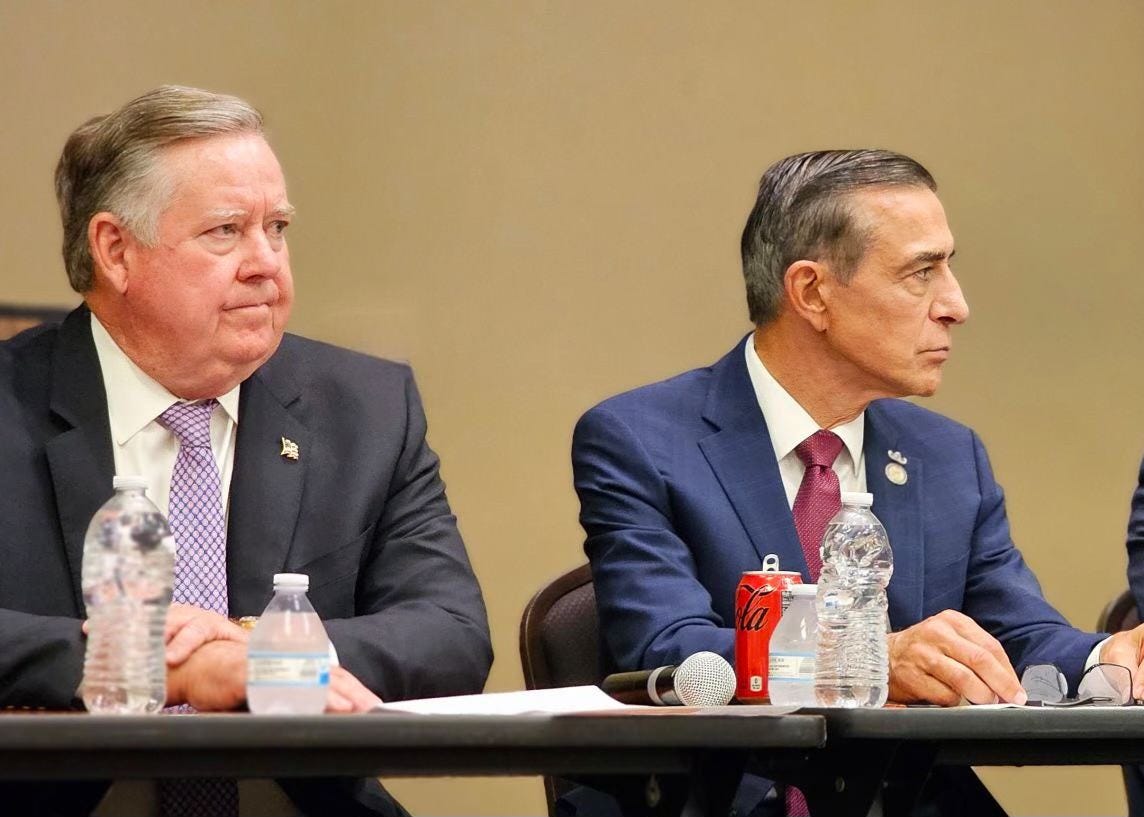
Rep. Darrell Issa unexpectedly announced on Friday that he would retire, the second time the California Republican has opted to quit the House rather than forge ahead with a difficult reelection campaign.
Shortly before the candidate filing deadline, reports emerged that Issa, who just days earlier insisted to Punchbowl that he would run again, would drop his bid for another term. Those reports proved correct.
“But after a quarter-century in Congress — and before that, a quarter-century in business — it’s the right time for a new chapter and new challenges,” Issa wrote in a statement published Friday evening on X.
In that same post, Issa also endorsed San Diego County Supervisor Jim Desmond, who had been running in a neighboring district, to succeed him.
Unlike most other states, though—including Montana—California makes it impossible for office-holders to hand off their seats to their preferred successors by scheming at the filing deadline. That’s because the state extends the deadline for five extra days in races where an incumbent doesn’t file, meaning would-be candidates have until Wednesday to make a late entrance.
Still, it’s unlikely any major names will jump in at this point. Several Democrats have been running for some time, and Republicans already face tough odds in holding Issa’s seat, which became decidedly bluer under California’s new map.
Before voters passed Proposition 50 last fall, Democrats weren’t even seriously considering targeting Issa’s 48th District, which voted for Donald Trump by a daunting 56-41 margin in 2024, according to calculations from The Downballot.
But in its new incarnation, it became much more competitive by absorbing blue areas around Palm Springs previously held by the 41st District while offloading some of its reddest precincts in San Diego County to the 51st. It also pulled in friendly turf around the North County cities of Escondido, San Marcos, and Vista that was in the 49th and 50th.
As a result, the new-look 48th would have backed Kamala Harris 50-47, according to data uploaded to Dave’s Redistricting App by researcher Josh Metcalf.
As the vote on Proposition 50 approached, a number of Democrats said they’d run for the 48th should the new map pass, including businessman Brandon Riker, Navy Reserve officer Ammar Campa-Najjar, and San Diego City Council member Marni von Wilpert. They were later joined by Vista City Council member Corinna Contreras, who entered in December.
But as Democrats piled in, Issa looked for a way out. Right after voters approved the new map, multiple outlets speculated that Issa was considering heading north to run in the 40th District, where two Republican representatives—Young Kim and Ken Calvert—were already preparing to do battle.
A few weeks later, Punchbowl reported that Issa might indeed try his luck in a different district, the 32nd. That is, Texas‘ 32nd District, a Democratic-held seat that Lone Star Republicans turned safely red with their summertime gerrymander that kicked off the nation’s redistricting wars.
Issa swiftly backed off that plan but acknowledged he had in fact mooted the idea.
“Texas House members and residents of that state did ask if I would consider running there following Gavin Newsom’s historically corrupt gerrymander,” he said in a statement. “I appreciate the opportunity, but California is my home. I told them I’m going to stay in Congress, and I don’t need to go to Texas for that. I can hold this seat, I’m not quitting on California, and neither should anyone else.”
Issa did, however, quit on California—a familiar experience for him.
In 2018, following an unexpectedly close shave two years earlier, Issa announced he would not seek reelection to what was then numbered the 49th District.
It seemed like the end of the line for the congressman, who had first won office in 2000 after making a fortune selling car alarms. (One site estimates his net worth today at $285 million.)
For more than a decade, Issa never had a difficult fight for reelection, but he long ago became a progressive bete noire, dating back to when he bankrolled the successful effort to recall Democratic Gov. Gray Davis in 2003.
Yet even though Davis lost, the election didn’t pan out as Issa had hoped. Issa had planned to run in the crowded recall campaign himself, but after Arnold Schwarzenegger jumped in and sucked up all the oxygen on the GOP side, he tearfully announced he wouldn’t join the race.
Issa may not have wanted to stick around in Congress, but he made the most of his position atop the House Oversight Committee after Republicans took back the House in 2010, declaring he wanted “seven hearings a week, times 40 weeks” in an interview with Politico.
The new committee chair got what he demanded and launched a flurry of investigations into the Obama administration, chief among them his Benghazi probe. But his zeal as an inquisitor also prompted the media to revisit many stories of his own less-than-upstanding past, which included multiple allegations of auto theft and insurance fraud involving a suspicious fire at a warehouse he’d owned.
Even as he rode high in Congress, however, shifting political winds in Southern California began causing serious problems for Issa at home. In 2016, he defeated an unheralded Democratic challenger, Marine veteran Doug Applegate, by just a 50.3 to 49.7 margin—an unexpectedly close result that spurred other Democrats to take a renewed interest in challenging him.
A little over a year later, with the gathering blue wave threatening to wash him out to sea, Issa retired. Democrat Mike Levin, an environmental attorney, easily won the race to replace him, defeating Republican Diane Harkey 56-44.
That wasn’t the last we’d hear of Issa, though. Almost immediately, reports emerged that he might run in the neighboring 50th District—a much more conservative seat—if Rep. Duncan Hunter, a fellow Republican, were to resign.
That didn’t come to pass in time for the 2018 election cycle, but Hunter left office early in 2020 following his conviction on finance charges. Issa, whose nomination to serve as Trump’s director of the United States Trade and Development Agency died in a hostile Senate, opted to instead wage a comeback.
After a challenging primary, he defeated Campa-Najjar 54-46, then won his final two elections with ease.
The Downballot only exists because of our readers.
We have no deep-pocketed corporate backers and no billionaire sugar daddies. That means we can always tell the truth without fear—something major media conglomerates increasingly refuse to do. But it also means we need as many people as possible to sign up as paid subscribers so that we can keep the lights on.
If you’re able to support our work, we hope you’ll upgrade today. Thank you so much.

Redistricting Roundup
NY Redistricting
Gov. Kathy Hochul said late last week that New York Democrats were not in a rush to amend the state constitution to allow them to pass a new congressional map, despite the Supreme Court writing just days earlier that state courts could not enforce a recent ruling that the 11th District discriminated against Black and Latino voters.
“I don’t think it will make a difference now,” Hochul said Thursday, according to Politico. “There’s not an urgency in light of what happened there.”
Nonetheless, the publication reported that Democrats “are still expected to push for a redistricting amendment.” To enact one, lawmakers would have to pass it twice, with an intervening election, before voters could weigh in.
Senate
OK-Sen
Most of the attention around possible successors to Oklahoma Sen. Markwayne Mullin, should he be confirmed as Donald Trump’s next Homeland Security secretary, immediately entered around GOP Reps. Kevin Hern and Stephanie Bice, though some other names have surfaced as well.
News 4 asked four Republicans vying to succeed term-limited Gov. Kevin Stitt whether they might be interested in switching races—some of whom didn’t entirely rule out the idea.
Former state Sen. Mike Mazzei was the most explicit in his disavowal, saying, “I have zero interest in serving in Congress.” And former state Cabinet official Chip Keating didn’t sound intrigued either, telling the station, “The Senate will remain just as dysfunctional with or without me. I am only focused on running for Oklahoma Governor.”
But former state House Speaker Charles McCall was a little less certain, saying, “I remain focused on becoming the next Governor of Oklahoma.” And Attorney General Gentner Drummond offered similar comments, informing the outlet, “Right now, my focus is the governor’s race.”
The Oklahoman further mentioned House Speaker T.W. Shannon, who’s currently running for lieutenant governor, as a potential candidate.
There’s also former state Superintendent Ryan Walters, who at one point had seemed likely to join the race to replace Stitt but instead announced his resignation as schools chief last fall and said he’d take a job at a conservative advocacy group. Walters did not respond to News 4 when asked for comment, however.
Still other possibilities flagged by Politico include Lt. Gov. Matt Pinnell, former state GOP chair Nathan Dahm, former Tulsa Mayor G.T. Bynum, and Oklahoma City Mayor David Holt, though Holt told News 4 he did not have any comments to offer.
Pinnell also spoke with News 4 and expressed interest, but it’s not clear whether he was referring to a campaign for a full term this fall or a desire to be appointed by Stitt to replace Mullin for the final months of his current term.
Whoever joins, the GOP primary should get underway soon. Punchbowl reported on Friday that Hern is “likely to make a formal announcement” this week.
Governors
RI-Gov
Attorney General Peter Neronha, who spent much of last year weighing a bid for governor before finally saying no, has endorsed former CVS executive Helena Foulkes in her bid against Gov. Dan McKee in this year’s Democratic primary.
House
CA-01
Assemblyman James Gallagher, who is Donald Trump’s endorsee in the June special election for California’s vacant 1st District, announced late last week that he’d run for a full term as well.
The two contests will be very different, however. The special election, which became necessary after GOP Rep. Doug LaMalfa died in January, will take place under the district’s old lines, which favor Republicans.
The race for a full two-year term, however, will use the revamped boundaries that voters approved last year in passing Proposition 50, which shifted the district well to the left. Under the previous map, the 1st District voted for Trump by a wide 61-36 margin, but the new version would have voted 54-42 for Kamala Harris.
The two leading Democrats, agriculture consultant Audrey Denney and state Sen. Mike McGuire, both previously said they’d run in both contests.
CA-06
Republican Rep. Kevin Kiley, who faces a difficult battle for reelection thanks to California’s new congressional map, announced on Friday that he’d appear on the ballot as an independent.
Earlier in the week, Kiley confirmed that he would run for the redrawn 6th District, an open, Democratic-leaning constituency in the Sacramento area. The new version of the district, though, would have supported Kamala Harris by a 53-44 margin. As a result, several notable Democrats opted to run here after Rep. Ami Bera said he’d seek another term in the neighboring 3rd District, which has a similar lean.
Kiley said he’d filed to run as “No Party Preference,” but he was unclear as to just how far he plans to go to shed his GOP associations. When asked whether Kiley intends to quit the House Republican caucus, a spokesperson told the San Francisco Chronicle, “That’s still being ironed out.”
Axios reported that Kiley’s move had “sparked considerable confusion among his colleagues,” one of whom said, “I hope to God” he plans to remain a member of the caucus.
CA-47
Former Assemblyman Bill Brough has filed to run against Democratic Rep. Dave Min, who hadn’t drawn any notable GOP opposition until now, but Republicans may not be especially interested in their new candidate.
Min held the Orange County-based 47th District with a tight 51-49 win over Republican Scott Baugh in 2024, but the state’s new congressional map made the district a much less appealing target for the GOP. Under the old lines, Kamala Harris carried it 50-46, but the new version would have backed her by a wider 53-43 spread.
Brough also brings heavy baggage with him. As noted by Inside Elections’ Jacob Rubashkin, who first flagged the filing, multiple women accused Brough of sexual harassment in 2019 and 2020, and he was stripped of his committee assignments by the legislature.
Even the Orange County GOP asked him to abandon his bid for reelection, but he persisted, finishing a distant fourth in the top-two primary. Three years later, election officials fined him $100,000 for spending campaign funds on personal expenses, including family vacations.
NV-02
James Settelmeyer, a member of Gov. Joe Lombardo’s Cabinet and a former state lawmaker, has joined the large field of Republicans hoping to succeed retiring GOP Rep. Mark Amodei in northern Nevada’s 2nd Congressional District.
Settelmeyer served in the legislature from 2006 to 2022, starting in the Assembly before ultimately becoming minority leader in the state Senate. In 2023, after Settelmeyer was termed out, Lombardo tapped him to run Nevada’s Department of Conservation and Natural Resources.
NY-04
Former Republican Rep. Anthony D’Esposito refused to answer questions at a congressional hearing last week about whether he plans to seek a comeback.
Referencing a Newsday article published a day earlier by reporter Billy House saying that D’Esposito would soon announce a bid for his old seat, California Democrat Judy Chu pressed the ex-congressman, who was confirmed as inspector general for the Department of Labor in December, on his plans.
D’Esposito, however, repeatedly dodged and suggested that Newsday’s story was not relevant or accurate because D’Esposito himself had not written it and had not offered any comment for the piece. House had reported that D’Eposito did not respond to multiple inquiries prior to publication.
SC-06
South Carolina Rep. Jim Clyburn told the Washington Post in a new interview that he’s “leaning towards” running for an 18th term, even though the 85-year-old Democrat said his “family is split on the decision.”
Clyburn also added that if he does retire, he’d like to be succeeded by his daughter, businesswoman Jennifer Clyburn Reed.
“You are a daughter,” he told the Post. “What would you think of your dad if you decided to do something and your dad didn’t support you?”
TX-19
The last uncalled House race in Texas is in the conservative 19th District, where businessman Matt Smith trails conservative activist Abraham Enriquez for the all-important second runoff slot by 193 votes.
Lobbyist Tom Sell easily secured first place on primary night with 40% of the vote, while Enriquez holds a narrow 15.8 to 15.5 lead over Smith. It’s not clear how many ballots are still untallied at this point, though it’s unlikely there are enough for Smith to leapfrog Enriquez. We’ll know soon, though, as local elected officials must complete their canvass by Thursday.
UT-02
State Rep. Karianne Lisonbee confirmed on Friday that she’s considering a bid against Rep. Blake Moore in the June GOP primary, though Utah Politics Watch’s Bryan Schott says she’s a virtual lock to run.
According to unnamed sources who spoke with Schott, Lisonbee’s “decision is effectively made,” and a formal announcement is “likely” this week.
Moore represents the old 1st but is seeking reelection in the redrawn 2nd, which runs along the state’s northern border and resembles the conservative constituency he currently represents.
Moore, however, doesn’t live in the district. He’s originally from Ogden, which is now the largest city in the 2nd, but he lives in Salt Lake City, which is now entirely in the 1st District.
By contrast, Lisonbee, who lives in the city of Syracuse, emphasized in a statement announcing her interest that the 2nd District is “where I live, where I raised my family, and where my children and grandchildren live.”
Last year, Lisonbee said she would not seek reelection to the legislature after losing a bid to serve as House majority leader.
Ballot Measures
UT Ballot
Utah Gov. Spencer Cox signed a bill passed by fellow Republicans in the legislature just before their session ended on Friday that would make it harder for voters to withdraw their signatures from a GOP-backed ballot measure that would allow lawmakers to once again engage in partisan gerrymandering.
The new law bars county clerks from processing signature removal forms if they were sent in an envelope with pre-paid postage. Opponents of the ballot measure have been sending such forms to signatories, along with postage-paid envelopes and a message encouraging them to withdraw their names. Republicans recently filed a lawsuit claiming such postage amounted to an illegal quid pro quo.
With the GOP’s ballot measure just barely clearing signature thresholds—in the tightest district, it’s just 571 above the minimum—its future could depend on how many voters have a change of heart. Several thousand signatures have already been withdrawn statewide, with some voters saying they were deceived into signing organizers’ petitions.
Legislatures
IN State Senate
Bluffton City Councilman Blake Fiechter has resumed his campaign against state Sen. Travis Holdman in the May 5 GOP primary, two weeks after he quit because of a lack of support for his bid.
Fiechter’s latest change of heart came the day after he joined several other Indiana Republicans, most of whom are challenging senators who opposed passing a new congressional gerrymander, on a visit to the White House to meet with Donald Trump.
When he dropped out last month, Fiechter told WANE 15, “I felt like I was on a raft alone trying to navigate.” It’s not clear, however, whether anything has materially changed on that front.
Another participant in the White House gathering, former state Rep. Jeff Ellington, told the Indiana Capital Chronicle that “there’s no doubt” that outside aid will be forthcoming, though he added, “Like I said, no details. You just get a feeling.”
NC State Senate
Rockingham County Sheriff Sam Page saw his lead over state Senate President Phil Berger grow from two votes to 23 after provisional ballots were tallied on Friday, though it may yet be some time before we know the winner.
A tiny number of ballots from overseas and military voters—under half a dozen, according to WRAL—still remain to be counted, though there aren’t enough to affect the outcome. What could, however, is a recount, which Berger is allowed to request by March 17.
But the Senate leader, who had Donald Trump’s endorsement and a massive spending advantage, didn’t sound committed to seeking one.
“If we believe a recount is merited, I will pursue that avenue as allowed by law,” he said in a statement.
Other Races
GA-LG
Democratic state Sen. Nabilah Parkes, who’d been running for insurance commissioner, made a last-second switch and entered the race for lieutenant governor just ahead of Georgia’s candidate filing deadline on Friday.
For a brief while, it looked like state Sen. Josh McLaurin would have the May 19 primary to himself after Macon-Bibb County Commissioner Seth Clark dropped out a week earlier. A third candidate, accountant Richard Wright, is also running, so it’s possible the race won’t get decided until a June 16 runoff.
Seven different candidates, meanwhile, filed for the GOP primary, making a runoff likely. The secretary of state has published a list of all candidates for all Georgia offices on the ballot this year.
Obituaries
Colleen Hanabusa
Former Democratic Rep. Colleen Hanabusa, who served two separate stints in the House but lost bids for Senate and governor, died on Friday at the age of 74. The Honolulu Star-Advertiser has much more on her career in its obituary.
Alvin Greene
Alvin Greene, an obscure South Carolina Army veteran who stunned the political world when he defeated a well-known Democratic politician to win a primary for the U.S. Senate in 2010, died last week at the age of 48. The Post and Courier has more on Greene’s emergence as a “[c]elebrity political long-shot” in its obituary.
Poll Pile
CA-Gov (top-two): Global Strategy Group for Tom Steyer: Steve Hilton (R): 20, Tom Steyer (D): 16, Chad Bianco (R): 15, Katie Porter (D): 13, Eric Swalwell (D): 11, Xavier Becerra (D): 5, Matt Mahan (D): 3, Antonio Villaraigosa (D): 2.
Early Feb.: Hilton 18, Bianco 18, Swalwell 14, Porter 12, Steyer 10, Becerra 4, Villaraigosa 3, Mahan 3.
NC-01: GQR for Don Davis: Don Davis (D-inc): 42, Laurie Buckhout: 39, Tom Bailey (Lib.): 9, other: 1, undecided: 9.
NY-12 (D): GQR for George Conway: Jack Schlossberg: 25, George Conway: 16, Micah Lasher: 11, Alex Bores: 11, undecided: 33.
VA-07 (D): Change Research for Free and Fair Democracy PAC: Elizabeth Guzman: 14, J.P. Cooney: 5, Saddam Salim: 5, Adele McClure: 4, Alfonso Lopez: 4, Dan Helmer: 4, undecided: 63.
Free and Fair Democracy does not appear to have issued an endorsement in the race, but its memo describes Guzman favorably. Guzman, a member of the House of Delegates, has not yet joined the race.
PPP/DSCC internal has Talarico up 1 over Cornyn (44-43), up 2 on Paxton (47-45).
https://punchbowl.news/wp-content/uploads/Texas-poll.pdf
I don’t have a small enough violin to post for Darrell Issa.