



Leading Off
CA-01
Republican Rep. Doug LaMalfa died unexpectedly on Tuesday at the age of 65, a development that both narrows the House GOP’s already slim majority and will set off a special election to succeed him.
LaMalfa, who Politico reports experienced an aneurysm and a heart attack, had no known serious health problems before his death. The congressman even told NOTUS last month that he would seek an eighth term in Northern California’s 1st Congressional District, which just became dramatically bluer following the state’s adoption of a new House map in November.
Despite the major changes made to his district, LaMalfa said the revamped map “makes me more invigorated to run” and was preparing for what would have been his first competitive race since he was first elected to Congress in 2012.
That was the first year the Golden State used congressional boundaries drawn by a new independent redistricting commission instead of by the legislature. It was also the first election cycle that saw the state switch to top-two primaries, under which all the candidates run on a single ballot and the two leading vote-getters—regardless of party—advance to the general election.
LaMalfa and a fellow Republican, former state Sen. Sam Aanestad, both sought to replace retiring GOP Rep. Wally Herger in the 1st District, a reliably conservative constituency based in the northeastern corner of the state. Only one, however, made it past the first round. LaMalfa led the way in the primary with 38% of the vote as Democrat Jim Reed outpaced Aanestad 25-14 for second, an outcome that all but assured LaMalfa’s victory that fall.
LaMalfa went on to beat Reed 57-43 and never struggled to keep his seat over the ensuing decade. He did face notable opposition in both 2018 and 2020 from Democrat Audrey Denney, an agricultural consultant who raised sizable sums during both her campaigns, but he comfortably won both times.
Following the most recent census, LaMalfa’s district remained safe for Republicans even after California’s redistricting commission redrew the lines to account for population shifts. But the congressman’s standing shifted abruptly after Gov. Gavin Newsom and fellow Democrats began plotting an unexpectedly potent response to the new gerrymander that Texas Republicans had drawn at Donald Trump’s insistence.
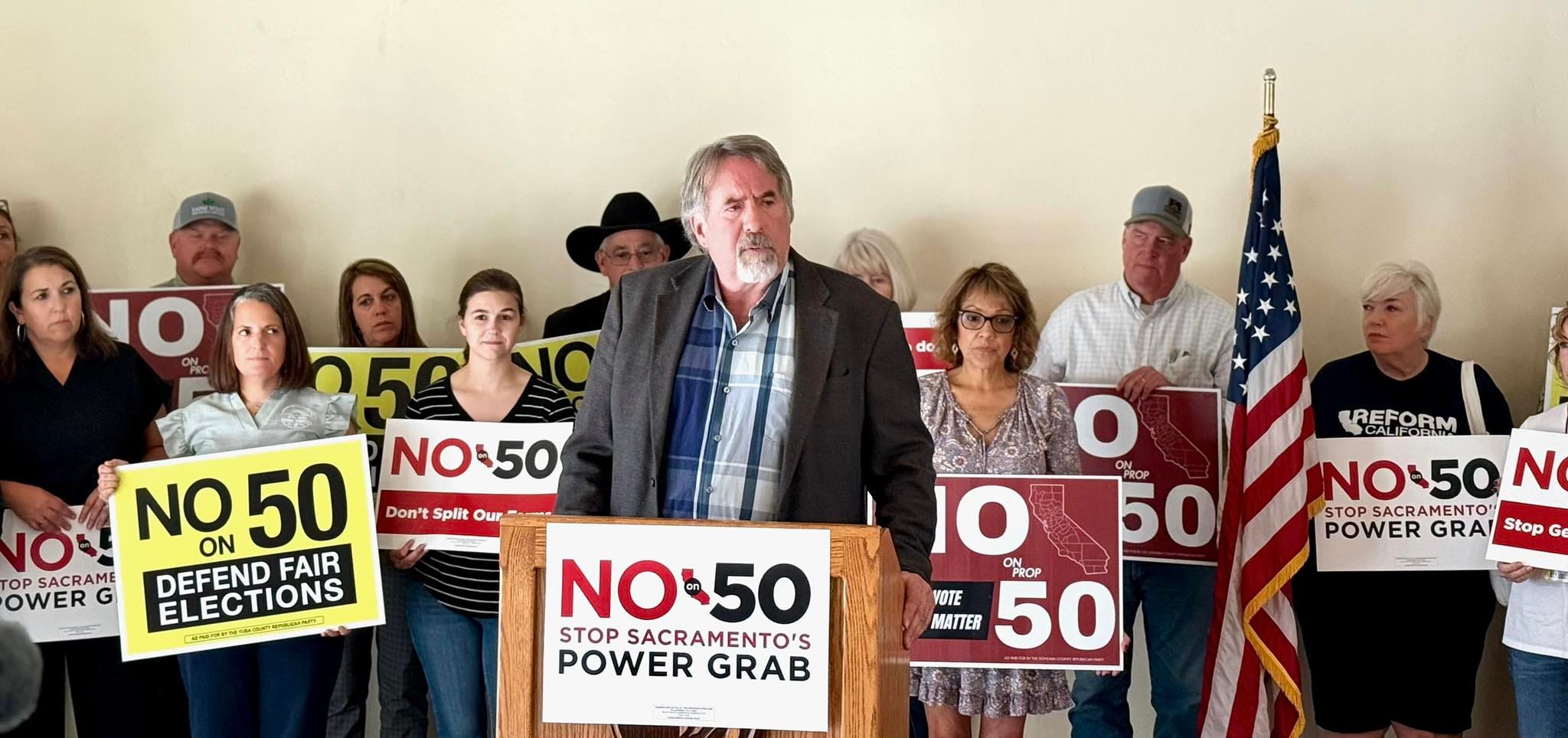
Lawmakers swiftly passed a new map, which voters approved in a 64-36 landslide last fall, that dramatically overhauled LaMalfa’s constituency. While LaMalfa had easily secured his most recent term as Trump was carrying his district 61-36, Kamala Harris would have won the new-look 1st District by a 54-42 spread.
Mapmakers accomplished this transformation by shifting conservative rural communities between Chico and Sacramento that had been in the 1st into neighboring Democratic districts. In exchange, LaMalfa’s district took in portions of two deep blue counties, Mendocino and Sonoma, that are located in the state’s wine country region north of San Francisco.
These alternations greatly improved Democrats’ chances of flipping the 1st District, but KCRA reported in August that the changes were intended to help one Democrat in particular.
According to the station, state Senate President Pro Tem Mike McGuire, who represents Mendocino County and nearby communities, had ensured the constituency was redrawn “specifically for him in exchange for his support of the redistricting plan.” McGuire’s team did not respond to KCRA’s request for comment.
Denney had announced a third campaign this summer, when the new map was still in the works, while McGuire only entered the race the week after voters approved it. Until Tuesday, it looked likely that LaMalfa would once again advance out of the top-two primary on June 2, but this time, he would have struggled against whichever Democrat joined him in the Nov. 3 general election.
Because of LaMalfa’s death, though, a special election will take place first, as required by the Constitution. Newsom has 14 days to schedule the contest, which must then be held between 126 and 140 days later. That would put the election sometime between mid-May and early June, with a primary nine weeks earlier.
Ordinarily, special elections that take place after redistricting but before the next general election use old district lines—but not always. A 2022 special election for Nebraska’s 1st District was held using the state’s new map that had been adopted the previous year, a move that did not face a legal challenge.
One legal commentator, Slate’s Mark Joseph Stern, argued that Newsom should nonetheless order that the new boundaries be deployed.
“It’s the map adopted by the people of California, and on top of being democratically defensible, it’s the kind of hardball that [Ron] DeSantis or [Greg] Abbott would obviously pull in the converse scenario,” he wrote on social media, referring to the Republican governors of Florida and Texas.
Regardless of which version of the 1st District is used, candidates will run on one ballot in the special primary, just as they will in the regularly scheduled primary in June. However, there’s one important difference in how the two contests will operate.
In the special election, a runoff would take place only if no one wins a majority of the vote in the first round. In the regular election, candidates running for a full term cannot win outright in June no matter how much support they secure.
GOP leaders in the House would be relieved if a Republican wins in a single round and gives them a reliable vote for the remainder of this session of Congress. LaMalfa’s death came just one day after Rep. Marjorie Taylor Greene’s resignation from Georgia’s conservative 14th District took effect, leaving Republicans with just a 218-213 advantage.
That edge will grow smaller still at the end of the month, thanks to a Jan. 31 special runoff election for Texas’ 18th District, a safely blue seat that features two Democratic candidates.
Apart from Greene’s district, where GOP Gov. Brian Kemp just scheduled a special election (see our GA-14 item below for more), one other seat remains vacant: New Jersey’s 11th District, a reliably blue constituency that will be filled on April 16.
The Downballot has changed the way people think—and talk—about special elections.
Once dismissed as inconsequential, our nuanced, data-driven analysis has put these contests front and center as a forecasting tool. If you appreciate our unique approach and want to know about the most important special elections long before they happen, please consider upgrading to support our work.
Election Recaps
Special Elections
Republicans appear to have narrowly hung on to a state House seat in South Carolina, after results on Tuesday night gave Republican Greg Ford a 21-vote lead over Democrat Sonja Ogletree Satani in the 98th District.
An automatic recount looks likely, though, since the margin between the two candidates is less than 1% of the total votes cast. It’s also possible that some uncounted provisional ballots remain to be tallied. Donald Trump had carried the district by 7 points last year, and Democrats had only contested it three times in four decades prior to Ogletree Satani’s first unsuccessful bid in 2024.
Elsewhere, both parties successfully defended seats in districts that leaned heavily in their direction, with Democrats winning two contests in Virginia and one in Connecticut, and Republicans prevailing in a race in Georgia. Follow every special election by bookmarking The Downballot’s continually updated Big Board.
4Q Fundraising
ME-Sen: Graham Platner (D): $4.7 million raised
MN-Sen: Angie Craig (D): $2.1 million raised, $4 million cash on hand
AL-Gov: Doug Jones (D): $480,000 raised (in December), $560,000 cash on hand; Tommy Tuberville (R): $150,000 raised (in December), $6 million cash on hand
PA-Gov: Josh Shapiro (D-inc): $10 million raised, $30 million cash on hand
WI-Gov: David Crowley (D): $800,000 raised (reporting period covers last half of 2025; Crowley launched campaign in mid-September), $600,000 cash on hand; Joel Brennan (D): $560,000 raised (launched campaign in mid-December)
AZ-01: Jonathan Treble (D): $370,000 raised, $1.54 million cash on hand
CO-08: Manny Rutinel (D): $425,000 raised, $1.2 million cash on hand
IA-01: Christina Bohannan (D): $1.14 million raised
IL-09: Laura Fine (D): $1.25 million raised
MI-07: Matt Maasdam (D): $400,000 raised
MI-10: Eric Chung (D): $255,000 raised
MS-01: Cliff Johnson (D): $260,000 raised
NE-02: Denise Powell (D): $305,000 raised
TX-21: Mark Teixeira (R): $300,000 raised, $2.5 million cash on hand
VA-06: Beth Macy (D): $615,000 raised (in six weeks)
Senate
AK-Sen, AK-Gov
Former Rep. Mary Peltola is “expected” to announce a bid against Republican Sen. Dan Sullivan sometime this month, Axios’ Hans Nichols reports—a move that would delight Senate Democratic leaders who have worked hard to recruit her.
Peltola, who has kept everyone in suspense about her plans ever since she narrowly lost reelection in 2024 as Alaska’s sole member of the House, has not publicly confirmed whether she’ll take on Sullivan. Nichols writes that Peltola has even “kept it vague” in interviews with potential campaign managers about whether she’d be hiring them to work on a campaign for the Senate or for the state’s open governorship.

Nichols’ sources, though, say that Peltola has now told allies she’s more interested in taking on Sullivan than in running to succeed Republican Gov. Mike Dunleavy, who is termed out.
Peltola would be the first—and probably only—serious Democrat to run for the Senate seat that Sullivan first won in 2014. State Sen. Matt Claman and former state Sen. Tom Begich, by contrast, are competing in a packed Aug. 18 top-four primary for governor that features several Republican candidates.
Governors
CA-Gov
California Attorney General Rob Bonta told reporters Monday he’ll decide “probably [in] the first two weeks of January” whether he’ll enter the race to replace termed-out Gov. Gavin Newsom, a fellow Democrat. Bonta would join a packed June 2 top-two primary field that could grow still larger before the March 6 candidate filing deadline.
MN-Gov
Sen. Amy Klobuchar confirmed to CNN on Tuesday that she’s interested in running to succeed Minnesota Gov. Tim Walz, a fellow Democrat who ended his reelection campaign the previous day.
“I love my job, I love my state, and I’m seriously considering it,” the senator said.

NM-Gov
Jim Ellison, a former member of the New Mexico Public Regulation Commission, announced Tuesday that he was entering the June 2 Republican primary for the state’s open governorship.
Ellison, who does not appear to have run for office before, is campaigning to succeed termed-out Gov. Michelle Lujan Grisham, a Democrat who appointed him to the body in 2023 (its members had until then been elected). Ellison left the Commission, which is tasked with regulating utilities, at the end of 2024 when his term concluded.
Ellison joins Rio Rancho Mayor Gregg Hull, state Sen. Steve Lanier, and businessman Duke Rodriguez in the hunt for the GOP nomination. Democrats have a three-way contest between Bernalillo County District Attorney Sam Bregman, former U.S. Secretary of the Interior Deb Haaland, and former Las Cruces Mayor Ken Miyagishima.
House
AZ-01
Donald Trump announced Tuesday that he was bestowing his “Complete and Total Endorsement” on former Arizona Cardinals kicker Jay Feely … in addition to Arizona GOP chair Gina Swoboda, who previously had been the sole recipient of Trump’s blessing in the swingy 1st District. The two are competing to succeed Rep. David Schweikert, a fellow Republican who is running for governor.
While Trump insisted that either of his picks “would be an incredible Representative,” Swoboda’s hardline critics don’t agree. Far-right influencer Laura Loomer has accused her of having “a record of working against MAGA grassroots activists,” while the state’s Freedom Caucus affiliate has also clashed with Swoboda.

State Rep. Joseph Chaplik and wealthy businessman John Trobough are also running in the Aug. 4 GOP primary, while Democrats likewise have a crowded nomination contest that same day.
CA-14
State Sen. Aisha Wahab filed paperwork with the FEC Monday for a potential campaign to replace Rep. Eric Swalwell, a fellow Democrat who is leaving California’s 14th District behind to run for governor. Wahab, whose 2018 election to the Hayward City Council made her one of the first Afghan Americans elected to office anywhere in the United States, did not immediately announce a campaign.
GA-14
Republican Gov. Brian Kemp has chosen March 10 as the date of the special election to succeed now-former Rep. Marjorie Taylor Greene—but that will be only the first of what could be as many as six different elections this year in Georgia’s dark-red 14th District.
All candidates from all parties will run together on a single ballot rather than in separate primaries. If no one wins a majority of the vote—as is likely—the two candidates with the most votes, regardless of party, will advance to an April 7 runoff.
The deadline for candidates to file for the special election to represent northwestern Georgia is Jan. 14, though the field is already so large that it would be a challenge for anyone to win outright in the first round.
The GOP lineup includes Lookout Mountain District Attorney Clayton Fuller, state Sen. Colton Moore, Dalton City Councilman Nicky Lama, former Paulding County Commissioner Brian Stover, and Jim Tully, who has worked as an aide to Greene.
The most notable Democratic candidate is Shawn Harris, a retired Army brigadier general who lost to Greene 64-36 in 2024 as Donald Trump was carrying the 14th District 68-31.
But anyone who wants to represent this seat for a full term in the next Congress will also need to file by March 6, which is four days before the first round of the special election. In the regular election, the state will hold partisan primaries, but candidates still need to win a majority or else face a runoff on June 16.
The general election, finally, will be on Nov. 3, but that still might not be the end. In the unlikely event that no one clears 50% of the vote, one more runoff would take place on Dec. 1.
IN-04
Republican Rep. Jim Baird was hospitalized following a car accident but “is expected to make a full recovery,” according to a statement released by his office on Tuesday. The congressman was discharged that evening.
Baird, 80, signaled last summer that he’d seek a fifth term representing Indiana’s conservative 4th District, though he faces a primary challenge from state Rep. Craig Haggard.
OH-09, OH-LG
Businessman Vivek Ramaswamy announced Tuesday that he’d chosen state Senate President Rob McColley to be his candidate for lieutenant governor, a move that means McColley won’t challenge Democratic Rep. Marcy Kaptur.
McColley looked set to take on Kaptur in late October after Ohio’s bipartisan redistricting commission approved a new congressional map that moved his home—and a sizable chunk of his Senate district—into the 9th District. While McColley didn’t serve on the seven-person commission, he did appoint one of its members, and one Democratic commissioner suggested McColley sought to make sure he had a favorable House seat to run for.

McColley, though, will instead serve as Ramaswamy’s running mate in the May 5 primary, a contest that Ramaswamy is favored to win. Several other Republicans, however, are facing off that day for the right to take on Kaptur in the 9th District, which would have backed Donald Trump 55-44 in 2024.
VA-02
Two months after dropping his bid for Virginia’s 2nd Congressional District, Marine veteran Michael Williamson announced that he’s returning to the race … sort of.
Williamson bowed out after former Rep. Elaine Luria decided to wage a comeback bid in November and endorsed her campaign. But with a new House map potentially in the offing, Williamson said he might rejoin the campaign trail should an opportunity present itself.
“I want to be clear: I do not intend to run against any Democratic incumbent or against former Representative Elaine Luria, whom I proudly endorse,” he said in a statement. “I will only be a candidate if the final map creates a new congressional district that includes my home in Suffolk.”
WA-04
Donald Trump has endorsed Yakima County Commissioner Amanda McKinney in the race to replace GOP Rep. Dan Newhouse, who is not seeking reelection in Washington’s conservative 4th District.
McKinney’s only notable intraparty foe in the Aug. 4 top-two primary is Jerrod Sessler, a former NASCAR driver who twice challenged Newhouse after the congressman voted to impeach Trump for fomenting the Jan. 6 riots.
Sessler’s X account still had a pinned screenshot of Trump’s 2024 endorsement on Tuesday evening, even after MAGA’s master provided his “Complete and Total”—and in this case, singular—backing to McKinney.
Mayors & County Leaders
Chicago, IL Mayor
Democratic Rep. Mike Quigley told WGN Radio 720 on Tuesday that he will run for mayor of Chicago next year but said he wouldn’t make a formal announcement until after Illinois holds its primaries in March.
Quigley, who represents the safely blue 5th District, is seeking a ninth full term this fall. While he faces minimal opposition in his bid for reelection, the first round of voting in the mayor’s race would take place in late February of 2027, just a few months after the midterms. A large number of potential candidates could challenge Democratic Mayor Brandon Johnson, who is in his first term.
Poll Pile
NH-Sen: Guidant Polling and Strategy (R) for One Nation: Chris Pappas (D): 47, John Sununu (R): 44; Pappas (D): 49, Scott Brown (R): 38. Poll was in the field Dec. 9-11. One Nation is an affiliate of the Senate Leadership Fund, which supports Sununu.
NH-Sen (R): Guidant for One Nation: Sununu: 49, Brown: 30.
NC-11: Impact Research (D) for Jamie Ager: Jamie Ager (D): 45, Chuck Edwards (R-inc): 44. Poll was in the field Dec. 15-17.
Editor’s Note: This Digest inadvertently did not include the last name for Chicago Mayor Brandon Johnson.
People who naysay Mary Peltola and think Dan Sullivan is a lock for re-election this year need to look at the 2014 and 2020 numbers. He flipped the Senate seat in 2014 (a very R-favorable midterm) by only 2 points and only bested it in 2020 by an extra 2 points.
Peltola won both 2022 races by that same margin. It's possible not only that but she could exceed that number giving how bad Trump is fucking Alaska over in terms of tariffs and ACA subsidies.
"Kari Lake buys Iowa condo as speculation swirls about her future
https://www.ms.now/news/kari-lake-2028-politics-iowa
The property purchase comes after years of Lake flirting with GOP politics in the state and ahead of the potential retirement of longtime Iowa Senator Chuck Grassley."