



Leading Off
Washington, D.C. Mayor
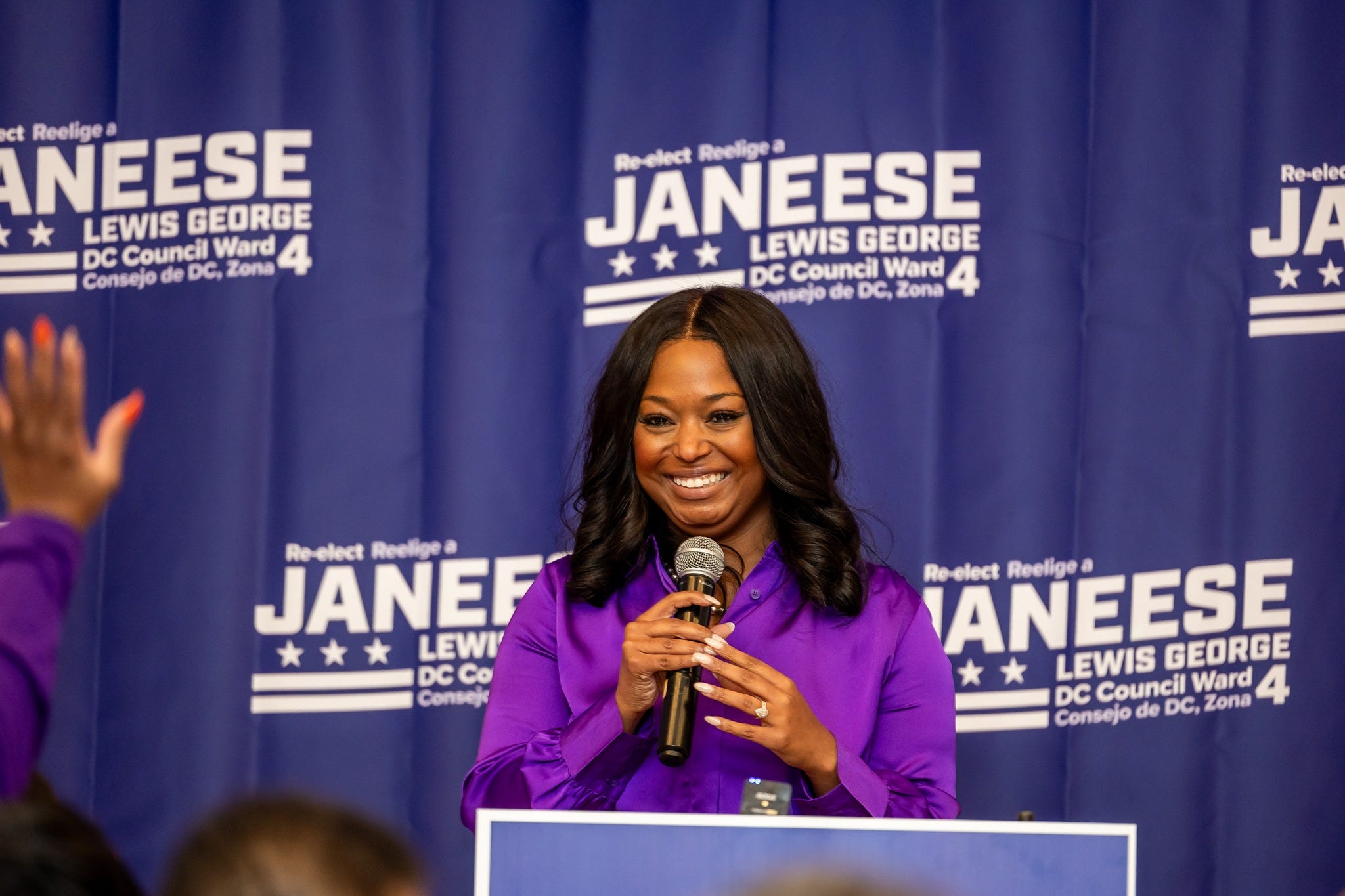
Councilmember Janeese Lewis George announced Monday morning that she would run to replace Mayor Muriel Bowser, who said last week that she would not seek a fourth term leading Washington, D.C.
But Lewis George, who is a self-described democratic socialist, almost certainly will have company in the race soon, as fellow Councilmember Kenyan McDuffie has reportedly been preparing his own campaign. And whoever prevails will face the same pressures Bowser did, thanks to the unique sway the federal government holds over the city.
Most of the chatter surrounding the June 16 Democratic primary has centered on these two members of the Council of the District of Columbia who offer contrasting ideologies: Lewis George, who is a Bowser critic, and McDuffie, who is close to both the incumbent and business groups. Axios’ Cuneyt Dil previously reported that the two were planning out their respective campaigns before Bowser confirmed she would step down.
Lewis George won her seat representing Ward 4 in the northern part of the city in 2020 after defeating a Bowser ally. This summer, she attracted outsized attention when she accused the mayor of responding to the Trump administration’s decision to deploy the National Guard and seize control of the district’s police force by “complying in advance.”
Observers speculated that Lewis George could oppose Bowser next year if the incumbent ran again, and the councilmember confirmed in October that she was interested.
Lewis George, though, may have already decided to run even before Bower’s announcement. Dil reported last month that a source had overheard a Lewis George advisor discussing the candidate’s forthcoming campaign at a D.C. restaurant with a former Council member, with the two mentioning a planned launch in the first half of this month.
Lewis George went on to kick off her campaign on the first day of December.
“How do we make this city more affordable, safe and have a government that actually works for everyone—where you call 911 and the call gets answered, where you put in a [request] for a traffic safety improvement and you get a speed bump on your street?” she said in an interview with the Washington Post. “It just takes leadership and courage to solve these problems, and that’s what this race is about for me.”
McDuffie, for his part, has also looked like a likely candidate for some time.
Dil wrote in October that McDuffie, who holds a citywide seat on the Council, was already telling people he’d enter the race—a move that signaled he didn’t expect Bowser to run again. McDuffie confirmed his interest but said at the time that he was still considering. He later told WUSA he wouldn’t let other contenders influence his decision.
McDuffie had reason to eschew an immediate campaign launch. He’s currently a registered independent, and his entry into the Democratic primary would require him to both change his affiliation and resign his seat on the Council.
McDuffie, who previously held a ward-level Council seat as a Democrat, opted to leave the party in 2022 after his plan to seek the Democratic nomination for D.C. attorney general ended when an opponent successfully challenged his eligibility regarding his legal credentials. But while it was too late to run in the primary for another office, he had another option.
The city’s electoral rules, designed to limit single-party dominance of the Council, permit each party to nominate just a single candidate for the two at-large seats that are on the ballot every two years.
As a consequence, that leaves a wide lane open for left-leaning independents like McDuffie, who chose to run as an unaligned candidate and won that fall. Those same rules, though, would force him to step down if he were to switch his registration back to Democratic—a step he’d need to take to run in the party primary for mayor.
Whoever becomes the new mayor will lead a city that has no voting representation in Congress—even though the very same body reviews all laws passed by the local government before they can go into effect and has authority over its budget. This summer’s crisis also underscored just how vulnerable the city is to a hostile Republican administration, a challenge Bowser’s successor will inherit.
The mayoralty is not the only major post that will be on the ballot in what will be a crucial election year for the nation’s capital.
Delegate Eleanor Holmes Norton, 88, has repeatedly insisted she’ll seek reelection as the city’s nonvoting advocate in Congress despite serious concerns about her physical and mental ability to perform her duties. Several of Holmes Norton’s fellow Democrats have announced campaigns against an incumbent they argue has served her constituents well for more than three decades but, they say, is no longer capable of standing up for them.
Winning the Democratic primary is tantamount to victory for both mayor and delegate, but unlike in past elections, a simple plurality won’t be enough to secure the nomination. Thanks to a ballot measure approved by voters last year, both primaries and general elections in D.C. will now use ranked-choice voting to determine winners, who will need to earn majority support.
We hope you had a wonderful Thanksgiving holiday! We were extremely grateful for the break, but The Downballot is already back to work, doing what we do best: shining a spotlight on critically important but frequently overlooked elections.
If you appreciate what we do each day, we hope you’ll consider helping us by becoming a paid subscriber. Not only will you be bolstering The Downballot, but you’ll also unlock access to our subscriber-only content and features!
Redistricting Roundup
NC Redistricting
A federal court declined to block North Carolina’s new Republican-drawn congressional gerrymander from taking effect in a ruling issued just before Thanksgiving.
The panel, made up of three Republican-appointed judges, concluded that plaintiffs demonstrated that the new map, which is aimed at unseating Democratic Rep. Don Davis, would have “a disparate impact on black voters.”
However, for a map to be barred as an unconstitutional racial gerrymander, challengers must also show that lawmakers “acted with invidious intent.” Even though the map would make it considerably harder for candidates preferred by Black voters to win, the court determined that plaintiffs had “not demonstrated that this effect likely reflects discriminatory intent.”
It’s not yet clear whether plaintiffs, who include the North Carolina branch of the NAACP, will appeal.
Governors
NE-Gov
Nebraska Gov. Jim Pillen, who faces a possible primary challenge from wealthy businessman Charles Herbster, earned an endorsement from Donald Trump on Tuesday—but his would-be opponent says he’s undeterred.
“This race is not about President Trump,” Herbster posted on social media. “It is about hard working Nebraskans trying to make ends meet.”
Herbster, who had Trump’s endorsement in 2022 when he lost a close race to Pillen, said that he expects to decide on a rematch “closer to the new year.” Herbster added, “I am more inclined to run than I was just a few days ago.”
Herbster, though, has talked a big game in the past without following through. Last cycle, he floated a potential campaign against another Republican incumbent, Sen. Pete Ricketts, only to stay home when the filing deadline rolled around.
NH-Gov
Portsmouth Mayor Deaglan McEachern, a Democrat who just won a third term, isn’t ruling out a bid against Republican Gov. Kelly Ayotte next year.
“If there’s a way for me to serve the state that I love, then I’m going to seriously consider that,” McEachern told WMUR’s Adam Sexton in a new interview.
McEachern was first elected mayor in 2021 by winning the most votes in Portsmouth’s at-large race for its nine-member City Council. (The top vote-getter becomes mayor while the runner-up is named assistant mayor.) He again finished first both in 2023 and in the city’s elections last month.
Ayotte has yet to draw a major Democratic opponent, though the New Hampshire Union Leader reported last month that former Executive Councilor Cinde Warmington was eyeing a second bid after losing in the primary last year. Trump apparatchik Corey Lewandowski also threatened to wage an intraparty challenge to Ayotte back in October over her refusal to support mid-decade redistricting.
House
NY-12
Nonprofit leader Liam Elkind has given up his bid for New York’s open 12th Congressional District, a safely blue seat in Manhattan that Democratic Rep. Jerry Nalder is retiring from.
Elkin announced a primary challenge to Nadler earlier this year, but after the longtime congressman announced his departure in September, the race saw a huge influx of ambitious candidates, including three local elected officials.
TN-07
The first—and very possibly last—independent poll of Tuesday’s special election in Tennessee’s conservative 7th Congressional District shows a very close race between Republican Matt Van Epps and Democrat Aftyn Behn.
Emerson College finds Van Epps leading Behn just 48-46, with just 2% of voters saying they support one of the four independents on the ballot and 5% undecided.
Those numbers, however, stand in contrast to the only other surveys of the race, a pair of Democratic polls from mid-October that looked markedly better for the GOP.
The first of those polls, which was shared exclusively with The Downballot, was a Behn internal from Workbench Strategies that put Van Epps up 51-41. The other was conducted by Impact Research for a pro-Behn PAC that similarly placed Van Epps ahead 52-44.
Since then, though, both sides have behaved as though the race is hotly competitive, despite the fact that Donald Trump carried the 7th District by a 60-38 margin last year. Outside Democratic groups have spent more than $2 million to boost Behn while Republicans have deployed even more than that to rescue Van Epps.
TX-22
Republican Rep. Troy Nehls said Saturday that he would retire from Congress after just three terms in office, but he’s hoping to be succeeded in Texas’ conservative 22nd District by a very familiar face—quite literally.
Former Fort Bend County Constable Trever Nehls, who happens to be the congressman’s identical twin brother, kicked off a bid the very same day. The incumbent quickly responded by endorsing his sibling’s campaign.
Not everyone, though, wants to see the Nehls family keep control of the district, which is based in the southwestern Houston suburbs and exurbs. GOP activist Rebecca Clark announced Saturday evening that she would run to give “voters a true conservative alternative to the status quo.”
The state’s candidate filing deadline is currently set for Dec. 8, which would give other potential contenders just a week to decide whether to run. But that deadline, as well as the schedule for primaries and runoffs, could be delayed due to ongoing litigation over the state’s congressional map.
No matter which set of lines gets used next year, though, the 22nd District will remain heavily Republican. Donald Trump won the current incarnation of this constituency 59-39 last year, while he would have prevailed by a slightly larger 60-38 spread using the map the GOP legislature passed this year.
There was considerably more doubt about which party would win this seat back in 2020 when Nehls first ran for it—which also marked his brother’s first attempt to succeed him in office.
Troy Nehls was serving as Fort Bend County sheriff when Republican Rep. Pete Olson announced that he would not seek reelection in the 22nd District, a longtime GOP stronghold that had moved sharply to the left as part of the suburban backlash against Trump. Nehls ran to replace Olson in Congress, while his twin ran for the now-open post of sheriff.
Both brothers decisively won their respective nomination contests, though Troy had to get past a wealthy opponent who didn’t hesitate to use her fortune to attack him. Their fates diverged in November, though: Troy scored a 52-45 victory over Democrat Sri Preston Kulkarni, who had waged a competitive campaign to flip the 22nd, while Trever lost the sheriff race 53-47 to Democrat Eric Fagan.
The new congressman, though, immediately benefited from a new gerrymander drawn by fellow Republicans in the state legislature, ensuring he’d never again have to struggle at the ballot box. The congressman easily won reelection in 2022, though his brother was once again the unlucky one: Trever Nehls lost a bid against Fort Bend County Judge KP George 52-48 in the general election.
(George, whose office is executive rather than judicial, was later charged with using a fake Facebook account during that campaign to make racist posts about himself that he then publicly condemned. George left the Democratic Party for the GOP earlier this year after being indicted for money laundering by local prosecutors.)
Troy Nehls, meanwhile, took advantage of his newly safe district to promote himself as an eager ally of Trump, the man whose unpopularity once had threatened to cost the GOP control of his seat. Nehls drew attention during Joe Biden’s State of the Union in March of last year by donning a T-shirt emblazoned with Trump’s mugshot and the caption “NEVER SURRENDER!”
Nehls earned a different kind of notice two months later when the House Ethics Committee said it had “probable cause to believe” that he had made improper personal use of campaign funds and had failed to provide required information on the annual financial disclosure forms that all members of Congress must file.
The matter, which has not yet been publicly resolved, did not stop Nehls from easily securing what would be his third and final term last fall. Shortly after his victory, the congressman summed up how he and his colleagues were preparing for Trump’s return to the White House by telling reporters, “If Donald Trump says ‘Jump three feet high and scratch your heads,’ we all jump three feet high and scratch our heads.”
Mayors & County Leaders
St. Petersburg, FL Mayor
Allies of former Rep. Charlie Crist last month set up a political committee to raise money for Crist’s potential campaign next year against St. Petersburg Mayor Ken Welch, a fellow Democrat.
Crist, who served as governor of Florida as both a Republican and an independent before being elected to Congress as a Democrat, said in October that he was considering another campaign. Crist told the Tampa Bay Times on Wednesday that he was “overwhelmed and humbled by the response thus far” and that it was “certainly helping me make a decision.”
City Councilmember Brandi Gabbard, who is also a Democrat, previously announced her own campaign in October. Gabbard has come into conflict with the mayor over several development projects.
Welch, whose 2021 election made him the city’s first Black mayor, said last year that he’d run for a second term. In 2022, voters approved a ballot measure moving St. Petersburg’s elections to even years, so this will be the first such contest to take place under the new calendar.
All the candidates will face off on one officially nonpartisan ballot on Aug. 18, which is the same day that Florida holds its party primaries. If no one wins a majority of the vote, the top two candidates will advance to the Nov. 3 general election.
Even if Behn loses by single digit percentage, that's going to be a MAJOR fire alarm for the GOP. But if she prevails... hoo boy! More House Rs are going to announce retirement before Christmas Day.
NC-1:
https://x.com/maxpcohen/status/1995462120591261857
Dem Rep. Don Davis is running here after all, and not NC-3.