


The redistricting wars triggered by Donald Trump and turbocharged by the Supreme Court are not over—they’ve only paused long enough for the November midterms.
Next year, they’re all but certain to heat up again, and depending on how Tuesday’s elections unfold, the nation’s congressional maps could once again look very different in 2028.
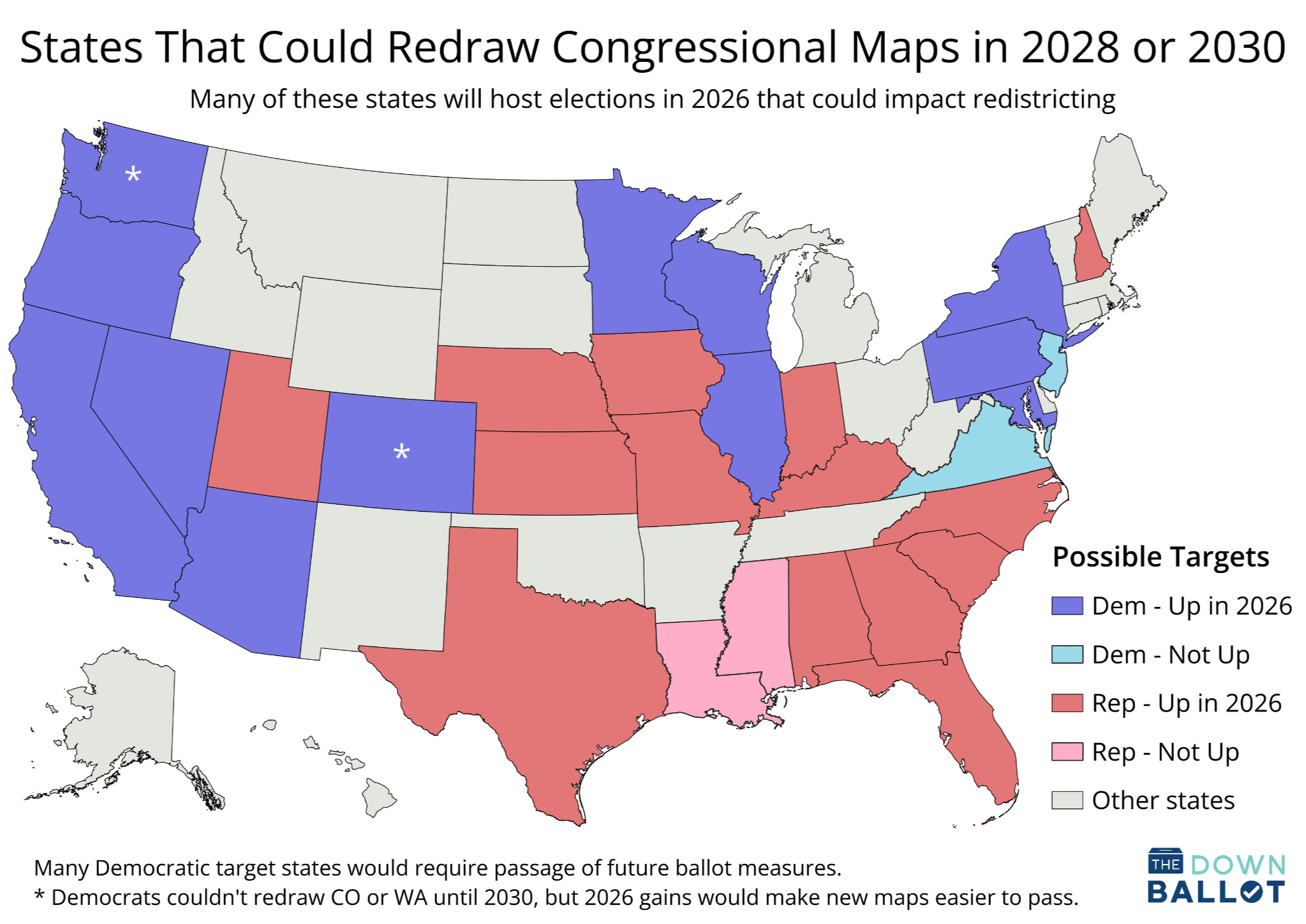
As shown on the map at the top of this story, Democrats could redraw the lines in as many as 12 states before the 2028 elections and in two more ahead of 2030. Whether they’ll be able to will turn on a host of elections taking place on Nov. 3, including races for governor, state legislatures, and state supreme courts, as well as ballot measures.
The GOP is unlikely to sit idly by, though. Republicans currently control 16 states where they could draw new maps in time for 2028, including some they already revamped this cycle. However, Democratic gains could block them in several states.
Below, we catalog all of the most important races that will help determine who wields the cartographer’s pen for the rest of the decade.
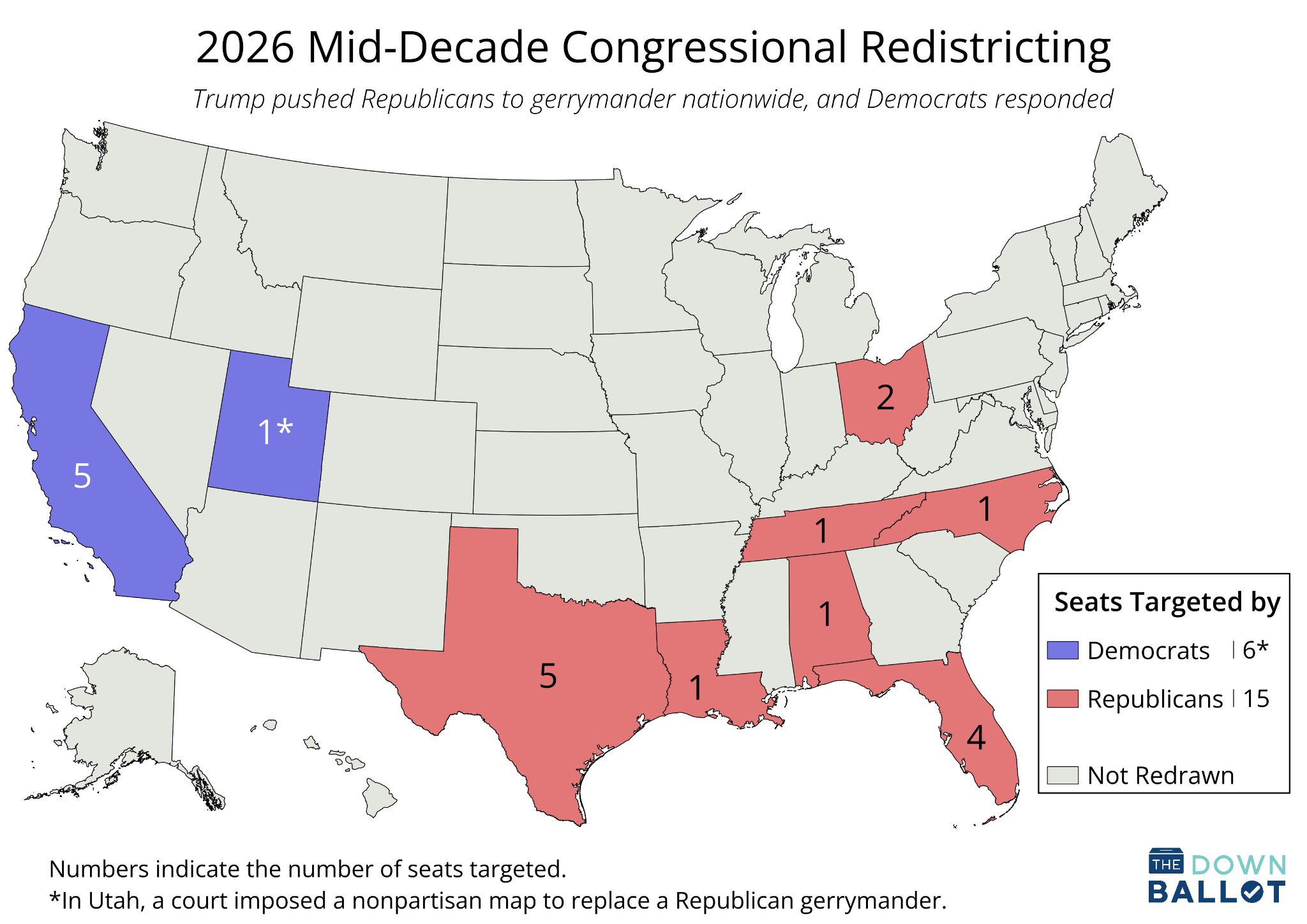
At Trump’s behest, Republicans altered the lines in seven states to target 15 seats held by Democrats. California Democrats targeted five Republicans in response, and a court-drawn map in Utah shifted one seat toward Democrats. Although Republicans are struggling to win many of those 15 seats due to this year’s pro-Democratic environment, their new maps could give them a further boost in future years that may not be so friendly to Democrats.
Accounting for these nine new maps, Trump would have won a 234-201 majority of districts, compared to his 230-205 advantage under the lines used in 2024. The median district shifted from Arizona’s 1st in 2024, where Trump won by 3.1 percentage points, to Wisconsin’s 1st, where he prevailed by 4.5 points. Since Trump won the national popular vote by only 1.5 points, the national map gives Republicans an advantage that’s around 3 points greater than their popular support.
That unwarranted edge could balloon by several more points in 2028—unless Democrats respond with their own maps and prevent Republicans from passing new ones.
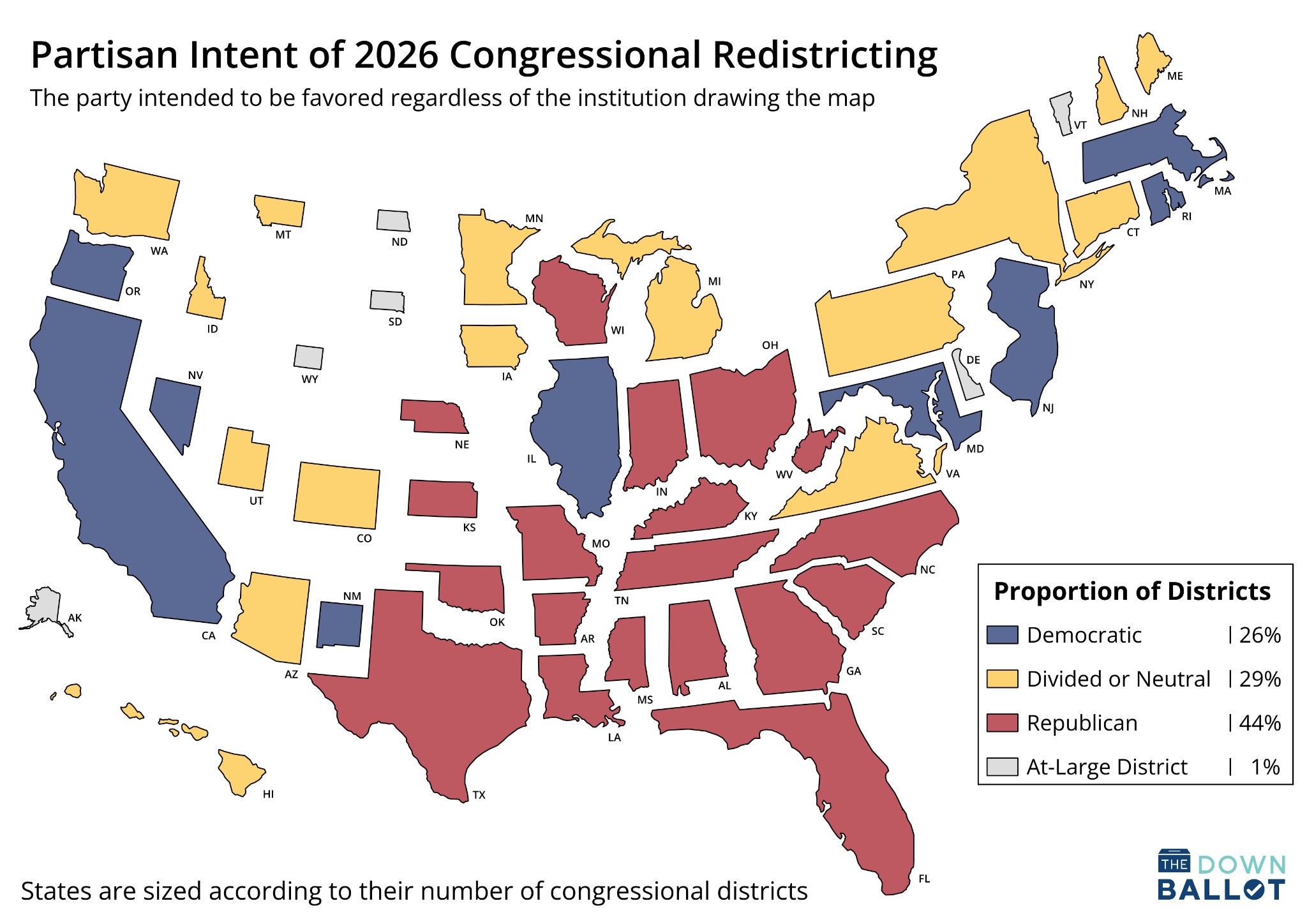
Heading into the 2026 elections, 44% of all districts are in states whose maps were drawn to favor Republicans, while just 26% are in states with maps intended to benefit Democrats, as shown on the map below. However, Democratic redraws could bring that ratio to parity before 2028, potentially resulting in the most balanced map in many years. That could in turn allow Democrats to ban congressional gerrymandering nationwide if they regain the presidency and win control of Congress.
Democratic Targets
Earlier this year, The Downballot published hypothetical maps exploring how Democrats could target particular Republican seats by redrawing the boundaries in nine states. Eight of these targets are still in play for 2028. We discuss these states below, along with several others that could present opportunities for Democrats.
Target seat counts below are based on the number of seats Republicans currently hold ahead of next week’s elections. Some of these seats will likely change hands this year, but new maps could still solidify Democratic chances of holding them in 2028.
Arizona
Intent of current map: Neutral
Current map drawn by: Independent redistricting commission
2026 elections that matter: State legislature
Democratic gains needed: 3 seats in state Senate; 4 seats in state House
U.S. House targets: 3 seats
Arizona Democrats have their best chance in 60 years to win unified control over state government. With simple majorities, a Democratic legislature could put an amendment on the ballot in 2027 asking voters to temporarily override the state’s independent redistricting commission and adopt a new map for 2028 and 2030, potentially pushing three GOP-held seats in Democrats’ favor.
Winning such a vote would be challenging in a state that Trump carried 52-47, but CNN reported earlier this year that national Democratic leaders consider Arizona a longshot possibility.
California
Intent of current map: Democratic
Current map drawn by: Democratic lawmakers (adopted by voters as Proposition 50)
2026 elections that matter: State legislature
Democratic gains needed: None
U.S. House targets: 1 to 4 seats
Last year, California Democrats placed an amendment on the ballot to temporarily replace the map drawn by the state’s independent commission with one of their own devising that targeted five Republicans. Voters approved it in a landslide. Democrats could put another amendment on the ballot in 2027 to go after one or more of the remaining four GOP seats in 2028.
Democrats only need to hold their current legislative supermajorities, which they are heavily favored to do (they are also strong favorites to retain the governor’s office).
Colorado
Intent of current map: Neutral
Current map drawn by: Independent redistricting commission
2026 elections that matter: State legislature
Democratic gains needed: 1 seat in state Senate; 1 seat in state House
U.S. House targets: 3 seats
Colorado’s Supreme Court disqualified ballot initiatives this year for a new Democratic map that would have targeted three of the state’s four Republicans in 2028. However, lawmakers could refer a constitutional amendment to the ballot in 2028 that would temporarily override the state’s independent redistricting commission and allow a remap for 2030.
