



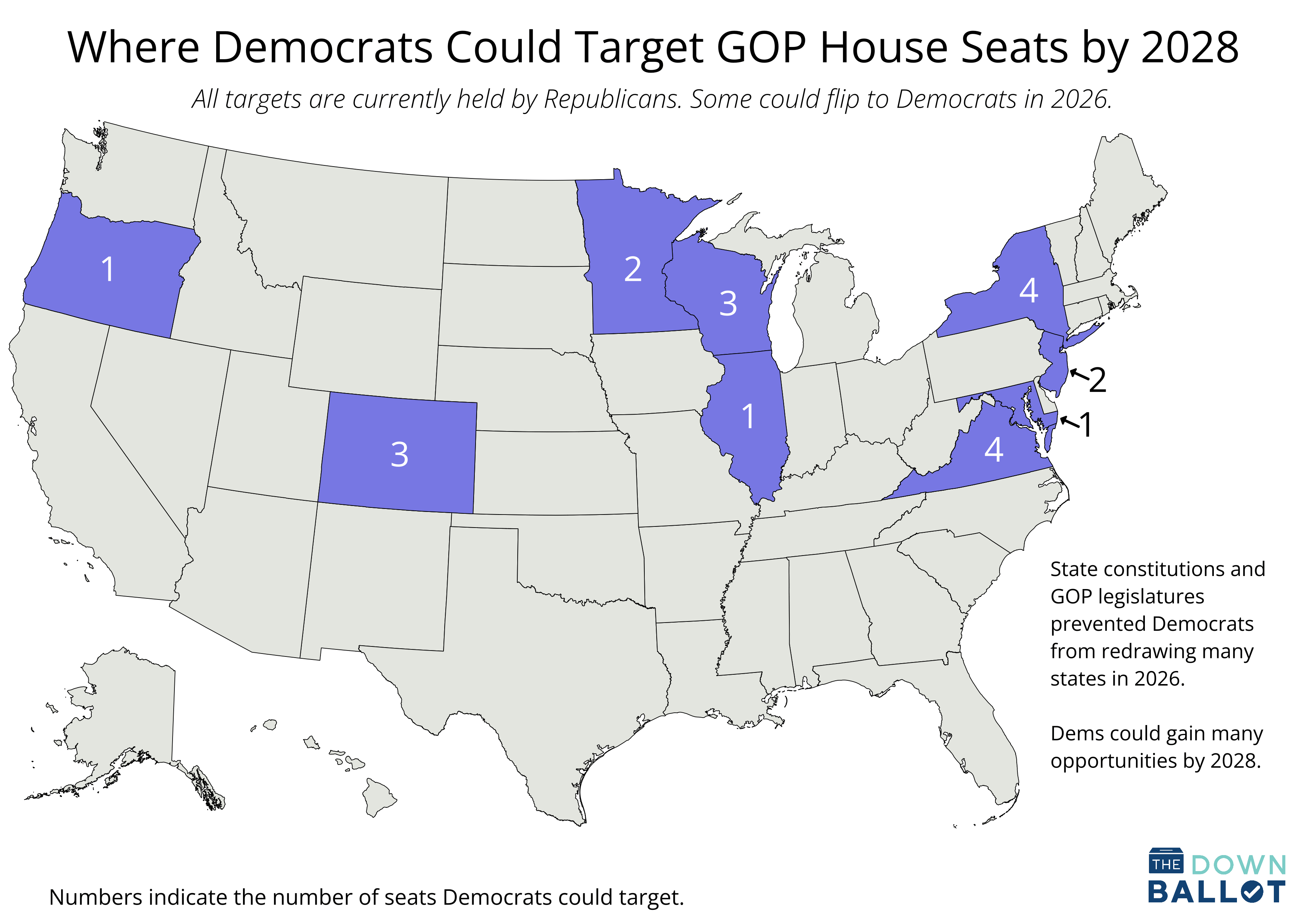
Note: In June, the Colorado Supreme Court rejected a pair of proposed ballot measures that would have allowed Democrats to enact a new map before 2028. The soonest they can now enact a new map is likely 2030.
Following the Supreme Court’s evisceration of the Voting Rights Act, Republican-run states are rushing headlong to dismantle congressional districts that had been drawn to protect the rights of Black and Latino voters. But Democrats could fight back by targeting at least 21 GOP districts in nine different states in time for the 2028 elections—and they can do so without disrespecting the VRA.
As The Downballot detailed in a special report we published immediately after the Supreme Court’s decision in Louisiana v. Callais last week, Republicans have their sights on a dozen minority districts in eight states, all in the South.
This new assault follows the GOP’s effort to gerrymander Democratic districts across the country that began last year when Donald Trump exhorted Texas Republicans to redraw their map.
When that project began, Republicans already enjoyed a decisive advantage on the congressional battlefield. Heading into the 2024 elections, they’d drawn 42% of all districts nationwide, while Democrats had drawn just 14% (the rest were drawn by neutral bodies).
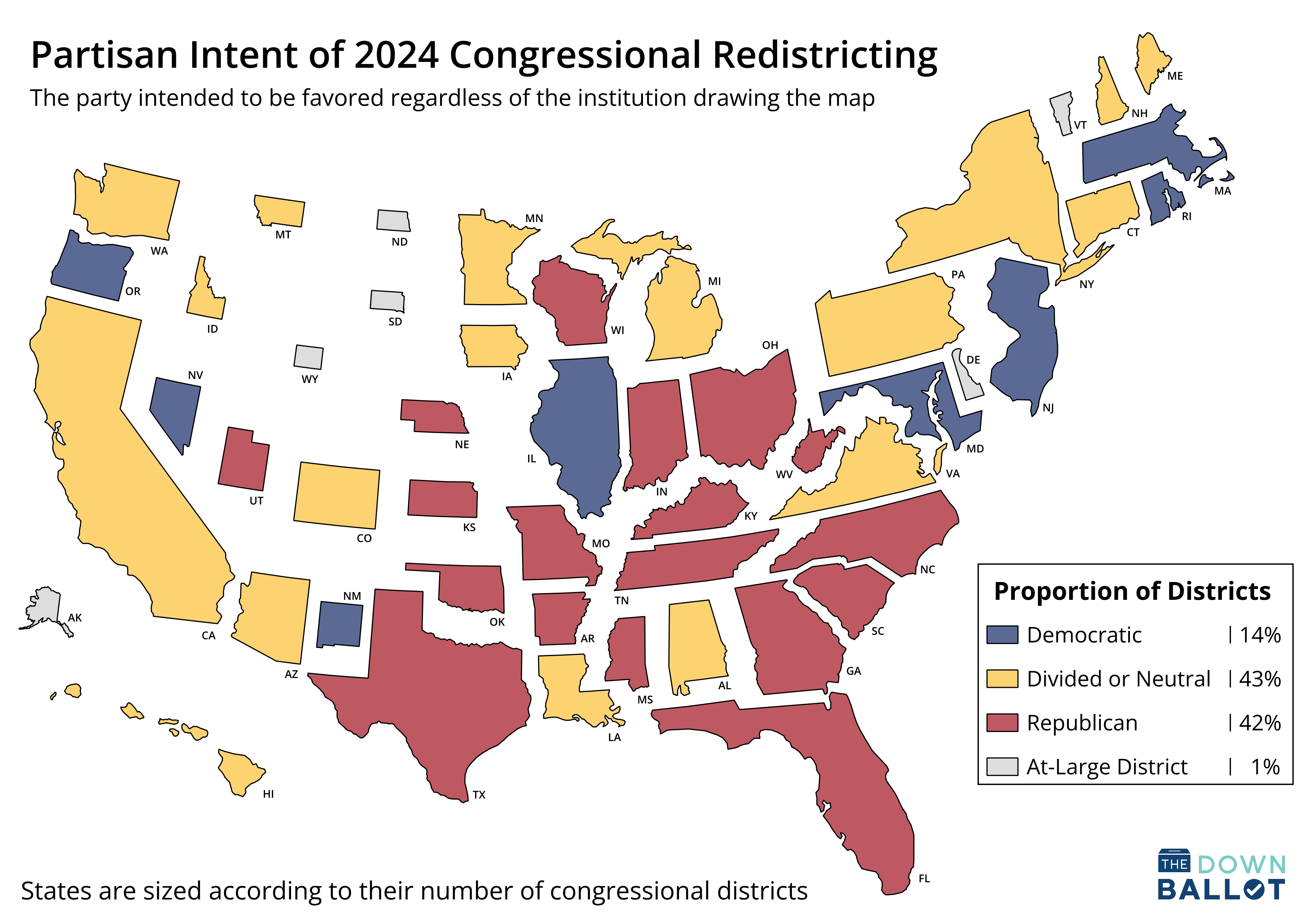
Trump and the GOP, however, did not expect Democrats to fight back. But that’s exactly what they did, starting with California last fall. Yet even though the balance in terms of the proportion of seats drawn by each party is still skewed in favor of Republicans—44% to 26% as of this moment—they’re champing at the bit to push it even further in their favor.
All of this could have been avoided had Republicans gotten behind a national ban on congressional gerrymandering, something that congressional Democrats have worked hard to pass. The GOP, however, remains unanimously opposed, giving Democrats no choice but to keep fighting fire with fire.
One of the most bellicose advocates is House Minority Leader Hakeem Jeffries, who last month promised “[m]aximum warfare, everywhere, all the time” and more recently told Politico, “We’re going to win in November, and then we’re going to crush their souls as it relates to the extremism that they are trying to unleash on the American people.”
Fortunately for Democrats—and democracy—they have many opportunities to do just that.
Below, we discuss each state Democrats could redraw, including how they could pass new maps and how many seats they could target. We also show what new, Democratic-leaning districts could look like with a series of hypothetical maps drawn by The Downballot’s Stephen Wolf, along with links to interactive versions hosted on Dave’s Redistricting App.
Many speculative maps have pushed extreme theoretical limits—a helpful exercise in demonstrating the art of the possible. These, however, aim to show what may be politically plausible. Our maps maintain minority districts, account for the concerns of incumbents, limit splits to counties and cities whenever possible, and largely avoid contorted shapes.
Our proposals, of course, are only a starting point, since there are many possible approaches Democrats could take in each state. But they all offer a realistic path forward for anyone willing to stand up in defense of democracy.
Colorado (3)
Current map: 4 Democrats, 4 Republicans
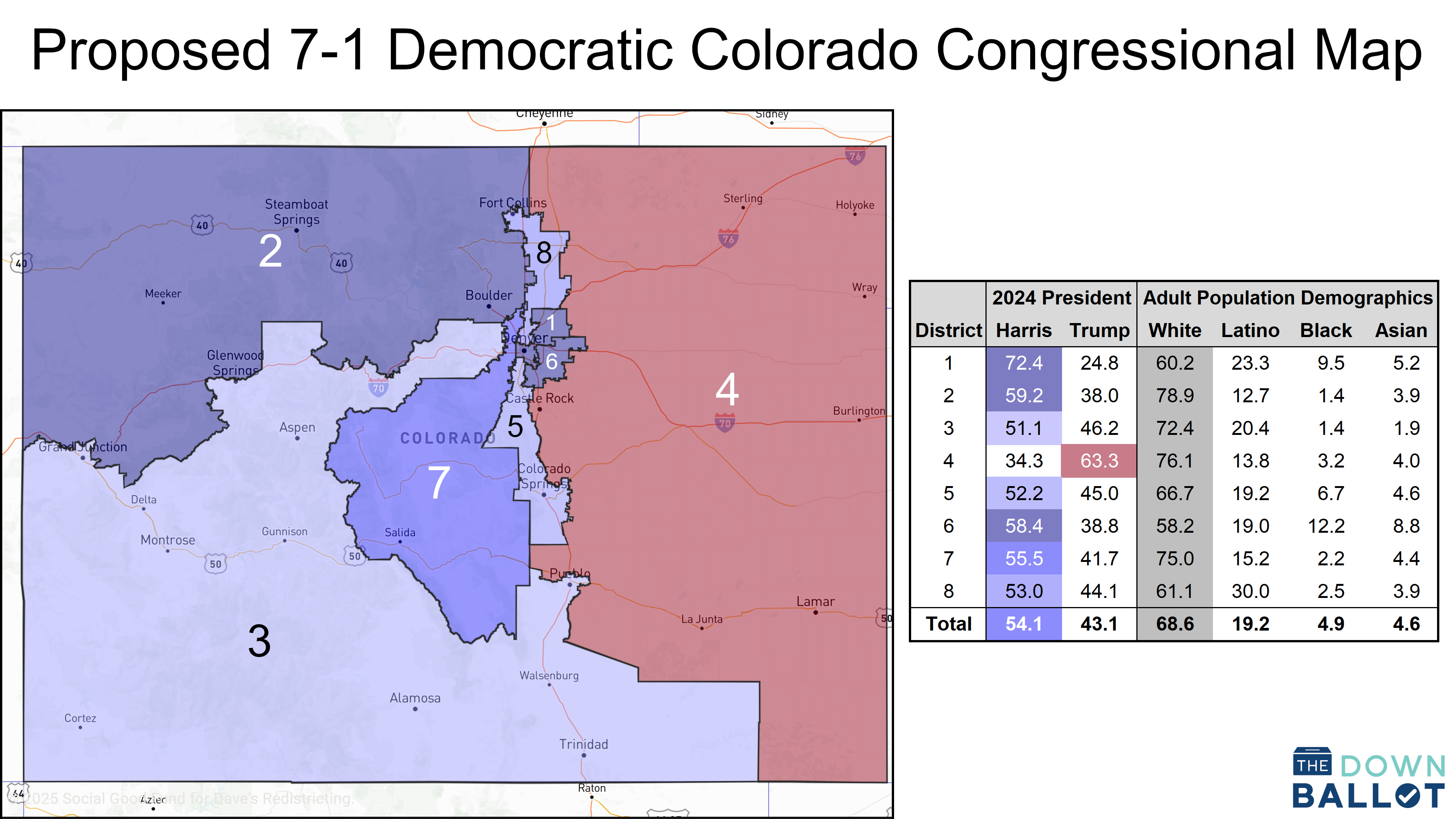
Colorado voters adopted an independent redistricting commission at the ballot box in 2018, but Democrats have proposed a measure for the November ballot that would temporarily impose a new map for the remainder of the decade.
Should the measure qualify for the ballot and pass, that map would turn two normally red districts blue while making a swingy GOP-held seat more Democratic. It could therefore transform the state’s evenly divided eight-member House delegation into one that elects seven Democrats and just one Republican.
Note that while Democrats are heavily favored to keep full control of state government in November, this plan doesn’t depend on any action by lawmakers because it relies on the authority granted to citizens to place their own initiatives on the ballot.
Illinois (1)
Current map: 14 Democrats, 3 Republicans
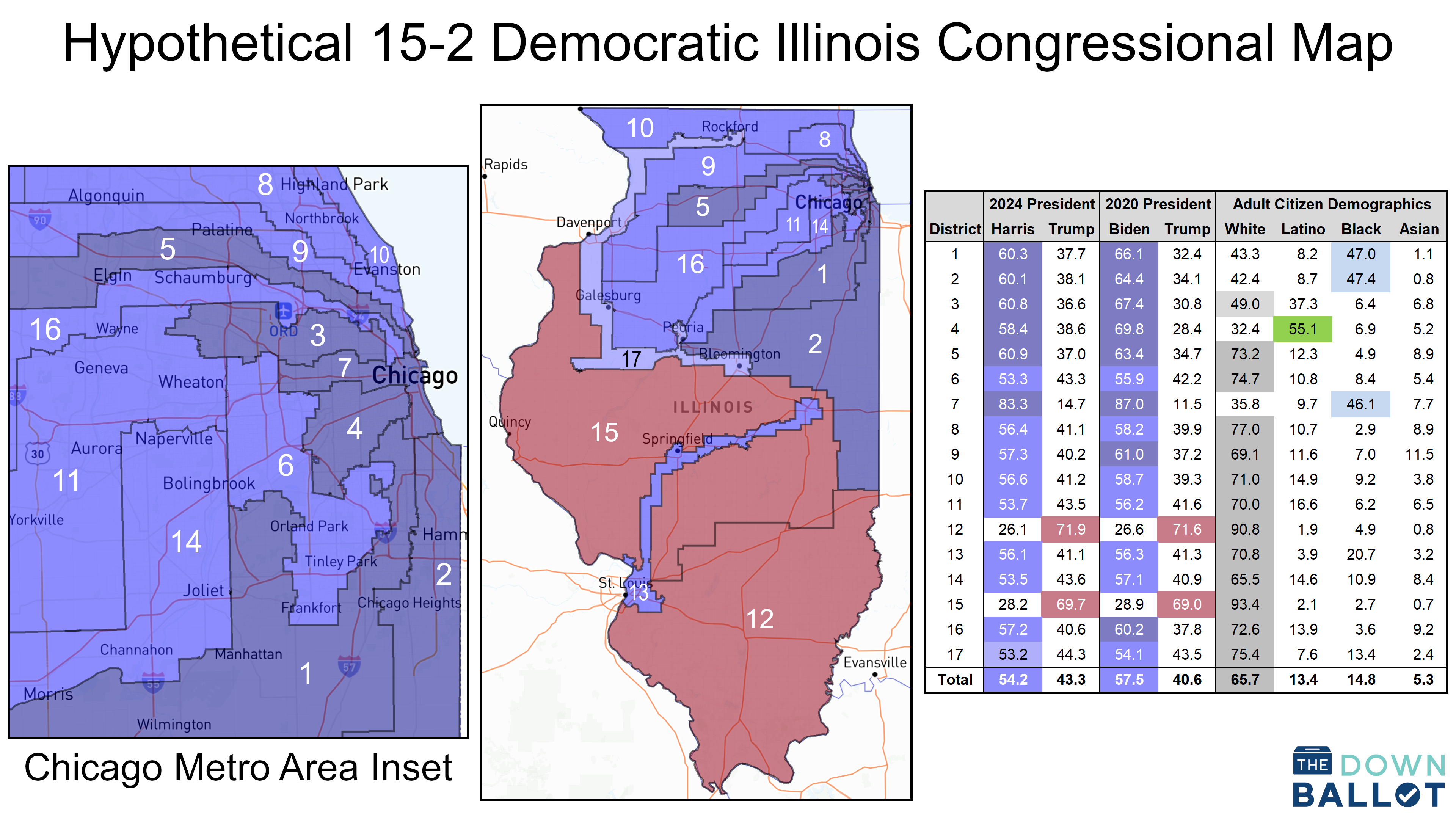
Illinois Democrats, who are certain to retain full control of state government this fall, already drew an aggressive map following the 2020 census. It’s elected 14 Democrats and just three Republicans, in large part because of some very twisted boundary lines. That makes going for a 15-2 map less than straightforward—but not impossible.
To do that, Democrats would need to redistribute the party’s voters from several deep-blue Chicago districts to target a Republican downstate. An added difficulty is that three of those seats are predominantly Black, and two were drawn to empower Latino voters. Nonetheless, it’s possible to preserve those five seats, turn a red district solidly blue, and still shore up some Democrats who hold more vulnerable turf.
However, if Democrats are bold enough to go further still, there is one unorthodox option that Illinois’ constitution does not prohibit: noncontiguous districts. As analyst Matt Mohn has proposed, Democrats could split several districts into unconnected halves and target all three Republicans by making every seat roughly as blue as the state is overall.
Such an approach might have been unthinkable in the past, but as Republicans have gone to ever-greater extremes over the last year, Democrats have responded with countermeasures that they once abjured. Noncontiguous maps could therefore be the next frontier.
Maryland (1)
Current map: 7 Democrats, 1 Republican
Gov. Wes Moore and Democrats in the state House tried to pass a new map last winter that would have given the party control of all eight of Maryland’s congressional seats, but Senate President Bill Ferguson blocked it—and in doing so drew an unexpectedly tough primary challenge.
In more recent days, though, Ferguson has changed his tune, but there’s still another potential obstacle: the state Supreme Court, where a majority of justices are appointees of Republican governors.
