



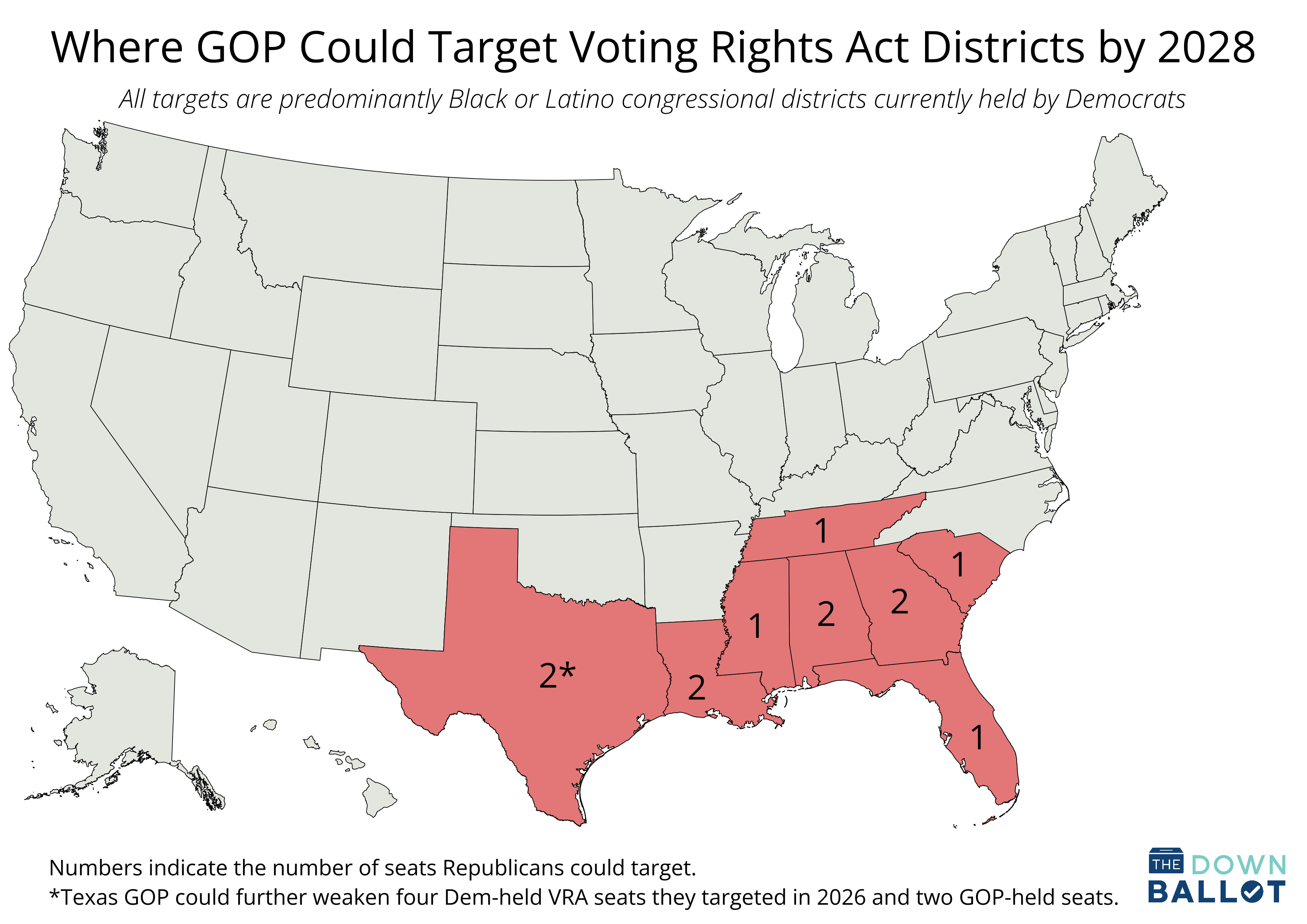
On Wednesday morning, the Supreme Court issued its long-awaited decision in Louisiana v. Callais. As many had feared, the decision all but eviscerated the most important remaining pillar of the Voting Rights Act.
As a direct consequence, Republicans in eight states have the chance to gerrymander more than a dozen congressional districts that were drawn to prevent discrimination against minorities—all of which are held by Democrats.
Below, we identify the districts that are most at-risk, and why.
The demise of Section 2 of the VRA, which prohibited states from unlawfully splitting members of racial and language minority groups between electoral districts as a way of diluting their voting power, will have a profoundly adverse impact on voting rights and will make American democracy even less representative than it already is.
And its effects will be felt far beyond Congress. Maps for state legislatures, county boards, city councils, and countless other governmental bodies have, since the VRA’s passage in 1965, all been required to comply with the Act. They, too, risk getting eviscerated in the coming years.
But it’s the United States House of Representatives that will experience the most high-profile impact of the Supreme Court’s ruling in Callais. Given how closely divided the chamber is, alterations to just a handful of seats could tip the balance.
The lone saving grace for Democrats—and the cause of voting rights—is that it’s too late in the 2026 election cycle for most states to implement changes in time for the November elections, with Florida a major exception. They can, however, get started on 2028 right now.
And unlike in the redistricting wars that unfolded over the past year after Donald Trump demanded Texas Republicans gerrymander their congressional map—which prompted Democrats to respond in kind in states such as California—Democrats will be reluctant to fight fire with fire this time, and with good reason.
Despite a widespread belief among Republicans and many in the media that the 2024 election had ushered in a new, multi-racial future for the GOP, subsequent events have exposed this supposed realignment as largely a mirage. What’s more, Republicans never adjusted their rhetoric or behavior to match this alleged new reality. To the contrary, the party has only grown more racist and xenophobic.
That means we can expect Republicans to demolish Black and Latino districts and convert them into conservative constituencies dominated by white voters with little hesitation.
But for Democrats, who espouse a belief in multi-racial democracy, and whose electoral coalition depends on strong support from minorities, dismantling these districts to create more blue seats may be politically untenable.
(Notably, though, House Minority Leader Hakeem Jeffries told CNN in February, “[I]f, for whatever reason, they allow certain states in the Deep South to reopen the congressional map, that doesn’t mean that every other state in other parts of the country ... can’t do exactly the same thing.”)
Under Section 2, states were obligated to draw districts where minority groups could elect their preferred candidates when, broadly speaking, three conditions were met.
First, members of a minority group had to comprise a majority in a sufficiently compact geographic area. Second, the group had to be politically cohesive. And third, white voters had to reliably vote as a bloc against the minority group’s preferred candidates, thereby keeping them out of office.
In practice, the law resulted in the creation of predominantly Black districts that typically elect Black Democrats, and predominantly Latino districts that typically elect Latino Democrats. Such districts were not required to have an electorate made up of a majority of minority voters, but most did, while the rest came very close.
Throughout the life of the VRA, map-makers were obligated to follow Section 2’s dictates when drawing boundaries, and many did. But many did not and were only compelled to do so following litigation, in cases that often dragged out over many years.
That’s precisely how many of the most vulnerable districts created under the VRA came to be. And it’s also why Republicans, who have frequently fought the establishment of such districts and even refused to recognize the legitimacy of courts that imposed them, will be particularly eager to unravel them now.
Note that the constituencies discussed below do not constitute a complete list of all districts that were protected by the VRA. However, the rest are either in states where Republicans do not control the redistricting process, or could not plausibly be targeted even with the most aggressive of gerrymanders.
Alabama
Alabama is home to two districts that directly owe their existence to the VRA: the 7th, based in Birmingham and Tuscaloosa, and the 2nd, which connects Mobile and Montgomery via a rural corridor known as the Black Belt.
Both are majority-Black, and both have only ever elected Black Democrats, though the 7th is much older. It came into being following the 1990 census thanks to a lawsuit and led to the election of the state’s first Black member of Congress since Reconstruction. It’s currently held by Rep. Terri Sewell, who was first elected in 2010.
The 2nd, by contrast, is of much more recent vintage. It was first imposed by a federal court ahead of the 2024 elections after another protracted court battle during which Republicans refused to draw a new map that complied with the VRA. Rep. Shomari Figures comfortably won the seat.
But because Alabama is such an overwhelmingly red state, with large swaths of conservative rural turf, GOP lawmakers could readily transform both districts back into majority-white constituencies that would easily elect Republicans.
Florida
Florida is home to several districts where Black or Latino voters can elect their preferred candidates, but Republicans have only one obvious target: the 9th District, which includes the southern part of the Orlando region, Disney World, and nearby agricultural areas, and has a large Latino population that is predominantly Puerto Rican.
When the 9th was first established in its current form following the 2010 census, it was a Democratic stronghold, and it elected Rep. Darren Soto, a Democrat of Puerto Rican descent, in 2016. By 2024, however, declining support among Latino voters had made the district much more precarious for Democrats.
