


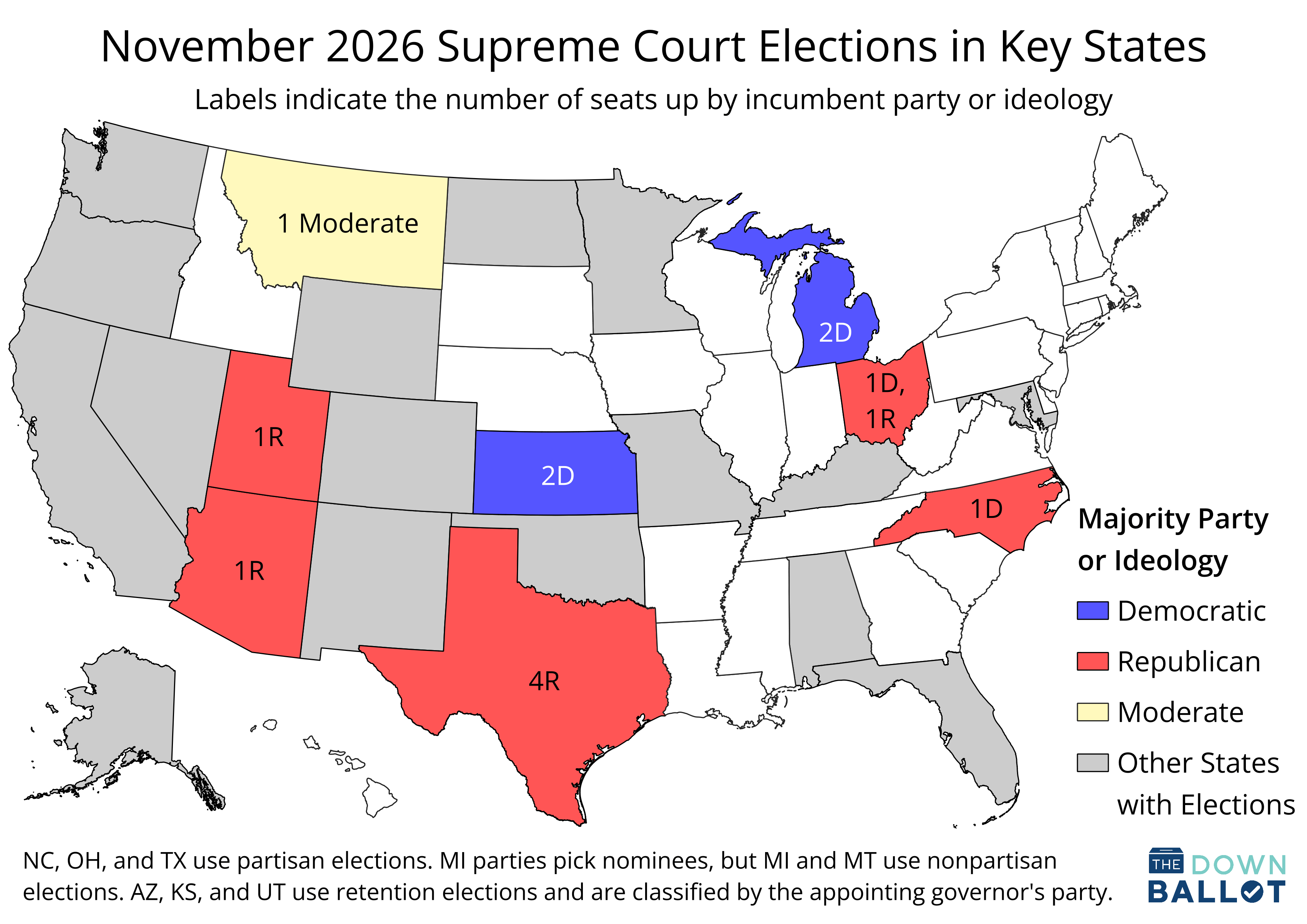
At a time when Donald Trump and the MAGA movement seek to undermine fair elections, civil rights, and the rule of law—and with much of the federal judiciary under the sway of conservative ideologues—state courts remain a powerful bulwark for democracy.
Next month, two dozen states will hold elections for their supreme courts, along with many other judicial posts. Below, we detail races in eight key states that could alter the balance of power on the bench or set up opportunities for pro-democracy jurists to win majorities two years from now.
Arizona - Retention (1 R-appointed)
Justice John Lopez, an appointee of former Republican Gov. Doug Ducey, faces a retention election for another six-year term after authoring an unpopular decision two years ago that upheld Arizona’s 1864 abortion ban. (Soon after, voters approved an amendment enshrining abortion rights into the state constitution.)
Although progressive groups spent very little to defeat two of Lopez’s conservative colleagues in 2024, they won retention with just 58 to 59% of the vote. However, no justice has ever lost a retention election since Arizona implemented the practice in 1978.
Liberals have not campaigned heavily against Lopez, and his defeat appears unlikely. But if he were to lose, and if Democratic Gov. Katie Hobbs wins reelection, she could appoint a replacement. Republican appointees hold a 6-1 majority on the court, though three more are up for retention in 2028.
Kansas - Retention (2 D-appointed)
Two Democratic-appointed justices face retention elections for six-year terms. Chief Justice Eric Rosen, who was appointed by former Gov. Kathleen Sebelius in 2005, is eligible for a final term before mandatory retirement rules kick in. Meanwhile, Larkin Walsh, appointed by Gov. Laura Kelly last year, is seeking her first full term. Democratic appointees hold a 6-1 majority.
Republicans have unsuccessfully pushed multiple ballot measures over the past decade to undo the court’s rulings protecting abortion rights. Most recently, voters rejected an amendment in August that would have paved the way for a switch to partisan elections in a 61-39 landslide. The GOP hasn’t yet devoted the same effort, however, to unseating either of the incumbents on the ballot this fall.
