


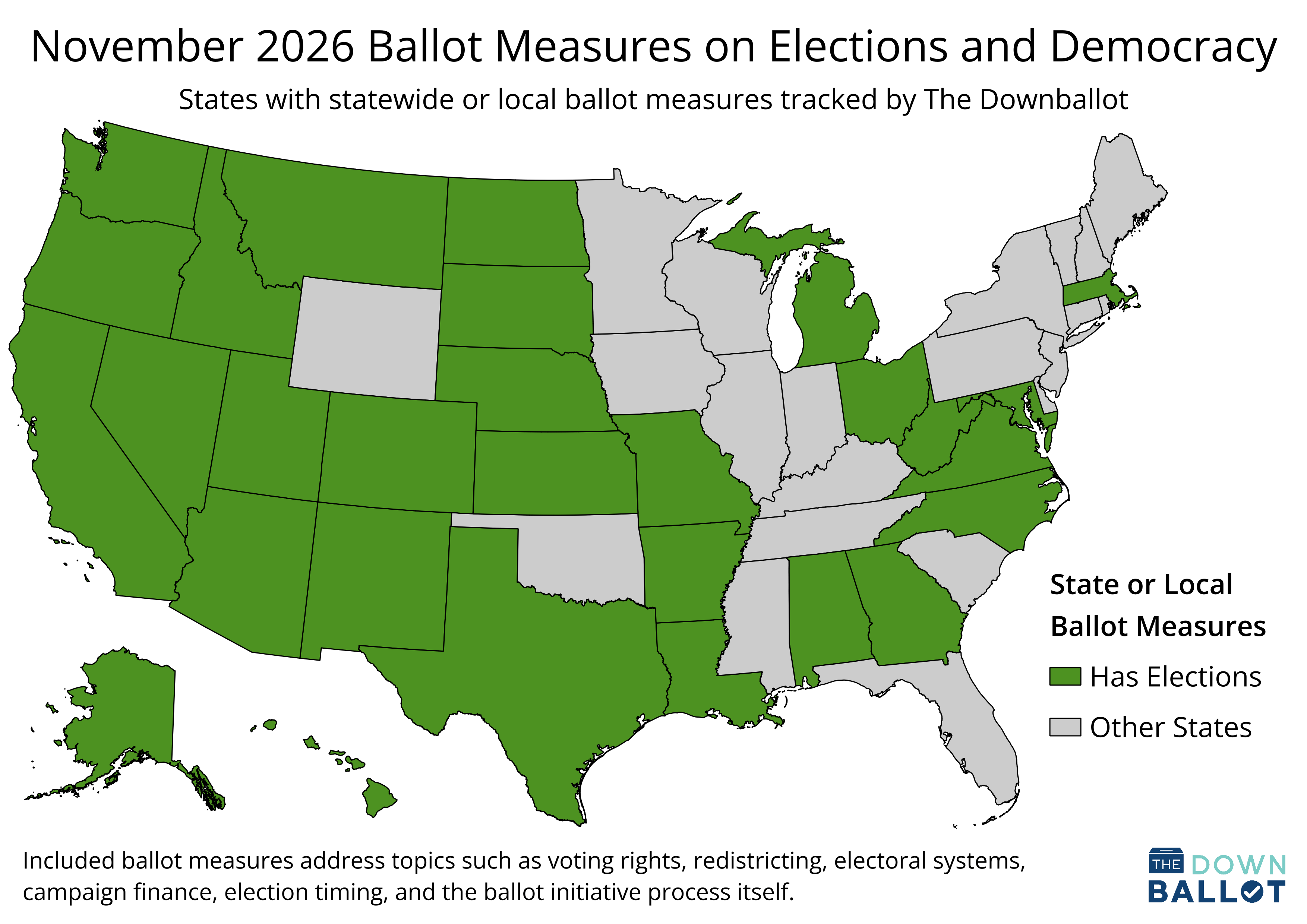
Democracy itself is on the ballot next month as dozens of states and cities will vote on measures to expand voting access, make it harder for citizens to pass ballot initiatives, change how elections themselves are conducted, and more.
Republicans and their allies in the courts have spent decades trying to restrict voting access, loosen campaign finance limits, and undermine fair elections. These efforts culminated this cycle with Donald Trump’s unprecedented drive to gerrymander congressional maps in red states, which the Supreme Court helped facilitate by eviscerating the Voting Rights Act.
Republican lawmakers and conservative activists are continuing those efforts at the ballot box this year. At the same time, however, reformers are going on offense by proposing measures that would safeguard voting rights and direct democracy. First, though, voters will have the chance to weigh in.
In all, The Downballot is tracking 53 different ballot measures across 29 states that could impact the machinery of American democracy. Below is our comprehensive guide to these proposals. You can also find a complete database of every measure here.
Voting Rights
Three jurisdictions could expand voting access—each in different ways—while a number of states could impose new restrictions.
In Virginia, Democrats are supporting a constitutional amendment called Question 3, which would abolish felony disenfranchisement for those not in prison and automatically restore voting rights upon release. Under Virginia’s 1902 Jim Crow constitution, felony convictions result in lifetime disenfranchisement unless the governor restores an individual’s rights.
Former Democratic Gov. Terry McAuliffe implemented a blanket policy of restoring voting rights upon completion of a prison sentence, and his successor, Ralph Northam, extended it to cover those on parole or probation.
However, after Republican Glenn Youngkin succeeded Northam, he reinstated the Jim Crow-era policy by requiring individual applications for rights restoration. Youngkin was replaced last year by Democrat Abigail Spanberger, who reinstated Northam’s policy, and a federal court later limited post-sentence disenfranchisement. Question 3, however, would permanently ensure those not in prison can vote.
In Massachusetts, Question 4 would allow same-day voter registration and eliminate the state’s requirement that voters register at least 10 days in advance of an election. Meanwhile, in the Los Angeles area, Culver City’s Measure YV would lower the voting age to 16 for local elections.
Republicans are also backing various voting restrictions, though many proposals would simply enshrine existing voter ID requirements or bans on noncitizen voting into state constitutions.
Arizona’s Proposition 144 could make voting harder and burden election administrators. The amendment would extend voter ID requirements to mail voting, restrict state court challenges to election laws enacted by legislators, enshrine an existing ban on noncitizen voting, bar foreign spending on ballot measures, and give voters a right to have mail ballots verified early at polling places instead of only after Election Day votes are counted.
The amendment’s main backer is Republican state Rep. Alex Kolodin, an election denier who is running for secretary of state and unsuccessfully sued to get mail and early voting deemed unconstitutional. Opponents warned that the unspecified voter ID requirement could make mail voting nearly impossible in a state where 75% voted by mail in 2024. Election experts have noted that not all polling places have the equipment to verify mail ballots.
Other measures that would impose or extend voter ID requirements include California’s Proposition 39, Colorado’s Amendment 84, Nevada’s Question 7, North Carolina’s voter ID amendment, and Ohio’s Issue 3.
Several additional measures would also ban noncitizen voting, including Alaska Ballot Measure 3, Arkansas Issue 1, an amendment in Kansas, South Dakota Amendment J, and an amendment in West Virginia.
Redistricting
Eight Republican-run states implemented new congressional gerrymanders in 2026 due to Trump’s push, while Democrats were able to respond only in California. However, many more states could redraw their maps in 2028 or 2030, and some have measures on the ballot this year that could impact future remaps.
You can unlock this complete post by taking advantage of The Downballot’s special 23rd anniversary sale this week! To mark the occasion, we’re offering 23% off our regular rates, so you’ll pay just $7 a month or $58 a year to access our premium content and perks, and support our unique work as a small independent media outlet.