



Leading Off
AZ-SoS
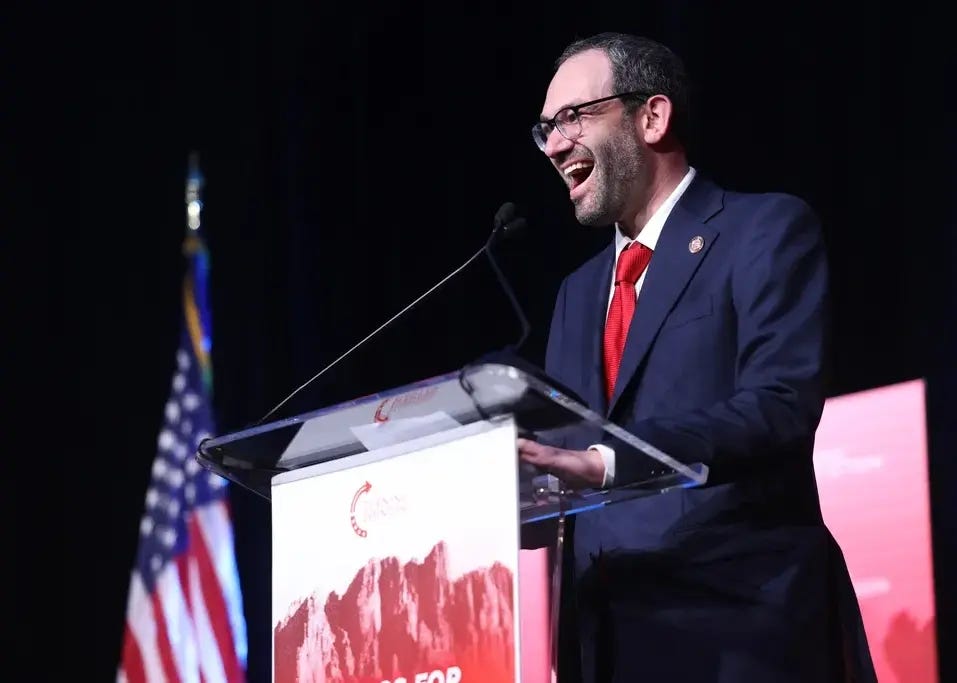
Democratic Secretary of State Adrian Fontes won the 2022 race to become Arizona’s top elections official by defeating an election denier, and now he may have to run against another one this fall.
NextGen Polling shows state Rep. Alex Kolodin, a member of the state’s affiliate of the nihilistic Freedom Caucus, with a wide 44-20 lead over Gina Swoboda, a former state GOP chair who has frequently clashed with far-right figures, in next week’s Republican primary.
Kolodin attracted attention shortly after the 2020 election when he filed an unsuccessful lawsuit aimed at overturning Joe Biden’s victory in the state. Kolodin, who went on to provide legal representation for a slate of fake Donald Trump electors, was ultimately sanctioned by the state bar in 2023 as part of a settlement that required him to admit he’d violated ethics rules.
That punishment, though, by no means diminished Kolodin’s influence in state GOP politics.
The sophomore lawmaker is the author of a proposed constitutional amendment that would require voters who cast ballots by mail to present ID. Last month, the GOP-run legislature voted to place Kolodin’s plan on the fall general election ballot, a maneuver that allowed Republicans to avoid a veto from Democratic Gov. Katie Hobbs.
A group called Protect the Vote Arizona initially put forward a competing plan backed by Fontes to enshrine mail voting in the Arizona constitution, but its leaders announced on July 1 that they didn’t believe they had enough signatures to make the ballot. Protect the Vote said it would instead focus on thwarting Kolodin’s amendment.
Kolodin, though, didn’t waste time bragging that he’d already scored a huge win over his would-be general election opponent, writing on X, “It isn’t November yet but I just beat Democrat Adrian Fontes at the ballot box!”
Swoboda, however, argues that Republicans can forget about defeating Fontes himself if they nominate a Freedom Caucus acolyte like Kolodin. Swoboda, who told Votebeat’s Sasha Hupka that Kolodin would have a “negative zero” chance of unseating the incumbent, pitched herself as an “electable” candidate who was not “a highly polarizing person.”
The warning comes four years after Fontes defeated Republican Mark Finchem by a close 52-48 margin. Finchem was a prominent member of an “America First” slate of conspiracy theorists across the country who were all running to serve as their state’s top election official. (All but one lost, and the lone winner, Indiana’s Diego Morales, was just denied renomination last month.)
Kolodin, however, recently told KJZZ that there were some differences between himself and Finchem, though he didn’t cite any disagreements on policy. Rather, he said he had more experience with elections, and added that he would not wear Finchem’s distinctive cowboy hat.
Swoboda, for her part, is pitching herself as a conservative who would competently administer Arizona’s elections.
“When there’s a fight to be had, I’m willing to fight,” she said to Hupka. “But I don’t believe everything is a fight, and I don’t believe that our system is helplessly broken. I do not want to burn it to the ground.”
The Freedom Caucus and allies like influencer Laura Loomer, though, have long wanted to torch Swoboda, who served under Hobbs as an election official back when the governor was secretary of state. (Swoboda had previously worked for Hobbs’ Republican predecessor.)
Swoboda, who led the state GOP in 2024 as Trump carried Arizona, appeared to have triumphed over her intraparty enemies last October when she entered the race for the open 1st Congressional District with Trump’s endorsement. But an enraged response from hardliners prompted Trump to announce in January he was backing former Arizona Cardinals kicker Jay Feely in addition to Swoboda.
Swoboda, who was hardly the first Republican to wind up on the wrong side of a Trump dual endorsement, said the next month that she would run for secretary of state rather than continue her campaign for Congress. Trump’s endorsement did not carry over to her new race, though, and MAGA’s master has remained on the sidelines.
Trump hinted he was about to break his silence in late June when he took to Truth Social to share a screenshot of Swoboda announcing she’d been endorsed by the Arizona Police Association. The post didn’t include any commentary from Trump, but Swoboda was happy to spread it anyway.
“Thank you Sir @POTUS,” she wrote in a tweet that ended with a folded hands emoji that is often used to symbolize both gratitude and prayer. Trump, though, has continued to sit on his own hands ahead of Swoboda’s difficult primary.
Sites like The Downballot can’t replace the likes of CNN, but if the traditional media is going to continue to bow and scrape before Trump, then we’re going to need independent media more than ever. And that includes outlets like ours—publications that you can trust to tell the truth.
If you’d like to support our work and help us get to a place where we’ll be financially sustainable for the long term, we hope you’ll consider upgrading to a paid subscription today.

2Q Fundraising
AK-Sen: Mary Peltola (D): $7 million raised
FL-09: Ben Butler (R): $330,000 raised
VA-02: Elaine Luria (D): $1.6 million raised, $3.5 million cash on hand
Senate
ME-Sen
Maine Democrats will select a new Senate nominee to replace Graham Platner at a convention in Bangor on Saturday, July 25, the state party announced on Friday.
The gathering will bring together 601 delegates, including 101 from the party’s governing body, known as the Democratic State Committee, and 500 chosen by party organizations in each of Maine’s 16 counties.
Those counties will make their selections at meetings this weekend. They’ll pick delegates based on the number of votes each county cast for Kamala Harris in 2024, ranging from 149 in populous Cumberland (home of Portland) to just four in Piscataquis, a tiny rural county in northern Maine.
At the Bangor convention, voting will proceed round by round. All but the top five candidates will be eliminated after the first round, after which the lowest vote-getter will be eliminated in each subsequent round, until one person wins a majority.
Democrats interested in running have until Wednesday to file a declaration of intent and must then submit at least 500 signatures of registered Democrats by July 21. Those signatures are also subject to a geographic distribution requirement: Candidates must collect a minimum of 50 in at least eight counties.
So far, a number of hopefuls have already put their names forward, including three prominent figures who came up short in last month’s primary for governor: former state Senate President Troy Jackson, former state health director Nirav Shah, and Secretary of State Shenna Bellows.
Platner, meanwhile, finally filed paperwork to formally withdraw from the race on Friday afternoon, clearing the way for Democrats to select a substitute by the July 27 deadline.
SC-Sen
Republican Sen. Lindsey Graham died suddenly on Saturday night at the age of 71 after experiencing a torn aorta due to hardening of the arteries, according to a statement released by his office.
South Carolina Gov. Henry McMaster, a fellow Republican, is now tasked with appointing someone to serve out the final months of Graham’s term, which ends in January. The governor has not yet indicated whether he’ll tap a caretaker or appoint someone who would seek a full six-year term this fall.
Either way, it will ultimately be up to Republican primary voters to pick someone to replace Graham, who won the GOP primary on June 9 in his quest for a fifth term, on the November general election ballot. Any interested Republicans, however, have little more than two weeks to decide if they’ll run.
State law gives Republicans until July 28 to file. A new primary is set to take place on Aug. 11, but candidates need to win a majority of the vote to avert a runoff on Aug. 25.
That accelerated timetable, though, may conflict with federal law, which requires that election officials send ballots to military personnel and other voters living overseas at least 45 days before a federal election. It remains to be seen, though, if anyone will sue to postpone the primary.
The eventual GOP nominee will take on pediatrician Annie Andrews, who won the Democratic nomination last month, in this conservative state. Andrews raised over $15 million through late May for what remains a difficult campaign.
While Graham’s death stunned the political world, one notable Republican quickly announced he would seek to replace him as others publicly or privately consider their next steps.
Wealthy businessman Mark Lynch, who unsuccessfully challenged Graham for renomination last month from the right, released a statement Sunday evening saying he would run again. Lynch, who lost to Graham 57-29, pledged to “commit an additional $5 million” to his new campaign.
He could have company very soon. Rep. Ralph Norman, who took third place that same evening in the GOP primary to replace the termed-out McMaster, informed Bloomberg News he was considering the race and would announce his plans on Tuesday.
The congressman may face some familiar intraparty rivals. Politico reported hours after Graham’s death that fellow Rep. Nancy Mace, who finished a distant fifth place in the gubernatorial primary, is interested in running for Senate. Mace, who has alienated just about everyone at one time or another during her six years in the House, didn’t rule it out, telling CNN that “there will be time to decide” about another bid.
Multiple media outlets also say Lt. Gov. Pamela Evette, who has spent eight years as McMaster’s second-in-command, is weighing a run. Evette advanced to the primary runoff for governor only to wind up on the wrong side of a 69-31 landslide against Attorney General Alan Wilson.
Punchbowl News adds that Rep. William Timmons, who won renomination last month for what he says will be his final term in the House, is “very interested” in entering the Senate race. Timmons himself didn’t rule anything out in a statement to CNBC saying, “If and when the time comes to discuss the future, I have always been willing to serve South Carolina wherever I can make the greatest difference.”
Graham’s eventual successor will replace a man who spent decades amassing influence on Capitol Hill even as he had to continually watch out for trouble on both his left and right flanks.
In 1994, Graham was serving his first term in the state House when he scored a landslide win in the general election for the open 3rd Congressional District, a victory that made him the first Republican to represent this constituency in the northwestern part of the state since Reconstruction.
Graham, whose victory came on the same night that Newt Gingrich was leading the GOP to its first House majority in 40 years, went on to achieve national attention in 1998 and 1999 when he served as an impeachment manager during President Bill Clinton’s trial in the Senate.
Graham, though, unlocked a new level of renown in 2002 after he won the race to succeed 100-year-old Sen. Strom Thurmond, once one of the most infamous segregationists in America who was first elected in 1954.
The new senator quickly became a close friend and ally of Arizona Republican John McCain and Connecticut Sen. Joe Lieberman, a Democrat—all of whom ardently supported George W. Bush’s invasion of Iraq.
But while the hawkish foreign policy advocated by Graham and the rest of the “Three Amigos” made the trio a powerful force in the Bush era, Graham’s occasional but high-profile bipartisan forays would infuriate his party’s far-right base—especially during Barack Obama’s presidency.
In particular, Graham was a key figure in the “Gang of Eight” that unsuccessfully pushed for a bipartisan immigration reform plan in 2013. The next year, he had to fend off six primary foes, including newcomer Nancy Mace, as far-right groups hoped to take down the influential incumbent.
Graham ultimately defeated his nearest opponent 56-16, a showing that, while not close, showed that a large minority of South Carolina Republicans were displeased with their senior senator. (Mace took fifth.)
The senator had no trouble winning his general election, but he was anything but chastened and soon announced he would run for president. But while Graham was and would remain an omnipresent face on political talk shows, he was one of the many GOP hopefuls who struggled to gain attention in a race that saw Donald Trump become a magnet for attention.
In the summer of 2015, Graham came into conflict with the unexpected frontrunner when he responded to Trump’s attacks on McCain’s war record by imploring him to “just stop being a jackass.” Trump quickly retaliated by sharing Graham’s cellphone number on national TV, while the senator—who made a point of destroying his old flip-phone—would spend the following months blasting Trump as a “kook” and “unfit for office.”
Trump, of course, came out on top, while Graham gave up on his White House dreams in December of 2015. Though he would initially remain an ardent enemy of MAGA, he wouldn’t stay one for long.
Soon enough, Graham transformed himself into a Trump ally and golfing partner during Trump’s first year in the White House. And while the South Carolinian was far from the only former critic who fell in line, Graham, who pivoted to accusing the media of trying to portray Trump “some kind of kook,” stood out for his fealty to his party’s new master.
That alliance helped protect the senator from any serious primary opposition in 2020, but Democrats hoped that voters were ready for a new face.
Jaime Harrison, the former chair of the state Democratic Party, capitalized on national antipathy to Graham—as well as polls showing a close race—to raise more than $130 million in a state that hadn’t held a seriously contested Senate election in many years. Despite the massive flow of money, though, Graham came out on top 54-44.
The race for the White House wasn’t the only one on Graham’s mind that year. After Election Day, Graham cemented his status as a Trump lackey when Georgia Secretary of State Brad Raffensperger accused him of being part of Trump’s effort to overturn Joe Biden’s win in the state.
Unsurprisingly, during Trump’s four-year exile from the White House, Graham remained a MAGA ally. Trump returned the favor last year when he provided an early endorsement to the senator as he sought yet another term in the Senate.
Lynch, though, hoped that the GOP base’s old frustration with Graham would finally doom the incumbent. The challenger aired ads with footage from the 2016 presidential primary showing Trump calling Graham “one of the dumbest human beings I’ve ever seen,” and argued the senator had enabled the Biden administration.
Graham and allies responded by dumping a hefty $15 million onto the airwaves. The senator ended up securing 57% of the vote—almost identical to his performance 12 years earlier in the pre-Trump era—in what would turn out to be his final campaign.
Governors
CT-Gov
Connecticut state Rep. Josh Elliott, who is challenging Gov. Ned Lamont in next month’s Democratic primary, just received an infusion of $3.75 million in public matching funds as he seeks to prevent the wealthy incumbent from winning a third term.
Days earlier, Elliott released his first ad of the race, a fast-paced, minute-long spot in which he shares his background and criticizes Lamont.
“There’s a lot to love about Connecticut,” he begins. “The coast, the people, the pizza. But we’re also the most unequal state in America, where a good life is out of reach for too many.”
He then notes that he was brought up by a single mother, raised seeing-eye dogs, and “played poker professionally, so I know when the game is rigged.” That’s when he turns his sights on his opponent.
“Ned Lamont, worth nearly a billion from a family banking fortune, is standing in the way of Democratic legislation, protecting a broken system that enriches him and his friends. Now he wants a third term. We can do better,” he says, stressing his support for making healthcare and housing more affordable and making “billionaires pay their fair share.”
Lamont, in fact, is a major reason why Elliott now has access to as much money as he does. The governor spent almost $26 million of his own money on his last campaign in 2022, while his Republican opponent, Bob Stefanowski, self-funded $13 million. That spending binge prompted lawmakers to double the amount of matching funds candidates could receive, and indexed it for inflation.
Elliott was always going to get outgunned, but the new injection of cash gives him a chance to get his message out to a wider group of voters. (He qualified by raising just over the necessary $335,500 in small donations.)
Lamont is still self-funding this time around, though less than last time—so far. According to new disclosures released on Friday, he’s written his campaign checks totaling $3.5 million to date.
Earlier this year, though, the governor acknowledged the new reality created by the beefed-up program, which the presumptive Republican nominee, state Sen. Ryan Fazio, is also participating in.
“We’re trying to raise as many small dollar donations as we can to show we got broad-based support,” Lamont told reporters in January. So far, though, his contributions from donors total $368,000, slightly behind Elliott’s $371,000 haul to date.
Lamont’s deep pockets, though, could let him tip the balance back in his direction at any moment. They also allowed him to beat Elliott onto the airwaves by launching his first ads in mid-June.
In his inaugural spot, the governor says, “I like people who go to work, roll up their sleeves, and get it done,” then touts his plans to pass universal healthcare, lower electricity bills, and end corporate welfare.
A second ad focuses on a Connecticut high school student named Rihan, who was detained by ICE and later released earlier this year.
“What Donald Trump and ICE are doing is, in my view, un-American,” says Lamont. “So we passed laws to stop these attacks and banned ICE from our schools.” Neither ad mentions either of his opponents.
House
AZ-01
The DCCC offered no public explanation of its recent decision to begin airing ads on behalf of former TV news anchor Marlene Galan-Woods in the hotly contested Democratic primary for Arizona’s 1st District, but Axios has now shed some light on the situation.
According to unnamed sources who spoke with the publication, the committee found former state Rep. Amish Shah, who is running again after losing a close race two years ago, “difficult to work with, chafed at his preference for door-knocking over making fundraising calls, and was unhappy with his refusal to run negative ads.”
A Shah spokesperson responded by criticizing “D.C. insiders trying to put their thumb on the scales” and chastised them for “attack[ing] Amish for taking the time to talk to voters and hear their concerns.”
In 2024, Shah narrowly won a crowded Democratic primary to take on Republican Rep. David Schweikert with 23.5% of the vote, while businessman Andrei Cherny took 21.3% and Galan-Woods finished just behind with 21.2%. However, he came up short in the general election, losing to Republican Rep. Dave Schweikert by a 52-48 margin.
The DCCC’s intervention, which Axios says is backed by a $200,000 buy, isn’t going over well with some Arizona Democrats, and it could even hurt more than it helps.
Rep. Adelita Grijalva, who represents the nearby 7th District, told Axios she was “frustrated” to see the committee weigh in and said it should only do so to thwart “DINO” candidates—Democrats in name only. An anonymous House Democrat, meanwhile, said that the DCCC’s support “may even work against” an endorsee like Galan-Woods.
Given how competitive the 1st District has been in recent years, though, the seat will be in play in November no matter what, especially since Schweikert has left it open to pursue a longshot bid for governor.
Another Arizona representative and member of the DCCC’s leadership team, Greg Stanton, acknowledged as much in comments to Axios, saying that “regardless of who wins the primary, they’re going to have massive support from DCCC to win this critical seat.”
The DCCC, though, isn’t the only influential organization trying to help Galan-Woods win her rematch against Shah.
A pair of groups affiliated with the Congressional Hispanic Caucus have spent well over $1 million to promote Galan-Woods, who is Cuban American, and attack Shah. An organization called Pro-Choice Majority Action has also spent around $800,000 more for the same purpose.
Allies of a third Democrat are also trying to block Shah. An obscure group with the name Crush MAGA PAC has deployed over $500,000 to go after Shah while also boosting Jonathan Treble, a wealthy businessman who has self-funded much of his campaign.
Shah, by contrast, has benefited from only around $100,000 in independent expenditures.
Businessman Rick McCartney, the final Democrat in the race, hasn’t been helped or hindered by outside groups, according to FEC reports.
Poll Pile
AZ-Gov (R): NextGen Polling:
Andy Biggs: 66, David Schweikert: 10.
June: 57-11 Biggs.
MN-Gov (R): Minnesota Private Business Council:
Lisa Demuth: 34, Kendall Qualls: 28, Mike Lindell: 24.
OR-Gov: Public Opinion Strategies for Christine Drazan:
Drazan (R): 48, Tina Kotak (D-inc): 44.
KY-06: GQR for Zach Dembo:
Ralph Alvarado (R): 42, Dembo (D): 39.
AZ-AG (R): NextGen:
Warren Peterson: 43, Rodney Glassman: 28.
June: 26-20 Peterson.
What’s the saying, you can’t spell crazy without (R-AZ)
These ICE domestic terrorist thugs just murdered someone in Maine and the videos are very graphic. This needs to be tied directly to Susan Collins.