



Leading Off
NY-Gov
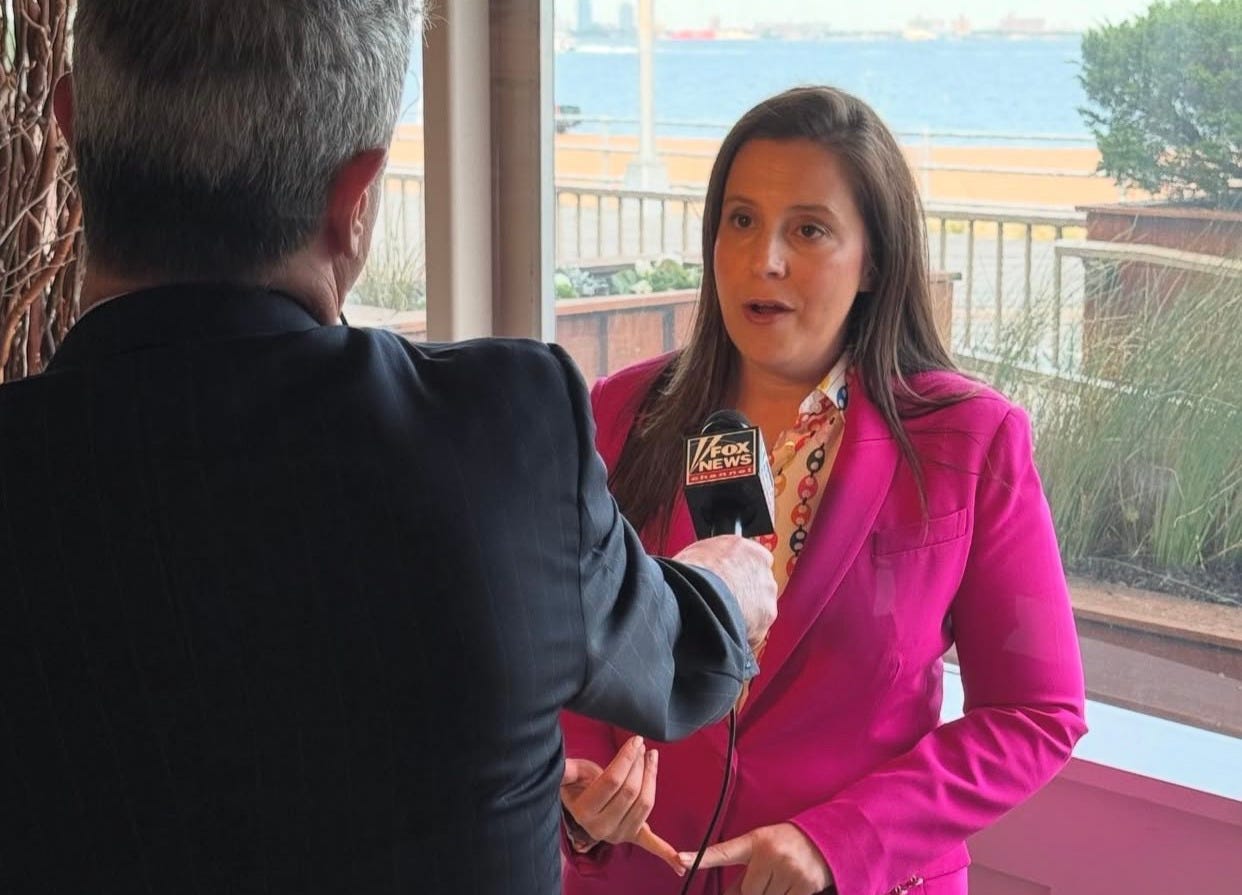
Rep. Elise Stefanik, who for years has served as one of Donald Trump’s most ardent allies in Congress, on Friday announced her long-anticipated run for governor of New York—a state that Trump never came close to carrying in any of his three campaigns.
But while Stefanik launched her bid to unseat Democratic Gov. Kathy Hochul with the support of state GOP leader Ed Cox, who confidently predicted that “[t]here will not be a Republican primary,” she hasn’t yet cleared the field.
Nassau County Executive Bruce Blakeman, who decisively won reelection on Tuesday on an otherwise brutal night for Republicans, responded to Stefanik’s entry by putting out a statement reiterating his interest in running and touting himself as the strongest potential nominee.
“I have tremendous respect for Elise, however our party must nominate a candidate that has broad based appeal with independents and common sense Democrats,” Blakeman said. “The party must nominate the candidate with the best chance to defeat Kathy Hochul, and I have been urged by business, community and political leaders across the state to make the run and I am seriously considering it.”
Stefanik, by contrast, hasn’t needed to win over crossover support in some time to prevail in the 21st Congressional District, a heavily Republican constituency in upstate New York’s North Country.
The congresswoman, though, is arguing that the GOP primary is all but over before it’s even begun. Stefanik says that she already has the support of enough county GOP chairs to assure her of 72% of the “weighted vote” at the upcoming state party convention.
Any candidate who fails to secure at least 25% of the vote at this gathering, which the Watertown Daily Times says will take place sometime in early 2026, can still make the June 23 primary ballot, but only by collecting thousands of signatures—an expensive and time-consuming task Stefanik need not worry about.
Hochul, who has been dogged by underwhelming approval ratings through much of her four-year tenure, faces an intraparty challenge from Antonio Delgado, whom she picked to be her lieutenant governor three years ago. Polls, though, show Hochul well ahead in the primary.
Stefanik also appears well-positioned to capture her party’s nomination, but she’ll have a difficult task winning the general election in a state where her party hasn’t won a single statewide race since 2002, when George Pataki secured his third and final term as governor.
Stefanik began her political career as a politician more in the mold of Pataki, a prominent figure in the pre-Trump GOP establishment, than the MAGA enthusiast she’s refashioned herself as.
She worked in the George W. Bush White House and as a staffer on Tim Pawlenty’s doomed 2012 presidential campaign, and she later served as future Speaker Paul Ryan’s debate coach ahead of his face-off with then-Vice President Joe Biden.
Stefanik called on those extensive connections in 2014 when she campaigned to succeed Democratic Rep. Bill Owens, who was retiring from what had once been competitive turf. Sporting endorsements from Ryan and Mitt Romney, she decisively won a closely watched primary, then took advantage of a favorable political climate and a weak Democratic opponent to easily flip the seat in the fall.
Stefanik, who at 30 was the youngest woman ever elected to Congress at the time, initially was anything but enthusiastic when Trump bulldozed his way through the 2016 presidential primaries.
Stefanik refused to support Trump for the nomination even after his dominant showing in the state’s primary, which led prominent Trump campaign official Carl Paladino to label her a “fraud” and “a RINO Washington elitist establishment sellout.” The freshman representative wouldn’t even say Trump’s name after it became clear he’d be the GOP’s standard-bearer, though she went along anyway, saying she’d back “my party’s nominee.”
Trump, though, proved to be good for Stefanik’s burgeoning career in more ways than one. His strength in rural areas like the North Country helped rapidly transform the 21st District from a swingy constituency that Barack Obama had carried twice into solidly red turf where she no longer needed to worry about reelection.
And while Stefanik was far from the only former Trump skeptic who eagerly embraced him following his surprise win against Hillary Clinton, she attracted attention in ways few others could. The New York Republican became a MAGA hero—and Democratic villain—in the lead-up to Trump’s first impeachment in 2019 when she tried to violate House Intelligence Committee rules and then claimed she’d been unfairly silenced.
Stefanik, who joined the majority of her caucus in voting against recognizing Joe Biden’s win in the hours after the Jan. 6 attack on the Capitol, rose even further in 2021 when she replaced Rep. Liz Cheney as the number-three Republican in the House leadership.
She would draw more attention over the next few years with rhetoric that echoed the racist and antisemitic “Great Replacement Theory,” as well as by invoking QAnon language with jeremiads against “pedo grifters.” Stefanik also endorsed her old adversary Paladino, who had his own long history of bigoted commentary, in his unsuccessful 2022 primary for Congress.
Stefanik’s profile swelled still further in 2023 when she grilled several college presidents, including the head of her alma mater, Harvard, about antisemitism on their campuses while remaining undeterred when critics highlighted her own embrace of antisemitic tropes.
Trump’s comeback in 2024 offered her the chance for even greater prominence. Days after the election, Trump announced that Stefanik would become his new ambassador to the United Nations.
The congresswoman embarked on a “farewell tour” of her district in February, but her nomination became stuck in limbo as Republicans worried that their poor performance in recent special elections could cost them control of her otherwise secure seat. Trump finally said in late March that he was pulling her name because of those fears, though he insisted he remained a fan of the still-congresswoman.
Multiple media outlets reported weeks later that Stefanik was considering challenging Hochul, and her candidacy became a virtual certainty over the ensuing months. She finally launched on Friday against the Democrat she branded the “Worst Governor in America.”
Stefanik also has another foil in mind who won’t be on next year’s ballot. The Republican used her launch video to link Hochul to New York City Mayor-elect Zohran Mamdani, whom her narrator identifies as a “defund the police, tax-hiking, antisemitic, communist.”
But while her video didn’t mention Trump at all, Republicans are hoping that Trump’s gains last year in the state he once called home will foreshadow more success for the GOP ticket in 2026. Even though he lost to Kamala Harris by a 56-43 margin, that marked a considerable shift to the right from his 61-38 deficit in 2020.
Similar Republican hopes, however, failed to materialize in neighboring New Jersey in last week’s race for governor, and Hochul’s team still sees Trump as a massive drag for the GOP.
The governor’s campaign immediately responded to Stefanik’s entry with a video featuring footage of Stefanik touting herself as “one of his top allies on Capitol Hill,” with Trump in turn labeling her “[p]henomenal.”
“’Phenomenal’ at putting Trump ahead of you,” responds Hochul’s narrator. “Like when she proudly cast the deciding vote to pass Trump’s agenda that rips healthcare away from 1.5 million New Yorkers.”
The Downballot only exists because of our readers.
We have no deep-pocketed corporate backers and no billionaire sugar daddies. That means we can always tell the truth without fear—something major media conglomerates increasingly refuse to do. But it also means we need as many people as possible to sign up as paid subscribers so that we can keep the lights on.
If you’re able to support our work, we hope you’ll upgrade today:

Election Recaps
WA State Senate
Democratic state Sen. Deb Krishnadasan has prevailed in a special election for Washington’s swingy 26th Senate District after her Republican opponent, state Rep. Michelle Caldier, conceded on Thursday.
Krishnadasan was appointed to her post last year after fellow Democrat Emily Randall won election to the U.S. House. As a result of Krishnadasan’s victory, Democrats will retain their 30-19 edge in the Senate. Half of the chamber’s members, including Krishnadasan, will be up for election next year.
King County, WA Executive & Seattle, WA Mayor
King County Councilmember Girmay Zahilay secured victory on Friday against Council colleague Claudia Balducci, a fellow Democrat who shares similar views, in the nonpartisan general election to serve as executive of Washington’s largest county.
The race to serve as mayor of Seattle, however, remains unresolved. Incumbent Bruce Harrell holds a 51-49 advantage over progressive activist Katie Wilson, a fellow Democrat who challenged him from the left, with about 233,000 ballots tabulated as of Friday—a sizable shift from the 54-46 edge Harrell held on election night.
KUOW writes that there are an estimated 45,000 ballots left to count, and local election officials say they will tabulate more votes on Monday. This contest is the last high-profile election in the country where the outcome is still in doubt.
Redistricting Roundup
KS Redistricting
Even though Kansas Republicans have failed in their push to gerrymander Democratic Rep. Sharice Davids’ district, the congresswoman is warning that she could still challenge GOP Sen. Roger Marshall if they somehow succeed.
“If they continue to move forward with this, which they have indicated that they will, I will continue to say that all options are going to be on the table,” Davis told reporters at a recent press conference.
Republicans recently abandoned their plans to call a special session of the legislature to redraw the state’s congressional map, though they say they’ll keep trying when lawmakers convene for their regular session in January. However, they’re still short of the necessary two-thirds support to pass a new map over Democratic Gov. Laura Kelly’s certain veto.
UT Redistricting
Utah Republicans have given up on a convoluted plan to ask voters to repeal a new congressional map recently passed by the state’s GOP-dominated legislature, saying instead they will forge ahead with a ballot initiative to undo anti-gerrymandering rules adopted by voters in 2018.
That new map was passed in response to a court ruling striking down Utah’s current districts for violating those redistricting reforms, but it may not pass legal muster. The judge in the case will likely issue a ruling very soon that will determine which lines the state will use in 2026.
Senate
GA-Sen
Powerful GOP groups reacted with outrage after Gov. Brian Kemp’s allies debuted a commercial ahead of next year’s Senate primary that suggested that Reps. Mike Collins and Buddy Carter, as well as other congressional Republicans, bear as much blame as Democrats for the federal government shutdown.
“What do Mike Collins, Buddy Carter, and Jon Ossoff have in common? They all failed and shut down the government,” says the narrator in the spot for a group called Hardworking Georgians. The ad goes on to tout former University of Tennessee football coach Derek Dooley, who is Kemp’s pick to take on Ossoff, as “an outsider.”
“Republicans are united with Trump in placing the blame where it belongs: Democrats like Jon Ossoff,” a spokesperson for the National Republican Senatorial Committee told Axios. “Telling Georgia voters any message other than that one is perpetuating Democrat lies.” The Senate Leadership Fund responded similarly.
Collins also tweeted that he was vexed to see Dooley’s backers “parroting the anti-Trump Democrat lie that ‘Republicans are to blame for the shutdown.’” He even defended the other Republican targeted by the spot, writing, “The fact is Republicans in Congress, including myself and my colleague Buddy Carter, have done our job, and passed a clean, nonpartisan Continuing Resolution that funds the government.”
OH-Sen
Wealthy businessman Fred Ode said Friday that he was abandoning his long-shot campaign to defeat former Sen. Sherrod Brown in next year’s Democratic primary. Brown now has no notable intraparty opposition in what will be a tough campaign to unseat Republican Sen. Jon Husted.

Governors
CT-Gov
Connecticut Gov. Ned Lamont finally confirmed on Friday that he would seek a third term next year.
Political observers had long anticipated that Lamont would run again, and the governor joked to reporters he was only announcing because he “didn’t want you to have to ask me any longer.”
Lamont, however, faces intraparty opposition from state Rep. Josh Elliott, who is challenging him from the left in the August Democratic primary. Elliott responded to the incumbent’s decision by highlighting the Democratic Party’s strong night on Tuesday, which included sweeping and historic wins in the state’s municipal elections, as a sign that Lamont needs to “stand up or step aside.”
State Sen. Ryan Fazio is currently the only notable Republican opposing Lamont, though New Britain Mayor Erin Stewart has spent the past year raising money for a likely campaign. Stewart’s decision not to seek reelection meant she was not on last week’s ballot, but she still got some unwelcome news when Democratic state Rep. Bobby Sanchez won the race to replace her.
That result, however, doesn’t appear to have deterred her. She responded to Lamont’s announcement on Friday by tweeting, I’ll have more to say on that soon… 👀”
MN-Gov
Businessman Patrick Knight has launched a bid to take on Minnesota Gov. Tim Walz, joining an increasingly crowded GOP primary.
Four other notable Republicans were already seeking to deny Walz a third term, including businessman Kendall Qualls, state Rep. Kristin Robbins, former state Sen. Scott Jensen, and state House Speaker Lisa Demuth, who jumped in just a week ago.
NM-Gov
State Sen. Steve Lanier on Thursday became the second notable Republican to enter the race for New Mexico’s open governorship.
Lanier, who does not appear to have shown any public interest in running before his announcement, was first elected to the legislature after previously serving on the Board of Commissioners for San Juan County in the northwestern corner of the state. He joins Rio Rancho Mayor Gregg Hull, who has struggled to raise money, in the race to succeed termed-out Democrat Michelle Lujan Grisham.
OR-Gov
Former NBA player Chris Dudley, who narrowly lost a bid for governor as a Republican in 2010, didn’t rule out the possibility of trying again next year in a new interview with the Oregon Journalism Project.
Dudley, a journeyman center who spent seven of his 16 seasons with the Portland Trailblazers, lost to Democrat John Kitzhaber by a 49-48 margin in a year that saw Republicans nationwide rack up massive wins. That election was the closest Republicans have come to winning the governorship since the late Victor Atiyeh secured his second and final term in a 1982 landslide.
(The 6’1” Kitzhaber and the 6’11” Dudley also combined for what The Downballot believes is the tallest gubernatorial election in American history.)
Oregon Republicans recently landed another repeat candidate in state Sen. Christine Drazan, who announced last month that she’d once again run against Democratic Gov. Tina Kotek. Three years ago, Kotek fended off Drazan in a close 47-43 race.
SC-Gov
Republican Rep. Nancy Mace has now spent more than a week dealing with, and drawing more attention to, an Oct. 31 story from Wired reporting she’d “unleashed a tirade against law enforcement at the Charleston International Airport.”
While Mace, who is running in next year’s busy primary for governor of South Carolina, is no stranger to unflattering accounts about her behavior, her fellow Republicans have usually ignored or quickly moved on after prior outbursts. But Mace, who reportedly told security officials they wouldn’t treat people like Sen. Tim Scott the way they were treating her, is having a different experience this time.

Scott issued a statement Tuesday praising Charleston airport officials and saying, “For those who want to invoke my name, please have the courtesy to note my actions and how I treat police officers, TSA agents, and fellow travelers with the respect they deserve.” Fellow Sen. Lindsey Graham also posted his own message expressing his agreement with Scott.
That evening, Mace tweeted in response, “Why are two men with a half dozen personal security guards everywhere they go, offended by a woman, who has been assaulted for her beliefs, and can’t get the same security, and very much cares about her safety in the wake of Charlie Kirk and Donald Trump getting shot?”
Mace, who The Independent says wrote and reported about the incident no fewer than 110 times on social media through Tuesday, has continued to keep the matter in the news. The congresswoman has alleged that airport and American Airlines employees “coordinated and conspired to create false and misleading incident reports,” and she’s threatened to sue.
House
CA-42
Former Republican state Sen. John Moorlach is hinting that he could challenge Democratic Rep. Robert Garcia in California’s newly redrawn 42nd District, a seat based in Los Angeles County that’s now redder thanks to the addition of part of Orange County.
Moorlach lost his seat in the Senate in an upset to now-Rep. Dave Min in 2020 and has since lost three different comeback bids for three different posts. Garcia’s district, though, changed dramatically thanks to the passage of Proposition 50, which lowered Kamala Harris’ margin from a wide 64-32 spread to a much narrower 55-42 win.
Garcia won praise from fellow Democrats for being willing to part with so much blue turf, with Rep. Zoe Lofgren calling him “an incredible team player” for “taking in some historically Republican neighborhoods.” As Lofgren noted, though, the district remains favorable to Democrats, and if 2026 looks anything like 2025, Garcia should have little to fear next year.
MD-05
Axios reports that an unnamed “senior House Democrat” says longtime Maryland Rep. Steny Hoyer, 86, “will” retire next year. Hoyer’s team “did not provide a comment,” says the publication.
MD-06
Former Maryland Rep. David Trone, who waged an unsuccessful bid for Senate last year, is reportedly interested in challenging the woman who succeeded him in the House, fellow Democrat April McClain Delaney.
According to Inside Elections’ Jacob Rubashkin, Trone is “taking pitches and calling local electeds” about a possible run for his old 6th District, which stretches from the Washington, D.C., area to the western part of the state.
In 2024, Trone, who became wealthy as the founder of the Total Wine chain of liquor stores, spent more than $62 million of his own money on his Senate campaign but lost the primary to Angela Alsobrooks, who went on to win the general election.
ME-02
Following Democratic Rep. Jared Golden’s retirement announcement on Wednesday, multiple media outlets have reported that former state Senate President Troy Jackson could run to replace him—and Jackson isn’t ruling the idea out.
Jackson is currently seeking the Democratic nod for Maine’s open governorship, but he faces a crowded primary. In a statement, Jackson hinted that he might choose a different path back to public office.
“I’m really flattered by everyone reaching out and I get why,” he said. “I’ve won multiple times in a district that voted for Trump by talking directly to rural working class voters from across the political spectrum about how to make Maine more affordable for them.”
He also went on to attack the likely GOP nominee for Golden’s seat, former Gov. Paul LePage, calling him “a disgraced grifter from Florida who cares more about tax cuts for wealthy donors than fighting for hard working Mainers.”
The Bangor Daily News also reports that Chief Kirk Francis of the Penobscot Nation is considering the race as well, according to an unnamed source. Francis was reportedly weighing a Senate bid earlier this year, though his standing took a hit in May after he was arrested for drunk driving.
NY-10
Outgoing New York City Comptroller Brad Lander, who previously had not ruled out challenging Rep. Dan Goldman in next year’s Democratic primary, tells Crain’s New York that he’s “very seriously considering” a bid. Lander added that he intends to decide by the end of this year.
Late last month, City & State reported that Lander had already told supporters he plans to take on Goldman, but at the time, he would only say that he was focused on helping Zohran Mamdani win the race for mayor.
WI-07
Secretary of Transportation Sean Duffy is scheduled to hold a fundraiser on Tuesday for his son-in-law Michael Alfonso that, according to NOTUS’ Reese Gorman, the White House did not authorize. An unnamed but angry person close to the Trump administration called Duffy’s action a “world-class stupid decision.”
The secretary previously alienated top Republicans in May by headlining a fundraiser for Bill Huizenga, a Michigan congressman who was considering defying GOP leaders and giving up his potentially competitive House seat to run for the Senate. (Huizenga finally gave in to pressure in July and decided not to seek a promotion, but he still hasn’t announced if he’ll run for reelection.)
Alfonso, a 25-year-old who has worked as a podcaster producer, is competing in next year’s primary for the safely red 7th District that Rep. Tom Tiffany is giving up to run for governor of Wisconsin. Duffy represented the previous version of the 7th from 2011 until his 2019 resignation.
Poll Pile
MI-Sen: Rosetta Stone (R): Mike Rogers (R): 47, Haley Stevens (D): 40; Rogers (R): 46, Mallory McMorrow (D): 39; Rogers (R): 45, Abdul El-Sayed (D): 31. Pollster says this “survey was not paid for by any candidate or any committee working for any candidate.”
TX-Sen (D): Impact Research (D) for James Talarico: James Talarico: 48, Colin Allred: 42. (Unreleased August poll: 61-31 Allred.)
AZ-Gov (R): Grayhouse (R): Andy Biggs: 43, Karrin Taylor Robson: 19, David Schweikert: 2. (Pollster did not identify a client.)
CA-Gov (top-two primary): UC Berkeley for the Los Angeles Times: Chad Bianco (R): 13, Katie Porter (D): 11, Xavier Becerra (D): 8, Steve Hilton (R): 8, Antonio Villaraigosa (D): 5, other candidates at 3% or less. (Aug.: Porter: 17, Bianco: 10, Becerra: 9, Hilton: 6.)
CA-Gov (top-two primary): Tavern Research (D) for Xavier Becerra: Bianco (R): 16, Porter (D): 15, Hilton (R): 12, Becerra (D): 9, Villaraigosa (D): 5, other candidates at 3% or less.
MI-Gov: Rosetta Stone (R): John James (R): 39, Jocelyn Benson (D): 34, Mike Duggan (I): 18; Benson (D): 37, Mike Cox (R): 33, Duggan (I): 19. Pollster says this “survey was not paid for by any candidate or any committee working for any candidate.”
Rep. Bonnie Watson Coleman (D-NJ) retiring.
Nancy Mace needs to take some time off and deal with her mental health issues. She is clearly struggling with mental health problems right now and she needs professional help. John Fetterman also needs to do the same but I suspect that he is going to leave the Senate soon. He hasn't been fundraising for 2028, which is a big clue that he isn't running for re-election. I know that neither Mace or Fetterman are popular here, but they both clearly need help.