



Leading Off
AZ-Gov, AZ-01
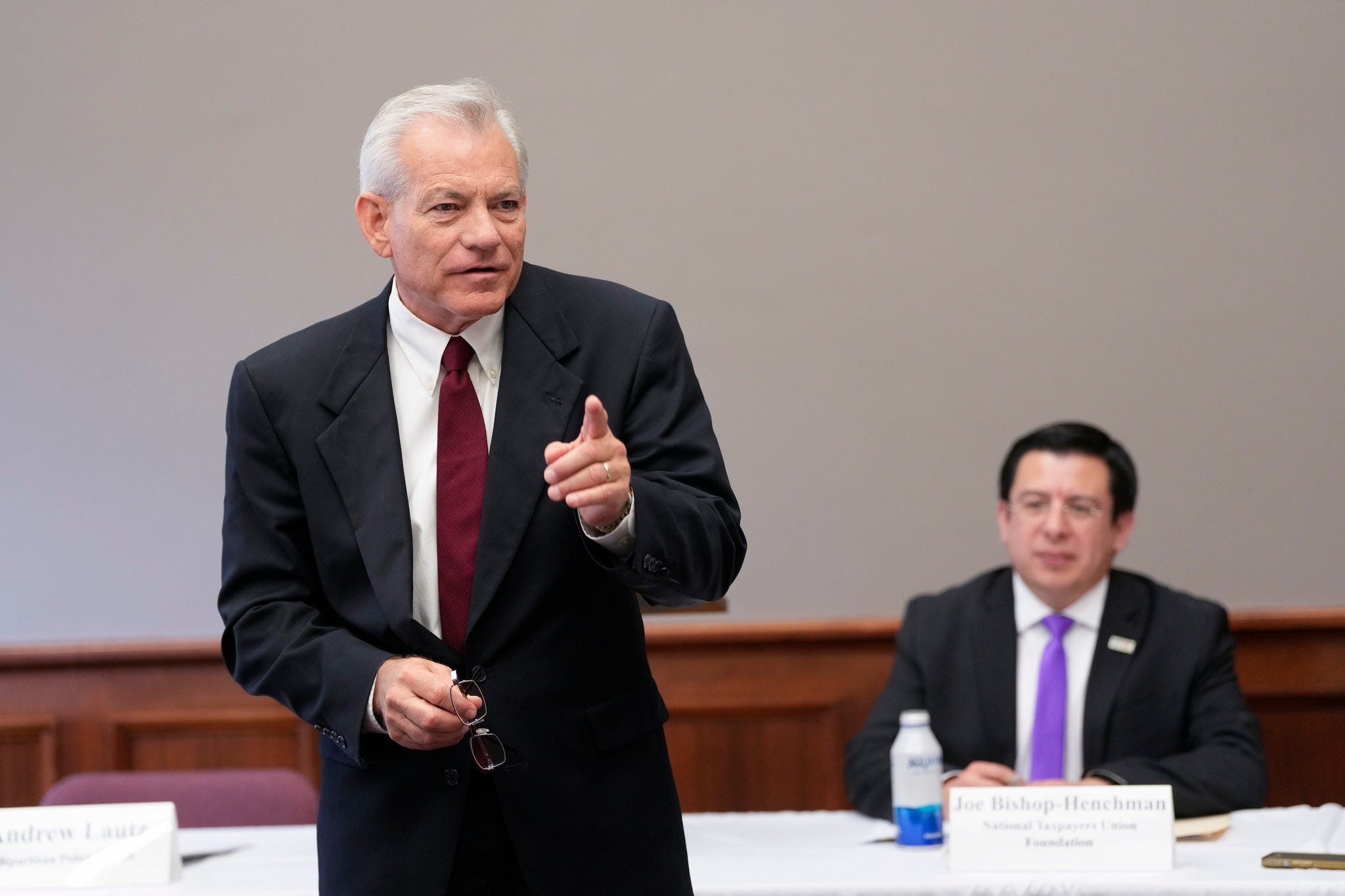
Republican Rep. David Schweikert announced Tuesday that he would run for governor of Arizona rather than defend his swingy House seat—a decision that will have a huge impact on two of next year’s most competitive elections.
Schweikert joins fellow Rep. Andy Biggs and businesswoman Karrin Taylor Robson in the Aug. 4 primary to face Democratic Gov. Katie Hobbs.
In 2022, Hobbs became the first Democrat to lead the Grand Canyon State in 14 years after she won a tight contest against far-right conspiracy theorist Kari Lake. Republicans are now determined to retake control of this swing state.
Schweikert, though, first needs to win a primary where he’s in the unusual position of facing two opponents who have Donald Trump’s “complete and total endorsement.”
The GOP’s supreme leader originally planned to support only Robson, who narrowly lost the 2022 primary to Lake. Trump, however, announced in the spring that he was also backing Biggs, saying that Arizona Republicans had two “fantastic candidates” to choose from.
Biggs secured Trump’s blessing after Charlie Kirk announced he had chosen to back Biggs rather than run for governor himself. Biggs also has Erika Kirk, who is Kirk’s widow and the new head of the Arizona-based Turning Point USA, in his corner.
Schweikert, though, believes there’s still an opening for him. The new candidate pitched himself to Axios as the strongest foe for Hobbs by highlighting his string of victories in the competitive 1st District, saying, “Find me someone as conservative as I am who has done as well.”
Schweikert, who was first elected to Congress during the 2010 GOP wave, won an eighth term last year by a 52-48 margin against Democrat Amish Shah after an expensive battle. Calculations from The Downballot show that Trump carried Arizona’s 1st District, which is based in northeastern Phoenix and Scottsdale, by a slightly smaller 51-48 spread; Joe Biden prevailed here by an even more slender 50-49 margin in 2020.
Several Democrats, including Shah, launched campaigns for the 1st District earlier this year at a time when everyone assumed Schweikert would run again. Now, Republicans are looking for candidates to defend what’s now an open seat; we detail the potential field in our AZ-01 item below.
Trump, though, may be irritated at Schweikert for making this an open-seat race in the first place. Trump has spent much of the year trying to convince House members in competitive seats to seek reelection rather than seek higher office.
While many have heeded his call, MAGA’s master has expressed annoyance with one who hasn’t. Trump told Michigan Rep. John James in June he was “not sure I’m happy” that the congressman chose to run for governor rather than defend his light-red House seat.

Schweikert, for his part, informed the Arizona Republic that when it comes to the White House, “There’s no question they would have preferred me staying and running for the House, but they also understand why I’m doing this.” He predicted to the Washington Post in a separate interview that his party would hold his House seat “[i]f I’m at the top of the ticket.”
Schweikert has long been a loyal vote for the Trump administration, and he’s avoided any high-profile conflicts with his party’s leader. However, it doesn’t sound like he believes Trump might expand his endorsement to include him—and yes, Trump has issued a triple endorsement at least once before.
The congressman said to the Post that he would “compliment the things that have been good for Arizona and then talk about what [I’m] going to do.” Most other GOP candidates across, by contrast, have launched their campaigns eager to talk about how they’ll be a vital ally for Trump.
Schweikert’s new campaign comes after a long—and at times volatile—career in state and national politics. He first won elected office in 1990 when he secured a spot in the legislature, but it took another 20 years for him to reach Congress.
Schweikert unsuccessfully ran for the U.S. House in 1994 and 2008, but he finally won on his third attempt in 2010 when he unseated Democratic Rep. Harry Mitchell in a competitive district. The state’s independent redistricting commission soon placed the new congressman in a more conservative constituency, but he had to get through a nasty 2012 primary against fellow Rep. Ben Quayle.
Schweikert’s campaign distributed mailers insinuating that Quayle, who is the son of former Vice President Dan Quayle, “goes both ways.” Quayle’s side condemned the message for falsely suggesting he was bisexual, but the uproar didn’t stop Schweikert from winning by a narrow 51-49 margin.
Schweikert, who easily won that year’s general election, was secure for most of the rest of the decade. But as suburban Republicans began deserting the party in the Trump era, Democrats saw an opening in 2020 as Schweikert became embroiled in a campaign finance scandal.
The congressman ultimately admitted to 11 different violations of congressional rules and campaign finance laws, agreed to pay a $50,000 fine, and accepted a formal reprimand in a deal with the bipartisan House Ethics Committee to conclude its two-year-long investigation. But while Democrats hoped the matter would finally cost him reelection, he instead won a close race against a well-funded opponent.
That win came just ahead of the next round of redistricting, and mapmakers this time made Schweikert’s district more competitive. Before he could focus on fending off Democrats again, though, the congressman had to face a wealthy primary foe who believed his old ethics issues would cost him renomination.
Businessman Elijah Norton aired ads in 2022 in which Schweikert’s former campaign treasurer told the audience that the incumbent “blamed his staff” for his many misdeeds.
“He lied to us,” said the ex-staffer. “Discovering the kind of person David has become has been one of the heartbreaks of my life.”
Schweikert responded by dusting off the tactic he used against Quayle a decade earlier and circulated mailers showing the challenger and a male friend with the caption, “Elijah Norton isn’t being straight with you.” Norton sued over what he called “homophobic” messaging falsely implying he was gay.
Schweikert secured renomination by an unimpressive 44-33 margin before winning another close race that fall. The congressman and his allies later reached a $50,000 settlement with Norton in 2024. That year, Schweikert went on to win what would turn out to be his final term in Congress in another close race, prevailing by just 4 points.
We’d be immensely grateful if you’d support our mission to shed light on overlooked elections by upgrading to a paid subscription. It’s just $7 a month or an even cheaper $60 a year. That works out to just 25 cents for every newsletter—and that’s not counting our subscriber-only content and features (like our Discord server).
Just click the button below to join the team and help us out!

Redistricting Roundup
KS Redistricting
Republican legislative leaders in Kansas have taken their first concrete steps toward passing a new congressional gerrymander by circulating a petition to convene a special session, which could take place as soon as next month.
To succeed, the petition needs the support of two-thirds of the membership of each house of the legislature. Republicans have supermajorities in both chambers, but they can only afford four defections each in the 40-member Senate and the 125-member House.
That could be a problem. Two GOP lawmakers have already expressed reservations about a remap in new comments to KCUR, and House Speaker Dan Hawkins recently acknowledged that the necessary numbers were “not there” yet.
Election Recaps
Jackson County, MO Executive
Voters overwhelmingly recalled Jackson County Executive Frank White by an 85-15 spread on Tuesday night. The county legislature will be tasked with choosing a new executive who, like White, must be a Democrat. The post will be up again for a full four-year term next year.
Senate
IL-Sen
Lt. Gov. Juliana Stratton’s allies have publicized an internal poll showing her trailing Rep. Raja Krishnamoorthi 33-18 in the March 17 Democratic primary for Senate in Illinois, with Rep. Robin Kelly at 8%.
The Democratic Lieutenant Governors Association, which commissioned this survey from Public Policy Polling, believes, however, that Stratton can overcome this deficit. PPP’s memo notes that Krishnamoorthi, who began airing TV ads in July, is the only candidate who has run any ads. It argues that Stratton will pull ahead once she gets her message out closer to the primary.
Krishnamoorthi, though, remains flush despite his early spending. The congressman’s team didn’t wait for the third quarter to end before announcing on Tuesday that he’d raised $3 million since the start of July and ended September with $17.5 million in the bank.
Governors
CA-Gov
Former state Senate leader Toni Atkins announced Monday that she was dropping out of the race for California’s open governorship, saying she saw “no viable path to victory” in the packed June top-two primary.
Atkins ended her campaign more than a month after Lt. Gov. Eleni Kounalakis, a fellow Democrat, also called it quits. But while Kounalakis said she would run for state treasurer instead, Atkins’ team told Politico she wouldn’t seek statewide office.
Atkins, like Kounalakis, struggled to stand out in a crowded field. Former Democratic Rep. Katie Porter has taken first in recent polls, while most surveys showed several other candidates in competition for the second spot in next year’s general election.
NJ-Gov
Democrat Mikie Sherrill holds a 50-42 lead over Republican Jack Ciattarelli in a new poll conducted for Fox News that was released on Tuesday.
The survey, conducted jointly by the Democratic firm Beacon Research and the Republican pollster Shaw & Company Research, closely mirrors a new internal that Sherrill’s campaign publicized earlier the same day showing her with a 50-43 advantage.
That latter survey, which was conducted by Global Strategy Group, was released a little more than a week after Ciattarelli showcased his own internal poll placing him ahead 46-45. Most independent polls have given Sherrill an advantage, though a recent Emerson College survey found the race tied 43-43.

OH-Gov
Former Rep. Tim Ryan’s team said Tuesday that he would take “a few additional days” to decide whether he’ll enter the Democratic primary for Ohio’s open governorship. That statement was distributed on Sept. 30, which was Ryan’s self-imposed deadline to make up his mind.
A spokesperson, though, said that Ryan remains “excited about what he could do as governor” and believes he’s “the strongest candidate to beat” Republican Vivek Ramaswamy.
Ryan would first face former state health director Amy Acton in next May’s primary.
House
AZ-01
Arizona Rep. David Schweikert’s decision to run for governor means that his fellow Republicans need to find a new recruit to defend his competitive 1st District. At least one legislator sounds interested in taking up the task.
The Arizona Republic mentioned state Rep. Matt Gress as a possible replacement candidate back in August when the possibility of a statewide bid by Schweikert first emerged. Gress hinted he was interested on Tuesday, tweeting, “For our nation and our state, I will do everything I can to make sure” that the GOP holds the seat.
Other Republicans sound less enthused. Phoenix City Council member Jim Waring told the paper in August that, while he was not “ruling anything out,” he was “very happy” in his current post.
Maricopa County Board of Supervisors Chairman Thomas Galvin, meanwhile, put out a statement Tuesday saying he would not run for Congress, while state Sen. Carine Werner told Bloomberg she also was a no.
Several notable Democrats began running back when Schweikert appeared set to seek reelection. The most familiar name belongs to former state Rep. Amish Shah, who lost a tight race to Schweikert last year.
The Aug. 4 primary field also includes former TV anchor Marlene Galan-Woods, who unsuccessfully sought the nomination last time; DNC member Mark Robert Gordon; and a pair of businessmen, Rick McCartney and Jonathan Treble.
ME-02
State Auditor Matt Dunlap filed paperwork last week with the IRS for a potential Democratic primary challenge to Maine Rep. Jared Golden, though his team told Bloomberg Friday he was still making up his mind. Dunlap separately informed the Portland Press Herald that he would decide sometime “soon,” as the paper put it.
MN-02
Former federal prosecutor Joe Teirab tells MPR he won’t run to succeed Democratic Rep. Angie Craig, who defeated him 56-42 last year and is now running for the Senate.
Minnesota Public Radio’s inquiries came after Teirab’s team filed a new statement of candidacy with the FEC, a move that’s usually a prelude to a full-fledged campaign announcement—usually, but not always. As we’ve written before, FEC filings from defeated candidates sometimes are about resolving loose ends from their last campaign rather than laying the groundwork for a future effort.
Teirab, a Republican, says that that was precisely the case here, explaining to MPR that his old treasurer had to amend some earlier reports and make administrative changes.
Both parties have busy fields in Minnesota’s 2nd District, a suburban Twin Cities constituency that Kamala Harris carried 52-46 last year.
Other Races
GA-LG
State Sen. Greg Dolezal on Tuesday joined the busy Republican primary for lieutenant governor of Georgia, a powerful post that GOP incumbent Burt Jones is leaving behind to run for governor.
Dolezal and Jones, who have both advanced election conspiracy theories, previously served together in the upper chamber. The pair attracted attention after the 2020 election when they joined with four other lawmakers to call for a special session to overturn Donald Trump’s loss to Joe Biden.
Then-Lt. Gov. Geoff Duncan, who was in charge of picking Senate committee chairs, responded by stripping Jones of his gavel while relegating Dolezal to run a minor panel. Jones was elected in 2022 to succeed Duncan, who at the time was a Republican but recently switched parties and is running for governor as a Democrat.
Dolezal was happy to remind fellow Republicans about this episode in August as Jones announced his campaign for the state’s top job. Jones has not endorsed anyone in the race to succeed him, though observers noted that he gave his former colleague a prominent speaking spot at his summer event.
Dolezal, who launched his own effort by saying he stood with Trump “when it mattered most,” joins a primary field that includes state Rep. David Clark and three other state senators: Steve Gooch, John F. Kennedy, and Blake Tillery. Candidates need to clear 50% of the vote to avoid a runoff on June 16.
State Sen. Josh McLaurin is the only notable Democrat campaigning for an office his party last won in 2002. While Republican senators, who are almost certain to retain their majority thanks to an aggressive gerrymander, could revoke many of the lieutenant governor’s powers if a Democrat wins next year, McLaurin has argued that a win would still represent a breakthrough for his party no matter what the GOP does.
A victory, McLaurin told the Atlanta Journal-Constitution in May, would prove “extremely useful for changing the tone of the Senate’s business and shining more of a light on the extremist policies Republicans increasingly are passing.”
Per Texas Tribune: "State Rep. James Talarico raised $6.2 million in the first three weeks of his bid for Senate, his campaign announced Wednesday, a massive haul that far outpaces the earliest fundraising numbers tallied by recent Democratic statewide hopefuls.
The staggering total establishes Talarico as an immediate fundraising juggernaut and gives him an early edge over his rival in the Democratic primary, former U.S. Rep. Colin Allred, who announced a $4.1 million haul over the three months since his July 1 campaign launch." https://www.texastribune.org/2025/10/01/texas-senate-democratic-fundraising-james-talarico-colin-allred/?_bhlid=e0f64f33e0acfb578716f1ee96850e5a88991cf0
PA Quinnipiac poll
Republicans 62 - 21 percent approve of the way Fetterman is handling his job, while Democrats 54 - 33 percent disapprove. Independents are evenly split, with 43 percent approving and 43 percent disapproving.
Forty-three percent of registered voters in Pennsylvania approve of the way Donald Trump is handling his job as president, while 54 percent disapprove.
https://poll.qu.edu/poll-release?releaseid=3933