



Leading Off
CA-11
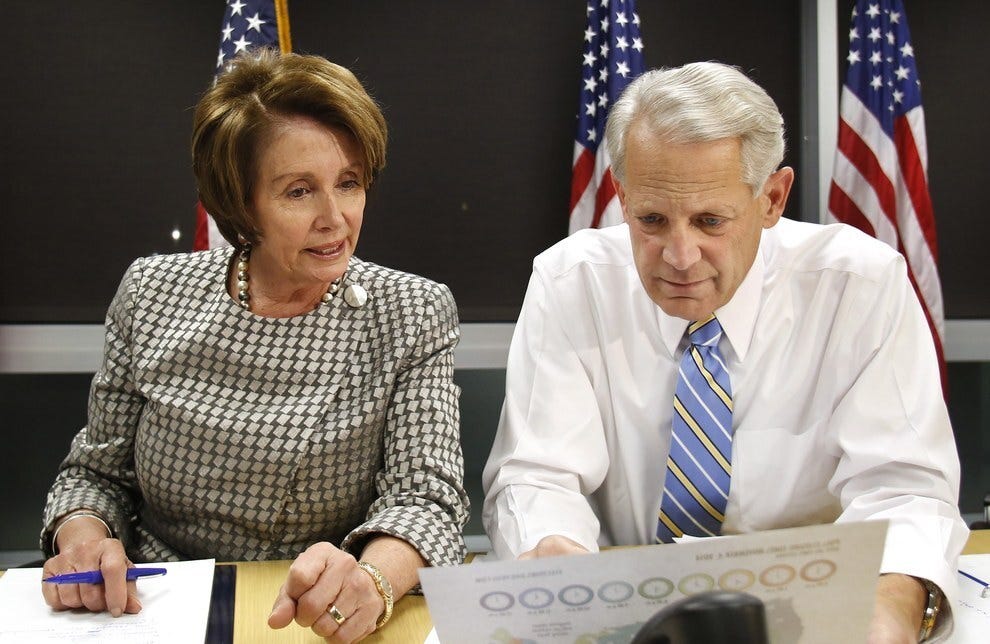
Rep. Nancy Pelosi announced Thursday that she would not seek reelection after almost four decades representing San Francisco in the House, a decision that marks the impending end of her groundbreaking career.
“I say to my colleagues in the House all of the time, no matter what title they had bestowed upon me—speaker, leader, whip—there has been no greater honor for me than to stand on the House floor and say, ‘I speak for the people of San Francisco,’” said Pelosi, who is the only woman to ever lead the House.
Local and national political observers have spent years looking ahead to what will be a competitive and closely watched election to succeed Pelosi, 85, in one of the most Democratic House seats in the country. Plenty of San Francisco politicians are now sure to consider running for a seat that, if Pelosi’s tenure is any guide, may not be open again for a long time.
Two notable names, though, didn’t wait for the speaker emerita to announce her departure before launching their own efforts.
Saikat Chakrabarti, a wealthy Democratic activist who served as campaign manager for now-Rep. Alexandria Ocasio-Cortez during her 2018 upset victory in New York City, announced he’d run in February. Chakrabarti, who insisted at the time of his kickoff—ultimately wrongly—that Pelosi was “running again,” has positioned himself as a political outsider.
State Sen. Scott Wiener announced his own effort late last month, not long before Pelosi made her plans known, saying he could no longer wait before organizing his campaign. Wiener, who would be the first gay House member to represent what has long been a center of LGBTQ life in America, said he had to act to counter Chakrabarti, whom he accused of “trying to buy the seat.”
Wiener, who avoided criticizing Pelosi in his announcement, received a high-profile endorsement from state Attorney General Rob Bonta hours after the incumbent confirmed her departure. His early start, though, is unlikely to deter other candidates—especially if one of them has Pelosi in their corner.
The congresswoman’s daughter, political strategist Christine Pelosi, has long been talked about as a potential candidate, and she recently deflected questions about her plans. The younger Pelosi instead told the San Francisco Chronicle that she was “100% focused” on Tuesday’s ballot measure to approve a new congressional map, just before the passage of Proposition 50.
The former speaker, however, may have a different person in mind as her preferred successor. Politico wrote last month that Pelosi has “been publicly elevating” San Francisco Supervisor Connie Chan, including by appearing with her at the city’s “No Kings” rally in October. While Chan has not publicly expressed interest, the outlet said she was interested in running.
Politico also mentioned former Mayor London Breed as someone that “tech powerbrokers” could recruit. Breed, though, badly lost reelection last year against fellow Democrat Daniel Lurie.
The publication additionally named former Supervisor Jane Kim, who lost a 2016 state Senate contest against Wiener and the 2018 race for mayor to Breed, as a possibility. Kim, who is now the head of the state branch of the labor-backed Working Families Party, told the New York Times all the way back in 2022 that she hadn’t “ruled it out,” but she doesn’t appear to have said anything more recently.
The field will be winnowed down to two on June 2 when California holds its top-two primary, when all candidates will compete on a single ballot, with the two highest vote-getters advancing to the general election.
This unusual system allows two contenders from the same party to face one another, and there’s almost no question that both finalists will be Democrats. The 11th District, which is entirely based in San Francisco, backed Kamala Harris 82-14 last year, according to calculations by The Downballot.
Pelosi herself had to get past a large field of opponents in 1987 when she first sought a seat in Congress. The future speaker, though, was anything but a political novice when she campaigned in the special election to succeed the late Rep. Sala Burton.
Pelosi learned politics from an early age in Baltimore as the daughter of Thomas D’Alesandro, who served the city in the U.S. House and as mayor. Pelosi and her siblings, including a brother who would also become mayor, took turns maintaining D’Alesandro’s “favor file,” which documented what he’d done for constituents who asked for his help.
Pelosi, though, would initially take more after her mother, Anunciata D’Alesandro, spending her first decades in politics as a powerful—but far less public—figure. After marrying Paul Pelosi, she moved west to his hometown of San Francisco in the 1970s and became active in the local Democratic Party.
Pelosi, who became known for using the couple’s large home for fundraisers (her husband had become wealthy in real estate investment), rose to become chair of the California Democratic Party in the early 1980s. She became close to a pair of brothers who served in Congress, Reps. John and Phillip Burton, who together were a powerful force in state and national politics.
Pelosi, though, seemed to pass up her chance to head to Washington herself in 1982 when she declined a request by John Burton, who was retiring as he combatted a drug addiction, to run to replace him in a seat that was largely located north of the city. Pelosi said her children were too young for such a campaign and instead saw the seat go to Barbara Boxer, a fellow Democrat who would later serve in the Senate.
Phillip Burton died the next year, and his widow, Sala, won the special election to represent San Francisco in the House. Sala Burton died of cancer in 1987, but she made an endorsement on her deathbed that changed Pelosi’s life—and the course of American politics.
The congresswoman, as recounted by Molly Ball in her 2020 book “Pelosi,” called Pelosi and urged her to campaign to succeed her in what was then numbered the 5th Congressional District.
“You must promise me you will run,” said Burton. “It’s the only thing that will make me feel better.” This time, Pelosi assented, and Burton publicly endorsed her shortly before she died.
Pelosi’s bid attracted endorsements from prominent California Democrats like John Burton, who chaired her campaign. (The former congressman, who died in September of this year, had gotten sober and would spend the next several decades as a major figure in California Democratic politics.)
However, Pelosi was by no means the only Democrat who coveted the seat. Her main opponent was Harry Britt, a prominent gay activist who had succeeded his boss, the legendary Harvey Milk, on the Board of Supervisors after Milk was assassinated in 1978.
Britt, who would have been one of the first openly gay members of Congress in history, argued that the ongoing AIDS crisis made it vital to have a member of the LGBTQ community in the nation’s capital.
Pelosi’s main obstacle, though, could have turned out to be another prominent figure who had initially begged off running. San Francisco Mayor Dianne Feinstein, however, began to reconsider, and Pelosi’s supporters feared that she could not win if another woman entered the race. Feinstein, though, sat the race out, and both she and Boxer would each be elected to the Senate in separate elections in 1992, which became known as the Year of the Woman.
Pelosi, who ran under the slogan “A Voice that Will Be Heard,” utilized her vast connections and personal wealth to far outspend the rest of the field.
And while Ball characterized Pelosi’s speaking as “halting and mechanical,” she proved to be an energetic politician who made over 200 campaign stops in just six weeks. Pelosi also focused on winning over enough LGBTQ voters to prevent Britt from consolidating this large bloc of San Franciscans.
Britt fought back by arguing that Pelosi was a “party girl” and “dilettante” who was being assisted by “oil companies, highrise developers, Washington lobbyists and other special interests.” Britt also made waves by acknowledging he’d hired a private investigator to probe his opponent and her family, though he admitted he hadn’t learned about “any heavy scandals.”
Another opponent attacked Pelosi—who, during the campaign, moved homes to live in the district she wanted to represent—as an outsider.
“Nancy has not spent any time in the district and basically has been involved only in party politics,” Supervisor Bill Maher charged. “Frankly, I think this race is between me and Harry.”
Maher’s read on the race was wrong. Pelosi outpaced Britt 36-32 on a ballot that featured 14 different candidates from various parties (Maher finished a distant third). A triumphant Pelosi proclaimed on election night, “When I go to Congress, I’m going to tell them that Sala Burton sent me.”
At the time, California special elections mandated that, if no one earned a majority, the top vote-getter from each party would advance to the general election. There was, however, no question that Pelosi would defeat Harriet Ross, a Republican who took a mere 3% in the first round. The New York Times commemorated her 64-31 win with the non-descript headline, “Democrat Elected in San Francisco.”
Pelosi, though, would spend nearly two decades climbing the ranks of the House on her way to obtaining a goal that almost no one would have guessed she had in 1987.
By 2006, though, she’d attained the rank of minority leader following the resignation of Missouri Rep. Dick Gephardt. That year, Democrats were finally poised to take advantage of the backlash against President George W. Bush and the Iraq War to return to the majority for the first time in 12 years.
Republicans, who already had a long history of using liberal San Francisco as a punching bag, hoped to rally conservatives and appeal to swing voters by demonizing the city’s representative. Pelosi was unimpressed by these efforts, which included a Star Wars-inspired video depicting “Darth Nancy” chasing down Republican rebels.
“Two-thirds of the public have absolutely no idea who I am,” she told Newsweek just before her party achieved a sweeping victory that made her the first woman to serve as speaker. “I see that as a strength. This isn’t about me. It’s about Democrats.”
Republicans, though, were undeterred by their failures in 2006. The GOP again made her one of its top villains during the 2010 cycle as President Barack Obama’s low approval ratings and a struggling economy dragged down Democrats across the nation.
Not every attack landed. Republicans lost a closely watched springtime special election in Pennsylvania to replace a close Pelosi lieutenant, Jack Murtha, despite an attention-grabbing “Attack of the 50-Foot Pelosi” commercial. But that fall’s red wave, which relegated Democrats back to the minority, reinforced Republican beliefs—and Democratic fears—that Pelosi would be a drag on her party as long as she remained leader.
But Pelosi’s allies, who pointed to her strong fundraising and legislative acumen, brushed off those concerns, and the Democratic leader argued her presence was more vital than ever following Donald Trump’s 2016 victory over Hillary Clinton.
“If Hillary had won, I was ready to go home,” Pelosi told reporters the next year. She said that Trump’s win instead “motivated me to stay” to protect the Affordable Care Act, legislation she had steered to passage in 2010 when much of her party was on the verge of giving up.
Republicans were more than happy to keep her as their bogeywoman, and their success in the expensive 2017 special election for Georgia’s 6th Congressional District—another campaign in which Pelosi involuntarily played a starring role in GOP attacks—set off a new wave of Democratic hand-wringing.
Following that race, several Democratic House candidates in competitive 2018 races pledged to vote against returning her to the speaker’s chair. Outside groups allied with Pelosi, though, didn’t let that deter them from spending heavily to help these skeptics win in what became known as the blue wave. Democrats returned to the majority, and Pelosi easily put down an intraparty revolt by dissident members to regain her gavel after eight years.
The speaker remained one of the GOP’s favorite targets even in the days after Paul Pelosi was almost murdered in 2022 by an intruder searching for his wife. After Republicans narrowly regained control of the House that fall, Pelosi announced that she would step down as leader so that Hakeem Jeffries of New York could take her place.
In an unusual move for former speakers, Pelosi opted to run for Congress one more time in 2024, but she finally announced this week that she was ready to retire.
At The Downballot, we don’t just cover upcoming elections. We also delve into the past to revisit elections from yesteryear, whether it’s to provide background on a new candidate, memorialize a deceased politician, or mark the retirement of a current office-holder—as managing editor Jeff Singer does just above. If you appreciate our deep understanding of the past as well as our clear-eyed take on the future, we hope you’ll consider becoming a paid supporter.

Redistricting Roundup
KS Redistricting
Despite abandoning plans for a special session of the legislature to further gerrymander the state’s congressional map, Kansas Republicans say that they plan to continue their efforts when lawmakers convene for their regular session in January.
However, the same basic problem that thwarted the GOP this year hasn’t changed. To call a special session, Republicans needed the support of two-thirds of the membership of each chamber. On paper, they have the necessary supermajorities, but a sufficient number of GOP holdouts in the state House refused to sign on to a petition to call legislators back early to redraw congressional districts.
Come next year, that same math will still apply, just in a different way. To pass a new map that targets Democratic Rep. Sharice Davids, Republicans will again need two-thirds support to overcome a guaranteed veto by Democratic Gov. Laura Kelly. GOP leaders will now have more time to keep pressuring dissidents, but they circulated their petition for a special session for more than a month before giving up earlier this week.
Governors
FL-Gov
Orange County Mayor Jerry Demings launched a bid for Florida’s open governorship on Thursday, making him the second notable Democrat in the race to succeed Republican Ron DeSantis.
Demings, who would be the state’s first Black chief executive, previously served as sheriff of populous Orange County—the home of Orlando—for a decade before winning election as mayor in 2018. His wife, former Rep. Val Demings, ran for Senate in 2022 but lost in a 58-41 blowout to Republican Marco Rubio. Demings joins former Rep. David Jolly, an ex-Republican, in the Democratic primary.
Republican Rep. Byron Donalds, who has Donald Trump’s endorsement, is the frontrunner for the GOP nomination.
IA-Gov
Investor Zach Lahn has joined the GOP primary for Iowa’s open governorship, telling the Des Moines Register that he would, as the paper puts it, “be the largest donor to his campaign.”
Several other Republicans are seeking the nod in the race to replace retiring Gov. Kim Reynolds, with Rep. Randy Feenstra the most prominent among them. On the Democratic side, state Auditor Rob Sand is the heavy favorite.
NY-Gov
Fresh off winning a second term as Nassau County executive, Republican Bruce Blakeman has finally confirmed he’s considering running against Democratic Gov. Kathy Hochul.
“I will be meeting with a group of leaders across the state in the next couple of weeks about whether I should run for governor,” Blakeman told the New York Post on Wednesday.
A day earlier, Blakeman defeated Democrat Seth Koslow by a 56-44 margin—a very rare bright spot for the GOP on a night that saw Republicans get shellacked from coast to coast. Should Blakeman seek a promotion, though, he’d be in for a primary clash with Rep. Elise Stefanik, who is reportedly set to announce a bid for governor on Friday.
House
CA-01, CA-22, CA-48
Following California’s adoption of a new House map after voters approved Proposition 50 earlier this week, EMILYs List has issued new endorsements in three redrawn districts that Democrats are hoping to flip.
In the 1st, the prominent pro-choice group has given its backing to agriculture consultant Audrey Denney, who currently is the only Democrat running against Republican Rep. Doug LaMalfa, though others are likely to join. LaMalfa has said he’ll run again despite his district becoming much bluer, telling the Los Angeles Times, “They’re not going to kidnap my district here without a battle.”
Meanwhile, in the 22nd District, EMILYs List is supporting Assemblymember Jasmeet Bains, who is challenging GOP Rep. David Valadao. A second Democrat, local school board member Randy Villegas, is also running. Villegas has criticized Bains for opposing Proposition 50, but while the new map made major changes elsewhere, it shifted the 22nd District only modestly to the left.
Finally, in the 48th District, EMILYs endorsed San Diego City Councilmember Marni von Wilpert, who faces several other Democrats. It’s not clear whether any Republican incumbent will run here, though. Rep. Darrell Issa represents the old version of the 48th, but he hasn’t firmly committed to seeking reelection in the new iteration and could instead run in the redrawn 40th, which is far redder.
CA-03
Nevada County Supervisor Heidi Hall confirmed that she’ll continue her campaign for the House following the passage of Proposition 50 on Tuesday, tweeting, “California’s 3rd congressional district has changed, but my campaign has not.”
Hall has been running against Republican Rep. Kevin Kiley since April, but her chances of victory dropped sharply after Democratic Rep. Ami Bera said he’d seek reelection in the redrawn 3rd earlier this week.
CA-13, CA-09
Former Stockton Mayor Kevin Lincoln announced Thursday that he would challenge Democratic Rep. Adam Gray in the revamped 13th District rather than continue his rematch campaign against Rep. Josh Harder in the neighboring 9th.
Lincoln, a Republican who lost to Harder 52-48 last year after an expensive contest, launched a second effort in July. His hopes of winning a seat in Congress, though, got tougher after voters approved the new map this week.
The reconfigured 13th District in California’s Central Valley would have backed Kamala Harris by a tight 49-48 spread, a shift to the left from Donald Trump’s 51-46 win there under the current lines.
But while Republicans might still have an opening against Gray, who prevailed last year in the closest House race in the nation, their prospects of taking down Harder just got a whole lot worse. The new-look 9th District would have supported Harris 54-43, an even bigger transformation from Trump’s 49-48 win under the old lines.
CA-41
Democrat Katherine Aleman said Thursday that she was ending her campaign for Congress now that California voters have approved a new congressional map.
Aleman, a teacher, chicken farmer, and former member of the Norco City Council, launched a challenge against GOP Rep. Ken Calvert in July in what was then the 41st District. But while former Sen. Barbara Boxer praised her as an “undiscovered star,” she was left without an obvious place to run after the redrawn lines placed her in Democratic Rep. Norma Torres’ 35th District.
CO-05
Democrat Jessica Killin has released a new internal poll that shows her in a close race with Republican Rep. Jeff Crank despite the recent entrance of an independent candidate who could undermine her hopes of pulling off an upset in Colorado’s conservative 5th District.
Killin’s survey, conducted by Global Strategy Group, finds Crank ahead by a 43-40 margin, while Army veteran Matt Cavanaugh takes 5% of the vote and 13% are undecided.
Killin, a former White House official under Joe Biden who also served in the Army, was also one of the top fundraisers among Democratic House candidates during the third quarter of the year, bringing in more than $1 million from donors—double Crank’s haul. Cavanaugh launched his bid after the quarterly filing deadline, so we won’t get a read on his fundraising prowess until the end of January.
IL-02
State Sen. Willie Preston, who is seeking the Democratic nomination for Illinois’ open 2nd Congressional District and has been a vocal opponent of redrawing the state’s House map, has a long history of social media posts supporting Donald Trump and attacking Joe Biden, the Chicago Tribune reports.
“So we’re supposed to just vote like our lives depend on it huh?” Preston wrote in one Facebook post. “Yea you’re right. No policy for us. This is nothing against my LGBTQIA friends whatsoever. But they want the Black community dragging everyone we know to the polls only to get nothing in return. This is what you call 47 years and a wake up and like Dr. King said it’s always the right time to do the right thing. Go to hell Joe Biden! #TRUMP2020”
In another, he said he voted for Trump in the 2020 election and even included a photo of an electronic ballot with a checkmark next to Trump’s name. Preston did not deny writing the posts but claimed to the Tribune that he did not actually vote for Trump, saying his social media history amounted to “shit-talking.”
“That’s probably the only amount of power that poor people in America have is to use their voice to talk and say outlandish things at times,” Preston told the paper. “I’m one of them. I’ll admit that. I’m guilty. You caught me.”
Preston was first elected to the Senate in 2022 and later became head of the Legislative Black Caucus, though he waged an unsuccessful primary challenge against a Democratic member of the state House in 2018.
He has also come out against revisiting Illinois’ congressional map to counter new Republican gerrymanders in other states, telling Politico last month, “We understand what’s at stake, but if Black representation is going to be diluted, that’s not a map I can support.”
IL-04
Chicago Alderman Byron Sigcho-Lopez says he’s considering an independent bid for Illinois’ open 4th Congressional District after Rep. Chuy Garcia engineered his retirement to ensure that only his chief of staff, Patty Garcia, would be able to file to run in next year’s Democratic primary.
Sigcho-Lopez, who was elected to the City Council as a Democrat in 2019, railed against the Garcias’ scheming in an interview with the Chicago Sun Times, slamming it as “machine tactics.”
“It sends a bad message to our community, especially in the middle of this horrific and atrocious attack by the Trump regime,” he told the paper. “These anointments, you know, talk about ‘No Kings.’ We also talk about no bosses.”
However, Sigcho-Lopez would face a daunting task getting on the ballot. To run in the primary for the solidly blue 4th, Democrats need to obtain just 697 signatures. By contrast, independents must gather 10,816 signatures to run in the general election—more than 15 times as many. But while filing for the primaries has already closed, Sigcho-Lopez would have until May 26 to qualify as an independent.
MI-10
Army veteran Mike Bouchard, the son and namesake of Oakland County’s longtime sheriff, jumped into the Republican primary for Michigan’s open 10th Congressional District on Thursday.
Bouchard, a paratrooper who just returned from a tour of duty in Iraq, hasn’t run for office before, but his well-known father has served in public office for more than 30 years. He joins a nominating contest that includes just one other notable Republican, attorney Robert Lulgjuraj, who raised almost $650,000 during the third quarter of the year.
A number of prominent Republicans were not satisfied with Lulgjuraj, however, and encouraged Bouchard to run, but others are still hoping wealthy businessman Kevin Rinke decides to enter.
Democrats, meanwhile, have a three-way primary for the Macomb County-based 10th District, which backed Donald Trump by a 52-46 margin last year.
NJ-11
Two new Democratic candidates have joined the already busy (and as yet unscheduled) special election to replace Gov.-elect Mikie Sherrill in New Jersey’s 11th Congressional District, former Rep. Tom Malinowski and Essex County Commissioner Brendan Gill.
Malinowski represented the 7th District for two terms after ousting Republican Rep. Leonard Lance in the 2018 blue wave. However, he narrowly lost to Republican Tom Kean Jr. in 2022 after a Democratic-drawn map weakened his district to shore up other vulnerable incumbents.
While Malinowski brings both name recognition and serious fundraising chops to the race, he has limited ties to the district he’s seeking. The new 11th incorporates just a small slice of the old 7th, and he’s also chair of the Hunterdon County Democratic Party, which is on the western border of the state and not adjacent to Sherrill’s constituency. (He says he plans to move into the district.)
Gill, meanwhile, entered the race with a large number of endorsements from fellow Democrats in populous Essex County, which makes up about two-fifths of the district. However, as the New Jersey Globe’s Joey Fox notes, voters “have grown more accustomed in recent years to voting against party-backed candidates,” particularly since the death of the Garden State’s notorious “county line” system last year.
Several notable Democrats were already running to succeed Sherrill, though it’s still not clear exactly when a special election will happen. Under state law, Democratic Gov. Phil Murphy must schedule a primary to take place 70 to 76 days after calling a special election, with a general election to follow 64 to 70 days after that.
The law doesn’t specify how quickly Murphy must act, but he can’t proceed until there’s an actual vacancy. If Sherrill waits to resign from Congress until she’s sworn in as governor on Jan. 20, the soonest a primary could happen is late March, with the general election in June. Murphy told reporters on Wednesday that he’d like to find a way to push up that schedule.
NY-15
Former Assemblyman Michael Blake launched a primary challenge against Democratic Rep. Ritchie Torres in New York’s 15th District on Thursday, criticizing the congressman for his vocal support for Israel and telling Politico, “We need to focus on cost of living.”
Blake is a borderline perennial candidate at this point, having badly lost a 2019 special election for New York City public advocate, a previous campaign for the 15th District (which was won by Torres) in 2020, and a bid for mayor earlier this year. Torres, though, has frequently antagonized progressives, though he emerged as a surprise defender of Zohran Mamdani following his victory in the mayoral primary.
TN-07
Democratic state Rep. Aftyn Behn has released her first TV ad ahead of the Dec. 2 special election in Tennessee’s conservative 7th District—featuring a mechanical bull.
As a white man in a suit clambers atop the bull, the ride is set to easy mode. Behn narrates, saying, “We all know the system is rigged in Washington. Here’s how it works: Politicians make it easy for their rich donors—tax cuts for billionaires and burying the Epstein files.”
While the man in the suit smugly rides the placid beast, a series of regular folks dressed in everyday clothes are mercilessly bucked from its back as it’s switched to a much more vigorous setting.
“Hardworking Tennesseans get a rough ride by cutting healthcare for Tennessee families, doubling health insurance premiums and tariffs that hurt our economy,” Behn continues, encouraging viewers to “vote early to shake up Washington.” Early voting in the race starts on Wednesday.
TX-09, TX-Sen
Astronaut Terry Virts announced on Thursday that he was dropping his bid for the Senate and would instead seek the Democratic nomination for Texas’ open 9th Congressional District, which Republicans just targeted with an extreme new gerrymander.
Under the new lines, the Houston-area 9th District would have voted for Donald Trump by a 59-40 spread, a massive shift from the 71-27 margin the prior version gave to Kamala Harris. The new district retains virtually nothing in common with the old one apart from its number, which is why Democratic Rep. Al Green said in August that he would not seek reelection there (but might run for the 18th).
VA-02
Democrat Matt Strickler, who served in the Cabinet of former Gov. Ralph Northam, has entered the race to take on Republican Rep. Jen Kiggans in Virginia’s competitive 2nd District.
After serving as Northam’s natural resource secretary, Strickler went on to work on similar issues for the Biden administration and Congress, Virginia Scope’s Brandon Jarvis details. He joins a busy Democratic primary that could soon be upended if, as Jarvis recently reported, former Rep. Elaine Luria launches a bid for a rematch with Kiggans.
Mayors & County Leaders
Miami, FL Mayor
Democrat Eileen Higgins leads Republican Emilio Gonzalez by a hefty 50-24 margin in their Dec. 9 runoff, according to an internal poll from Higgins’ PAC shared by Florida Politics.
This survey from MDW Communications was conducted last month, before anyone knew that Higgins and Gonzalez would face off in round two. Gonzalez, though, almost fell short of making it past another Democrat in Tuesday’s nonpartisan primary—a result that would have ended 16 years of Republican control of the mayor’s office.
Higgins, who was a commissioner in Miami-Dade County, finished firmly in first with 36%. (The candidate, who had to step down under Florida’s resign-to-run law, officially left her post on Wednesday.) Gonzalez, a former city manager who previously led the U.S. Citizenship and Immigration Services under George W. Bush, edged out former Democratic City Commissioner Ken Russell by a slender 19.5 to 17.6 margin.
Democrats had reason to feel optimistic about the runoff even before they saw this poll, though. Higgins and Russell notched a combined 54% of the vote, compared to 36% for Gonzalez and the two other main Republican contenders. Another 5% went to former Mayor Xavier Suarez, an independent and former mayor who is the father of termed-out GOP incumbent Francis Suarez.
Russell, though, says that, despite their shared political affiliation, Higgins can’t count on having the votes of his supporters next month—or even his.
“My voters could go either way,” Russell told the Miami Herald. “There’s a broad coalition there that has nothing to do with party.” Russell added that he hasn’t decided whether to support his former rival.
Gonzalez has also argued that he’d perform better in a one-on-one race now that he doesn’t have to deal with attacks from fellow Republicans like City Commissioner Joe Carollo, another former mayor who placed fourth.
“Eileen was hitting me from the left, and Joe was hitting me from the right,” Gonzalez told the paper. “I’m very happy with my performance. It’s right where I thought it would be.”
Republicans are betting that recent trends will matter far more than what happened on Tuesday.
Miami, like the rest of South Florida, has veered sharply to the right in recent years. Hillary Clinton set a high-water mark in 2016 when she carried the city by a giant 69-29 margin, but four years later, Joe Biden racked up a considerably smaller 59-40 score. In 2024, when the bottom dropped out for Florida Democrats, Kamala Harris eked out just a 50-49 win.
They’re also hoping that Higgins, who is white, will struggle to win over Miami’s large Latino electorate against Gonzalez, who was born in Cuba.
But Higgins, who earned the nickname “La Gringa” during her upset campaign for a majority-Latino seat on the county commission in 2018, believes she’ll once again demonstrate the kind of crossover appeal that’s served her well. Her team highlighted her performance on Tuesday to make the case that she’s well on her way to pulling off a victory that would also make her the first woman to lead Miami.
No one, though, knows what turnout will look like in the city’s first mayoral runoff since 2001. The victor in that contest was Manny Diaz, an independent who would go on to support Barack Obama but only became a Democrat after leaving office.
Diaz was termed out in 2009, marking the start of a winning streak for Republicans that Higgins could soon snap.
Editor’s Note: Our last newsletter incorrectly said that Nevada County Supervisor Heidi Hall did not appear to have said which congressional district she will run in following the passage of Proposition 50. Hall responded to Proposition 50’s win by writing, “California’s 3rd congressional district has changed, but my campaign has not.”
Without Nancy Pelosi, America would not have had the Affordable Care Act.
(On the other hand, had we been spared the vindictiveness of Senator Joe Lieberman, America would have been blessed with *public-option* healthcare!)
I angrily recall Seth Moulton trying to sabotage Pelosi’s re-election as the most effective Speaker in my lifetime, without even being able to present an alternative candidate. I hope Massachusetts voters aren’t foolish enough to put Moulton in the Senate.
*) EDIT: Thanks to correction by AWildLibAppeared.
Steny Hoyer also eyeing retirement per Axios