



Leading Off
AK-Gov, AK-Sen
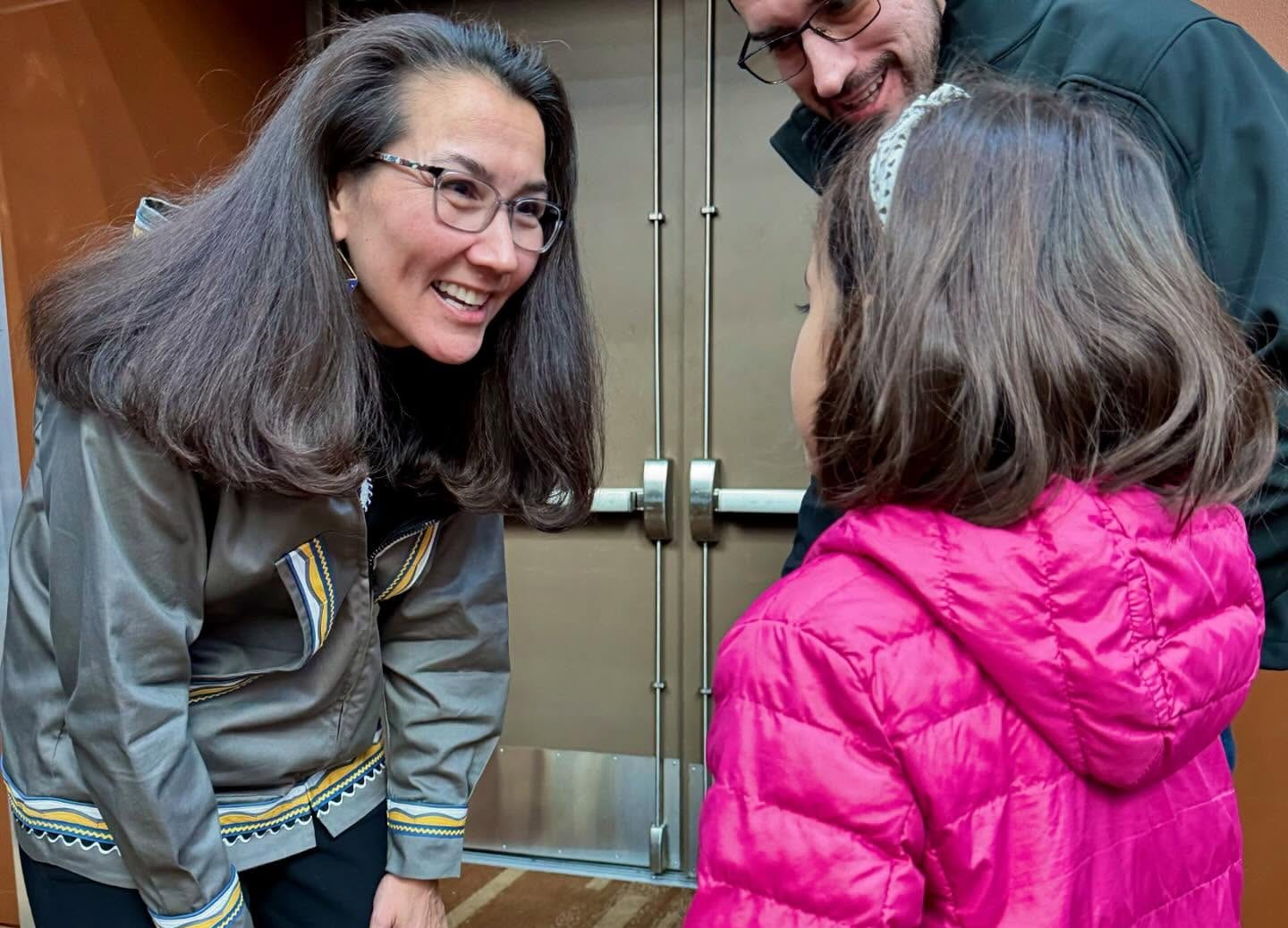
A new poll finds former Democratic Rep. Mary Peltola far ahead in a hypothetical preview of next year's open-seat race for governor of Alaska, while she narrowly trails Republican Sen. Dan Sullivan in what would be a tough race for federal office.
The Democratic firm Data for Progress, which first shared its survey with The 19th News, initially shows Peltola taking 40% in a packed race to succeed Republican Gov. Mike Dunleavy. Operative Bernadette Wilson narrowly leads Lt. Gov. Nancy Dahlstrom, a fellow Republican, 11-10 for second, while none of the other five names included in the poll take more than 6%.
The pollster, which asked respondents to rank their choices, found Peltola clearing a majority with 54% in a fifth round of tabulations, while Dahlstrom would edge out Wilson 19-16 for second; Peltola also beats Dahlstrom 65-35 when Wilson's supporters are reallocated.
(Alaska's election system works somewhat differently. Only the four candidates who win the most votes in next August's primary will advance to the general election, and voters will only then be asked to rank those finalists.)
The poll also tested Peltola in a hypothetical one-on-one Senate matchup against Sullivan and found the Republican with a tiny 46-45 edge.
Data for Progress, though, believes that the 4% of respondents who said they were "not sure" are disproportionately conservative and would "likely break towards Sullivan and increase his margin." (The remaining 5% said they wouldn't choose either candidate.)
This poll, which did not mention a client, comes at a time when Democrats in Alaska and nationally continue to wait to see whether Peltola will run for governor, Senate, the House, or none of the above.

Peltola hasn't publicly expressed a preference for any race, but observers noticed last month when she used social media to highlight Democratic state Sen. Forrest Dunbar's mad dash back to Alaska from his National Guard deployment in Poland—a trip he made at his own expense—after Dunleavy scheduled a veto override session to take place when Dunbar was supposed to be overseas.
"For folks in the Lower 48 wondering why Alaskans are talking so much about a Governor’s race 16 months out, this is what we’re dealing with," Peltola tweeted. After thanking Dunbar, who wound up on the winning side in the vote to override the governor and secure school funding, she added, "Extreme measures to combat extremist politics....Alaskan kids deserve better, and a better way is coming next November."

Just below, you’ll find our “Redistricting Roundup” section—which we’ve unexpectedly had to revive thanks to the GOP’s new efforts to ram through mid-decade gerrymanders. If you appreciate this sort of coverage, we hope you’ll consider upgrading to a paid subscription.
Redistricting Roundup
AL Redistricting
A federal court has declined to place Alabama back under the "preclearance" regime of the Voting Rights Act due to the GOP's repeated efforts to pass discriminatory congressional maps, but in a Thursday ruling, it forbade the state from engaging in mid-decade redistricting.
Under a key plank of the VRA, many states with a history of discrimination were required to submit any changes to voting laws or procedures to the Department of Justice for approval, a process known as preclearance.
In 2013, the Supreme Court struck down this system as unconstitutional, but a separate provision of the law still allows courts to require preclearance for jurisdictions that continue to discriminate against members of racial or language minorities, an option known as "bail in."
The plaintiffs in this case, who'd successfully challenged Alabama's previous congressional boundaries for diluting the strength of Black voters, had wanted the court to bail Alabama back into the preclearance system, specifically regarding its House map.
The three-judge panel that's been adjudicating the dispute since 2021 declined to do so, but it said it would retain jurisdiction over the case "until Alabama enacts a congressional districting plan based on 2030 census data." It also emphasized that, pursuant to an agreement between the parties, the state must use the map the court imposed last year for all congressional elections through the end of the decade.
Alabama, however, has also appealed the entire matter to the Supreme Court, which could overturn all the proceedings below if it finds that the remaining pillar of the VRA on which this case has hinged also violates the Constitution.
CA Redistricting
Assembly Speaker Robert Rivas said at a Friday press conference that he expects that the temporary congressional map California Democrats plan to put before voters in a special election this fall will be made public this week.
At the same event, at which California Democrats were joined by their counterparts in the Texas state House who've left the state to thwart a new GOP gerrymander, Rep. Zoe Lofgren confirmed earlier reporting that the proposal would target five Republican-held seats. She added that there was widespread backing for the idea among her colleagues.
"I'm happy to report that every single member of the California delegation is willing to support a plan to do that," she said.
In a separate appearance on CNN on Sunday, reporter Manu Raju asked Lofgren whether the new map would target Reps. Doug LaMalfa, Kevin Kiley, David Valadao, Ken Calvert, and Darrell Issa, a plan of attack previously reported by the Associated Press. Noting that there are only nine Republicans in the state's delegation, Loften said Raju's list was "a pretty good guess."
IN Redistricting
"Noncommittal" is the word multiple outlets are using to describe the reaction of Indiana Republicans to JD Vance's request that the state redraw its congressional map to target Democratic seats.
When asked by reporters whether Republicans would move forward with a remap following Vance's Thursday visit to Indianapolis, GOP Gov. Mike Braun would only say, "We listened."
However, in an appearance earlier that same day on Fox News, Braun sounded slightly more interested.
"Here in Indiana, we've become more Republican over time," he said. "And these maps probably need to be looked at anyway." While noting that it's "unusual to do it outside of a census," he also praised Texas for "leading the charge."
KY Redistricting, SC Redistricting
Republican leaders in two red states have rejected the idea of mid-decade gerrymandering in remarkably similar terms.
“With the next session being a 60-day budget session, I would give the odds of that happening somewhere around a zero percent chance,” a spokesperson for Senate GOP leadership in Kentucky told the Lexington Herald-Leader on Thursday.
The majority leader of the state House in South Carolina was even more negative—literally—when asked about the chances his state would revisit its congressional map.
"Is anything less than zero?" Davey Hiott told The State that same day.
Both states have just one Democratic-held seat: in Kentucky, the 3rd District in Louisville, and in South Carolina, the 6th District, which includes parts of Charleston and Columbia as well as the state's Black Belt. The latter district is home to a Black plurality and is likely protected by the Voting Rights Act, though the Supreme Court will soon hear arguments that could invalidate what remains of the law.
NH Redistricting
Republican Gov. Kelly Ayotte indicated in a new interview that she doesn't want to see New Hampshire pursue mid-decade redistricting, telling WMUR on Friday that "the timing is off for this because we are literally in the middle of the census period."
Ayotte didn't completely rule out the idea, but she did not sound enthusiastic, saying that "when I talk to people in New Hampshire," a redraw is "not on the top of their priority list."
Republican state Sen. Dan Innis, who is running for New Hampshire's open Senate seat, recently began pushing legislation to revisit the state's congressional map. Without Ayotte's buy-in, though, no such proposal can become law.
TX Redistricting
Texas Republicans once again failed to achieve a quorum on Friday as they seek to push through their new congressional gerrymander, with only 95 of the necessary 100 members registering their presence in the state House.
It was the third unsuccessful quorum call since House Democrats left the state in an effort to prevent the GOP from advancing its map. Republicans, however, continue to try to ramp up the pressure.
Attorney General Ken Paxton filed a pair of lawsuits in Illinois and California, asking courts in both states to enforce civil arrest warrants that were issued in Texas for the absentee lawmakers. Such warrants, however, are generally not enforced across state lines, leading the Texas Tribune to call them "a largely symbolic threat."
Paxton filed both cases in deep-red counties far from where Texas Democrats are reportedly staying, likely in an attempt to shop for a friendlier judge. Should Paxton nevertheless obtain a favorable ruling at the lower court level despite what state constitutional law expert Quinn Yeargain termed "horrible lawyering," any such decision would be unlikely to survive on appeal.
On the litigation front, Paxton has had better luck back home. On Friday, a Texas judge appointed by Republican Gov. Greg Abbott issued a two-week restraining order barring a group led by former Rep. Beto O'Rourke from financially supporting the quorum-breaking Democrats. Tarrant County Judge Megan Fahey, who issued her order just hours after Paxton filed his request, will hold a hearing on Aug. 19 to determine whether to keep it in place longer.
That same day, Paxton filed yet another suit before the state Supreme Court, asking it to declare that 13 House Democrats had "abandoned" their seats, which should therefore be declared "vacant." Paxton's arguments mirror those in a nearly identical suit brought by Abbott last week and share the same legal infirmities that Yeargain previously detailed.
Senate
ME-Sen
State Attorney General Aaron Frey is likely to seek the Democratic nomination for Senate if Gov. Janet Mills opts not to challenge Republican Sen. Susan Collins, the Washington Post reports. Frey has yet to publicly comment on his interest in such a campaign.
The attorney general of Maine is chosen by state lawmakers rather than by voters, but it can still be a springboard to elected office. Mills held this post in 2018 when she was elected governor, and the legislature picked Frey to succeed her.
MI-Sen
State Rep. Joe Tate announced Friday that he was dropping out of the Democratic primary for U.S. Senate and would consider seeking reelection to the legislature instead.
Tate, who served as speaker for two years after his party unexpectedly flipped the chamber after the 2022 elections, entered the race to succeed retiring Democratic Sen. Gary Peters in May after bailing on what had looked like an almost certain bid for mayor of Detroit. However, he raised little money through the end of June, a problem none of his major intra-party rivals have had.
The primary is now a three-way race between former Wayne County Health Director Abdul El-Sayed, state Sen. Mallory McMorrow, and Rep. Haley Stevens. Former Rep. Mike Rogers, who was the GOP's nominee last year for Michigan's other Senate seat, appears to have avoided serious opposition after Donald Trump's allies helped scare away potential opponents.
SC-Sen
Former Lt. Gov. Andre Bauer on Friday ended his brief campaign to deny renomination to Republican Sen. Lindsey Graham.
Wealthy businessman Mark Lynch and attorney Paul Dans, who was the mastermind of Project 2025, are, however, continuing to run in the primary against Graham, a longtime South Carolina politician who has Donald Trump's endorsement. A runoff would take place if no one earns a majority of the vote in the first round.
Governors
CA-Gov
Lt. Gov. Eleni Kounalakis announced Friday that she was ending her campaign for governor of California and would instead run in the top-two primary for state treasurer. That post is held by Fiona Ma, a fellow Democrat who is running to succeed Kounalakis in the lieutenant governor's office.
Kounalakis announced more than two years ago that she would run to replace Gov. Gavin Newsom, who, like both Ma and Kounalakis herself, cannot seek a third term in his current post. But while the lieutenant governor's early launch gave her a head start, it didn't deter other prominent Golden State Democrats from running or establish her as a frontrunner.
A poll from Emerson College that was also released Friday underscored how tough a task it would have been for her to break out in the packed race for governor.
The school shows former Democratic Rep. Katie Porter in first with 18% as former Fox host Steve Hilton leads Riverside County Sheriff Chad Bianco, a fellow Republican, 12-7 for the second general election spot. Eight other Democrats trail still further, with Kounalakis taking just 3%.
A 38% plurality are undecided with 10 months to go before the first round of voting in June.
House
PA-07
Northampton County Executive Lamont McClure has published a new internal poll that shows him in first place in the crowded Democratic primary for Pennsylvania's swingy 7th Congressional District, but a majority of voters remain undecided.
The survey, from Public Policy Polling, finds McClure taking 23%, while two opponents, former utility company supervisor Carol Obando-Derstine and Lehigh County Controller Mark Pinsley, take 7% apiece.
Two others, former federal prosecutor Ryan Crosswell and Bob Brooks, the president of the Pennsylvania Professional Firefighters Association, are tied at 3% each. However, 58% of voters have to make up their minds, and the primary is not until May.
Brooks, unlike the other Democrats included in this survey, has not yet announced whether he'll enter the race to oust Republican Rep. Ryan Mackenzie, though Inside Elections' Jacob Rubashkin reported last month he was "gearing up" to run.
TX-18
Former Houston City Councilwoman Amanda Edwards has earned the endorsement of EMILYs List in the Nov. 4 special election for Texas' vacant 18th Congressional District.
Edwards is one of several notable Democrats running for this solidly blue seat in the Houston area. All candidates will compete on a single ballot, and in the likely event that no one secures a majority, the top two vote-getters will move on to an as-yet unscheduled runoff.
Attorneys General
TX-AG, TX-21
Far-right Rep. Chip Roy is considering running for Texas attorney general, an open post that's one of the most powerful offices in the state.

Roy did not rule anything out when The Hill's Mychael Schnell asked for confirmation of what his sources had told him, saying merely, "I’m always considering where I can best serve the people I represent to ensure we preserve and protect a free, secure, and prosperous Texas for generations to come."
Roy, who served as Sen. Ted Cruz's chief of staff before he was elected to Congress in 2018, has spent his four terms in office infuriating his party's leaders—including Donald Trump himself.
Trump took to Truth Social in 2023 to urge someone to challenge Roy, who had endorsed Florida Gov. Ron DeSantis, in that year's GOP primary—a call no one could take up because the state's filing deadline had already passed.
Trump expressed that same wish last December after Roy opposed his last-second call to abolish the debt ceiling without Roy's desired spending cuts. No serious opponents have surfaced more than half a year later, though, and Trump has yet to fire off another post calling for the end of Roy's career.
House GOP leaders, though, would probably be just fine if Roy, a member of the obstructionist Freedom Caucus, left Congress one way or another. The congressman has a history of loudly insisting that he can't back key priorities because they don't meet his ideological standards, though he's still regularly fallen into line when it's time to actually vote.
If Roy seeks to succeed Attorney General Ken Paxton, who is leaving to run for the Senate, he'd find himself in a competitive primary.
The GOP field already includes former Department of Justice official Aaron Reitz, who has deep connections in MAGA World, as well as state Sens. Joan Huffman and Mayes Middleton. A runoff would take place if no one were to earn a majority of the vote.
No matter what Roy does, though, the GOP should have little trouble holding his House district, which is based in northern San Antonio and the Texas Hill Country. The current version of the 21st District favored Trump 61-38, according to calculations by The Downballot, and Trump would have carried it by a similar margin under the GOP's proposed new gerrymander.
Mayors & County Leaders
New Orleans, LA Mayor
Former Judge Arthur Hunter announced Thursday that he was ending his campaign for mayor of New Orleans and endorsing state Sen. Royce Duplessis in the Oct. 11 contest. Hunter, whose name will still be on the ballot, took last place in the few polls that were released.
Duplessis is competing against two members of the City Council—Helena Moreno and Oliver Thomas—in the contest to succeed termed-out Mayor LaToya Cantrell. (All are Democrats.) Duplessis and Thomas are each hoping to prevent Moreno, who has polled well ahead of her rivals, from winning the majority she needs to avert a Nov. 15 runoff.
Prosecutors & Sheriffs
Douglas County, NE Attorney
Douglas County Attorney Don Kleine, a former Democrat who joined the GOP in 2020 after his old party accused him of having "perpetuated white supremacy," faces a familiar opponent in his campaign for a sixth term next year.
Former prosecutor Amy Jacobsen announced Thursday that she would seek the Democratic nomination to oppose Kleine, who until very recently was her boss, in the race to be the top prosecutor for Nebraska's largest county, which includes Omaha and nearby communities.
Jacobsen, who spent 13 years as a deputy county attorney, told the Nebraska Examiner's Cindy Gonzalez that Kleine "fired" her less than 24 hours after she informed him she'd be running. Jacobsen recounted that Kleine offered other reasons for why she could no longer keep her post—though she did not say what they were—but said she didn't believe they were the cause for her termination.
"If he was actually unhappy, why did it take until I told him I was running to fire me?" Jacobsen asked rhetorically.
Kleine, for his part, declined to tell Gonzalez why he'd dismissed his subordinate-turned-opponent.
"Amy is fully aware of the reasons related to her separation, which were fully communicated to her," he said. "I will leave it at that."
Kleine was first elected in 2006 as a Democrat to serve as attorney for Douglas County, which has long been one of the few Democratic-friendly areas in this red state. (Kamala Harris carried it 54-44.)
Once in office, he had no trouble winning his subsequent three reelection campaigns, but his response to the 2020 fatal shooting of a Black racial justice protester named James Scurlock left him on the outs with his party.
Kleine, as Alex Burness recounted in Bolts two years later, attracted widespread attention—and condemnation—when he announced he wouldn't press charges against bar owner Jacob Gardner for Scurlock's death.
Kleine said he determined that Gardner, who was white, had acted in self-defense. He also argued that there "was never any racial tone to any of the conversation" that preceded their confrontation. Under pressure, though, he soon appointed a special prosecutor who indicted Gardner on charges of manslaughter. Gardner killed himself days later.
The Nebraska Democratic Party responded to Kleine's handling of the case by passing a resolution "denouncing the actions of elected Democrat Don Kleine in his handling of the James Scurlock case in a way that perpetuated white supremacy and sparked deep division in Omaha."
State party chair Jane Kleeb said at the time that the state party was "not condemning Don Kleine" and even was ready to support him for reelection, but the incumbent had no interest in taking her up on the offer. Kleine announced weeks later that he was joining the GOP, and prominent Nebraska Republicans quickly embraced their new compatriot.
Democrats hoped to punish Kleine at the ballot box in 2022, but he instead prevailed by a convincing 57-43 spread. Kleine, who is 72, announced last month he'd seek a sixth term, telling the Omaha World-Herald, "I’ll continue to be in the courtroom because I like to set an example. I still have the energy. I still have the desire."
But Jacobsen, who is his first notable opponent, believes it's time for change.
"The public’s trust in the justice system has slipped, and for good reason," she argued in her interview with Jacobsen. "As Douglas County Attorney, I will be focused on working together with community leaders and law enforcement to repair and reform the office’s culture."
I totally understand why Mary Peltola would choose to run for governor. That’s a position in which she can make consequential decisions that will really make a difference to Alaskans. In the Senate, she would be just one of a hundred votes/voices – and it sounds like it would be an uphill climb for her to get there.
Frey served 5 years in the Maine House of Representatives representing the Bangor area. Good to see a "name" as an alternative if Mills doesn't run. He might even be a better choice since he's younger and hasn't accumulated the bruises that come with serving a high-profile office like Governor.