



Leading Off
FL-11
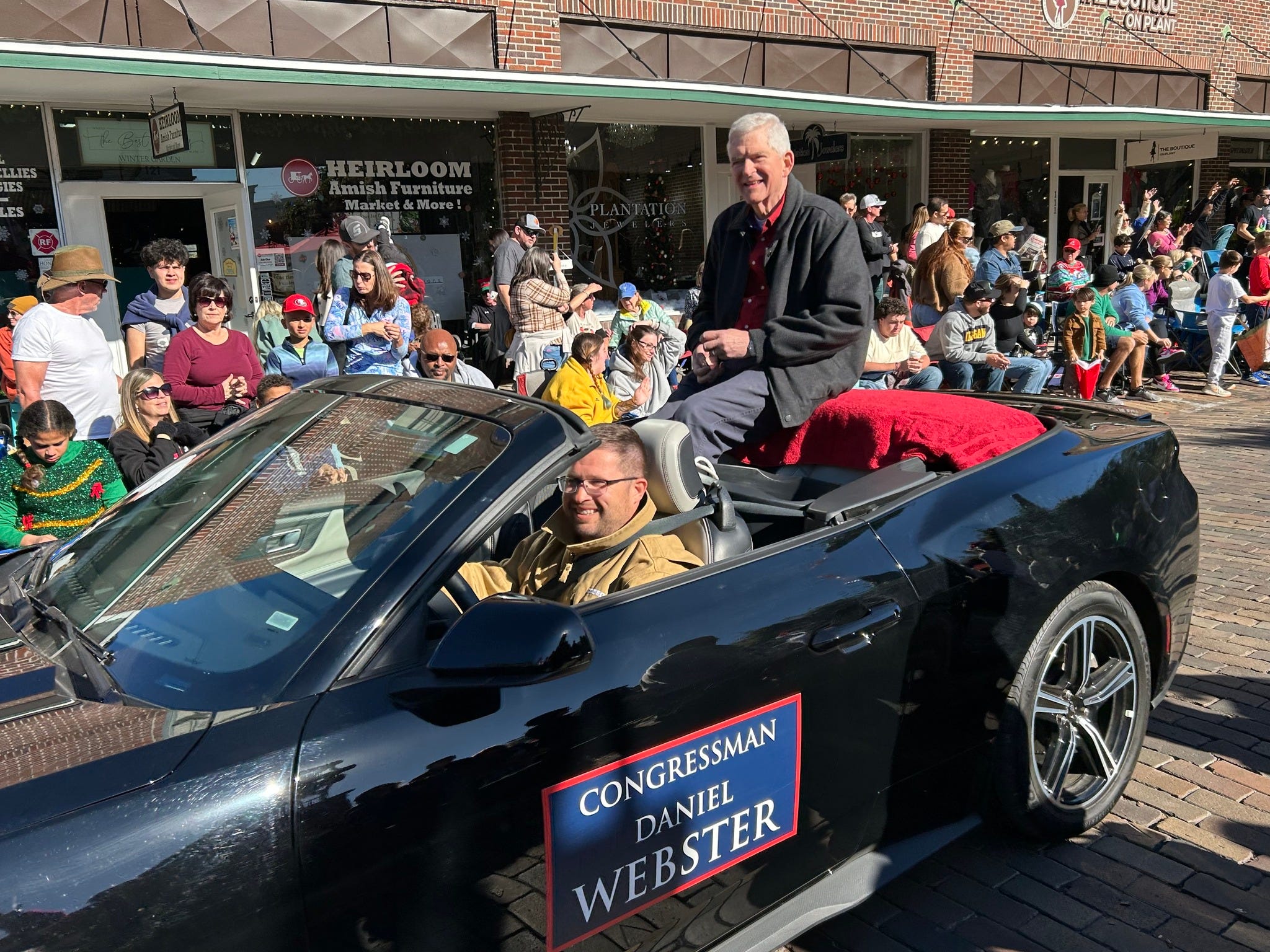
Republican Rep. Daniel Webster said Tuesday that he would not seek a ninth term representing Florida’s 11th Congressional District, an announcement that marks the end of a lengthy career in which Webster both made history and nearly lost his seat in Congress on three different occasions.
Webster, who revealed his plans a day after his 77th birthday, is leaving behind a constituency that includes Disney World, Orlando’s western suburbs, and the gargantuan retirement community of The Villages.
Donald Trump carried the current incarnation of this district 58-41 in 2024, and he would have taken it by a similar 57-42 spread under GOP Gov. Ron DeSantis’ proposed new gerrymander.
Anyone looking to replace Webster has until June 12 to file to run in the Aug. 18 primary. Florida, unlike its neighbors, does not have primary runoffs, so whoever wins a plurality in the GOP primary will be favored to capture the seat in the fall.
But the state’s political landscape was quite different in 1980 when Webster, who, according to family lore, is related to the famed 19th-century politician of the same name, first ran for office at the age of 31.
Webster decided to seek a seat in the state House, which had been dominated by Democrats since Reconstruction, after local officials in Orlando’s Orange County rejected a proposal by his church to rezone a home as a Sunday school.
Ronald Reagan’s landslide victory over Jimmy Carter helped Webster narrowly win in the general election, but state Democrats remained firmly in power. Webster, however, rose through the ranks in the minority caucus as his party gradually picked up more seats. His patience was finally rewarded in 1996 when Republicans flipped the chamber and made him the first GOP speaker since 1874.
Term limits forced Webster to leave the chamber just two years later, but he successfully made the jump to the state Senate in 1998. Webster’s attempts to become the chamber’s president faltered, though he did claim the still-influential post of majority leader in 2006.
Webster was again termed out in 2008, the same year that Democrat Alan Grayson flipped what was then numbered the 8th Congressional District in the Orlando area. Webster initially decided against challenging the freshman congressman, who attracted national attention when he summed up the GOP’s healthcare plan as “die quickly,” but he changed his mind and entered what had become a busy primary field.
Webster’s late start didn’t stop him from easily winning the GOP nod, though, and he surfed the 2010 national Republican wave to a landslide 56-38 victory over Grayson. (Grayson would return to Congress after winning a 2012 election for a new seat, but he would give it up to wage an unsuccessful Senate campaign in 2016.)
But despite his easy initial victory, Webster came close to losing his seat no fewer than three times over the next decade.
His first serious threat came in 2012, when Democrats recruited former Orlando Police Chief Val Demings to challenge him. Demings’ task got considerably tougher after GOP lawmakers passed a new gerrymander that made Webster’s constituency, now numbered the 10th, considerably more conservative. The incumbent, though, ran behind Mitt Romney and only prevailed 52-48.
While Webster had no such trouble in 2014, he received dire news the following year when the Florida Supreme Court, which still had a liberal majority at the time, struck down the GOP’s congressional map for violating the voter-approved Fair Districts Amendments.
Webster recognized that his district was about to become dramatically more Democratic, but he seemed to have no good options for continuing his political career. That sense of doom hovered over Webster’s long-shot bid to replace House Speaker John Boehner after Boehner stepped down mid-way through his term in 2015.
Webster was unable to keep Paul Ryan out of the speaker’s chair that October, but his fortunes began improving the following month when GOP Rep. Richard Nugent announced he wouldn’t seek reelection in the reliably red 11th District. Webster eventually decided to run to succeed his colleague, even though he represented less than a fifth of the redrawn constituency.
Nonetheless, Webster scored a 60-40 victory in the primary over Justin Grabelle, Nugent’s former chief of staff and preferred successor, before easily winning the general election. Demings, meanwhile, replaced Webster in the revamped 10th District, which she would eventually leave behind when she unsuccessfully challenged Republican Sen. Marco Rubio in 2022.
Webster’s third and final major scare came that same year, when an infamous far-right loudmouth almost ended his career.
Laura Loomer, a self-described “proud Islamophobe” who had raised millions in 2020 for a doomed campaign against Democratic Rep. Lois Frankel in the 21st District far to the south, ventured up to central Florida to challenge Webster for renomination.
Loomer blasted the incumbent as one of the “do-nothing Republicans who are in safe red seats who have an ability to push back and fight back against what is happening and they’re not” and won outsized attention for her effort.
Redistricting also once again complicated Webster’s life. Gov. Ron DeSantis rammed through a new gerrymander that, to spread conservative voters throughout the Orlando area, left Webster with a constituency that was almost two-thirds new to him. The state Supreme Court, which by now had a conservative majority, blessed the new boundaries this time.
In the end, Webster survived his bout with Loomer with a shockingly weak 51-44 win—a near miss that helped propel Loomer to even greater influence in GOP politics. The narrow escape proved to be a one-off, though, as the congressman easily secured victory in 2024 for what would be his final term.
Webster announced his retirement one day after DeSantis unveiled his new proposal to re-gerrymander Florida—an idea the congressman had urged him not to pursue in the first place.
“Don’t do it. I’ve said it from the beginning,” Webster told Punchbowl News last month. “I’ve been around enough reapportionments to know it’s a slippery slope.”
David Nir here, publisher of The Downballot! It’s been our hope since day one to keep this newsletter paywall-free, but it’s a goal we can achieve only if folks who are able to support our work sign up as paid subscribers. If you appreciate our unique coverage of overlooked elections and are in a position to upgrade your subscription, we’d be tremendously grateful if you’d consider doing so.
Redistricting Roundup
WI Redistricting
A panel of three Wisconsin judges dismissed a lawsuit challenging the state’s congressional map as an incumbent-protection gerrymander on Tuesday, saying that a state Supreme Court ruling from 2021 bars lower courts from entertaining the plaintiffs’ claims.
In that earlier Supreme Court case, a conservative majority rejected arguments that the state Constitution barred partisan gerrymandering, concluding, “Claims of political unfairness in the maps present political questions, not legal ones.”
Plaintiffs in this latest lawsuit sought to differentiate their case by arguing that Wisconsin’s map was instead an “anti-competitive” gerrymander designed to help reelect incumbents of both parties.
The panel, however, ruled that it was “unable to meaningfully distinguish between ‘fairness’ and ‘competitiveness’” as far as Supreme Court precedent was concerned.
“These holdings are dispositive of Plaintiffs’ claims, and this panel, as an inferior court, is obligated to obey them,” the judges wrote. “Until the Supreme Court says otherwise, Plaintiffs’ claims are non-justiciable and non-cognizable under Wisconsin law.
The plaintiffs told the Associated Press’ Scott Bauer that they would appeal, and they could get a more favorable audience, since liberal justices—several of whom dissented in that 2021 case—now hold a majority on the state Supreme Court.
House
CA-14
Eleven candidates have filed to run in the summertime special election for California’s safely blue 14th District, scuttling a Democratic plan to rally around a placeholder who could have filled the seat two months early.
Several Democrats who were running for a full term had urged the field to unite behind former state Sen. Bob Wieckowski, arguing that he was best-suited to win an outright majority in the first round of voting on June 16. That would have allowed Wieckowski to be seated in Congress right away, replacing former Rep. Eric Swalwell’s vote in the Democratic caucus.
However, one of the leading Democrats seeking a full term, state Sen. Aisha Wahab, declined to join the call to get behind Weickowski and opted to run in the special election herself. Two other Democrats are also running in both races: BART board president Melissa Hernandez and self-funding businesswoman Rakhi Israni, both of whom had supported the placeholder strategy.
They’ll be joined by two more little-known Democrats, five Republicans, and one independent. Given the large field, it’s likely that a runoff will be required on Aug. 18, though it’s possible Wahab could win a majority in the first round given her prominence.
Three other Democrats, all of whom had backed Weickowski, have opted to run solely for a full term: San Leandro City Councilman Victor Aguilar, campaign operative Matt Ortega, and nonprofit founder Carin Elam.
FL-07
Ryan Elijah, a former TV anchor with Orlando’s Fox affiliate, announced Tuesday that he would challenge scandal-ridden Rep. Cory Mills in the Republican primary for Florida’s 7th District.
Elijah told Fox News he was running because of the “serious” allegations against Mills, who, among other things, has been accused of domestic abuse against two different women.
Mills has proclaimed his innocence and continued his campaign for reelection, and Donald Trump rewarded him with an endorsement in February. The congressman, however, has struggled to convince donors he’s worth investing in and finished March with less than $120,000 in the bank.
A few other Republicans were already challenging Mills for renomination, but none of them have attracted much attention or money. But Elijah, who left Fox35 earlier this month, argues Republicans would be courting disaster in the general election if they renominate Mills.
Trump carried the current incarnation of the 7th District by a 56-43 spread, while Gov. Ron DeSantis’ proposed new gerrymander would reduce Trump’s margin of victory to 55-43. The map, which would weaken Democrats in other Central Florida seats, would still leave Mills in a conservative constituency, but Elijah said there’s “obviously a chance we could lose the seat” if the incumbent is on the November ballot.
Democrats, meanwhile, are hoping to take advantage of the situation Elijah is seeking to prevent. The most prominent contender is Bale Dalton, a former NASA chief of staff. Navy veteran Marialana Kinter has also raised a notable sum, though Dalton has maintained a large financial edge.
NY-11
Democrats face a potential catastrophe in New York’s 11th Congressional District as their only candidate who’s actually running just got knocked off the ballot, while their only candidate on the ballot is not actually running.
The debacle took full form on Tuesday when New York City’s Board of Elections ruled that Michael DeCillis, a former officer with the New York Police Department, had failed to submit enough signatures to make the June primary ballot.
The objections to DeCillis’ signatures were filed by Rennie Meyers, a staffer for the other Democrat in the race, electrician Allison Ziogas. Ziogas, though, dropped her short-lived bid last week, leaving DeCillis as the lone Democrat seeking to take on Republican Rep. Nicole Malliotakis.
At a hearing before the Board of Elections on Tuesday, attorneys for the Ziogas campaign sought to withdraw Meyers’ objections to DeCillis’ filings and also sought to remove Ziogas’ name from the ballot. The panel, however, denied both requests.
It’s not clear what might happen next, though the Staten Island Advance recently reported—after Ziogas dropped out but before DeCillis was disqualified—that Staten Island Democrats were considering trying to field an independent candidate.
The deadline for such a candidate to file is May 26, though they’d have to collect 3,500 signatures—almost three times as many as the requirement for those affiliated with a recognized political party.
Judges
WI Supreme Court
Wisconsin Court of Appeals Judge Pedro Colon has joined next year’s race for an open seat on the state Supreme Court, making him the second liberal candidate hoping to replace retiring conservative Justice Annette Ziegler.
Two weeks ago, Clark County Circuit Court Judge Lyndsey Brunette kicked off her campaign to flip Ziegler’s seat, a prospect that would give progressives a 6-1 edge on a court that conservatives had dominated until 2023.
Colon’s entry, though, makes it likelier that the state will hold a primary next spring, something that wasn’t necessary in this year’s contest—won in a landslide by liberal Judge Chris Taylor earlier this month—because only two candidates filed.
No conservative contenders have emerged yet for 2027, but should three or more candidates file to run, they’d all face off in an officially nonpartisan February primary. The top two vote-getters would then advance to a second round of voting in April.
Poll Pile
IA-Sen (D): FM3 Research for VoteVets (pro-Josh Turek):
Josh Turek: 48, Zach Wahls: 28.
Unreleased March poll: 34-25 Wahls.
MI-Sen (D): Glengariff Group for the Detroit Regional Chamber:
Haley Stevens: 25, Abdul El-Sayed: 23, Mallory McMorrow: 16.
May 2025: Stevens: 34, El-Sayed: 22, McMorrow: 14.
TX-Sen: Slingshot Strategies for Texas Public Opinion Research:
James Talarico (D): 44, John Cornyn (R-inc): 41.
Talarico (D): 46, Ken Paxton (R): 41.
CA-Gov (top-two primary): YouGov for CBS:
Steve Hilton (R): 16, Tom Steyer (D): 15, Xavier Becerra (D): 13, Chad Bianco (R): 10, Katie Porter (D): 9, Matt Mahan (D): 4, Antonio Villaraigosa (D): 4, Tony Thurmond (D): 1, undecided: 26.
MI-Gov (D): Glengariff for the Detroit Regional Chamber:
Jocelyn Benson: 66, Chris Swanson: 8
The Detroit Regional Chamber supports Mike Duggan, a former Democrat who is running for governor as an independent.
MI-Gov (R): Glengariff for the Detroit Regional Chamber:
John James: 37, Perry Johnson: 20, Mike Cox: 10, Aric Nesbitt: 7, other candidates 3% or less.
OR-Gov (R): Hoffman Research Group for Crosstabs:
Christine Drazan: 35, Ed Diehl: 18, Chris Dudley: 14.
TX-Gov: Slingshot Strategies for TPOR:
Greg Abbott (R-inc): 48, Gina Hinojosa: 43.
Emerson generic Ds by 10. https://x.com/PpollingNumbers/status/2049438477582737768?s=20
Opinion Diagnostics (a GOP-leaning outlet) has Roy Cooper leading by 50.4% to Michael Whatley's 41.4%. They surveyed 830 NC voters from April 21st-24th, with a margin error of 3.5 percentage points.
https://www.wral.com/news/nccapitol/cooper-leads-whatley-in-us-senate-race-new-nc-polls-april-2026/
If the GOP polling has Cooper leading Whatley by almost 10 points and it holds through the summer, it's going to be a blowout for Republicans across the board.