


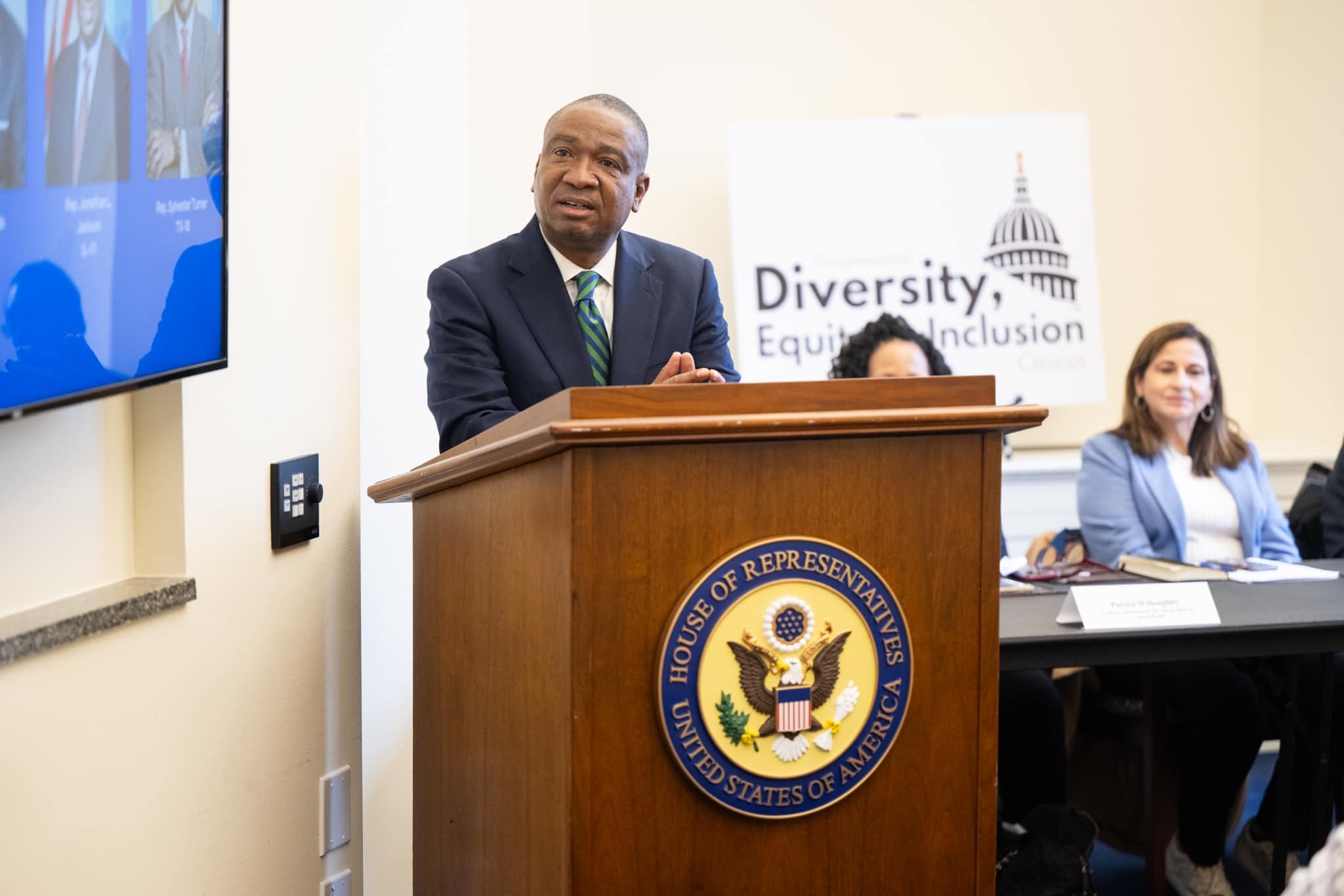
Leading Off
LA Redistricting
Republican Gov. Jeff Landry signed a new congressional gerrymander on Friday after both chambers of Louisiana’s Republican-dominated legislature passed a map that transforms Democratic Rep. Cleo Fields’ predominantly Black 6th District into a majority-white and safely Republican constituency.
Following similar moves in Alabama and Tennessee, Fields’ seat is now the third majority-Black constituency that Republicans have sought to eviscerate following the Supreme Court’s late April decision to gut the Voting Rights Act in Louisiana v. Callais.
According to data from the Redistricting Data Hub uploaded to Dave’s Redistricting App, Donald Trump would have won at least 65% of the vote in five of Louisiana’s six congressional districts in his most recent election. The lone exception is Democratic Rep. Troy Carter’s 2nd District in the New Orleans area, which will once again be the Pelican State’s only majority-Black and safely Democratic district.
Fields, who was elected to Congress in 2024 after a 28-year absence, has not yet announced what he’ll do now that mid-decade redistricting has made it all but impossible for him to win again.
In 1992, Fields was first elected to represent what was then numbered the 4th District after the legislature, which at the time was dominated by conservative Democrats, created a second majority-Black district to accompany five predominantly white seats. (The state lost its seventh House seat after the 2010 census.)
That victory made Fields, who was elected two years after Democrat Bill Jefferson won the 2nd District, the second Black person to represent the state since Reconstruction.
But federal courts ruled that Fields’ sprawling district, a skinny Z-shaped constituency that hugged the state’s northeastern borders with Arkansas and Mississippi, was an impermissible racial gerrymander and ordered it to be redrawn.

In response, the 4th was dramatically refashioned, linking Fields’ base in Baton Rouge with Shreveport in the northwestern corner of the state. He easily won that district, too, but he wouldn’t get to represent it for long.
The courts again determined it was an unconstitutional racial gerrymander, prompting the state to replace it in 1996 with a heavily white district that resembled the one it had used in the 1980s.
Fields, who had badly lost his campaign for governor against Republican Mike Foster the previous year, understood he had little chance to win the latest iteration of his district. The congressman did not seek reelection, though he quickly returned to elected office in 1997 by winning a seat in the state Senate.
Louisiana, which is about one-third Black, would continue to have just one majority Black district for almost another three decades. Only in 2024 did things finally change, after a federal court ruled that the state was obligated to draw a second district where Black voters could elect their preferred candidate.
That candidate turned out to be Fields, who had left the state Senate following the 2007 elections because of term limits but returned in 2019. And the district he sought, now numbered the 6th, bore a close relationship with the one he’d won in 1994.
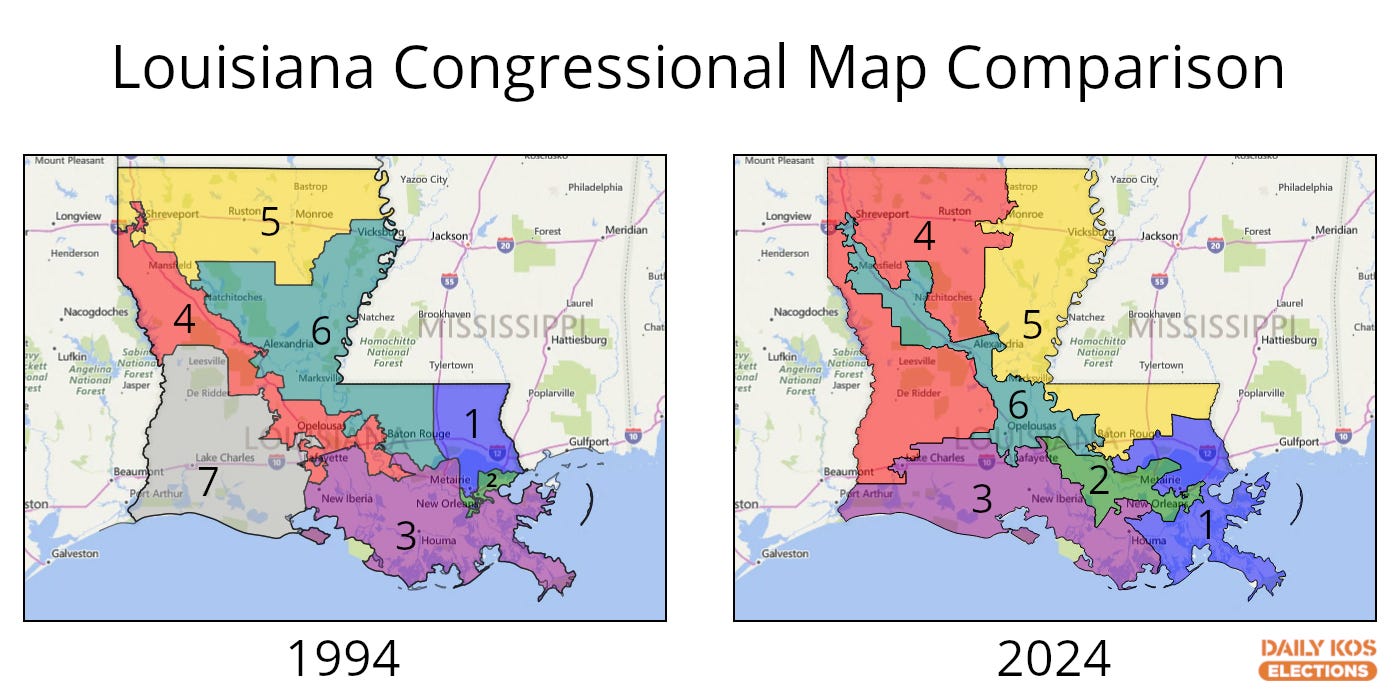
Once again, though, that configuration proved to be its undoing. A group of voters, unhappy with the new district, challenged it as a racial gerrymander in a separate lawsuit.
The Republican-appointed supermajority on the U.S. Supreme Court sided with them in Callais, striking down the 6th District in a decision that eviscerated the Voting Rights Act and turbocharged the GOP’s drive to gerrymander predominantly Black congressional districts out of existence.
Landry immediately sought to cancel the state’s House primaries even though 45,000 votes had already been cast, and Republican lawmakers quickly set about drawing up a new map to erase at least one of the state’s two Black districts.
While there was initially talk that GOP lawmakers could target both Carter and Fields, or even go after Carter while leaving Fields alone, they instead approved boundaries similar to those used from 2012 through 2022.
But that’s not the only way Republicans have turned back the clock. Landry signed a bill last month requiring all House elections this year to use the all-party primary system the state employed in most elections from 1975 onward.
Under that method, all candidates from all parties will run on a single ballot on Nov. 3, with the top two vote-getters advancing to a Dec. 2 runoff if no one wins a majority. Candidates have until Aug. 7 to file. This change does not impact the race for U.S. Senate, where both parties will hold primary runoffs on June 27.
But while it’s far too early to know who will replace Fields in the 6th District, which once again incorporates largely white areas in and around Baton Rouge, there’s little question that Louisiana’s next congressional delegation will include five white Republicans and just one Black Democrat.
Fields drew attention to this imbalance—Louisiana is a third Black—when he appeared before the legislature last month alongside Carter, Jefferson, and former Rep. Cedric Richmond.
“Since Reconstruction, Louisiana has elected four African Americans to Congress,” Fields told lawmakers, “and you’re looking at all of them.”
One of the things we’ve long been proudest of at The Downballot is our ability to set aside our personal preferences when we analyze elections.
Far too many pundits out there can’t separate the two. They puff up the chances of candidates they like and pooh-pooh the prospects of candidates they dislike. And when the former succeeds, it’s because they embraced that particular commentator’s preferred vision. When the latter fails, it’s because they didn’t.
If you’re as sick of the hot takes as we are, then we hope you’ll consider supporting our work. We always play it straight, no matter how unfashionable that might be.
Redistricting Roundup
WI Redistricting
The Wisconsin Supreme Court on Friday agreed to hear an appeal of a lawsuit challenging the state’s congressional map as an incumbent-protection gerrymander, which a lower court dismissed in April. The justices, though, rejected a request by plaintiffs to expedite the hearing, so any decision almost certainly won’t impact this year’s elections under the current map.
Senate
MA-Sen
Sen. Ed Markey defeated Rep. Seth Moulton 73-27 at the Massachusetts Democratic Party’s convention on Saturday, but Moulton exceeded the 15% of the vote necessary to secure a spot on the primary ballot. The two will face off again in a closely watched Sept. 1 nomination battle.
ME-Sen
Democrat Graham Platner’s campaign acknowledged Saturday that he had sent sexually explicit text messages to multiple women after he was married in 2023. An aide told the New York Times that Platner had ceased such activities before launching his bid for Senate in August of last year.
The admission came after the Wall Street Journal reported that the candidate’s wife, Amy Gertner, had told the campaign days after his kickoff she’d discovered the messages several months earlier.
Gertner, who serves as the campaign’s volunteer coordinator, said in a subsequent statement Saturday that she had “confided deeply personal details about my marriage to someone I considered a friend.”
While she did not name that person, Genevieve McDonald, who resigned from the Platner campaign last October following a series of revelations about the candidate’s social media history, told the Times that Gertner had come to her out of concern the messages could hurt Platner’s effort to defeat Republican Sen. Susan Collins.
In her statement, Gertner also defended her husband, the presumptive Democratic nominee, and said their marriage is now “stronger than ever before.”
The Platner campaign later shared a video in which Gertner told the audience she believed it was “shameful behavior to spend time and energy and resources on negative ads and negative stories on Graham when all he’s trying to do is improve the lives of people who work for a living.”
MN-Sen, MN-Gov
The Minnesota Republican Party gave its formal endorsement to Navy SEAL veteran Adam Schwarze’s bid for Senate and did the same for businessman Kendall Qualls, who is running for governor. But despite their success at the GOP’s convention over the weekend, both still have to get through tough primaries on Aug. 11.
After six rounds of voting on Friday, the roughly 2,000 delegates backed Schwarze by a 63-32 margin over former sports broadcaster Michele Tafoya, the candidate preferred by the National Republican Senatorial Committee. The win gives Schwarze access to the state party’s resources, though it doesn’t guarantee him the nomination—even if, in the past, it might have.
That’s because activists from both parties in Minnesota have long taken their endorsement process seriously, and candidates have often pledged to, in local parlance, “abide” by the convention results and end their campaigns if someone else wins.
Tafoya, though, said she would continue her campaign to flip the seat held by retiring Democratic Sen. Tina Smith. Tafoya has reason to think she’ll do better with the far larger primary electorate: She ended March with almost $1.9 million in the bank, while Schwarze had just over $200,000 to spend.
The two, however, won’t have the primary to themselves this summer. Former NBA player Royce White, a far-right conspiracy theorist who waged a disastrous 2024 campaign for the state’s other Senate seat, was eliminated from contention for the endorsement after the first ballot on Friday, but he, too, said he would keep running.
In an even longer marathon the next day, Qualls beat House Speaker Lisa Demuth 60.4 to 37.3 in the 10th and final round of balloting, which was just above the 60% threshold necessary to win an endorsement. Delegates supported Qualls, who would be Minnesota’s first Black governor, hours after they took part in a moment of silence for Derek Chauvin, the police officer convicted of murdering George Floyd.
Demuth and Qualls were the only two notable GOP candidates who pledged to abide by the convention, but Demuth had an apparent change of heart after her defeat and would not commit to dropping out afterwards. The speaker complained about technical problems during the protracted vote, which at one point required a 30-minute recess to check for “inconsistencies.”
Demuth has until Tuesday’s filing deadline to make her decision, though Qualls will face opposition no matter what she does. Other Republicans like Mike Lindell, one of the most notorious election conspiracy theorists in the nation, have already said they’ll forge on to the primary.
There was less suspense going into the Democratic convention this weekend.
Lt. Gov. Peggy Flanagan all but secured her party’s endorsement for Senate on Wednesday when Rep. Angie Craig announced she would skip the convention and focus on the primary. Delegates backed Flanagan by acclamation.
Sen. Amy Klobuchar, meanwhile, won the endorsement to succeed retiring Democratic Gov. Tim Walz following a last-minute challenge from the left.
Klobuchar defeated former legislative aide Kobey Layne, who would be the first trans person to lead any state, 68-27. Layne says she’ll continue running in the primary, though she’s unlikely to pose much of a threat to the well-known Klobuchar.
WY-Sen, WY-AL
Wyoming Gov. Mark Gordon did not file to run for any office before the deadline passed on Friday. Previously, Gordon had not ruled out seeking the Republican nomination for U.S. Senate or House, though he never took any steps to prepare a campaign for either open seat.
Governors
AK-Gov
Former Gov. Bill Walker, an independent, said Thursday he’s considering launching a last-minute campaign to regain his old job. Walker, who was elected to his only term in 2014, has until Monday evening to decide whether to join the packed field that will duke it out in a top-four primary on Aug. 18.
IA-Gov
Donald Trump endorsed Rep. Randy Feenstra on Friday, just hours after a poll unexpectedly showed Feenstra taking second place in Tuesday’s Republican primary for Iowa governor.
The GOP firm JMC Analytics, which says it’s not affiliated with any Iowa candidates running for governor or Senate, finds wealthy businessman Zach Lahn edging out Feenstra 27-24. Adam Steen, who served in the administration of retiring GOP Gov. Kim Reynolds, is at 16%, while two others have single-digit support.
The only publicly available poll of this race was an April survey for Feenstra’s campaign that showed him crushing Steen 41-9, with Lahn at 8%.
But Lahn, who has used his wealth to finance his advertising campaign, has hoped to capitalize on what the Des Moines Register reported in April was a widespread lack of enthusiasm for the congressman within the party base.
“I haven’t seen him in Iowa,” one voter told the paper. “And I know he’s got a job in Washington and that sort of thing, which I haven’t seen him do anything with either. So, my overall opinion right now of Randy is not real good.”
And even when he’s been on the trail, the congressman has had trouble generating much excitement.
“I routinely see more people at events for state legislative candidates,” Laura Belin wrote at Bleeding Heartland of the crowd at a February campaign event Feenstra’s team characterized as a “packed house.”
Despite his seemingly low-energy campaign, though, none of Feenstra’s four opponents had managed to emerge as the main alternative to the frontrunner for most of the race, and the congressman looked set to capture the GOP nod with ease.
But in the final days of the race, the campaign grew tenser. Feenstra’s allies launched ads charging that Lahn had “invested $1 million in a sex toy company,” while Lahn countered that Feenstra “ran a program that gave taxpayer-funded benefits to illegal immigrants.”
Trump’s late endorsement may be enough to propel Feenstra to victory on Tuesday. But if MAGA’s master can’t assuage the congressman’s skeptics, the GOP may need to wait a while longer to learn the identity of its nominee.
That’s because Iowa has a unique law that requires candidates for many offices to win at least 35% of the vote to secure their party’s nomination at the ballot box. If no one hits that threshold, the task of picking a nominee falls to delegates at a party convention.
There’s no such drama on the Democratic side, where state Auditor Rob Sand has no opposition on Tuesday’s primary ballot.
Iowa, once a regular battleground, shifted hard to the right during the Trump era, but Republicans appear more than a little concerned that Sand could become the state’s first Democratic governor in 16 years.
Last month, the GOP-dominated legislature approved a bill to limit the governor’s emergency powers, legislation Democrats said only passed because Republicans are worried Sand could soon be in charge. Reynolds has not yet signed the bill.
OK-Gov, SC-Gov
Donald Trump endorsed two more candidates running to succeed outgoing Republican governors on Friday: former state Sen. Mike Mazzei of Oklahoma and South Carolina Lt. Gov. Pamela Evette.
Trump’s decision to back Mazzei ahead of the packed June 16 primary startled political observers in Oklahoma, Reese Gorman of NOTUS reported.
“My phone is blowing up with Oklahoma officials and politicos absolutely SHOCKED at this endorsement,” Gorman tweeted. “Nobody saw this coming.”
Mazzei, who served as budget secretary to termed-out Gov. Kevin Stitt, seemed like an afterthought for most of this race. Indeed, every poll published last year showed him taking 2% of the vote at best.
Those surveys generally found Attorney General Gentner Drummond and former House Speaker Charles McCall as the frontrunners to advance to an all but certain primary runoff. Meanwhile, former state cabinet official Chip Keating, the son of former Gov. Frank Keating, typically trailed far behind, though his famous name gave him reason to think he could move forward.
Mazzei, though, has been on the upswing in the few polls that were released in 2026, and a survey released mere hours before Trump made his endorsement gave him more reason to smile.
The Club for Growth, whose network is airing ads attacking Drummond but has not endorsed any of his rivals, publicized an internal poll from Pulse Decision Science showing the attorney general in first place with 24% of the vote. Mazzei, however, was just behind at 22—good enough for the second spot in a probable Aug. 25 runoff. Keating, meanwhile, was at 17 and McCall at 12.
The pollster’s memo also argued that, while Drummond is still in the lead, his standing has fallen precipitously as Mazzei’s has risen. In an unreleased Pulse poll from early April, Drummond took 33%, with Keating edging out Mazzei 21-15 for second, and McCall stalled at 12.
Trump’s decision to back Evette going into South Carolina’s June 9 primary, by contrast, was far less surprising.
Evette already had the support of termed-out Gov. Henry McMaster, a longtime Trump ally, and most polls showed her in the hunt for a spot in a likely runoff later this month.
Trump used his Truth Social post to tout Evette’s connections to her state’s “GREAT Governor,” though that wasn’t the only Henry McMaster he wanted to talk about.
“A BIG added plus for Pam is that, I hear, Henry McMaster, Jr., the brilliant and very competent son of Henry and Peggy, will be running with her as the next Lieutenant Governor,” Trump told his followers. Neither Evette nor the younger McMaster responded to the South Carolina Daily Gazette’s inquiries about such a team-up.
But while Trump’s blessing could give Evette a lift, it’s unlikely to be enough for her to secure the majority she’d need next week to avoid a second round of voting. The race includes wealthy businessman Rom Reddy, Attorney General Alan Wilson, and Reps. Nancy Mace and Ralph Norman.
House
FL-24
Rep. Frederica Wilson announced Friday she would not seek a ninth term representing Florida’s 24th Congressional District, a safely Democratic constituency that includes part of the Miami area.
Wilson, 83, made her plans known about a week after she returned to Congress following a month-long absence. The congresswoman, who said surgery on her left eye had prevented her from flying to Washington, had publicly denied subsequent reports she was planning to retire, telling Axios last weekend, “It’s a crazy rumor. … I’m almost distraught.”
But in an interview with the Miami Herald conducted a day before she made her decision public, Wilson said she had in fact made up her mind some time ago.
The congresswoman said she’d sought to be “politically strategic” because she feared a new Republican gerrymander would target her district if she’d already announced she wouldn’t seek reelection. However, she did not address why she continued to say she wanted to run nearly a month after the GOP passed its new map.
Anyone who wants to run to replace Wilson, who was first elected in 2010, has until June 12 to file. Physician Rudy Moise, who lost to Wilson in both the 2010 and 2012 primaries, began running last week before the incumbent revealed her plans, while other potential successors began making preparations to join him.
Miami-Dade County Commissioner Oliver Gilbert on Thursday filed an irrevocable resignation letter with county authorities, citing the state’s “resign-to-run” law in his letter. Gilbert did not initially announce a campaign, though Florida Politics noted his departure takes effect the same day the new Congress convenes on Jan. 3.
State Sen. Shevrin Jones had announced the previous day he would not seek reelection to the legislature, a move that intensified talk he was preparing to run for Congress if Wilson were to step aside.
Former Rep. Kendrick Meek, Wilson’s immediate predecessor, also does not appear to have ruled out a comeback in a recent interview with the Miami Herald’s Claire Heddles. Meek, whom Heddles wrote “was not currently planning to run,” sought an open U.S. Senate seat in 2010. He ultimately placed third behind Republican Marco Rubio and then-Gov. Charlie Crist, who had bolted the GOP to run as an independent.
Heddles also said Miami-Dade County Commissioner Marleine Bastien had been mentioned as a possible contender, but she did not respond to inquiries about her interest.
Wilson ran against both Bastien and Moise 16 years ago in the race to replace Meek in what was then numbered the 17th District.
Bastien and Moise had both hoped to become the first person of Haitian descent to serve in Congress, but neither of them consolidated enough support with the district’s large Haitian American electorate. Wilson, then a state senator, outpaced Moise 34-16 in the nine-person field, with Bastien taking sixth place with 6%.
Wilson, who won the general election without opposition, faced a rematch with Moise in 2012, by which point the district had been renumbered as the 24th. Moise, who this time was her only opponent, got the endorsement of Haiti’s then-president, Michel Martelly, for his second effort. Wilson, though, prevailed 66-34, and she never again faced any serious opposition at the ballot box.
FL-27
Businessman Lev Parnas filed paperwork Thursday to run for Congress as an independent after launching a bid in March as a Democrat, a filing first flagged by Axios’ Andrew Solender.
However, it’s unlikely that Parnas, a former associate of Rudy Giuliani who tried to push the Ukrainian government to investigate Hunter Biden and later served time in prison, will be much of a factor in the race against Republican Rep. Maria Elvira Salazar, no matter what banner he runs under.
HI-01
State Rep. Della Au Belatti said Thursday she was ending her primary campaign against veteran Democratic Rep. Ed Case and would run for lieutenant governor of Hawaii instead. Her switch was welcome news for state Sen. Jarrett Keohokalole, who is now the only notable candidate challenging Case for renomination on Aug. 8.
Case, who won a comeback bid for Congress in 2018 after a 12-year absence, has long been one of the most conservative members of the Democratic caucus. The congressman, though, has never struggled to win reelection since his return, and his critics feared he’d be unbeatable if Belatti and Keohokalole were both on the primary ballot for the safely blue 1st District.
Case, who represents most of Honolulu, has argued his constituents would be worse off if they lost his seniority, including his spot on the influential Appropriations Committee. Keohokalole, however, believes the incumbent is the wrong person to address the state’s challenges.
“People are struggling with rising costs, rising housing pressures and growing uncertainty about the future,” Keohokalole told supporters last month. “We cannot afford complacency when so many local families are worried about whether the next generation will still be able to build a life here in Hawaii.”
NV-02
Donald Trump endorsed Air Force veteran David Flippo on Friday ahead of the June 9 primary for Nevada’s open 2nd District, a decision that puts him crossways with the two most prominent Republican elected officials in the state.
Rep. Mark Amodei, who is not seeking reelection, and Gov. Joe Lombardo are both supporting James Settelmeyer, a former state Senate minority leader, in the race to represent this conservative constituency in the northern part of the state.
Amodei griped on social media that Trump “made a mistake today” by supporting Flippo, who was running his second campaign for the 4th District around Las Vegas before switching races in March. The Nevada Independent notes that Flippo only relocated from Las Vegas to Reno after Amodei announced in February that he was calling it a career.
“With all due respect Mr. President, Nevada already has five representatives who live in Clark County,” Amodei wrote. “Your endorsement if followed, would make it six out of six.
“CD-2 has been especially good to you throughout your three runs,” the congressman continued. “This endorsement is an incredibly curious way to say thank you to those people who have been the bedrock of your political endeavors here in original Nevada. JAMES SETTELMEYER WILL NOT LET YOU DOWN.”
One of Settelmeyer’s now-former rivals agreed with that last bit. Former Eureka County Sheriff Jesse Watts said later on Friday he was dropping out and endorsing Settelmeyer, writing, “I cannot support a candidate for Congress who does not genuinely represent Northern Nevada.”
Flippo’s critics haven’t just been using social media to portray him as an outsider. A third-party group called Conservatives for American Excellence has spent close to $500,000 on ads praising Settelmeyer and attacking “Vegas Dave.”
TN-09
Democratic Rep. Steve Cohen has endorsed state Sen. London Lamar’s campaign to succeed him in Tennessee’s 9th District, a longtime Democratic bastion Republicans radically transformed with their new gerrymander.
Lamar began running last month when Cohen announced he would not seek reelection after Republicans transfigured what was a heavily Black and safely Democratic district into a predominantly white constituency that Trump would have won 60-39. Lamar faces state Rep. Justin Pearson, who began running against Cohen last year, in the Aug. 6 primary.
Poll Pile
IA-Sen (R): JMC Analytics and Polling:
Ashley Hinson: 61, Jim Carlin: 22.
JMC says it “is not affiliated with any candidate running for Governor or Senator.”
TX-Sen: Slingshot Strategies for Texas Public Opinion Research:
James Talarico (D): 47, Ken Paxton (R): 44, Ted Brown (Libertarian): 1.
CA-Gov (top-two primary): UC Berkeley for the Los Angeles Times:
Xavier Becerra (D): 25, Steve Hilton (R): 21, Tom Steyer (D): 19, Chad Bianco (R): 11, Katie Porter (D): 7, Matt Mahan (D): 4, other candidates 1% or less.
March: Hilton (R): 17, Bianco (R): 16, Eric Swalwell (D): 13, Porter (D): 13, Steyer (D): 10, Becerra (D): 5.
CA-Gov (top-two): Emerson College for Inside California Politics:
Becerra (D): 28, Steyer (D): 22, Hilton (R): 21, Bianco (R): 12, Porter (D): 5, Mahan (D): 5, other candidates 2% or less.
Mid-May: Becerra (D): 19, Hilton (R): 17, Steyer (D): 17, Bianco (R): 11, Porter (D): 10, Mahan (D): 8.
TX-Gov: Slingshot:
Greg Abbott (R-inc): 46, Gina Hinojosa (D): 41, Pat Dixon (L): 1, Jenn Mack Raphoon (I): 1.
TX-AG: Slingshot:
Mayes Middleton (R): 44, Nathan Johnson (D): 39, Tom Oxford (L): 2.
Editor’s note: In the last Digest, we inadvertently omitted Democrat Katie Porter in our summary of an April poll from the Public Policy Institute of California. Porter took 10% in that poll.
Happy Pride month!
IA-GOV: I went to Zach Lahn's event in Ankeny (a suburb of Des Moines) on Sunday. For anyone who wants to see what this guy's pitch is about, here is the full video.
https://www.youtube.com/watch?v=Kc6kl018PRY
Rob Sand would need to completely rethink his case if this guy wins the nomination because he is running on a change message and can't be tied to anything enacted by Congress or Iowa's GOP trifecta.