



Leading Off
GA-Gov
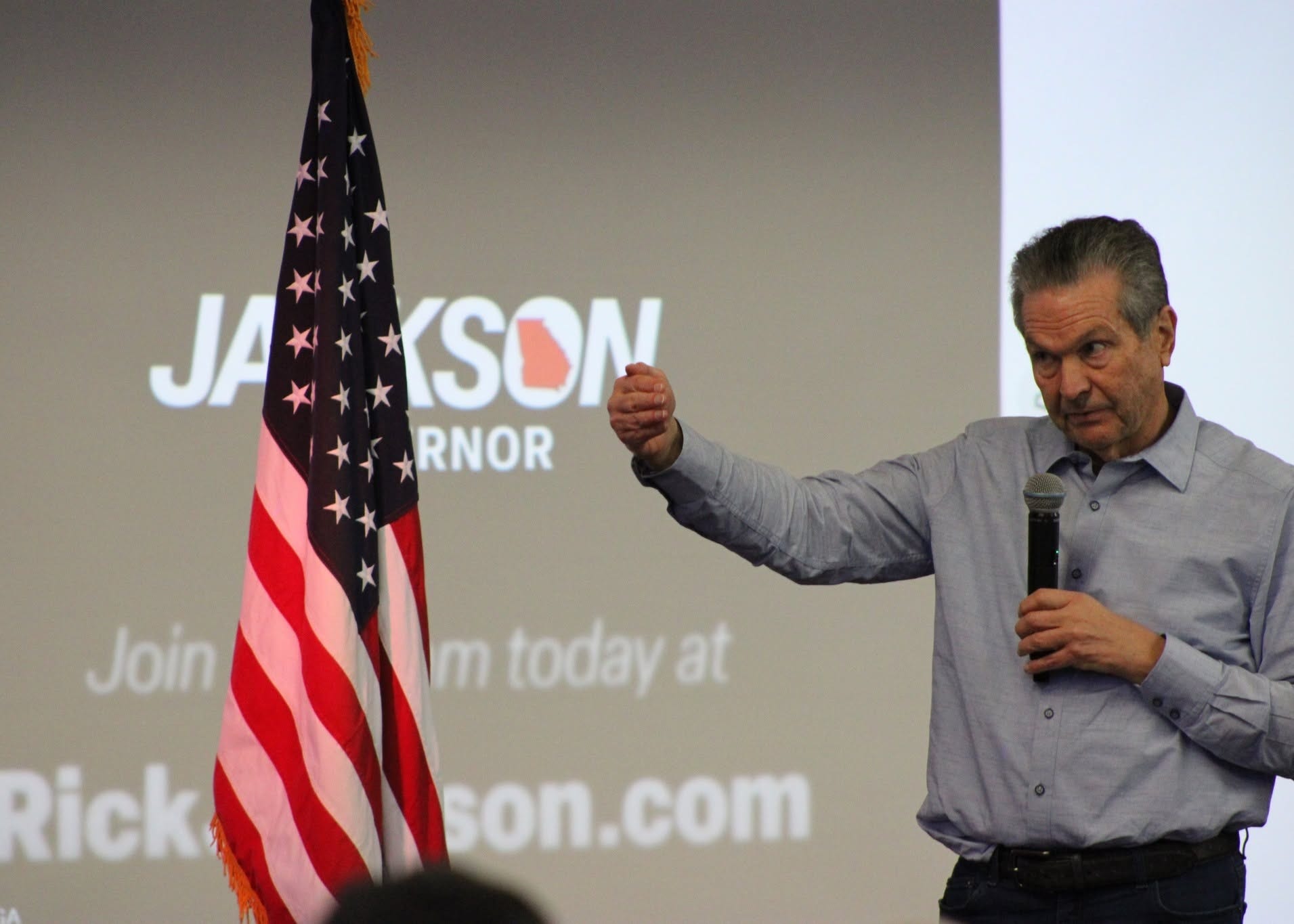
Wealthy Republican Rick Jackson announced on Monday that he was reserving $87 million in ad reservations in his quest to become Georgia’s next governor, a move that could reverberate far beyond his own race—just as similar spending did during the primary.
Jackson and Lt. Gov. Burt Jones, who is also rich, together spent over $90 million ahead of the first round of the GOP nomination contest on May 19, according to data from AdImpact. Their joint spending spree not only made it tough for any of their Republican rivals to break through on the airwaves, but it also drastically limited the ad inventory available for anyone else to purchase.
The battle between Jackson and Jones, which drove up prices for the scraps that remained, had a notable impact on the seven-person Democratic primary in the same contest, forcing it to be fought largely off the airwaves.
This worked to the advantage of former Atlanta Mayor Keisha Lance Bottoms, who began the race with high name recognition and avoided any well-funded attacks as the primary progressed.
Bottoms didn’t air many ads herself, but she didn’t need to. She ended up securing 56% of the vote against a field of opponents who struggled to get their own message out, allowing her to avoid a runoff the following month. Jackson and Jones, by contrast, continued slugging it out until June 16, when the former won the second round in an upset.
But while Jackson’s massive spending ended up benefiting Bottoms in the spring, it may hurt her in the fall.
Bottoms and her allies don’t need to match Jackson dollar for dollar, but Democrats still need to purchase enough ad space to make their case against the GOP—and they need to act while there’s still space available to purchase.
The shortage will be even more acute in the general election than it was during the primary because of Georgia’s other marquee race, the Senate contest between Democratic incumbent Jon Ossoff and Republican Rep. Mike Collins.
Ossoff finished June with an astounding $43 million to $2 million cash advantage over Collins, and he’s already running ads attacking the Republican even with Election Day more than three months away.
Collins, though, won’t be left to face this juggernaut alone. AdImpact reported two weeks ago that Republicans—most likely allies of Collins rather than the congressman’s own campaign—had reserved $26 million in ad time, compared to $17 million for Democrats. However, the senator’s massive war chest, as well as the GOP’s reported pessimism about Collins’ chances, mean that Ossoff is likely to dominate the airwaves.
Georgia’s recent ascension from Republican stronghold to swing-state status means that there are many other competitive elections further down the ballot.
Democrats are aiming to take control of several powerful offices Republicans have held for well over a decade, including attorney general and secretary of state. They’re also looking to secure a majority on the Public Service Commission, the powerful body that regulates public utilities, and to gain seats in the state House and Senate.
Candidates in all of these races, though, will be competing for precious ad time as Election Day draws closer and the airwaves get blanketed with wall to wall—to wall—political ads. This surging demand will drive prices up and force campaigns and allied outside groups to pay more as Nov. 3 nears.
Eventually, though, there may not be ads left to sell, even to those willing to pay top dollar.
Alaska Gov. Sean Parnell learned the hard way that ad time is a finite resource in 2014 when the Republican incumbent found himself locked in an unexpectedly tough race against Bill Walker, an independent who was running with support from state Democrats.
Parnell had spent most of the year looking secure as both parties spent huge amounts to advertise in the closely watched Senate race between Democratic incumbent Mark Begich and Republican challenger Dan Sullivan. But by the time Parnell realized in the fall that he also needed to buy ads to fend off Walker, it was too late to purchase many.
The National Journal reported at the time that while around 51,000 TV ads had aired in the Senate contest on state broadcast TV, only 1,300 had run in the gubernatorial race—and just 170 of those ads were from Parnell. Deprived of the most popular way to reach large numbers of voters at once, the governor went on to narrowly lose to Walker even as Sullivan ended up defeating Begich.
Other candidates across the country since then have struggled to buy ad time during the crucial final weeks of the campaign when there’s little left to buy. Bottoms, who has led in almost every publicly available poll, will now have an incentive to lock down airtime well before Election Day so that Georgians aren’t only hearing from her opponent.
If you appreciate the work we do to compile the Morning Digest day in and day out—240 times a year—then we hope you’ll consider upgrading to a paid subscription to support The Downballot. Thank you so much!
Election Night
GA-13, SD-Gov
Three Democrats and two Republicans are competing in Tuesday’s special election for Georgia’s 13th District, heavily Democratic turf in the Atlanta area that’s been vacant since Rep. David Scott died in April.
Scott’s former constituents, though, may go without representation for another month. All contenders will face off on a single ballot rather than in separate party primaries, but candidates need to win a majority of the vote to avert a runoff on Aug. 25.
The two main Democrats are Marcye Scott, the late congressman’s daughter, and Everton Blair, a former Gwinnett County Board of Education chair who took a distant third in the May primary for a full term. State Rep. Jasmine Clark, who defeated Blair and several others, opted against running in the special election, which would have required her to resign from the legislature.
The other major contest to watch on Tuesday anywhere in the nation is the Republican primary runoff for governor in South Dakota, where incumbent Larry Rhoden is trying to fend off wealthy businessman Toby Doeden. The only publicly available poll was a mid-July survey from Emerson College that showed Rhoden ahead by a wide 62-32 margin.
Senate
ME-Sen
Deep-pocketed Republican groups are already airing ads linking former Maine Senate President Troy Jackson, the new Democratic nominee for U.S. Senate, with the man he just replaced on the ballot.
“A ‘volatile personality,’ ‘anger issues’ with women, verbal abuse,’” the narrator declares in a commercial for Senate Leadership Fund as the audience sees text from several news reports. “It’s not Graham Platner, it’s Troy Jackson.”
“Jackson has a ‘history of conflicts with women,’ ‘bullying,’ even intimidation,” the spot continues. “Jackson’s conduct was so bad his fellow Democrats raised alarm bells about his temperament.”
One of the stories SLF cites is a Washington Post report from last week describing an argument Jackson got into in 2021 with then-state Sen. Heather Sanborn after she opposed one of his priorities in the legislature. The dispute, which the paper says “became legend” in the state capitol, culminated when Jackson threw a plastic water bottle.
Jackson’s team acknowledged that he’d thrown the bottle in frustration but denied he was aiming at Sanborn or anyone else. Sanborn declined to comment for the piece, but multiple legislators say she did not return to the Senate for days after the incident.
According to unnamed sources who spoke to CNN, though, Sanborn believed Jackson “was aiming to hit her with the bottle” and opted not to seek reelection the following year partly due to Jackson’s behavior.
Another Republican outfit is also airing ads tying Jackson to Platner more directly.
“Troy Jackson bragged about being one of Graham Platner’s earliest supporters,” declares the narrator in a commercial for Pine Tree Results, a super PAC dedicated to aiding Republican Sen. Susan Collins.
The spot continues by saying that “Jackson stood by Platner” after the public learned about “Platner’s Nazi tattoo” and even after further allegations surfaced.
Maine voters will see many more ads like these over the next 14 weeks, as Republicans have reserved $61.5 million in airtime, according to AdImpact. Democrats, by contrast, have booked just $23.3 million on the airwaves.
One reason for this disparity is that Collins has had close to six years to rebuild her war chest after her tough 2020 reelection campaign. The senator ended June with over $11 million banked for what she anticipated would be an expensive contest against Platner.
Platner, though, ended his campaign on July 8 following rape allegations, while Jackson, who had lost the Democratic primary for governor just weeks earlier, launched a Senate bid later that evening.
Jackson, who secured the Democratic nomination at Saturday’s party convention, had to start fundraising again from scratch, but he says he’s already benefiting from a wave of enthusiasm. According to Jackson’s campaign, the newly minted nominee raised approximately $2 million in the 24 hours after Maine Democrats overwhelmingly chose him to replace Platner.
Governors
KY-Gov
Kentucky Senate President Robert Stivers said Monday that he would not seek the GOP nomination for governor next year. No major Republicans have announced campaigns to replace Democratic incumbent Andy Beshear, who is termed out, though several have expressed interest.
House
TX-05
The House Ethics Committee said Monday that it was investigating Republican Rep. Lance Gooden following a referral by the independent Office of Congressional Conduct.
The committee did not reveal what it was looking into, though Politico notes that the Campaign Legal Center submitted a complaint to the OCC in 2021 accusing Gooden of failing to disclose stock transactions.
Gooden, a four-term incumbent who is seeking reelection in Texas’ conservative 5th District, responded to the Ethics Committee’s announcement with a statement blasting “bogus spending allegations perpetrated by dishonest unelected OCC bureaucrats.”
Supreme Court
NC Supreme Court
Democratic Justice Anita Earls continues to enjoy a staggering financial advantage over Republican challenger Sarah Stevens in an important race for the North Carolina Supreme Court, newly released campaign fundraising reports show.
Earls, who is seeking a second eight-year term, hauled in about $1.9 million from Feb. 15 to June 30 and ended this four-and-a-half-month period with $3.5 million banked. Stevens, who resigned from the state House last month to focus on her campaign, took in just over $90,000 and had a little less than $260,000 on hand.
While this race won’t change the balance of power on the state’s highest court, which Republicans control five to two, it’s still a key part of the Democrats’ long-term goal to flip the body in 2028.
A victory for Earls would mean her party would next need to win races for two of the three GOP-held seats on the ballot during the next presidential election. If Stevens prevails, though, Democrats would have to sweep all three seats to regain the majority they lost in 2022.
Poll Pile
CA-48: Lake Research Partners for Marni von Wilpert:
Von Wilpert (D): 48, Jim Desmond (R): 46.
I would 100% support a constitutional amendment to give us a defined campaign season and limits on total spending within that season, like they have in Canada. Spending astronomical sums has a diminishing margin of return anyway.
New IA-1 poll Bohannon up over Miller-Meeks https://x.com/PpollingNumbers/status/2082088228429897736?s=20