


Leading Off
GA-13
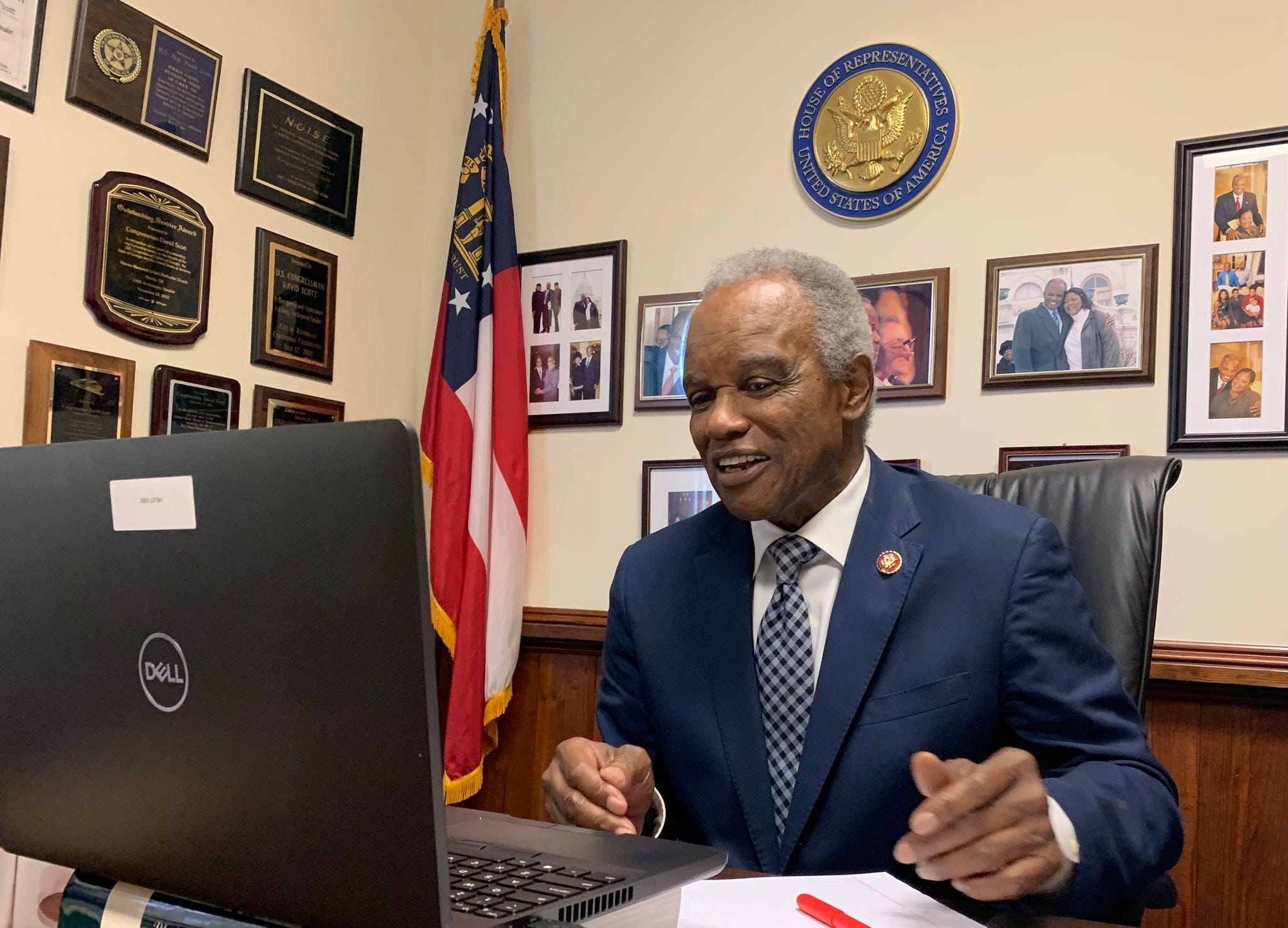
Democratic Rep. David Scott died Wednesday at the age of 80, a development that came following years of scrutiny about his physical and mental health.
Scott was seeking reelection to Georgia’s 13th Congressional District, a heavily Democratic seat that includes Atlanta’s southeastern and outer northeastern suburbs, despite calls for him to step aside after 12 terms in office.
Six fellow Democrats were challenging Scott in a May 19 primary where the issue of generational change was at the forefront.
Everton Blair, a 33-year-old former Gwinnett County Board of Education chair, launched his bid last year by arguing it was “time for the next generation to step up and correct the direction that this country is headed.”
But while Blair, who would be the first gay person to represent Georgia in Congress, initially refrained from criticizing Scott directly, that changed as the campaign progressed. The challenger’s website faulted the congressman for being “absent in the district” and from the House floor, which he called “a threat to our democracy.”
State Rep. Jasmine Clark, likewise, began her campaign last spring by saying she didn’t intend to focus on Scott’s health or performance in office. She instead told the Atlanta Journal-Constitution, “What’s our succession plan? The voters are asking the question, and I don’t know that I have to expressly criticize him.”
But Clark, 43, made news in the fall when she discovered Scott hadn’t cast a ballot in the last six elections - mainly municipal elections, but including the November 2024 election when Georgia’s 16 electoral votes were on the line.
“Voting is literally, to me, bare minimum of what we as elected officials are called to do when we are in public service,” she told CBS, which confirmed Scott had last voted in May of 2024.
State Sen. Emanuel Jones and dentist Heavenly Kimes, a member of the cast of the reality TV show “Married to Medicine,” also are on the ballot, though they each largely refrained from criticizing Scott. Two little-known candidates filed ahead of last month’s candidate filing deadline as well.
Scott turned in paperwork to seek a 13th term even as several fellow Democratic House members in their 70s and 80s opted to retire. State election officials tell the Georgia Recorder that it’s too late to remove the congressman’s name from the ballot, but votes cast for him will not be counted.
The close of filing also means that it’s too late for any new candidates to enter the race to represent this seat in the next Congress. The six remaining candidates will face off on May 19 in the primary, and contenders need to win a majority of the vote to avoid a runoff on June 16.
It will be up to Republican Gov. Brian Kemp, though, to schedule a special election for the remainder of Scott’s term. This contest, which would take place sometime after next month’s primary, would operate under somewhat different rules.
All the candidates would compete on one ballot rather than in separate party primaries. The top two vote-getters, regardless of party, would advance to a general election unless one person won a majority in the first round.
But while there’s little question that the next representative from the 13th District, which Kamala Harris carried 71-28, will be a Democrat, Scott’s constituents will go without representation for several months. The GOP caucus now holds a 218-212 majority in the House, with the 13th being one of five vacant seats in the chamber.
Scott’s death marks the end of a half-century career in Georgia politics. Tia Mitchell writes in her obituary in the AJC that Scott first decided to run for the state House in 1974 after Alberta Williams King, the mother of Martin Luther King Jr., was murdered along with a deacon at Atlanta’s Ebenezer Baptist Church.
Scott won his election, and he earned a promotion to the state Senate eight years later. He then got the chance to run for Congress in 2002 after Georgia gained two seats following the 2000 census, and he sought the brand-new and heavily Democratic 13th District.
Scott campaigned alongside his brother-in-law, the legendary Atlanta Braves Hall of Famer Hank Aaron, and decisively won both his primary and the subsequent general election.
While Scott would anger his fellow Democrats during his long tenure by endorsing GOP Sen. Johnny Isakson’s 2016 reelection campaign and voting with Republicans to undermine regulations aimed at reining in predatory payday lenders and preventing auto dealers from charging higher interest rates to people of color, he rarely struggled to win renomination.
His only tough race took place in 2020 when he unexpectedly earned just 53% of the vote against several underfunded primary foes, which was just a few points more than the majority he needed to avert a runoff. Scott, however, scored 66% two years later, and he took 58% in 2024 after court-ordered redistricting dramatically transformed the boundaries of his district.
Scott, meanwhile, began the 2020s on the ascent in the House. He became chair of the Agriculture Committee after the 2020 elections, a milestone that made him the first African American to lead the panel. However, Scott’s fellow Democrats soon questioned whether he was the right person for such an important role.
Politico wrote in 2022 that even those close to Scott “acknowledged he’s noticeably slowed in the last few years, citing his increasingly halting speech and trouble at times focusing on a topic.” When a reporter asked the chair some months later how a hearing had gone, the Georgian replied, “I don’t know.”
Scott remained the top Democrat on the panel after Republicans won control of the House in 2022, but his party continued to gripe about his performance.
“David Scott is Exhibit A for term limits,” an unnamed Democratic colleague told Politico in 2024. “He was a respected, talented member who has become diminished. And it’s painful for people to watch.”
While Scott tried to play down concerns about his age, he drew attention to it that November after Politico’s Francis Chung snapped a picture of him in a wheelchair. An irate Scott responded, “Who gave you the right to take my picture, asshole?” while an accompanying staffer threatened to complain to Chung’s editor.
Scott’s efforts to keep his prominent committee post ended the following month when he received the support of just five out of 61 members of the Democrats’ Steering and Policy Committee.
Scott, though, remained determined to stay in Congress despite yearslong rumors that he’d retire, and he filed to run again just the month before his death.
House
MI-13
Detroit City Councilmember Mary Waters filed paperwork just before candidate filing closed on Tuesday for a primary rematch against Democratic Rep. Shri Thanedar.
The news, which was first reported by Sam Robinson of the site Detroit one million, is an unwelcome development for state Rep. Donavan McKinney, Thanedar’s main intraparty challenger in Michigan’s safely Democratic 13th District. Candidates only need to win a plurality of the vote in August to earn their party’s nomination, and the incumbents would benefit from having two notable opponents rather than just one.
Thanedar first won his House seat after he defeated state Sen. Adam Hollier 28-24 in a packed 2022 primary for the open 13th District, an outcome that guaranteed Detroit wouldn’t have a Black representative in Congress for the first time since the early 1950s. (Thanedar is Indian American while Detroit’s other House member, Democratic Rep. Rashida Tlaib, is Palestinian American.)
Black leaders hoped to avoid a repeat of this scenario this cycle by consolidating behind just one African American candidate ahead of the August primary, and McKinney earned endorsements last year from prominent local elected officials. The strategy seemed to be working until Tuesday, when Waters, who is also Black, unexpectedly filed.
However, it remains to be seen if Waters, who does not appear to have made a public announcement about her plans to run again, was able to collect the requisite 1,000 signatures she needs to be on the ballot.
Waters accomplished this task in 2024 when she first challenged Thanedar, but a more prominent candidate did not. Hollier, who was running two years after his close defeat, failed to make the ballot after election officials determined he’d failed to turn in enough valid signatures—a problem that has sunk many other Michigan candidates.
Waters argued that Detroit once again needed a Black member of Congress and charged that Thanedar had done a poor job serving his constituents, but she struggled to raise enough money to compete against the wealthy congressman. Thanedar ultimately turned in a 55-34 victory over Waters, who had more success last year in her reelection campaign to the City Council.
MN-02
Democratic state Sen. Matt Klein drew unwelcome national attention on Wednesday when the prediction market platform Kalshi said it had fined and suspended him for having “traded a small amount on the outcome of his own election.”
Klein, who is competing in the August primary for Minnesota’s open 2nd Congressional District, soon apologized.
“I heard from friends that there was a prediction market site with wagers on my primary race,” he said in a statement to the Minnesota Reformer. “I was curious about how it worked. I set up an account and bet $50 of my own funds that I would win the primary.”
“My experience, like many other Minnesotans, points to the need for clearer rules and regulations for these types of markets,” added Klein, who paid about $540 and accepted a five-year suspension from the platform.
Klein faces state Rep. Kaela Berg and former state Sen. Matt Little in this summer’s primary for the seat that Rep. Angie Craig, a fellow Democrat, is giving up to run for the Senate. Little responded to the news about Klein by snarking, “Did he bet on me to win? Because I could understand that.”
NJ-07
VoteVets, an influential organization that backs Democrats with backgrounds in national security, announced Wednesday that it would spend at least $200,000 on ads to aid Navy veteran Rebecca Bennett ahead of the June 2 primary. VoteVets is the first major outside group to air commercials in the four-way contest to take on Republican Rep. Tom Kean in New Jersey’s 7th District.
WI-01
Milwaukee Alderman Peter Burgelis told Urban Milwaukee this week that he’s considering seeking the Democratic nomination to take on Republican Rep. Bryan Steil in Wisconsin’s 1st District. Burgelis, who said he “will make a decision in the near future,” has until June 1 to file.
While the entire city of Milwaukee is located in Democratic Rep. Gwen Moore’s 4th District, Burgelis argued he would give voters in this southeastern Wisconsin constituency the kind of representation they’re lacking. He told the site, “Families and seniors in the first Congressional district are struggling with affordability and they don’t have anyone in Congress standing up for them.”
A few Democrats were already challenging Steil, but they’ve all struggled to raise money. Emergency room nurse Mitchell Berman ended March with just over $140,000 on hand, which was only a fraction of the roughly $5.6 million that Steil had stockpiled. None of the other Democrats, however, had so much as $13,000 banked.
Donald Trump carried the 1st District by a 52-47 margin in 2024, while Steil won a fourth term by a wider 54-44 spread.
Judges
WI Supreme Court
State Appeals Judge Pedro Colon, a former Democratic member of the Wisconsin legislature, “is planning to enter the state Supreme Court race soon,” reports the Milwaukee Journal Sentinel’s Molly Beck.
Colon would join Clark County Judge Lyndsey Brunette, a fellow liberal, in next year’s race to succeed Justice Annette Ziegler, a conservative who is not seeking reelection. No notable conservatives have entered the race for Ziegler’s seat.
Poll Pile
GA-Gov (D): Concord Public Opinion Partners for Education Reform Now Advocacy:
Keisha Lance Bottoms: 42, Michael Thurmond: 12, Geoff Duncan: 8, Jason Esteves: 6, other candidates 2% or less, undecided: 29.
Education Reform Now does not appear to have made an endorsement in this race.
GA-Gov (D runoff): Concord:
Bottoms: 56, Thurmond: 22.
Bottoms: 60, Duncan: 16.
Bottoms: 60, Esteves: 16.
RI-Gov (D): Expedition Strategies for the Rhode Island League of Charter Public Schools:
Helena Foulkes: 34, Dan McKee (inc): 20, Gregory Stevens: 8, undecided: 38.
The poll was conducted March 24-29. The Rhode Island League of Charter Public Schools says it does not make endorsements in gubernatorial races.
AZ-01 (R): NextGen Polling:
Joseph Chaplik: 24, Jay Feely: 15, John Trobough: 6, undecided: 54.
PA-07 (D): GBAO for CPC PAC (pro-Bob Brooks):
Bob Brooks: 24, Lamont McClure: 17, Carol Obando-Derstine: 12, Ryan Crosswell: 9, undecided: 36.
Unreleased Feb. poll: McClure: 19, Brooks: 13, Carol Obando-Derstine: 13, Crosswell: 8.
The fact that Scott did NOT vote in several federal elections ticks me off. He represented constituents in a federally elected position, but didn't participate in them as a voter is outrageous.
AK Sen.: Another poll; Another Peltola lead.
RCV Round 1:
Mary Peltola (D) 49.1%
Dan Sullivan (R) 42.5%
James Ryan (R) 5.2%
Sid Hill (I) 3.2%
RCV Round 2:
Mary Peltola (D) 50.2%
Dan Sullivan (R) 43.6%
James Ryan (R) 6.2%
Alaska Survey Research; (4/16-19); 946 LV; MOE=+/-2.5%
https://bsky.app/profile/alaskasurvey.bsky.social/post/3mk6ej2v5yv27