



Leading Off
VA Redistricting
Virginia voters approved a constitutional amendment by a 51.4 to 48.6 margin to allow the state to adopt a new congressional map designed to give Democrats control of 10 of the 11 congressional districts.
Republicans are still waging a legal battle to stop the new map, and the state Supreme Court is set to hear arguments next week. But if Republicans lose in court after losing at the ballot box, conservative candidates—including members of the Old Dominion’s five-member GOP delegation—will need to decide where, or if, they’ll run this fall.
But while Republicans hoped to make this problem moot by defeating the referendum, Democrats began launching campaigns for the redrawn districts soon after lawmakers unveiled the new boundaries in February. The victory for the “yes” side on Tuesday is also sure to spur a new wave of campaign kickoffs from Democrats ahead of the May 26 candidate filing deadline.
Del. Elizabeth Guzman, for instance, announced Wednesday morning that she would seek the Democratic nomination in the new 7th District, which already features a large roster of candidates. Whoever wins the Aug. 4 Democratic primary for the 7th, as well as in several other revamped seats, will be in a strong position to prevail in the general election.
Below, we go seat-by-seat to assess where candidates are already running. We also include how each district would have voted in the 2024 presidential election, based on data from the Redistricting Data Hub uploaded to Dave’s Redistricting App. You can also find a summary in this chart.
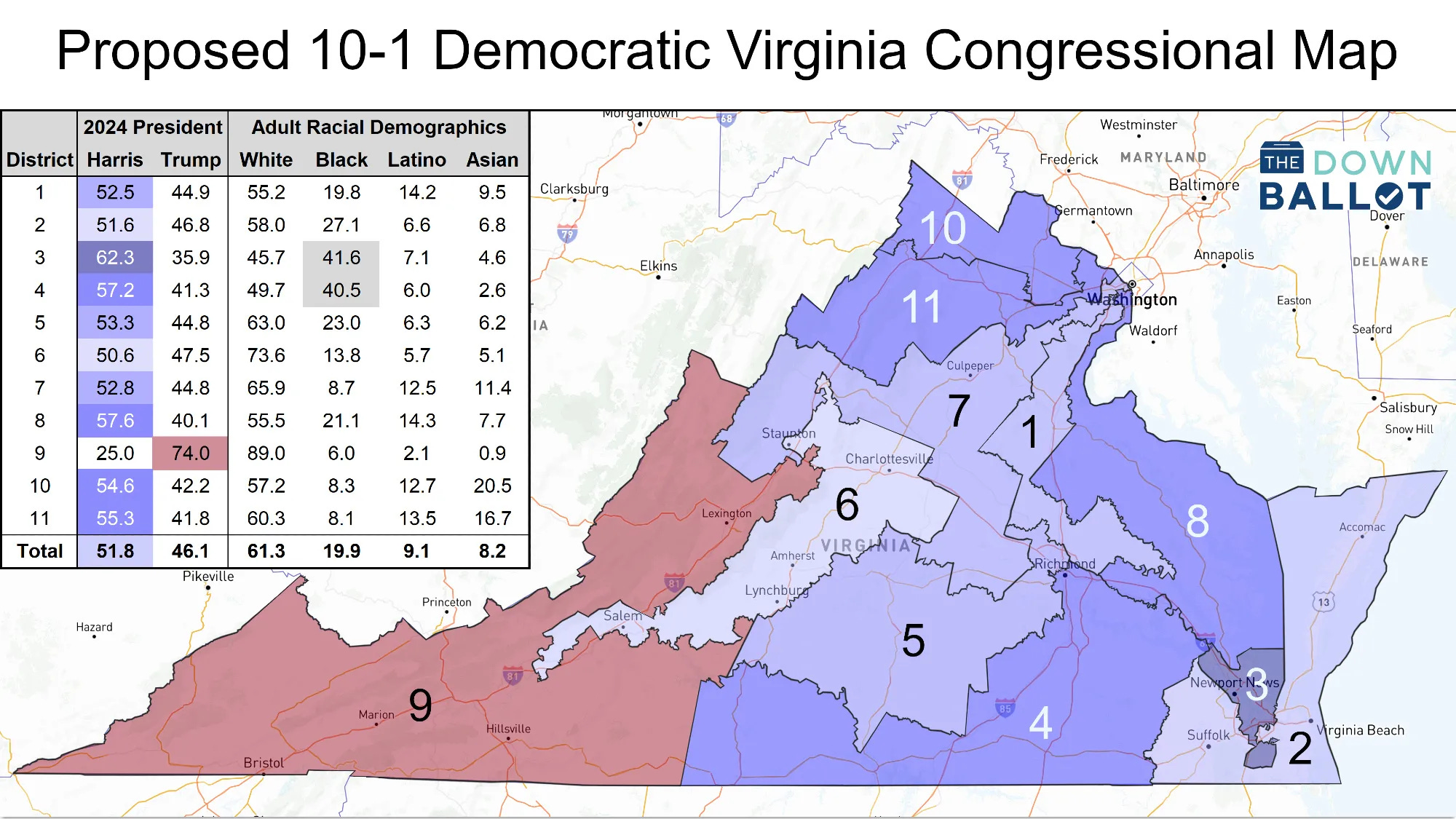
VA-01 (52-45 Harris)
Democratic Rep. Eugene Vindman announced in February that he would seek reelection in the new 1st District, which would be the natural successor to his current 7th District. Vindman will be favored against any Republican opponents in this new constituency, which extends from Northern Virginia south to Richmond’s suburbs.
VA-02 (52-47 Harris)
While Republican Rep. Jen Kiggans’ 2nd District is still based in the Virginia Beach area, mapmakers transformed it from a seat Donald Trump narrowly carried into one Kamala Harris would have taken by 5 percentage points.
Former Rep. Elaine Luria, who Kiggans unseated in a close 2022 general election, launched her rematch campaign last year just as Democrats were planning the remap. A few other Democrats are also running, but they’ve all struggled to raise the kind of money necessary to wage a strong campaign against the well-known and well-funded Luria.
VA-05 (53-45 Harris)
Democrat Shannon Taylor, the commonwealth’s attorney for Henrico County, had been waging a challenge against Republican Rep. Rob Wittman in the 1st District, but she said in February she’d instead run in the 5th.
Taylor currently faces no serious intraparty opposition in the 5th, which now includes part of the Richmond suburbs, as she waits to learn if Republicans will field a strong candidate against her. GOP Rep. John McGuire could run here, though his home was drawn into the 7th.
VA-06 (51-48 Harris)
Two prominent Democrats have already converged on the new 6th, which now includes Staunton, Charlottesville, and Lynchburg.
Former Rep. Tom Perriello, who scored a major upset victory in 2008 before losing a close reelection contest two years later, says he’ll wage a comeback campaign here. Journalist Beth Macy, who wrote the 2018 nonfiction bestseller “Dopesick” about the opioid crisis, also will seek the Democratic nod.
Republican Rep. Ben Cline, a four-term incumbent who has represented safely red versions of the 6th during his entire tenure, will need to decide if he’ll try to defend what’s now a light blue seat. Cline could instead switch over to the heavily Republican 9th, though he’d be in for a tough primary battle against Rep. Morgan Griffith.
VA-07 (53-45 Harris)
Del. Elizabeth Guzman, who would be the first Hispanic person to represent Virginia in Congress, announced Wednesday that she was entering an already packed Democratic primary for the 7th, which includes part of Northern Virginia and communities to the south like Culpeper.
Guzman, who lost to Eugene Vindman in the 2024 primary for the old 7th, joins fellow Dels. Dan Helmer and Adele McClure. The field also includes former federal prosecutor J.P. Cooney; attorney Dorothy McAuliffe, the wife of former Gov. Terry McAuliffe; state Sen. Saddam Salim; and Olivia Troye, a former national security adviser to Mike Pence who left the White House in 2020 to advocate against Trump’s reelection.
McGuire, as noted above, could potentially run here, though this district is considerably different from the conservative constituency he won in 2024.
VA-08 (58-40 Harris)
Democratic Rep. Don Beyer remains well-positioned to win reelection in the revamped 8th, which now sprawls from Arlington and Alexandria to just south of Yorktown. His most serious intraparty opponent appears to be Navy veteran Jason Knapp, who initially planned to oppose Wittman but reiterated Tuesday evening that he’d take on Beyer.
Beyer finished March with a $755,000 to $265,000 cash-on-hand lead against Knapp, who has self-funded a large portion of his campaign. A few other Democrats are also opposing Beyer, but none have brought in much money.
It’s possible that Beyer, who has represented a safely blue seat since he was first elected in 2014, will face opposition from one of his colleagues from the other side of the aisle. If Wittman, who was left with no good places to run, decides not to retire and instead wages a long-shot bid to remain in Congress, he’d likely do so in the 8th, which includes his residence.
VA-09 (74-25 Trump)
The 9th, in the southwestern corner of the state, would become Virginia’s only GOP safe haven, and longtime Republican Rep. Morgan Griffith would be sure to run here. It remains to be seen if Cline will try to remain in Congress by taking on his colleague in the primary, or if Griffith will be the only Republican in the state’s delegation to have an easy reelection campaign.
VA-11 (55-42 Harris)
Democratic Rep. James Walkinshaw, who was elected last year in a special election, faces a notable primary opponent, but he remains the favorite.
Retired Space Force Col. Bree Fram, who was ousted from the military last year because of Donald Trump’s ban on trans service members, said in January she’d “run in the district where my house is.” Fram, who has since confirmed she’d take on Walkinshaw, was the subject of a recent profile in Politico detailing what she acknowledged would be a difficult campaign.
Walkinshaw ended March with close to $800,000 banked to defend himself in the new 11th, which is situated in Northern Virginia. Fram, for her part, had a little less than $140,000 available.
The 3rd, 4th, and 10th districts would all remain solidly Democratic, and their current incumbents are all likely to seek reelection, without much in the way of GOP opposition.
House
FL-20
Democratic Rep. Sheila Cherfilus-McCormick resigned from Congress Tuesday afternoon just before the House Ethics Committee was scheduled to announce whether it would recommend her expulsion.
Federal authorities indicted Cherfilus-McCormick last year for allegedly using stolen taxpayer funds to finance her victorious 2021 primary campaign for Florida’s safely blue 20th Congressional District. While Cherfilus-McCormick’s trial has been delayed until February, the Ethics Committee last month found her guilty of 25 counts of misconduct related to the same affair.
But Cherfilus-McCormick, who was facing multiple primary opponents in her South Florida constituency, decided to quit before she could be forced out.
“This was not a fair process,” Cherfilus-McCormick wrote in her statement announcing her resignation, which took effect immediately. “By going forward with this process while a criminal indictment is pending, the Committee prevented me from defending myself.”
Cherfilus-McCormick’s departure both removes her from the Committee’s jurisdiction and leaves the 20th District, which includes inland areas around Fort Lauderdale and Palm Beach, without a representative for the second time in half a decade. Cherfilus-McCormick herself was elected in January of 2022 to replace Democratic Rep. Alcee Hastings, a veteran congressman who died the previous April.
Republican Gov. Ron DeSantis, who chose to keep the seat vacant for nearly a year after Hastings’ death, has yet to say when, or even if, there will be a special election for the remainder of Cherfilus-McCormick’s term.
There will, however, be a busy race to succeed Cherfilus-McCormick in the next Congress.
Former Broward County Commissioner Dale Holness, who lost the 2021 special primary to Cherfilus-McCormick by all of five votes before badly losing their rematch the next year, and perennial candidate Elijah Manley each began challenging the incumbent last year.
They were joined in February by Luther Campbell, the famed rapper who co-founded the hip-hop group 2 Live Crew, and physician Rudy Moise, who unsuccessfully ran for the House in both 2010 and 2012.
The deadline for U.S. House candidates to file to run isn’t until June 12, so other prospective candidates have several weeks to decide whether to join them in the Aug. 18 primary.
Cherfilus-McCormick’s resignation, which came the week after Democrat Eric Swalwell of California and Republican Tony Gonzales of Texas each stepped down following separate scandals involving sexual misconduct, leaves the GOP caucus with a 218-213 majority. The final vacant seat was held by Rep. Doug LaMalfa, a California Republican who died in January.
While California Gov. Gavin Newsom has scheduled special elections to replace LaMalfa and Swalwell, Texas Gov. Greg Abbott has yet to act.
NY-04
Former Assemblywoman Taylor Darling said this week she was ending her longshot primary campaign against Democratic Rep. Laura Gillen in New York’s 4th District.
Gillen will likely face Republican Jeanine Driscoll, who serves as receiver of taxes for the Town of Hempstead, in the general election for this competitive constituency on Long Island. Driscoll only entered the race last week after local GOP leaders spent over a year waiting in vain for former Rep. Anthony D’Esposito to seek a rematch against Gillen.
NY-21
Donald Trump has backed Anthony Constantino, a wealthy sticker magnate whom New York Republicans fear could jeopardize their prospects of holding Rep. Elise Stefanik’s House seat.
Constantino faces Assemblyman Robert Smullen, who has the endorsement of the state Republican Party, in the June 23 primary for the 21st District in the northernmost part of the state. Smullen, though, is already assured a spot in the general election thanks to his support from the New York Conservative Party, and there’s reason to think he’d use it to continue his campaign if he loses the primary to Constantino.
The Watertown Daily Times’ Alex Gault wrote earlier this month that Conservative leaders “specifically asked that Smullen keep their party line no matter what happens with the GOP primary.” Smullen himself also responded to Trump’s decision to endorse Constantino by telling reporters, “I’ll be on the ballot in November on the Conservative line and I’m confident that I’m going to win the Republican primary.”
Democrats, meanwhile, have largely consolidated behind dairy farmer Blake Gendebien. Gendebien, who began raising money in late 2024 for a special election to replace Stefanik that never ended up taking place, finished March with close to $2.5 million stockpiled for this fall’s general election.
All of this has given Republicans an unwelcome flashback to the 2009 special election for a previous incarnation of this seat, when Republicans and Conservatives fielded rival candidates, paving the way for a historic Democratic flip.
State law required local GOP leaders, rather than primary voters, to choose their nominee in the contest to replace John McHugh, a moderate Republican who resigned to become Barack Obama’s secretary of the Army, in what was then numbered the 23rd District. They opted for Assemblywoman Dede Scozzafava, another centrist who initially seemed well-positioned to defend a historically Republican seat that Obama carried the previous year.
One important organization, though, was unwilling to fall into line. While the Conservative Party almost always nominates the same candidate as the Republicans—something it’s able to do because of New York’s unusual fusion voting system—its leadership decided instead to give its spot on the ballot to accountant Doug Hoffman.
What followed was a strange three-way general election between Scozzafava, Hoffman, and Democrat Bill Owens. Things became even more chaotic during the final weekend when Scozzafava suspended her campaign and endorsed Owens.
Owens ended up beating Hoffman 48-46 as Scozzafava secured the remaining 6%, a win that made him the first Democrat to represent this area in the House since the 19th century. But while Owens would go on to win two full terms, his decision to retire ahead of the 2014 elections helped propel Stefanik to an easy victory in the general election for what was now the 21st District.
Trump’s strength in rural areas helped rapidly transform Stefanik’s constituency into solidly red turf for the next decade. Trump in 2024 carried this district in a 60-39 blowout, while Stefanik had no trouble winning what would turn out to be her final term.
Trump soon announced that he was nominating Stefanik to become his ambassador to the United Nations, and several Republicans stepped forward to run in what they believed was an imminent special election to replace her in a solidly red seat.
One of those Republicans was Constantino, who was the subject of a 2024 New York Times story detailing his feud with city leaders in his sticker company’s hometown of Amsterdam over a giant illuminated pro-Trump sign he placed atop his headquarters that the mayor said violated municipal codes.
But Constantino, who told Republican leaders that he’d run in 2026 whether or not they nominated him for the special, quickly made more enemies on the right.
Constantino would later post audio of what he said was a call with Conservative Party head Gerard Kassar where Kassar was heard saying, “Telling us that you’re going to run in November is just a bigger reason why we intend to kill you … If you get knocked out of the special, then you tell us you’re going to run in November, then we’re going to do everything in our power to make sure you’re destroyed before you get to November.”
“Was it hyperbole? I don’t know,” Constantino said last summer after sharing the recording. “My aide’s brake lines were subsequently cut.” Kassar subsequently filed a defamation lawsuit against Constantino that has yet to be resolved.
Constantino made those comments well after Trump pulled Stefanik’s nomination amid escalating Republican worries about their ability to win special elections in red districts. Stefanik went on to announce last November that she would challenge Democratic Gov. Kathy Hochul, and while she ended her campaign the next month, Stefanik stuck to her plan to leave the House.
Smullen and Constantino are now facing off in a nasty and expensive primary where Constantino has continued to antagonize just about everyone. Constantino was ejected from a local Republican meeting in February after he repeatedly heckled his rival, and he responded to the state GOP’s subsequent decision to endorse Smullen by promising to “clean out the Republican committees because they are losers.”
Constantino’s vast wealth, though, has given him a huge financial advantage. Constantino, who is self-funding virtually his entire campaign, ended March with a roughly $3.5 million to $960,000 cash-on-hand advantage over Smullen.
Constantino got an even bigger boost Tuesday when Trump told his Truth Social followers, “Anthony is strongly supported by many of the most Highly Respected MAGA Warriors in our Movement, including Mayor Rudy Giuliani and Roger Stone!”
Smullen, though, believes that Constantino’s deep pockets and endorsement from Trump will only take him so far. Smullen told reporters that Trump only snubbed him because of Stone, whom he called a “consultant [who] got to the president, somebody who is being paid by my opponent.”
“Anthony Constantino is not the candidate voters in NY-21 support,” Smullen also said in a statement. “He has proven he is mentally unfit to serve in Congress.”
WI-07
Wealthy attorney Paul Wassgren announced Tuesday that he was dropping out of the August Republican primary for Wisconsin’s open 7th District, a conservative constituency in the northwestern corner of the state.
The GOP frontrunner is Michael Alfonso, a podcaster producer whose main qualification is that he’s the son-in-law of Transportation Secretary Sean Duffy and Fox host Rachel Campos-Duffy. Donald Trump endorsed Alfonso in a January Truth Social post that gushed about Alfonso’s in-laws but said little about the actual candidate.
The Republican field also includes investment adviser Kevin Hermening, who has self-funded much of his campaign, and public relations professional Jessi Ebben, who lost a primary in 2020 for the neighboring 3rd District. The eventual nominee will be favored to replace Republican Rep. Tom Tiffany, who is running for governor.
Other Races
AZ Corporation Commission
Republican state Rep. David Marshall has ended his campaign for a seat on the Arizona Corporation Commission and resigned from the legislature to accept an appointment as Navajo County recorder.
Marshall and fellow state Rep. Ralph Heap, who are each allied with the state’s branch of the far-right Freedom Caucus, were running as a team for seats on the powerful body that regulates utilities across the state. The pair were hoping to defeat Commissioners Nick Myers and Kevin Thompson, whom they argued failed to do enough to advance Donald Trump’s pro-coal agenda, in the July GOP primary.
But while there are serious questions about whether Marshall is allowed to become Navajo County recorder— the state constitution prohibits lawmakers from holding state or county posts “during the term for which he shall have been elected”—he didn’t wait for them to be answered before filing paperwork to end his campaign for the commission.
Heap is now running solo against Myers and Thompson. The trio will compete on one statewide ballot, and voters can vote for up to two options. The two contenders with the most votes will advance to the November general election, making it possible that any mixed-and-matched set will move forward.
The winners will take on Democrats Jonathon Hill and Clara Pratte, who face no intraparty opposition, in the fall.
Poll Pile
FL-Sen: Echelon Insights for NetChoice:
Ashley Moody (R-inc): 50, Alex Vindman (D): 43.
NetChoice is a trade association whose membership includes major companies like Amazon and Google.
GA-Sen: Echelon:
Jon Ossoff (D-inc): 52, Buddy Carter (R): 43.
Ossoff (D-inc): 51, Mike Collins (R): 44.
The poll did not test Derek Dooley, the third major Republican candidate.
IA-Sen: Echelon:
Zach Wahls (D): 46, Ashley Hinson (R): 44.
Josh Turek (D): 46, Hinson (R): 45.
ME-Sen: Echelon:
Graham Platner (D): 51, Susan Collins (R-inc): 45.
Janet Mills (D): 48, Collins (R-inc): 46.
OH-Sen: Echelon:
Jon Husted (R-inc): 51, Sherrod Brown (D): 45.
FL-Gov: Echelon:
Byron Donalds (R): 49, David Jolly (D): 43.
Donalds (R): 48, Jerry Demings (D): 44.
GA-Gov: Echelon:
Keisha Lance Bottoms (D): 49, Burt Jones (R): 43.
Bottoms (D): 49, Rick Jackson (R): 43.
Bottoms (D): 46, Brad Raffensperger (R): 44.
The poll did not test any other potential Democratic candidates.
IA-Gov (R): Victory Enterprises for Randy Feenstra:
Randy Feenstra: 41, Adam Steen: 9, Zach Lahn: 8, Brad Sherman: 5, Eddie Andrews: 5.
IA-Gov: Echelon:
Rob Sand (D): 51, Feenstra (R): 39.
OH-Gov: Echelon:
Vivek Ramaswamy (R): 49, Amy Acton (D): 44.
OR-Gov (R): Nelson Research:
Christine Drazan: 37, Chris Dudley: 18, Ed Diehl: 18, David Medina: 7, Danielle Bethell: 2.
Nelson Research says it did not conduct this poll for a client.
CA-14 (top-two primary): David Binder Research for the Working Families Party (pro-Aisha Wahab):
Aisha Wahab (D): 29, Wendy Huang (R): 9, Melissa Hernandez (D): 9, Dena Maldonado (R): 8, Matt Ortega (D): 2, Rakhi Israni (D): 2, other candidates 1% or less, undecided: 35.
The poll was conducted April 1-4.
CA-48 (top-two primary): SurveyUSA for KGTV and the San Diego Union-Tribune:
Jim Desmond (R): 25, Kevin Patrick O’Neil (R): 13, Ammar Campa-Najjar (D): 12, Marni Von Wilpert (D): 6, Mike Schaefer (D): 6, Corinna Contreras (D): 4, Brandon Riker (D): 4, Abel Chavez (D): 3, other candidates 2% or less, undecided: 24.
NJ-08 (D): Center for Strategic Politics for Mussab Ali:
Rob Menendez (inc): 42, Mussab Ali: 27.
Editor’s Note: In our last Digest we incorrectly identified businesswoman Holly Adams as a businessman. It also incorrectly identified Betty Yee’s former position: Yee served as California’s controller, not comptroller.
This piece incorrectly identified Arizona Corporation Commissioner Nick Myers as “Nick Myer.”
The polling for the VA referendum ended up being pretty much spot on. Yet another data point indicating that the death of the polling industry has been greatly exaggerated. Generally speaking, arguments that polls are worthless tend to be trotted out when people don't like what the polls have to say.
How funny it will be if somehow Greg Abbott who started this redistricting battle also loses his reelection bid for Governor.