



Leading Off
GA-Gov
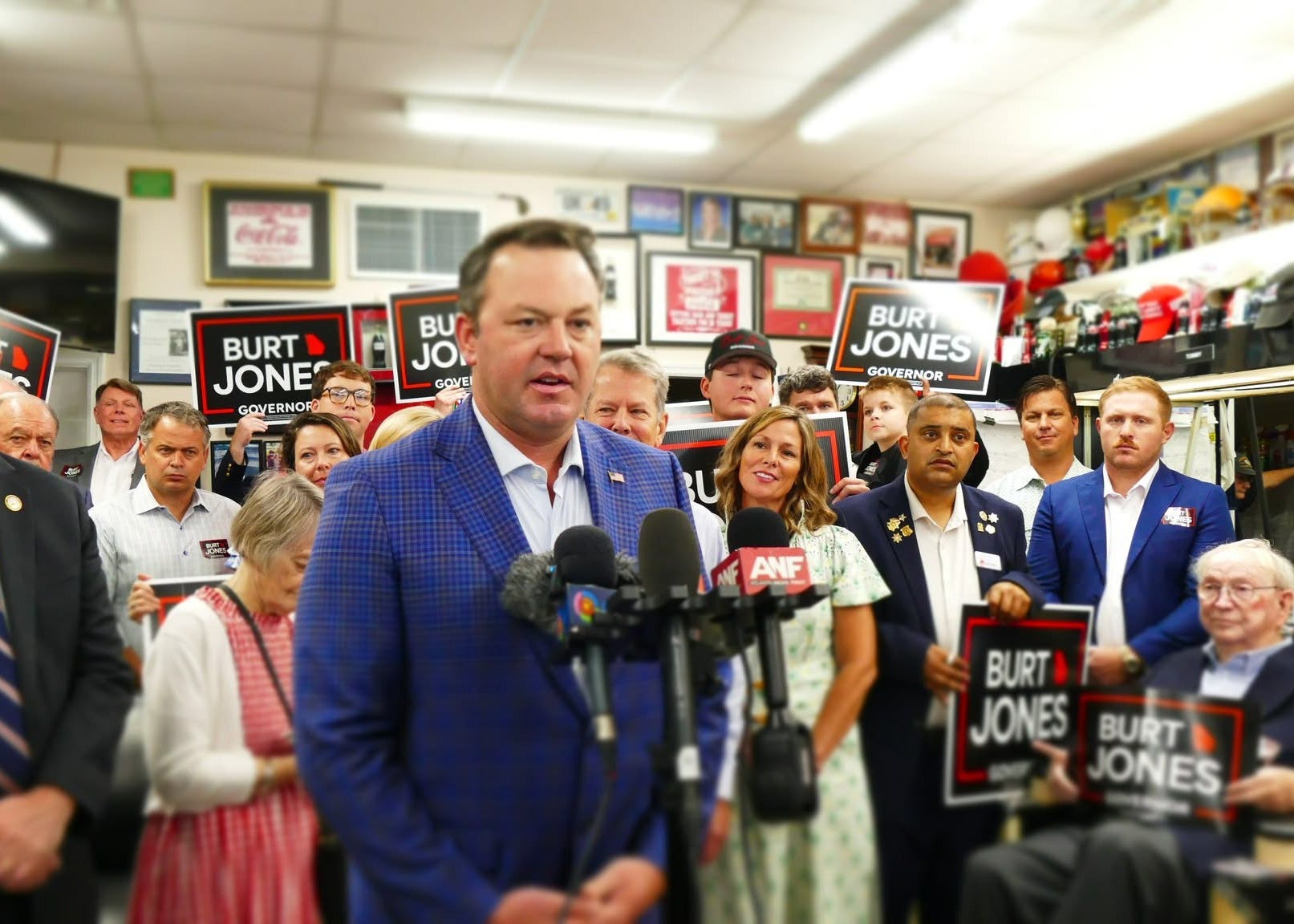
Healthcare billionaire Rick Jackson upset Lt. Gov. Burt Jones in the Republican primary runoff for governor of Georgia on Tuesday night—and handed a smarting defeat to Jones’ top backer, Donald Trump.
Jackson's 53-47 win comes two weeks after Trump’s “COMPLETE AND TOTAL ENDORSEMENT” failed to carry Rep. Randy Feenstra to victory in Iowa over Zach Lahn, another wealthy businessman who captured the Republican nomination for his state’s open governorship.
The win for Jackson, whose $100 million personal investment allowed him to swamp the mere $25 million in self-funding his opponent offered up, also came as an embarrassment for term-limited Gov. Brian Kemp, who endorsed Jones just two days before the runoff.
Kemp argued Monday that Jones would be the strongest nominee to defeat former Atlanta Mayor Keisha Lance Bottoms, who is seeking to become the first Democrat to win an election for governor since 1998.
But Kemp’s failure to help Jones get over the finish line could have serious repercussions for his drive to pass new congressional and legislative gerrymanders in time for the 2028 elections.
Last month, Kemp called a special session to address redistricting that’s set to begin on Wednesday, just one day after the runoffs. The Atlanta Journal-Constitution’s Greg Bluestein, however, reported Tuesday morning that some members of the GOP majority in the state House were already wary of the push to redraw the maps.
Their reluctance doesn’t stem from concern for Black Georgians, who would see their voting power undermined by any new Republican plan. Rather, Bluestein explained that some Republicans fear that such gerrymanders could “energize Democrats and distract from the party’s message on the economy and public safety.”
Now, Kemp’s ability to keep his party in line on redistricting may have just gotten weaker. Bluestein relayed on election night as Jackson led in the vote count, “House lawmakers I’m talking to are signaling it’s DOA.” And with Jones, who also serves as president of the Senate, now a lame duck, legislators are likely to feel less hesitancy in opposing him. (Both Jones and Jackson said they support remapping.)
While Kemp is about to find out whether he can still bring his reluctant members in line, Republicans will need to wait until November to learn whether Jackson can defend an office his party has held for more than two decades. If Lance Bottoms breaks the GOP’s long winning streak, though, she’ll make history as the first Black woman ever elected to lead any state.
Election Recaps
All race calls and estimates of the proportion of the vote that’s been tabulated come from the Associated Press. You can also check out our cheat-sheet that summarizes the outcomes in every key race.
Alabama
AL-Sen (R) (65-34 Trump)
Rep. Barry Moore decisively defeated Navy SEAL veteran Jared Hudson 56-44 in the Republican primary runoff for Alabama’s open U.S. Senate seat, a win that puts him on a glide path in the fall general election.
Moore, one of the most notorious election deniers in the House, benefited from both Donald Trump’s endorsement and a massive spending edge. While some polls showed Hudson ahead, Moore’s advantages proved to be far too much to overcome.
California
CA-14 (special) (66-30 Harris)
State Sen. Aisha Wahab and Melissa Hernandez, the president of the board for Bay Area Rapid Transit, appear set to face off in an all-Democratic special election runoff on Aug. 18 ahead of their showdown in November for a full term.
Wahab leads with 43% in California’s 14th District, while Hernandez holds a 17-13 edge over businesswoman Rakhi Israni, a third Democratic candidate. The AP, which estimates that 80% of the vote is in, has called the first spot for Wahab, but it has not made a projection about who her opponent will be.
Georgia
GA-Sen (R) (50-48 Trump)
Rep. Mike Collins, boosted by a last-minute endorsement from Trump, will now take on Democratic Sen. Jon Ossoff after the congressman scored a 56-44 win over former college football coach Derek Dooley, who had the support of term-limited Gov. Brian Kemp.
Ossoff, however, has been preparing for years and enjoys a massive financial advantage. As of late May, the incumbent reported raising more than $70 million and had $32.5 million stockpiled. Collins, by contrast, has brought in under $5 million and had under $1.2 million in the bank, though he likely spent much of that before the runoff.
Republicans, aware of the gap in both money and charisma, don’t seem especially excited about their chances.
“If you went to a laboratory and tried to create the worst general election candidate for this state and environment possible, you couldn’t do better than Mike Collins,” one unnamed “prominent Georgia Republican strategist” recently told MS Now.
This operative cited Collins’ “ton of personal baggage” and “unique ability to offend female voters,” warning that Republicans “have to hope he doesn’t take everyone else down with him.”
GA-11 (R) (61-38 Trump)
Physician John Cowan is now well on his way to Washington after turning back former congressional aide Rob Adkerson by a wide 65-35 margin in the GOP runoff for Georgia’s open 11th District. Cowan’s previous bid for Congress ended in a high-profile runoff loss to Marjorie Taylor Greene in the neighboring 14th District in 2020.
GA-LG (D & R) (50-48 Trump)
Democrat Josh McLaurin and Republican Greg Dolezal, who are each members of the state Senate, will vie to serve as Georgia’s next lieutenant governor following their victories in Tuesday’s runoffs.
This powerful post, whose occupant sets much of the agenda in the state Senate, is open because Republican incumbent Burt Jones opted to wage an unsuccessful bid for governor.
GA-SoS (D & R) (50-48 Trump)
The race to serve as Georgia’s top election official will pit Democrat Penny Brown Reynolds against Republican Tim Fleming after both easily won their respective runoffs for secretary of state on Tuesday night. The two are vying to succeed Republican Brad Raffensperger, who unsuccessfully ran for governor last month.
GA Public Service Commission (R) (50-48 Trump)
Power plant engineer Joshua Tolbert will face Democrat Angelia Pressley after winning the GOP primary runoff in a key race for Georgia’s Public Service Commission.
Republicans currently hold a 3-2 majority on the board, but if Pressley wins and Democrats successfully defend another seat, held by incumbent Peter Hubbard, they would take control of the powerful body, which regulates public utilities.
Hubbard recently appeared on The Downballot podcast to discuss his race, including the issues—like soaring electricity bills and unwelcome data center construction—that are motivating voters.
GA State Senate District 7 (special) (56-42 Harris)
Democrat Adrienne White defended a vacant seat in the Georgia Senate after her party warned that Republicans could flip the district due to disproportionate turnout generated by the GOP runoffs for U.S. Senate and governor.
White narrowly defeated Republican Aizaz Shaikh 51-49 with all precincts reporting, except for provisional ballots. While the margin may shift slightly, the AP has called the race for White.
Democrats in this Gwinnett County constituency were right to be worried that Republicans eager to vote in their two marquee races could reshape the electorate. Statewide, Republican voters cast nearly twice as many ballots as Democrats, who last month renominated Sen. Jon Ossoff without opposition and picked former Atlanta Mayor Keisha Lance Bottoms to be their nominee for governor.
White and her allies, however, overcame those headwinds and prevented Republicans from flipping their first Democratic-held legislative seat at the ballot box anywhere in the nation since Trump returned to the White House.
Shaikh will be the GOP nominee again for a full two-year term, but White, who only ran in the special, will not be his opponent. Instead, he’ll face state Rep. Ruwa Romman, who defeated attorney Rahul Garabadu 60-40 in Tuesday’s Democratic primary runoff.
Oklahoma
Candidates need to win a majority of the vote to avoid a runoff on Aug. 25.
OK-Sen (R) (66-32 Trump)
Rep. Kevin Hern, who had the backing of Trump and the entire GOP establishment, easily turned aside minor opposition to secure the Republican nomination for Oklahoma’s open Senate seat.
OK-Gov (R) (66-32 Trump)
Attorney General Gentner Drummond and former state Sen. Mike Mazzei will face off in a runoff for Oklahoma’s open governorship after both fell far short of a majority on Tuesday night.
Drummond finished first with 26.3% while Mazzei, a former state budget secretary who unexpectedly received Trump’s endorsement last month, was just behind with 25.9%. Chip Keating, another one-time member of termed-out Gov. Kevin Stitt’s administration and the son of former Gov. Frank Keating, ended up well behind in third place with 18%.
The eventual GOP nominee will be the favorite against state House Minority Leader Cyndi Munson, who captured the Democratic nomination with close to three-quarters of the vote, in the race to succeed termed-out GOP Gov. Kevin Stitt.
OK-01 (R) (60-38 Trump)
Wealthy state Rep. Mark Tedford will go up against Jackson Lahmeyer, an evangelical pastor backed by Trump, in the runoff for the Tulsa-based constituency Rep. Kevin Hern is leaving behind to run for the Senate.
Tedford, who self-funded more than $1 million, finished a clear first with 32%. Lahmeyer outpaced businessman Nathan Butterfield 26-16 for second, a performance that came just days after the British tabloid Daily Mail reported that Lahmeyer had sent sexual messages to a former Miss Oklahoma USA and that his wife had discovered the relationship last month.
Lahmeyer, who responded by acknowledging he’d “cross[ed] a boundary line through text messaging,” still denounced what he called a “distorted story” and insisted the “matter was already dealt with privately between me and my wife.” Trump, for his part, took to Truth Social one day before the election to again urge Republicans to nominate Lahmeyer.
Washington, D.C.
All primaries with three or more candidates are conducted using a ranked-choice ballot. Voters rank candidates in their order of preference, and if no one takes a majority, the last-place candidate gets eliminated and has their votes reassigned to their voters’ next preferences.
Election officials say they intend to release ranked-choice tabulations by June 21 for all ballots that have been counted by then, with final results on or close to June 26.
Washington, D.C. Mayor (D) (90-6 Harris)
Councilmember Janeese Lewis George leads former Councilmember Kenyan McDuffie 53-37 in the Democratic primary for mayor, with an estimated 64% reporting. The AP has not made a call in the race between Lewis George, a self-described democratic socialist, and McDuffie, who is closer to business groups.
The Democratic nominee will be all but assured to replace Mayor Muriel Bowser, who is not seeking a fourth term as leader of the nation’s capital.
Washington, D.C. Delegate (D) (90-6 Harris)
Councilmember Robert White scored an outright win in the Democratic primary for delegate, which sets him up to replace retiring incumbent Eleanor Holmes Norton as the capital’s nonvoting member in Congress. White, a vocal progressive, turned in a landslide victory over Brooke Pinto, a more moderate colleague on the Council of the District of Columbia, and three other candidates.
House
MD-06
Former Rep. David Trone has released an internal poll giving him a small lead over Rep. April McClain Delaney heading into Tuesday’s Democratic primary, a week after McClain Delaney shared her own numbers showing her well ahead in a contest that has smashed spending records.
Trone’s survey from Global Strategy Group finds him with a 43-40 advantage against McClain Delaney in his comeback bid for Maryland’s 6th District, which Trone gave up in 2024 to wage an unsuccessful campaign for the Senate. The firm’s memo also says that a pair of previously unreleased surveys from another firm, Impact Research, gave him a 2-point edge last month.
McClain Delaney’s pollsters, however, see a very different race between her and Trone, whose yard signs urge people to “re-elect” him. Hart Research placed her ahead 52-37 in early June, while she led by that same margin in mid-May.
But there’s no ambiguity about which candidate holds the financial advantage in the primary for this Democratic-leaning constituency based in western Maryland and the northwestern exurbs of Washington, D.C.
Trone, the founder and owner of the Total Wine chain of liquor stores, has loaned his new effort an enormous $25 million, which makes this the third time he’s broken the record for self-funding in a House campaign.
Trone first set a high-water mark in 2016 when he poured $13.4 million, or roughly $19 million in 2026 dollars, into his campaign for the 8th District, but he still lost the primary to now-Rep. Jamie Raskin.
But Trone had more success two years later when he threw down almost $18 million—about $24 million adjusted for inflation—on his bid to replace McClain Delaney’s husband, Rep. John Delaney, in the neighboring 6th District after Delaney launched an ill-fated bid for president.
No well-heeled House candidate exceeded Trone’s investment during the ensuing three election cycles, according to OpenSecrets. Trone, though, set a different record in 2024 when he spent $62 million of his fortune to finance his quest to succeed retiring Democratic Sen. Ben Cardin.
However, he convincingly lost the primary to now-Sen. Angela Alsobrooks 53-43, while McClain Delaney won the contest to replace him in the House. But Trone was far from done with politics: Last year, the ex-congressman launched a campaign to reclaim the 6th from McClain Delaney, whom he faulted for supporting the Laken Riley Act.
McClain Delaney, for her part, has self-funded more than $8 million to win renomination, a figure that would have allowed her to outspend almost any other opponent. The congresswoman, who has Alsobrooks and other prominent Maryland Democrats in her corner, is using her resources to argue she’s the more reliable liberal in the race.
One commercial faults Trone for joining with Florida Gov. Ron DeSantis in calling for a constitutional convention to institute congressional term limits if Congress fails to act first. The narrator warns that such a change would give conservatives the chance to “put an abortion ban into our Constitution.”
MN-02
State Rep. Kaela Berg’s allies at EMILYs List have launched what the Minnesota Star Tribune says is “the first major ad” ahead of the August Democratic primary for Minnesota’s open 2nd District.
The opening spot, which is part of a reported $500,000 buy, begins by highlighting Berg’s other job as a flight attendant, where she “organized her union for livable wages.” (The Minnesota legislature, like many others, is a part-time body.) The ad continues, “The private jet guys have plenty of representation in DC. Kaela Berg gets it because she lives it.”
Berg faces state Sen. Matt Klein, former state Sen. Matt Little, and three little-known candidates in the primary for the House seat that Rep. Angie Craig is giving up to seek the Democratic nomination for Senate.
The winner will be favored against state Sen. Eric Pratt, who has the Republican side to himself, in a suburban Twin Cities constituency Kamala Harris carried 52-46.
Mayors & County Leaders
Orange County, CA Board of Supervisors
Two races that will determine whether Orange County Democrats retain control of the Board of Supervisors will head to runoffs in November.
With almost all of the vote counted from the June 2 nonpartisan primary, Democratic incumbent Katrina Foley holds a tiny 47.0 to 46.8 plurality over Republican Assemblywoman Diane Dixon in the 5th District. The balance went to Lucy Vellema, an underfunded candidate who benefited from spending by Dixon’s allies at the conservative Lincoln Club.
Dixon’s backers may have helped Vellema to prevent Foley from securing the majority of the vote she needed to win outright and avoid a second round of voting this fall. But while Foley will need to keep running, she still finished first after initially trailing. Dixon led 49-45 the morning after the election, but Foley pulled ahead as more ballots were counted.
Foley’s 5th District, which includes Costa Mesa, part of Irvine, and other communities in the southern part of the county, backed Kamala Harris just 49-48—a margin of 318 votes. Foley, who won her spot on the Board in a 2021 special election, secured a full term the following year with a 51-49 win that gave Democrats control of the Board of Supervisors for the first time since 1976.
To keep it, though, Democrats must both reelect Foley and defend the 4th District that Supervisor Doug Chaffee, who has often been at odds with his party, is termed out of.
This time, though, both Chaffee and the Orange County Democratic Party are aligned in backing Buena Park Mayor Connor Traut’s campaign to win a seat Harris carried 52-45. Traut leads County Board of Education member Tim Shaw, the choice of the local GOP, by a small 33-31 spread.
Two other candidates took 18% apiece: Fullerton Mayor Fred Jung, a former Democrat who became an independent last year and had the Lincoln Club’s support; and La Habra City Councilwoman Rose Espinoza, who ran for the state Assembly in 2022 as a Democrat.
If Foley and Traunt both win in the fall, Democrats will remain in charge of the board. Democratic Supervisor Vicente Sarmiento won reelection outright this month with almost two-thirds of the vote, while the two Republican-held seats won’t be on the ballot again until 2028.
Poll Pile
ME-Sen: Wick for 2Way:
Graham Platner (D): 48, Susan Collins (R-inc): 45.
MA-Sen: Suffolk University for the Boston Globe:
Ed Markey (D-inc): 55, John Deaton (R): 30.
Seth Moulton (D): 54, Deaton (R): 26.
MA-Gov: Suffolk:
Maura Healey (D-inc): 56, Michael Minogue (R): 31.
Healey (D-inc): 56, Brian Shortsleeve (R): 29.
MI-Gov (R): Mitchell Research & Communications:
John James: 28, Mike Cox: 27, Perry Johnson: 23, Aric Nesbitt: 4.
May: James: 32, Johnson: 23, Cox: 19, Nesbitt: 7.
MI-Gov (R): Tarrance Group for James:
James: 38, Johnson: 26, Cox: 22, Nesbitt: 12.
MI-Gov (R): Strategic National for Johnson:
Johnson: 27, James: 24, Cox: 12, Nesbitt: 6, undecided: 31.
SC-Gov (R): JMC Analytics and Polling:
Alan Wilson: 63, Pamela Evette: 28.
JMC says it is “not affiliated with any candidate running for Governor.”
NY-13 (D): Mercury Public Affairs for National Black Empowerment Action Fund (pro-Adriano Espaillat):
Adriano Espaillat (inc): 35, Darializa Avila Chevalier: 27.
Very glad that White had a narrow win in the Ga State Senate Special Election. Good to keep the seat, even if we get it back in November, with the special sessions Kemp wants to call.
No Georgia redistricting it seems.
https://www.ajc.com/politics/2026/06/georgia-house-leaders-nix-redistricting-plans-over-fears-of-energizing-democrats/