



Leading Off
TX Redistricting
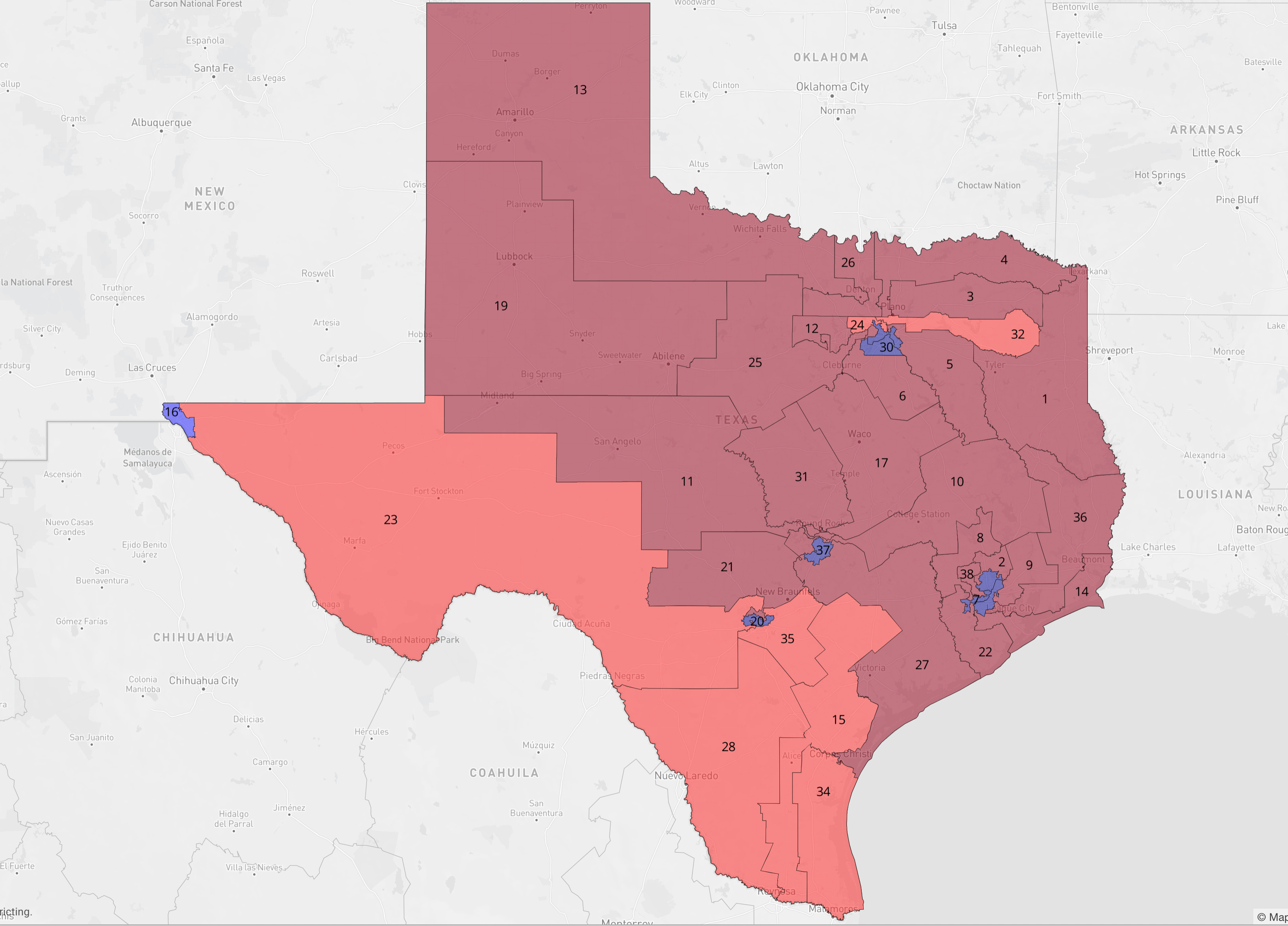
A three-judge federal court blocked Texas from using its new Republican-drawn congressional districts in a stunning ruling on Tuesday, ordering the state to conduct its elections next year under its previous map.
Republicans immediately filed an appeal, which would be heard directly by the Supreme Court. Should Tuesday’s ruling stand, however, it would halt the GOP’s plan to target five House seats held by Democrats.
And by triggering a response in blue states—most notably California—Republicans could see their nationwide push for mid-decade redistricting backfire on them in the 2026 midterms, since Democrats may come out ahead in the gerrymandering arms race that the GOP instigated at Donald Trump’s urging.
Texas’ bid to please Trump ran aground, wrote U.S. District Judge Jeffrey Brown in a 160-page opinion, because lawmakers improperly divided voters between districts based on their race. That practice, known as racial gerrymandering, violates the 14th and 15th Amendments to the Constitution.
Brown, a Trump appointee, was joined in his ruling by a second judge on the panel; the third judge dissented but has yet to file a written opinion.
Republicans sought to combat the charge that they’d engaged in racial gerrymandering by arguing that their primary motivation was to maximize their partisan advantage. However, pointing to reams of evidence, the court concluded that they had impermissibly allowed race to predominate over other redistricting criteria.
Brown specifically cited a July letter sent by Harmeet Dhillon, who heads the Civil Rights Division at the Department of Justice. Dhillon’s missive, addressed to Gov. Greg Abbott and state Attorney General Ken Paxton, threatened legal action should Texas not redraw its map.
That letter, however, made “the legally incorrect assertion that four congressional districts in Texas were ‘unconstitutional’ because they were ‘coalition districts’—majority-non-White districts in which no single racial group constituted a 50% majority,” Brown wrote.
“It’s challenging to unpack the DOJ Letter because it contains so many factual, legal, and typographical errors,” he continued. Nonetheless, Texas Republicans proceeded to do exactly as Trump’s Justice Department asked.
“The map ultimately passed by the Legislature and signed by the Governor—the 2025 Map—achieved all but one of the racial objectives that DOJ demanded,” the court determined. “The Legislature dismantled and left unrecognizable not only all of the districts DOJ identified in the letter, but also several other ‘coalition districts’ around the State.”
To remedy Texas’ illegal racial gerrymandering, the court issued a preliminary injunction forbidding the state from using its new map next year. (A full trial on the merits would be held at a later date, though Brown concluded that the plaintiffs would likely prevail—a legal requirement for obtaining a preliminary injunction.)
Instead, officials must hold next year’s elections under the same lines that have been on the books since 2021. Those districts are still the subject of a long-running challenge by the same plaintiffs, but those plaintiffs specifically asked that they be used in place of the new map the GOP passed this summer.
Because the dispute was heard by a three-judge district court panel, any appeals will go straight to the Supreme Court, without a stop at the Fifth Circuit Court of Appeals along the way.
It’s impossible to say how the justices might rule, but a separate case out of Louisiana that could eviscerate the Voting Rights Act is unlikely to play a role. That’s because the arguments the district court cited to block the Texas map relied solely on the Constitution rather than the VRA.
If Brown’s ruling remains in force, it would prompt a major realignment of the playing field just three weeks ahead of the Dec. 8 candidate filing deadline. Many Democrats had already announced plans to run in different districts or retire, while ambitious Republicans had eagerly launched campaigns for seats they expected to be much redder. All of that reshuffling would have to come undone.
One map that won’t be affected, however, is California’s. While an early Democratic plan to redraw the lines in the Golden State included a provision specifying that new California districts would take effect only if another state also engaged in mid-decade redistricting, it was removed from the final version voters passed earlier this month.
Want to ensure The Downballot can keep bringing you the best-in-the-biz coverage of redistricting? Upgrade to a paid subscription today!

Redistricting Roundup
AL Redistricting
A federal judge has ordered Alabama to use a new state Senate map starting next year after finding the previous map violated the Voting Rights Act by diluting the power of Black voters in the Montgomery area.
The new map, called Remedial Plan 3, was proposed by a teenager known by the initials D.D. and was one of three recommended by a court-appointed expert, Richard Allen.
However, Allen concluded that D.D.’s approach “only weakly remedies” the VRA violations found in Alabama’s prior map, which was drawn by Republicans, because candidates preferred by Black voters would likely often lose elections in one of the two affected districts.
He instead urged U.S. District Judge Anna Manasco to pick one of two other proposals he created based on submissions by plaintiffs. Manasco, however, chose Plan 3, noting in an opinion issued on Monday that it makes the fewest changes to the map she struck down earlier this year. She also rejected plaintiffs’ arguments that the plan did not sufficiently remedy the harms to Black voters.
“[T]he Court discerns no legal basis to hold that a district where a Black-referred candidate wins approximately half of the (seventeen or nineteen) modeled elections is not an effective remedial district,” she wrote. “In the Court’s view, requiring a greater chance of success would erroneously convert the requirement of equal opportunity into a requirement of something more.”
Plan 3 shifts some Black voters from the heavily Black 26th District to the neighboring 25th. The 26th remains majority-Black and solidly Democratic, while the 25th would retain a white plurality and would have voted for Donald Trump by a 51-47 margin last year, according to data from Dave’s Redistricting App and the Redistricting Data Hub.
Democrats will now have a better shot at unseating Republican Sen. Will Barfoot in the 25th District, but even if they’re successful, Republicans will retain a wide majority in the Senate, which they currently control 27-8.
FL Redistricting
A Florida House committee created by Republicans specifically to deal with redistricting will hold its first meeting on Dec. 4, though Florida Politics’ Jacob Ogles reports that “some members of the committee were surprised to see the meeting on the schedule.”
The surprise is understandable: Just last week, state House Speaker Daniel Perez—who established the special committee in the first place—told Politico that there’s “no plan on redistricting right now.”
However, Republican Gov. Ron DeSantis has continued to push for a remap. In response to Perez’s comments on Thursday, DeSantis tweeted, “Stay tuned,” and he was even more explicit at a Young Republicans gathering at his alma mater the following day.
“I’m going to make the legislature do redistricting,” he told attendees, according to the Yale Daily News.
It’s not clear, though, whether the state Senate is on board, as its top leader has remained noncommittal.
IN Redistricting
Indiana’s GOP-dominated Senate voted on Tuesday to adjourn until January, rejecting Republican Gov. Mike Braun’s call that they take up mid-decade congressional redistricting next month.
Indiana Senate Pro Tem Rodric Bray announced late last week that his caucus did not support a remap, making Tuesday’s vote no surprise. But Bray’s opposition has come in the face of escalating attacks from Donald Trump, who has threatened to endorse primary challengers to Republicans who stand in his way on redistricting. Braun has said he supports Trump’s primary threats.
Governors
CT-Gov
Former New Britain Mayor Erin Stewart on Tuesday announced her long-awaited campaign to take on Connecticut Gov. Ned Lamont, a Democrat who is seeking a third term next year.
But before Stewart can focus on winning in a blue state that decisively rejected Donald Trump in all three of his campaigns, she first needs to get past state Sen. Ryan Fazio in the Aug. 11 Republican primary. Lamont, for his part, faces a long-shot intraparty challenge from state Rep. Josh Elliott.
Stewart, who left office last week, found herself on the defensive even before her launch over her allegiance to Trump—or lack thereof.
The CT Mirror writes that a pro-Fazio group sought to undermine her last week by sending mailers to GOP activists condemning her as “anti-Trump.” The literature includes a 2017 quote in which Stewart, who had just agreed to visit Trump at the White House, sought to preempt Democratic attempts to link her to MAGA.
“I have no ties to them, and I’ve been pretty outspoken about not supporting Trump and about not supporting or being in favor of a lot of what he’s done and his approach,” she told the Mirror at the time.
Stewart, for her part, featured pictures of her meeting with Trump in her announcement video, though she avoided otherwise mentioning her party’s master. The candidate instead argued that Connecticut was failing under its current leadership, saying she would offer “something different.”
But the ex-mayor, who began raising money for a gubernatorial campaign early this year, was more than happy to associate herself with Trump shortly after he was sworn in for a second term in January.
“We knew what we were getting when he won,” she said at a press conference. We knew that everything that’s happened in the last week, all the executive orders, we knew that was going to happen, because he’s the type of leader who says he’s going to do something and does it. He doesn’t waffle. And I’m that same type of leader.”
Stewart, whose father was also a mayor of New Britain, became a Republican rising star in 2013 when, at the age of 26, she was elected to lead her heavily Democratic city. But while she would easily win another five two-year terms, her efforts to secure statewide office in 2018 went poorly.
That year, Stewart was one of several Republicans hoping to succeed Gov. Dan Malloy, a Democrat who decided not to run again in the face of weak approval ratings.
Stewart, though, ended her campaign just one day before delegates at the state party convention were set to award the party’s endorsement, a prize that gives its recipient the top spot on the primary ballot, and announced she’d run for lieutenant governor instead.
She ended up losing the primary for that post, however, to state Sen. Joe Markley by a 48-33 margin. Lamont and his running mate, Susan Bysiewicz, ultimately prevailed in a close race against the GOP team of Bob Stefanowski and Markley.
Stewart considered opposing Lamont in 2021 but ultimately sat the race out, and the governor went on to decisively beat Stefanowski in a rematch the next year. She showed no such hesitation about running in 2026, though, and chose not to seek reelection as mayor—an election won two weeks ago by Democrat Bobby Sanchez.
SD-Gov
South Dakota Gov. Larry Rhoden announced Tuesday that he would seek the Republican nomination to keep the job he was elevated to earlier this year.
Rhoden, who was serving as lieutenant governor in January when Kristi Noem resigned to join Donald Trump’s cabinet, joins three other prominent Republicans in the June 2 primary: wealthy businessman Toby Doeden, state House Speaker Jon Hansen, and Rep. Dusty Johnson.
All three challengers responded to the incumbent’s launch by reaffirming that they’d remain in the race. Doeden was the most explicit in his criticisms, though he was just as adamant about trashing Johnson in a statement to the South Dakota Searchlight.
“Their faces and names are different, but Larry Rhoden and Dusty Johnson are one and the same: career politicians that answer to big donors, special-interest groups, and the rich and powerful,” Doeden said.
Johnson, by contrast, offered backhanded praise of Rhoden, calling him a “worthy caretaker for South Dakota” even as the congressman argued he was the best candidate to lead the state. Hansen, for his part, framed himself as the one “proven conservative Republican fighter who will put you and your family first again.”
A runoff would take place on July 28 if no one wins at least 35% of the vote, though it doesn’t appear that a second round of voting has ever been needed in a gubernatorial primary in South Dakota. The eventual GOP winner will be the heavy favorite in a state where Democrats last won the governorship in 1974—the Democrats’ longest losing streak in the nation.
Rhoden, who was first elected to the state legislature in 2000, tried to win higher office in 2014 when he waged a long-shot bid for the U.S. Senate seat held by retiring Democratic incumbent Tim Johnson. Rhoden, though, had trouble gaining traction against former Gov. Mike Rounds in a primary that included three other candidates. Rounds won 56-18 before prevailing in the general election to replace Johnson.
That setback, though, didn’t spell the end of Rhoden’s career. He rejoined the legislature in 2016, and two years later, Noem successfully urged delegates to the GOP’s nominating convention to name him as her running mate following her own victory in the party’s primary. (A law signed by Rhoden this year now requires gubernatorial nominees to choose their own ticket-mates before the primary.)
While Rhoden became the Mount Rushmore State’s new leader this winter, he kept observers guessing for more than half a year about whether he’d run for a full term. The new governor, though, finally began raising money for his campaign in August, though he waited another three months before announcing he was in.
House
CA-06
Sacramento County District Attorney Thien Ho announced Tuesday that he would run for California’s open 6th District.
Ho, a Democrat, used his launch video to highlight how he and his family fled Vietnam when he was a child. He also talked about his role in convicting Joseph DeAngelo, the notorious murderer whose crimes in the 1970s and 1980s earned him the nickname the “Golden State Killer.”
Ho, who has the backing of Sacramento Mayor Kevin McCarty, joins former state Sen. Richard Pan and Planned Parenthood official Lauren Babb Tomlinson on the Democratic side in the June top-two primary. Kamala Harris would have carried the redrawn 6th District 53-44 last year.
All three candidates entered the race after Democratic Rep. Ami Bera, who represents the existing incarnation of the 6th, announced earlier this month that he’d challenge GOP Rep. Kevin Kiley for the redrawn 3rd District. Kiley himself has not ruled out running in the 6th, though he’s also talked about defending his current seat or opposing fellow GOP Rep. Tom McClintock in the 5th District.
FL-07
Real estate agent Sarah Ulrich said Tuesday that she would challenge scandal-ridden Rep. Cory Mills in the Aug. 18 Republican primary for Florida’s 7th District.
Without mentioning the incumbent by name, Ulrich issued a statement calling for “a Representative focused on the people of District 7, not personal scandals, and certainly not from Washington bureaucrats who do not reside in our District.”
Ulrich is the first notable Republican to oppose Mills, who largely avoided condemnation by party leaders even after a judge awarded a restraining order against the congressman last month to a former girlfriend he concluded was likely a “victim of dating violence.” Speaker Mike Johnson responded to that news by telling Politico, “I have not heard or looked into any of the details of that.”
Attorney Noah Widmann and former NASA official Bale Dalton are both seeking the Democratic nomination to take on Mills in a central Florida constituency that Donald Trump carried 56-43 last year.
FL-13
Reggie Paros, an official at the Environmental Defense Fund, on Monday became the first notable Democrat to launch a bid against far-right Rep. Anna Paulina Luna.
Donald Trump carried Florida’s 13th District, which is based in the St. Petersburg area, 55-44 last year. Luna turned back a well-funded opponent by a similar spread despite her attention-grabbing antics, which included apparently lying about having a Jewish background.
IL-04
Mayra Macias, a former executive director for the Latino Victory Fund, said Tuesday that she’s considering running as an independent for Illinois’ 4th Congressional District, which became open this month after Rep. Chuy Garcia engineered his retirement to ensure that only his preferred candidate would be able to run in next year’s Democratic primary.
Macias put out a statement the day after NOTUS’ Daniella Diaz reported that she’d already decided to run and would announce “in the next few weeks.” Macias, who writes that she wants to give voters “a choice,” would face Patty Garcia, who is Chuy Garcia’s chief of staff. (The two Garcias are not related.)
Previously, Chicago Alderman Byron Sigcho-Lopez expressed interest in waging his own independent campaign for what’s an otherwise safely Democratic seat. Anyone who wants to run without a party label has until May 26 to turn in 10,816 valid signatures, which is more than 15 times as many as Patty Garcia had to submit.
NC-01
Carteret County Sheriff Asa Buck on Tuesday entered the Republican primary to flip North Carolina’s 1st District, which the GOP legislature aggressively gerrymandered just last month.
Democratic Rep. Don Davis has not yet announced if he’ll seek reelection here or campaign against Republican Rep. Greg Murphy in the redrawn 3rd District.
NJ-08
Former Jersey City Board of Education President Mussab Ali is considering challenging Rep. Rob Menendez in next year’s Democratic primary, the New Jersey Globe reports. Ali, who took a close fourth place in the Nov. 4 nonpartisan race for Jersey City mayor, has not publicly talked about his interest in seeking the safely blue 8th District.
Menendez last year faced serious intraparty opposition from Hoboken Mayor Ravi Bhalla after the incumbent’s father and namesake, Sen. Bob Menendez, was charged with corruption.
Bhalla urged voters to punish the man he derided as the “entitled son of corrupt Bob ‘Gold Bars’ Menendez.” But the younger Menendez, who was never implicated in the scandal, still enjoyed the support of state and national Democrats, and even some of his father’s most ardent critics argued that he shouldn’t be punished for the senator’s wrongdoing.
The congressman won renomination 52-38 and went on to easily secure a second term weeks after his father resigned following his conviction. The former senator has since begun an 11-year prison sentence.
NJ-11
Gov.-elect Mikie Sherrill announced Tuesday that she would resign from the House effective on Thursday evening.
The New Jersey Globe’s Joey Fox anticipates that Gov. Phil Murphy, a fellow Democrat, will quickly schedule a special election to succeed her in New Jersey’s 11th District. (Murphy cannot take action until her seat is officially vacant.) Fox writes that the primary will likely take place between Jan. 30 and Feb. 5, with a general election to follow sometime between April 4 and April 16.
NY-06
Chuck Park, a former official at the New York City Economic Development Corporation, said Monday that he would challenge Rep. Grace Meng in the Democratic primary for New York’s 6th District.
Park, who previously served as a U.S. foreign service officer, told the Queens Daily Eagle he was running because Meng was too close to corporate interests and hadn’t done enough to tackle issues like affordability.
Meng became the state’s first Asian American member of Congress following her 2012 victory in the 6th District, which is based in northeastern Queens. The congresswoman has never had trouble securing renomination over the ensuing decade.
Meng also easily won reelection last year even as Donald Trump made huge gains in what’s long been a safely blue constituency. The incumbent secured her seventh term 60-38 last year as Kamala Harris prevailed only 52-46 in a district that had favored Joe Biden 64-35 in 2020.
NY-12
Two new candidates have joined the packed Democratic primary for New York’s open 12th District: Cameron Kasky, who co-founded the gun safety group March for Our Lives, and LGBTQ rights activist Mathew Shurka.
Kasky, who announced on Tuesday, survived the 2018 Marjory Stoneman Douglas High School shooting in Florida when he was 17. Kasky, now 25, went on to co-host a podcast for The Bulwark.
Shurka, who launched the following day, became politically active after he spent five years in “conversion therapy” that began when he was 16. Shurka, who describes himself as a “survivor,” has since become a prominent advocate for banning the long-discredited practice.
TN-07
National Republicans have ramped up their expensive last-minute mission to rescue Matt Van Epps ahead of the Dec. 2 special election for Tennessee’s dark red 7th District.

AdImpact reports that Republicans now have $1.1 million in ad time reserved for the remaining two weeks of the campaign, a huge increase from the $75,000 it had tracked as of Friday morning. Democrats, by contrast, have just under $300,000 booked for the rest of the campaign.
Conservatives for American Excellence, which is one of the outside groups helping Van Epps, uses its opening ad to label Democrat Aftyn Behn as a “radical liberal.” The spot goes on to feature clips of Behn saying, “[W]e’re bullying the ICE agents and state troopers,” and “I ran on protecting trans children.”
Poll Pile
AL-Gov: Cygnal (R): Tommy Tuberville (R): 53, Doug Jones (D): 34. Cygnal tells The Downballot the survey was not done on behalf of a client. Jones is considering running for governor but has not yet announced.
NY-Gov: Siena University: Kathy Hochul (D-inc): 52, Elise Stefanik (R): 32. (Sept.: 52-27 Hochul.)
NY-Gov (D): Siena: Hochul (inc): 56, Antonio Delgado: 16. (Aug.: 50-15 Hochul.)
OK-Gov (R): yes. every kid.: Gentner Drummond: 22, Charles McCall: 22, Chip Keating: 7, Jake Merrick: 2, Mike Mazzei: 2.
Marist Poll:
A majority of registered voters nationally (55%) say they would support the Democratic candidate for Congress in their district, if the 2026 congressional elections were held today. 41% would support the Republican
https://maristpoll.marist.edu/polls/a-look-to-the-2026-midterms-november-2025/
Absolutely hilarious that after picking this redistricting fight, Republicans are looking like net losers once the dust settles. Truly the Find Out portion of the program.