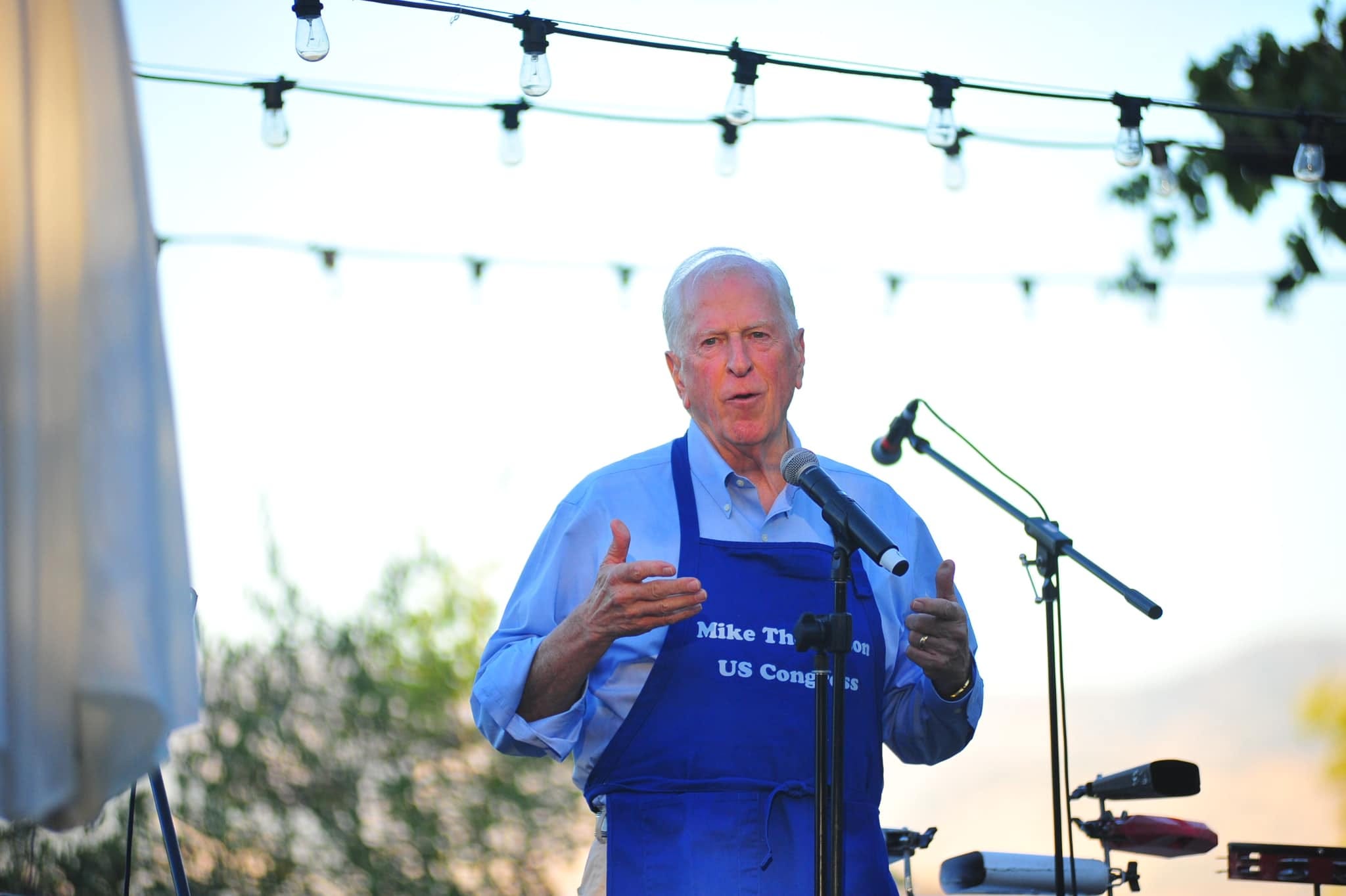
Democratic Rep. Mike Thompson of California faces a well-funded intraparty opponent in his campaign for a 15th term (credit: Mike Thompson Facebook)
Leading Off
3Q Fundraising
Frustrated Democrats across the country have launched campaigns targeting a wide range of House incumbents this year, seeking generational change and a more aggressive response to Donald Trump. But just how serious a threat are these primary challengers?
From members of the research and graphics team of now-defunct FiveThirtyEight comes a new website for tracking all the latest political polls in the U.S. Publicly available averages distill noisy polling data, and all raw data is accessible via an API for paying customers.
In some, insurgents may have kicked off their bids with fanfare but have yet to stockpile the resources necessary for the exceedingly difficult task of ousting a sitting member of Congress. In others, though, longtime representatives now face opponents who’ve shown they’re capable of raising real money and running real campaigns.
At the same time, some incumbents are taking these new threats seriously, while others are scarcely mustering a response.
Below we highlight four races that each offer a different perspective on the ongoing battle for the soul of the Democratic Party. All are in safely blue districts, and all involve contests in which a serious challenger emerged only in the second half of the year.
These are by no means the only such elections worth watching, but they all shed light on the party’s intense internal struggle that will play out in next year’s primaries.
CA-04
Rep. Mike Thompson, 74, faces a well-funded opponent in Eric Jones, a venture capitalist who is giving the incumbent his first serious challenge—in either a primary or a general election—since he was first elected in 1998 to represent Northern California’s wine country.
Thompson raised almost $600,000 during the most recent reporting period, which represents a modest increase from the roughly $440,000 he took in during the second quarter. He also finished last month with a healthy $1.5 million banked.
Jones, however, lapped him by taking in more than $1.3 million from donors and self-funding another $150,000. The 34-year-old Jones had $1.3 million banked as September came to a close. He’s pitched himself as an alternative to a failing status quo, saying that “too many Democrats have been in Washington so long they’re not up to the fight.”
The two will face off in the June top-two primary for what will remain a reliably blue district whether or not voters approve a new congressional map next month, but that special election could still affect this race.
To strengthen their chances in nearby districts, the proposed Democratic map would slash Kamala Harris’ margin of victory from 64-33 to 56-41. Such a change would make it easier for a Republican to advance out of the June top-two primary, an outcome that would avert a costly general election between two Democrats.
CT-01
After picking up four notable primary foes during the third quarter, Connecticut Rep. John Larson, 77, augmented his fundraising accordingly. Yet despite ramping up his activity considerably, the 14-term incumbent still finds himself behind one of his opponents.
Larson raised just over $800,000 for the quarter, representing a nearly eight-fold increase compared to his haul during the preceding three months. However, because of his relatively soft fundraising during the first half of the year, Larson’s cash stockpile—around $880,000—wasn’t much larger than his quarterly take.
Former Hartford Mayor Luke Bronin, though, eclipsed Larson—and the rest of the field—with his opening haul. Bronin took in $1.2 million in just over two months, and he had a similar $1.1 million on hand. Last month, the 46-year-old Bronin said that, while he had “an enormous amount of respect” for the incumbent, he was running because “I don’t think John Larson recognizes the moment that we’re in.”
Bronin’s huge quarter helped him cement his status as Larson’s main opponent in the August primary. None of the other three serious Democratic candidates—Hartford Board of Education member Ruth Fortune, state Rep. Jillian Gilchrest, and Southington Town Councilman Jack Perry—even came close to raising six figures from donors, though Perry self-funded $500,000. (All are in their 30s or 40s.)
HI-01
Hawaii Rep. Ed Case, unlike his colleagues mentioned above, actually saw his fundraising dip during the third quarter despite the entry of state Sen. Jarrett Keohokalole.
The 73-year-old Case, who has long been one of the more conservative members of the Democratic caucus, took in just under $110,000 for the quarter, compared to around $130,000 from April through June.
Keohokalole, 41, raised around $230,000 during his first months in the race. At a recent event announcing an endorsement from the Hawaii State Teachers Association, he took Case to task, saying, “For far too long, we’ve needed a fighter in this seat who is willing to stand strong against an authoritarian regime intent on weakening, and even destroying, our democracy.”
The incumbent, though, maintained a roughly $580,000 to $170,000 cash lead with the better part of a year to go before the August primary.
Complicating things further for Keohokalole is the presence of state Rep. Della Au Belatti, who could divide the anti-Case vote and make it easier for the congressman to win with a plurality. Belatti, 51, launched her campaign during the final days of September and raised just over $30,000 before the reporting period ended, so we won’t know the full extent of her financial prowess until the end of the fourth quarter.
Washington, D.C.
Delegate Eleanor Holmes Norton, 88, has repeatedly said she’s seeking reelection as the nonvoting advocate for the nation’s capital despite serious concerns about her ability to perform her duties, but her minimal fundraising is once again calling those plans into question.
Norton raised all of $3,227 during the last fundraising quarter and had less than $7,000 in her campaign coffers. The delegate faces several opponents for renomination to the seat she first won in 1990. The roster includes D.C. Education Board member Jacque Patterson, Councilmembers Brooke Pinto and Robert White, and former DNC member Kinney Zalesne. They range in age from their early 30s to about 60.
The June primary is set to be held using ranked-choice voting, thanks to an initiative voters approved last year. Congress, however, could still use its powers to dictate how the District is run to prevent the new system from being implemented.
Celebrate The Downballot’s 22nd anniversary since our founding by taking 22% off our regular subscription rate!
Normally, our annual rate is $60. But with this special offer, you can support our work and gain access to subscriber-only content and features for just $46.80 a year.
In response, a spokesperson for Davis said he would still seek reelection but might run either in the 1st District or in the neighboring 3rd. The latter is held by Republican Rep. Greg Murphy and would become bluer as a result of taking on Democratic-leaning turf—including Davis’ home county—from the 1st. However, both would still have supported Donald Trump by double digits.
The House will reportedly take up the map on Wednesday. Under North Carolina law, the governor plays no role in redistricting, so Democratic Gov. Josh Stein cannot veto
Senate
ME-Sen
Democratic Senate candidate Graham Platner revealed on Monday that he has a tattoo of a Nazi symbol on his chest but said he was unaware of its meaning until reporters recently began inquiring about it.
In an interview with Pod Save America, Platner disclosed the tattoo, which resembles a Totenkopf—a death’s head that, according to the Anti-Defamation League, was adopted by the Nazi paramilitary organization responsible for guarding concentration camps and death camps. Following the war, the ADL explains, white supremacists “resurrected the Totenkopf as a hate symbol because of its importance to the SS.”
Platner, a military veteran, said that he and fellow Marines got the tattoo in Croatia in 2007 while drunk, saying they “chose a terrifying-looking skull and crossbones off the wall because we were Marines and, you know, skulls and crossbones are [a] pretty standard military thing.”
He has, however, insisted he was unfamiliar with the symbol’s provenance.
“I am not a secret Nazi,” Platner told Pod Save America. “Actually, if you read through my Reddit comments, I think you can pretty much figure out where I stand on Nazism and antisemitism and racism in general. I would say a lifelong opponent.”
Others, though, have questioned Platner’s claim of ignorance. One unnamed acquaintance told Jewish Insider that Platner told him in 2012, “Oh, this is my Totenkopf.” (Platner told the Bangor Daily News the story was untrue.)
Platner’s former political director, who quit the campaign just days ago after the candidate’s history of questionable online commentary emerged, was also skeptical.
“Platner prides himself on his extensive knowledge of military history,” Genevieve McDonald, a former state representative, told the Portland Press Herald. “While he may not have known what his tattoo meant when he selected the image, it is not plausible he remained ignorant of its meaning all these years.”
In a recent interview before the tattoo story broke, Platner informed GQ, “I loved military history. I loved war films. I loved playing in war. I was a Civil War reenactor.”
McDonald also said that Platner had told her he had a tattoo that “could be problematic” about a month ago. The campaign dismissed McDonald’s comments as “a lie from a disgruntled former employee.”
Former Oklahoma House Speaker Charles McCall has publicized an internal poll that shows him outpacing Attorney General Gentner Drummond in both the June Republican primary for governor and in a likely August runoff.
Stratus Intelligence finds McCall and Drummond taking 32% and 30%, respectively, in the first round, with former state cabinet official Chip Keating a distant third with 7%. (Candidates need to secure a majority to win outright.) Respondents, however, favor McCall by a much wider 49-36 spread in a runoff.
The numbers are very different from an early August poll that showed Drummond demolishing McCall 48-10; that survey was conducted by Cole, Hargrave, Snodgrass & Associates, a Republican firm that regularly releases data on its home state. The GOP nominee will be heavily favored to succeed Republican Gov. Kevin Stitt, who cannot seek a third term in this dark-red state.
McCall and his allies at the Oklahoma Conservative Coalition have already spent well over $1 million on ads touting him as an ardent conservative and opponent of transgender rights. Drummond’s side has yet to launch a comparable ad campaign, though the primary remains far off.
WI-Gov
Former Lt. Gov. Mandela Barnes “plans” to enter the busy Democratic primary for governor of Wisconsin, Reid Epstein reports in the New York Times. Barnes, who lost a tight 2022 Senate race to Republican incumbent Ron Johnson, said during the first week of October his decision would come “very soon.”
Former Pinal County Sheriff Mark Lamb has filed paperwork with state election officials ahead of a possible campaign for Arizona’s dark red 5th District.
The news came shortly after a firm called NextGenP released another poll giving Lamb a massive lead over all of his would-be opponents in the August GOP primary. The survey shows Lamb outpacing his nearest competitor, former Arizona Cardinals kicker Jay Feely, 54-7, which is similar to what NextGenP found in July.
Lamb, who has been an ardent ally of far-right causes, ran for the Senate last year but lost the primary to Kari Lake by a 55-40 margin. Lamb, though, now has the chance to resurrect his political career following Republican Rep. Andy Biggs’s decision to run for governor.
CO-05
Army veteran Matt Cavanaugh announced Tuesday that he would run as an independent for Colorado’s 5th District, a development that complicates Democrats’ hopes of flipping this longtime Republican bastion.
Freshman Rep. Jeff Crank already faced serious opposition from Democrat Jessica Killin, an Army veteran and one-time chief of staff to former second gentleman Doug Emhoff, before Cavanaugh jumped in.
Killin, who launched her campaign in July, demonstrated her fundraising prowess by hauling in $1 million during her opening quarter, which was twice what Crank brought in during the same period. The incumbent’s head start left him with a tiny $779,000 to $773,000 cash on hand advantage at the end of September, but Killin’s strong opening gives her reason to be optimistic she’ll keep pace.
Cavanaugh, though, could cost Killin some much-needed support in a Colorado Springs-based constituency that favored Donald Trump 53-44 last year. While the “lifelong independent” pitched himself to Colorado Politics as a centrist, his belief that “Mike Johnson does not deserve to be the speaker of the House of Representatives” is likely to resonate more with voters who might otherwise back Killin than with Crank’s supporters.
“Thomas Massie has become one of the biggest roadblocks to President Trump’s ‘America First’ agenda,” Gallrein, who is a Navy SEAL veteran, said in a statement. “President Trump endorsed me because Kentuckians deserve a congressman who will stand with our president, not against him.”
But Massie, whose iconoclasm made him an outcast in MAGAworld long before he sponsored a petition to require a vote on the release of files related to the investigation of Jeffrey Epstein, quickly offered his own take about the primary in this dark-red constituency.
In a statement, the incumbent castigated Gallrein as “someone willing to be a rubber stamp for globalist billionaires, endless debt, foreign aid and forever wars.”
“Fourth District voters appreciate having an independent, conservative voice who works for them and I look forward to continuing my fight for transparency, constitutional rights, secure borders, a true America-first foreign policy and fiscal responsibility,” he added.
Gallrein, who narrowly lost a state Senate primary last year, entered the race after a monthslong White House search for a strong candidate to take on Massie. Trump’s allies, though, didn’t wait for someone to emerge before spending almost $2 million on ads attacking the congressman.
Massie, though, has plenty of money available to defend himself next year. The incumbent, who has represented the northern part of the state since 2012, hauled in over $750,000 during the most recent fundraising quarter, and he ended September with more than $2 million in the bank.
Massie also has vocal—but not yet financial—support from the world’s wealthiest man. Over the summer, Elon Musk responded to former Michigan Rep. Justin Amash’s call for him to back Massie by pledging, “I will.” Musk, though, did not donate to the congressman’s campaign through the end of September, and it remains to be seen if he’ll fund a super PAC to aid him.
MA-06
John Beccia, an attorney and executive in the cryptocurrency industry, has joined the Democratic primary for Massachusetts’ newly open 6th Congressional District.
Beccia, a first-time candidate, told the Boston Globe that he’s “worried about the damage the Trump administration is doing to democracy right now” but added that “we really need to start working together and get away from all the polarizing politics.”
Meanwhile, Lynn Mayor Jared Nicholson, another Democrat whose name had come up as a possible contender, has said no to the race.
ME-02
Former Rep. Mike Michaud, who represented Maine’s 2nd District for six terms, has endorsed state Auditor Matt Dunlap as he seeks to oust the seat’s current occupant, Rep. Jared Golden, in next year’s Democratic primary.
“Matt’s an individual who has great character and great conviction. He won’t be influenced or bought off by lobbyists and special interests,” Michaud said in a video. “You deserve a better choice. That better choice is Matt Dunlap.”
Golden was dismissive of Michaud, who was last on the ballot in 2014, when he lost a bid against then-Gov. Paul LePage 48-43.
“When it comes to assessing who has what it takes to beat Paul LePage, I’m not sure I’d take the advice of someone with a record of losing every county in the district to him,” his campaign manager said in a statement. LePage launched a comeback bid in the conservative 2nd District earlier this year.
NY-12
Former public radio anchor Jami Floyd has joined the already crowded Democratic primary for New York’s open 12th Congressional District, touting herself as a “relentless centrist” on her campaign website.
TX-21
Bexar County GOP Vice Chair Kyle Sinclair, who’d been considering a bid for Texas’ 21st Congressional District, jumped into the busy Republican primary on Tuesday.
Several other candidates are also running for this conservative district, which became open when Rep. Chip Roy announced he’d run for state attorney general in late August. In the short time since then, new disclosures show former Texas Rangers first baseman Mark Teixeira leading the pack in fundraising, taking in $214,000 and self-funding another $500,000.
Democratic Attorney General Keith Ellison announced Tuesday that he would seek a third term as Minnesota’s top lawyer.
Ellison, whose initial victory in 2018 made him the first Muslim elected to statewide office anywhere in the country, won his second term 50.4 to 49.5 in 2022, and Republicans are hoping to give him another tough challenge next year.
Ellison’s only notable GOP opponent so far, though, is attorney Ron Schutz, who launched his campaign earlier this month. Minnesota Republicans last won an election for attorney general in 1966.
NV-AG
Adriana Guzman Fralick, who chairs Nevada’s Cannabis Compliance Board, announced last week that she’d seek the Republican nomination for the open post of attorney general.
Guzman Fralick, whose resignation takes effect next month, joins Douglas County Commissioner Danny Tarkanian, who may be the most prominent perennial candidate in the country, in the June GOP primary.
The Democratic contest pits state Senate Majority Leader Nicole Cannizzaro against state Treasurer Zach Conine. The eventual nominees will compete to replace termed-out Attorney General Aaron Ford, who is seeking the Democratic nomination for governor.
Fond du Lac District Attorney Eric Toney on Tuesday kicked off his long-awaited rematch campaign against Wisconsin Attorney General Josh Kaul, the Democrat who fended him off 51-49 in 2022.
Toney is the first prominent Republican to launch a campaign to unseat Kaul, who announced earlier this month that he’d seek a third term rather than run for governor.






Graham Platner needs to remove his offensive tattoo as well as his name from the Maine ballot.
IN-Redistricting
Per Rodric Bray's office, the votes aren't there.
https://www.wthr.com/article/news/local/indiana/report-indiana-senate-republicans-dont-currently-have-votes-redistricting-statehouse-government-mike-braun-special-session-politico/531-131df970-9d69-4d1b-9d8a-a6029fa905cd?tbref=hp