



Leading Off
UT Redistricting
A Utah judge ruled on Monday night that Republicans violated the state constitution when they sought to gut a citizen-backed initiative to clamp down on partisan gerrymandering, ordering lawmakers to draft a new congressional map within a month.
New, nonpartisan districts could allow Democrats to pick up a seat in the Salt Lake City area at a time when red states nationwide are pushing forward with aggressive new gerrymanders at Donald Trump's behest.
At the center of the long-running legal dispute over Utah's map is a measure that voters narrowly approved in 2018 to create an independent redistricting commission and institute a set of criteria forbidding electoral boundaries from being drawn to favor any political party.
Republicans reacted to the adoption of that measure, known as Proposition 4, with open hostility. In 2020, they passed legislation to eviscerate the commission and its rules against gerrymandering, which also would have applied to the legislature if it were to reject maps proposed by commissioners.
The following year, the GOP codified new congressional lines that ensured the state would retain an all-Republican House delegation by carving up the populous blue bastion of Salt Lake County four ways. That resulted in four red districts that have elected four Republican members of Congress in each of the last two elections.
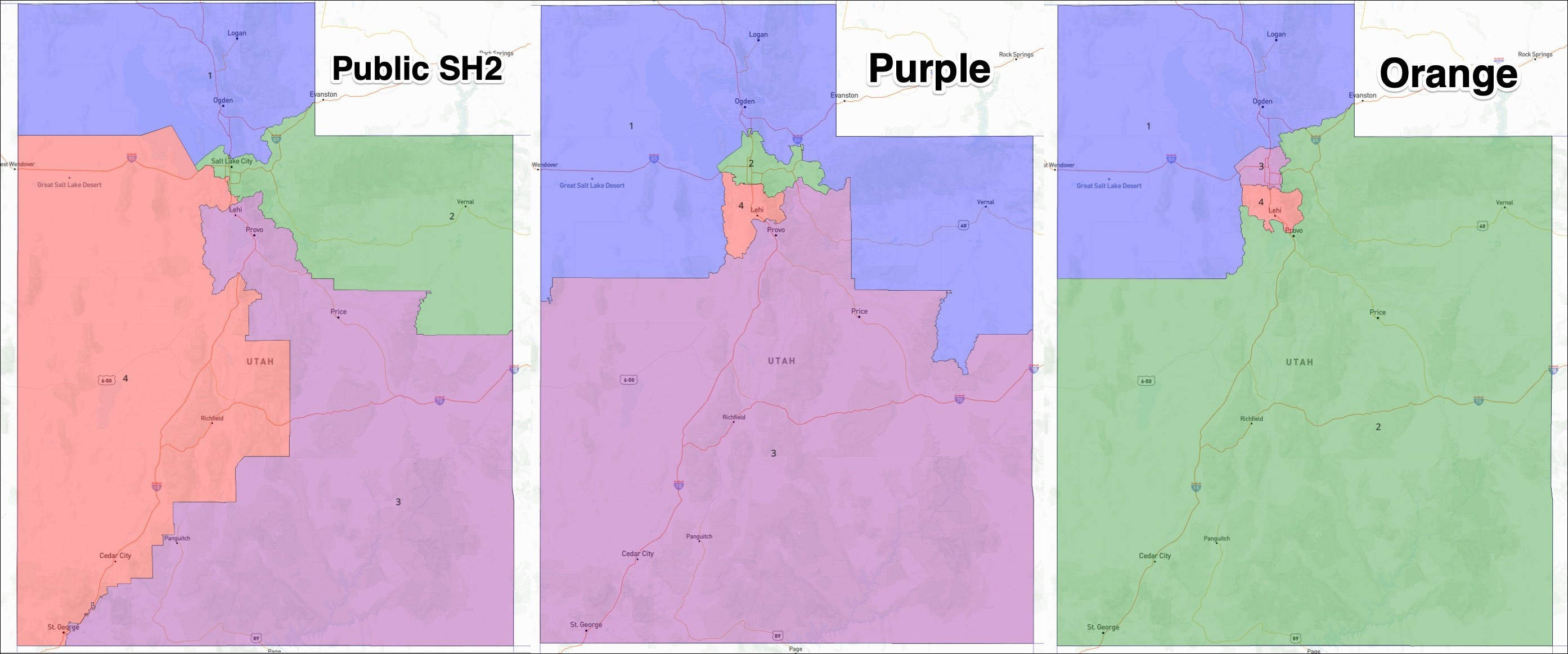
The commission, following traditional redistricting criteria that prioritize keeping communities whole and avoiding unnecessary county splits, took an entirely different approach. It offered up three different proposals, one that would have divided Salt Lake County three ways and two more that would have portioned it between just two districts.
All three maps would have yielded one solidly blue district—one too many, in the eyes of Utah Republicans, who ignored the commission's work.
But reformers were undeterred, filing a lawsuit charging that lawmakers had acted in defiance of the state constitution when they dismantled the 2018 ballot measure and its protections against gerrymandering. After a long delay, the state Supreme Court unanimously ruled last year that the challenge could proceed.
Finally, more than three years after plaintiffs first brought their case, District Court Judge Dianna Gibson sided with them.
In a 76-page opinion, she concluded that the Republican-dominated legislature had violated the rights of voters when it sought to overwrite Proposition 4.
"Because legislative power is shared co-equally and co-extensively between the Legislature and the people, and because redistricting is legislative, the people have the fundamental constitution[al] right and authority to propose redistricting legislation that is binding on the Legislature," she wrote.
Gibson further concluded that the GOP's congressional map, known as H.B. 2004, was in violation of the law because legislators had "intentionally stripped away all of Proposition 4's core redistricting standards and procedures that were mandatory and binding on it."
"It would exacerbate the constitutional violation to let the Legislative Defendants further delay any remedy by attempting to defend H.B. 2004 by claiming it complies with Proposition 4, a law they refused to follow."
As a consequence, Gibson gave lawmakers until Sept. 24 to pass a new, compliant map and indicated she would impose one if they do not. She also invited plaintiffs and interested third parties to submit proposals by that same date.
Republicans could appeal to the Utah Supreme Court or, in a Hail Mary, to the U.S. Supreme Court, and ask that Gibson's order be stayed. However, as noted above, the state's top court has not offered a warm reception to prior GOP requests in this same case, so pleas for a further delay may fall on deaf ears.
If you depend on candid, comprehensive coverage of redistricting, now is an excellent time to upgrade to a paid subscription. You’ll help ensure we can keep bringing you reports like the one above, and you’ll also unlock access to our continually updated redistricting tracker just below—available only to subscribers.

Election Recaps
IA State Senate
Iowa Democrat Catelin Drey won a major upset on Tuesday night, flipping a deep-red seat in the state Senate and breaking the GOP's supermajority in the chamber.
Drey defeated Republican Christopher Prosch by a wide 55-45 margin in a district Donald Trump carried by 11 points last year.
The Downballot sent a special breaking news alert to subscribers immediately following Drey's victory. Read our full report below explaining how she won—and what it means for Democrats both in the short term and next year.

Senate
IA-Sen
State Sen. Zach Wahls has released an internal poll to bolster his case that he's the strongest Democrat to take on Republican Sen. Joni Ernst, though the differences are small.
Public Policy Polling shows Ernst edging out Wahls 43-42, while she leads Des Moines School Board Chair Jackie Norris by a slightly larger 45-42 spread. Two other Democrats, military veteran Nathan Sage and state Rep. Josh Turek, trail Ernst 45-41.
KS-Sen
Immigration attorney Anne Parelkar said Monday that she would seek the Democratic nomination to face Republican Sen. Roger Marshall. Parelkar joins former Biden administration official Christy Davis in the primary in Kansas, a state that last elected a Democrat to the Senate in 1932.
Parelkar attracted attention in March when she traveled 350 miles west from her home in Overland Park to Marshall's town hall in the small community of Oakley so that she could question the senator about his support for cutting the federal workforce.
After Marshall accused her of having her facts wrong, Parelkar replied, "Half the people in the U.S. are brainwashed one way or the other way. So how do we get us on the same page again?" Marshall went on to spread Donald Trump's evidence-free claim that the crowd, which the senator sniffed was "one of the rudest audiences I've ever had," was full of outsiders paid to disrupt GOP town halls.
In response, Parelkar wrote on Facebook, "I do not apologize to you for driving 10 hours round trip to attend the only townhall of which any of the Kansans I know are aware. I do not believe it was rude of those who travelled to meet you to be there."
TX-Sen
Texas Attorney General Ken Paxton posts a 42-37 lead over Sen. John Cornyn in next year's Republican Senate primary, according to GOP pollster Echelon Insights.
This survey from Echelon, which did not mention a client, is the third in recent weeks to show a single-digit race after previous polls found Cornyn trailing by double digits. Texas Southern University gave Paxton a similar 44-39 edge, while Emerson College had Cornyn ahead 30-29.
Only TSU, however, had previously polled this primary. Its latest numbers show a small improvement for Cornyn from his 43-34 deficit in May.
Governors
CA-Gov
Democratic Sen. Alex Padilla might run for governor of California, Politico reports, a decision that would reshape the packed contest to lead the nation's largest state. However, Padilla's team indicated it won't be made for some time.
A spokesperson for the senator merely said that he was "focused on" the Nov. 4 election to pass a constitutional amendment that would allow the state to counter the new Republican gerrymander in Texas. Politico noted that this brief statement did not address whether Padilla was interested in running to succeed termed-out Gov. Gavin Newsom, a fellow Democrat.
The story broke the same day that UC Berkeley released a survey for the Los Angeles Times that shows most candidates are struggling to break away from the rest of the field ahead of June's top-two primary.
Former Democratic Rep. Katie Porter takes first with 17%, which would earn her a spot in next fall's general election. Riverside County Sheriff Chad Bianco, a Republican, holds a tiny 10-9 edge over Democrat Xavier Becerra, who previously served as state attorney general, for the second slot.
Nine other declared or potential candidates take 6% or less, while a 38% plurality of respondents are undecided.
While the first round of voting is still over nine months away, there are few would-be candidates left who could launch a strong campaign at this point. Successful statewide contenders need massive sums of money and as many allies as they can gather, and almost anyone still on the sidelines no longer has enough time to assemble such an operation.
But Padilla, who is not up for reelection to the Senate until 2028, might be the rare Golden State politician prominent enough to make a late entry.
Padilla is a longtime presence in state politics who was serving his second term as secretary of state in 2020 when Newsom picked him to replace Vice President-elect Kamala Harris in the Senate.
The appointment made Padilla California's first Latino senator, and he easily defended his seat when it came up for election in 2022. He was also the subject of international media coverage in June when federal officials handcuffed him and threw him to the ground when he tried to question Secretary of Homeland Security Kristi Noem at a press conference in Los Angeles.
CO-Gov
While Republican state Sen. Barbara Kirkmeyer has said little about her interest in running for governor since last year, Colorado Pols anticipates she'll enter the race shortly after Labor Day.
Kirkmeyer lost a tight 2022 race to Democrat Yadira Caraveo for the newly created 8th District, but she won a new four-year term in the legislature in 2024 after no Democrat secured a spot on the ballot.
A few other Republicans are running to succeed term-limited Democratic Gov. Jared Polis in a former swing state that's become a blue bastion in recent years. Observers have unsurprisingly paid considerably more attention to the Democratic primary between Sen. Michael Bennet and Attorney General Phil Weiser.
House
CA-48
Attorney Anuj Dixit said Tuesday that he'll challenge Republican Rep. Darrell Issa in the revamped 48th District if voters approve a constitutional amendment this November that would make this reliably red seat in the San Diego area much more competitive.
Dixit is currently challenging GOP Rep. Ken Calvert in the 41st District, which includes the city of Palm Springs. Businessman Brandon Riker, another Democrat who is opposing Calvert, previously announced that he'd campaign in the 48th if Palm Springs is merged into Issa's constituency.
Navy Reserve officer Ammar Campa-Najjar, who lost to Issa in 2020, also said he'd run for the 48th if the new boundaries go into effect. Campa-Najjar, unlike Dixit and Riker, was not running for Congress this year before the proposed new map was unveiled.
CT-01
State Rep. Jillian Gilchrest announced Tuesday that she would challenge longtime Rep. John Larson in next year's Democratic primary. Gilchrest is the fourth notable candidate opposing Larson for renomination in Connecticut's 1st District, a safely blue seat based around Hartford.
"I respect Congressman Larson," Gilchrest, 43, said of the 78-year-old incumbent. "I appreciate the work he has done, but I think we need elected officials who can work on multiple issues at the same time and can be out there pushing for change every single day, and I don't see that happening currently."
Gilchrest, who first won her spot in the legislature in 2018 after defeating a 12-term lawmaker in the primary, joins former Hartford Mayor Luke Bronin, Hartford Board of Education member Ruth Fortune, and Southington Town Councilman Jack Perry in the primary. Larson, who was filmed twice this year freezing mid-speech, has repeatedly said he will seek a 15th term.
A crowded field of opponents would almost certainly make it easier for Larson to win renomination with just a plurality of the vote, but there's no guarantee all of these contenders will advance to next August's primary.
The CT Mirror explains that candidates need to win at least 15% of the vote at next year's party convention to ensure they have a spot on the ballot. Candidates can also collect signatures from 2% of the district's registered Democrats, but they have just 42 days to do so.
GA-01
Army veteran Brian Montgomery has entered the Republican primary for Georgia's 1st District, a conservative constituency on the state's coast that GOP Rep. Buddy Carter is leaving behind to run for the Senate.
Montgomery joins Chatham County Commissioner Patrick Farrell and insurance executive Jim Kingston, who is the son of former Rep. Jack Kingston, in the contest. Kandiss Taylor, a far-right activist who's fared poorly in past statewide elections, is also in, but she'd raised almost no money through the end of June.
No notable Democrats have entered the race for a constituency that Donald Trump, according to calculations by The Downballot, carried 58-42 last year.
MI-10
Republican state Rep. Joe Aragona endorsed prosecutor Robert Lulgjuraj's campaign to defend Michigan's open 10th District on Tuesday despite previously expressing interest in running himself.
Lulgjuraj is currently the only notable Republican campaigning to succeed GOP Rep. John James, who is giving up this light-red seat to run for governor, while several Democrats are running. Donald Trump prevailed 52-46 here last year after carrying the 10th just 50-49 in 2020.
MI-11
Businessman Don Ufford, who served as Ford's director of global vehicle engineering, announced Tuesday that he would seek the Democratic nomination for Michigan's 11th District. Ufford is seeking office for the first time.
The newcomer joins state Sen. Jeremy Moss, who launched his campaign more than three months ago, in the contest to succeed Rep. Haley Stevens, a fellow Democrat who is seeking a promotion to the Senate. The 11th District, which is based in Detroit's northwestern suburbs, backed Kamala Harris 57-41.
NH-01
New Hampshire Gov. Kelly Ayotte said Tuesday she would nominate Attorney General John Formella to serve another four-year term, a decision that almost certainly means Formella won't seek the Republican nomination for the open 1st Congressional District.
A spokesperson for Formella didn't rule out such a campaign back in May after Ayotte initially declined to say whether she'd retain him. Now that the governor has made up her mind, though, it will be up to the Executive Council—a unique five-member body with a GOP majority—to confirm him.
TX-18, TX-09
Democratic Rep. Al Green said Tuesday that he'll announce in November whether he'll run in the reconfigured 18th District around Houston, which is home to about two-thirds of the constituents he currently represents as well as his residence.
But Green, who turns 78 next week, indicated he's likely to run again in large part, he says, to protect the legacies of Reps. Sheila Jackson Lee and Sylvester Turner, two septuagenarians who both died in office. He told reporters, "I'm going to be in a race just to defend those two people if for no other reason."
The congressman, though, did say he wouldn't run in this fall's special election to succeed Turner in the existing 18th District, a move he said could confuse voters and leave his constituents without a representative. Whoever wins that special, which likely will not be resolved until a runoff takes place early next year, will need to quickly prepare for the March primary for a full term.
Green also confirmed he wouldn't run in the revamped 9th, a conservative constituency that has little in common with his longtime district beyond sharing a number.
TX-33
Democratic Rep. Marc Veasey recently told Dallas' NBC affiliate that he might run statewide or for local office in Tarrant County rather than seek another term in Texas' redrawn 33rd District, which no longer contains Veasey's Fort Worth base. The congressman made similar comments to CNN earlier this month.
While the 33rd remains a safely Democratic constituency, it's now based entirely in Dallas County. Reps. Jasmine Crockett and Julie Johnson, who respectively represent the current 30th and 32nd Districts, have both talked about running here, though Johnson says she wouldn't campaign against Veasey.

TX-34, TX-28
Former Rep. Mayra Flores announced Monday that she would wage a third campaign against Democratic Rep. Vicente Gonzalez in the 34th District, a move that comes four months after Flores initially decided to challenge Democratic Rep. Henry Cuellar in the 28th.
Flores told the conservative Washington Examiner that she switched races after her fellow Texas Republicans passed their new gerrymander to make the 34th more conservative. Donald Trump would have carried the new 34th 55-44, compared to his 52-47 showing under the current lines.
Trump, though, would have also won the revamped 28th 55-44, which is several points to the right of his 53-46 performance in the existing incarnation of Cuellar's seat. Joe Biden would have still carried the redrawn versions of both Rio Grande Valley seats in 2020, but Lone Star Republicans are betting that Trump's dramatic gains with Latino voters won't be reversed anytime soon.
Flores launched her new campaign to oppose Gonzalez by arguing she was the best Republican to flip the 34th and would ensure "we elect strong Republicans and not RINOs." National GOP leaders, though, reportedly want a different nominee here.
Army veteran Eric Flores launched his campaign against Gonzalez in July, and Punchbowl News wrote at the time that party operatives were "excited" about him. Flores, who the Examiner says is not related to the former congresswoman, went on to receive an endorsement from Rep. Monica De La Cruz, who represents the neighboring 15th District.
Mayra Flores, however, has released an internal poll from 1892 Polling that shows her beating Eric Flores 38-5 in the primary, which she argues shows her as "the clear winner for this primary." Eric Flores and his allies, though, have until the March 3 primary to boost the first-time candidate's name recognition.
Mayra Flores, by contrast, is anything but an unknown quantity. Flores, who says she left the Democratic Party after supporting Barack Obama in 2008, briefly became a conservative star after she flipped a longtime Democratic House seat in an unusual 2022 special election.
Democratic Rep. Filemon Vela, who had previously announced that he would not seek reelection in the Brownsville-based 34th District, ultimately resigned early to take a job at a lobbying firm. Gonzalez, who represented the 15th District at the time, had already won the primary for the full term in the redrawn—and more Democratic—version of the 34th, but he had little reason to run in the special election for the final six months of Vela's term.
Flores defeated former Cameron County Commissioner Dan Sanchez, a Democrat who would have entered Congress as a lame-duck representative, 51-43 in the last election to take place under the district lines that were in use during the previous decade. The victory made Flores the first woman born in Mexico to serve in Congress, as well as the first Republican elected to represent portions of this constituency since 1870.
Flores, though, quickly had to defend the redrawn 34th from Gonzalez that fall, and this time, her extreme views attracted far more scrutiny.
Democrats ran ads tying Flores, who had spent the weeks after the 2020 elections denying Trump lost and repeatedly used the hashtag "#qanon" on social media, to the Jan. 6 rioters. The congressman's allies also went after her ardent opposition to abortion rights, an issue she said led her to bolt the Democratic Party more than a decade earlier.
While Republicans hoped that the Rio Grande Valley's ongoing shift to the right would benefit Flores, Gonzalez won this unusual incumbent vs. incumbent battle 53-44. (De La Cruz flipped the 15th District that same evening.)
Flores soon launched a rematch campaign against Gonzalez, and their second bout once again attracted millions in outside spending. The final result was much closer, but Gonzales held on 51-49, even though Trump carried the 34th this time.
Flores unexpectedly announced this spring that she would take on Cuellar in the 28th by telling Fox News, "It's not about what Mayra Flores wants. It's what this country needs me to do." The former congresswoman's campaign, though, announced hours later that she had been hospitalized because of "a sudden health scare."
Flores told The Hill the next week that her situation was caused by stress and "replacing my meals with shakes," saying that she would continue her campaign against Cuellar. But she changed her plans on Monday, though, when she returned to the 34th.
TX-35
Republican state Rep. John Lujan confirmed his interest in seeking the overhauled 35th District in new comments to the Texas Tribune. The new version of the 35th, which now includes part of San Antonio and rural areas to the east and south, would have favored Donald Trump 55-44.
Democratic Rep. Greg Casar, whose base is in Austin, is running in the 37th.
Editor's note: In a previous Digest, we said that Texas Rep. Marc Veasey had not "shown any indication of wanting to give [] up" the 33rd Congressional District. Veasey had previously suggested he could run for statewide or local office.
Q poll TRump keeps sinking 37-55. https://x.com/IAPolls2022/status/1960764129435636130
It's great that The Downballot gets all this visibility from the special election posts, but they certainly attract some more outré perspectives on what Democrats need to do to win elections.
It takes a certain amount of self control not to pull a Barney Frank and respond as he did in this 2009 town hall:
WOMAN (after comparing Obama and the Affordable Care Act to Hitler and the Nazis):
My question to you is, why do you continue to support a Nazi policy?
BARNEY FRANK:
I am going to revert to my ethnic heritage and answer your question with a question: On what planet do you spend most of your time?