


Leading Off
TX-Sen
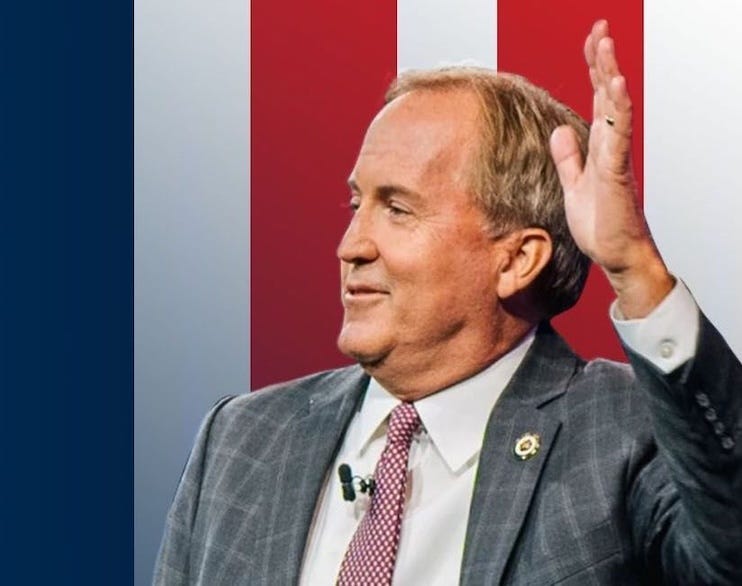
Texas Attorney General Ken Paxton defeated Sen. John Cornyn in a 64-36 landslide in Tuesday’s Republican primary runoff, an outcome that Senate GOP leaders fear could cost their party control of a crucial Senate seat and divert much-needed money from other battlegrounds.
Paxton will now take on state Rep. James Talarico, who won the Democratic nomination outright in March, in what will be one of the most closely watched elections anywhere in the country.
Lone Star State Democrats were already hoping that Donald Trump’s poor approval ratings nationwide and Talarico’s strong fundraising would give them an opening to score their first statewide victory since 1994, even before it became clear that Cornyn was done for.
Their optimism for a breakthrough only grew last week when Trump endorsed Paxton, a man for whom the term “scandal-plagued” barely does justice. Sen. Thom Tillis of North Carolina spoke for many frustrated Republicans over the weekend when he told CNN, “To call Paxton ethically challenged is to call Jeffrey Dahmer suffering from an eating disorder.”
Paxton wasn’t even a year into his first term as attorney general in 2015 when he was indicted for securities fraud. He remained under indictment eight years—and two reelections—later when the Republican-led state House overwhelmingly voted to impeach him for allegedly using his office to benefit a wealthy donor named Nate Paul. Paxton’s accusers also alleged both that he’d been unfaithful to his wife, state Sen. Angela Paxton, and convinced Paul to hire the woman Paxton was having an affair with.
The attorney general, however, would demonstrate a Trump-like ability to survive, and even thrive, in the face of these seemingly career-ending scandals.
The state Senate in 2023 acquitted Paxton, and he soon began a largely successful primary revenge campaign against the state representatives who impeached him in the first place. Federal prosecutors also reached an agreement with Paxton in 2024 under which they agreed to drop his nearly nine-year-old indictment for securities fraud as long as he paid $271,000 in restitution over the next 18 months.
Cornyn failed to persuade Trump or the state’s restive Republican base that all of this, as well as Angela Paxton’s decision to file for divorce last year “on biblical grounds,” made the attorney general too toxic to nominate, though it was hardly for lack of trying.
AdImpact reports that Cornyn’s side outspent Paxton and his backers roughly $94 million to $15 million on ads across both rounds of voting in “the most expensive Senate primary on record.”
The incumbent’s backers argued that this massive outlay was worth it. Majority Leader John Thune, who defeated none other than Cornyn in a 2024 contest to succeed Mitch McConnell as the Senate’s top Republican, told Punchbowl News in January that this “will allow us to deploy resources to places like Michigan and North Carolina, where we’re going to have some really expensive races.”
But while GOP outside groups went along with Thune’s “business proposition,” Trump saw things differently. MAGA’s master last week endorsed Paxton, who spearheaded the failed lawsuit to overturn Joe Biden’s 2020 election victory, over the senator he said “was very late in backing me in what turned out to be a Historic Run for the Republican Nomination, and then, the Presidency, itself.”
Texas Republicans, though, had long been suspicious of Cornyn, who was first elected to the Senate in 2002 as a George W. Bush ally, well before Trump came out against him. Several county parties censured the senator in 2022 after he supported the gun safety bill in the aftermath of the Uvalde school massacre.
But his problems with the base go deeper than a single vote: One unidentified former Cornyn adviser succinctly summed up the incumbent’s problems to Texas Monthly’s Eric Benson: “Can I be Mitch McConnell’s best friend for eighteen years and Donald Trump’s best friend for eighteen months?”
The answer was no, and Cornyn has now become the first elected senator in Texas to lose reelection since 1970. It was that year that liberal Sen. Ralph Yarborough lost his Democratic primary for the state’s other seat to the more conservative Lloyd Bentsen, who went on to defeat future President George H.W. Bush in the general election.
Talarico hopes all of this will redound to his benefit and give him the chance to succeed a different Texan who would later occupy the White House. The seat Talarico and Paxton are fighting for has been in GOP hands since 1961, when John Tower won a special election to replace Vice President Lyndon Johnson in the Senate.

Defeated House Incumbents
TX-18 (D) (77-22 Harris)
Rep. Al Green’s campaign for a 12th term ended with his lopsided loss to Rep. Christian Menefee in a race where the new GOP gerrymander led to a confrontation between the two Democratic incumbents.
Menefee, who arrived in Congress following his victory in a January special election, scored a 69-31 victory over Green, who was first elected to represent Houston in 2004.
Crypto-aligned groups spent over $4 million to boost Menefee, an effort that included commercials highlighting the generational gap between the 38-year-old Menefee and his 78-year-old rival. That argument may have had an especially deep resonance in Houston, where a pair of septuagenarian representatives, Sheila Jackson Lee and Sylvester Turner, died within a year of one another in 2024 and 2025.
TX-33 (D) (65-33 Harris)
Rep. Julie Johnson lost renomination to former Rep. Colin Allred, her immediate predecessor in the House, in a Dallas-based district that’s largely new to her. Allred, who left the House to challenge Republican Sen. Ted Cruz in 2024, is all but certain to return following his 54-46 win against Johnson.
Johnson made history two years ago when she became the first openly gay person elected to represent Texas in Congress, but the GOP’s new map and Allred’s widespread name recognition proved to be too much for her to overcome.
Johnson argued her opponent, who began running for the state’s other Senate seat before switching contests in December, was only “parachuting back when another campaign doesn’t work out.”
But Allred, who enjoyed a huge fundraising advantage, successfully countered by highlighting his own record in Congress and airing ads faulting Johnson for buying and selling stock in Palantir, the mass surveillance firm that’s sold tools to ICE.
Texas
TX-09 (R) (59-40 Trump)
Army veteran Alex Mealer defeated state Rep. Briscoe Cain in an open Houston-area constituency that Republicans just radically overhauled to make it a near-certain flip. Mealer leads 68-32 with the Associated Press estimating that about three-quarters of the vote is in, but while the margin may shift, the outcome is not in doubt.
Trump and well-funded outside groups supported Mealer, who lost a tight 2022 race to lead Harris County, while Gov. Greg Abbott backed Cain. Mealer is the favorite to defeat Democrat Leticia Gutierrez, a community organizer who has struggled to raise money.
TX-19 (R) (75-24 Trump)
Tom Sell, the founder of a prominent lobbying firm, prevailed 64-36 against conservative activist Abraham Enriquez, who had Abbott’s support. Sell is now on a glide path to replace retiring GOP Rep. Jodey Arrington in this constituency in the Lubbock area.
TX-35 (D & R) (55-44 Trump)
Democrat Johnny Garcia and Republican Carlos De La Cruz will compete for a Democratic-held open seat that Republicans aggressively gerrymandered, but that both parties recognize is still in play this fall.
Garcia, a Bexar County Sheriff’s deputy, overcame heavy spending by an obscure group with links to Republicans and defeated Maureen Galindo, a sex therapist who has drawn widespread condemnation for her antisemitism, by a 64-36 margin.
De La Cruz, an Air Force veteran and the brother of Republican Rep. Monica De La Cruz of the 15th District, turned in a 58-42 victory over state Rep. John Lujan. This was another GOP primary where Trump supported the winner, while Abbott backed the losing candidate.
TX-38 (R) (60-39 Trump)
Mortgage broker Jon Bonck, who has Trump’s endorsement, defeated former FAA official Shelly deZevallos by a 65-35 spread. Bonck should have little trouble replacing GOP Rep. Wesley Hunt, who waged an ill-fated Senate campaign that ended in March, in this seat northwest of Houston.
TX-AG (R & D) (56-42 Trump)
Republican Mayes Middleton will face Democrat Nathan Johnson, a fellow member of the state Senate, in the general election to replace Attorney General Ken Paxton in one of the most influential posts in Texas.
Middleton, a wealthy oil businessman, scored a 55-45 win against U.S. Rep. Chip Roy, the onetime frontrunner who couldn’t overcome his history of getting on Trump’s bad side. Johnson, for his part, prevailed 61-39 against former Galveston Mayor Joe Jaworski.
TX-LG (D) (56-42 Trump)
State Rep. Vikki Goodwin beat union activist Marcos Velez 68-32 in the runoff to face Republican Lt. Gov. Dan Patrick, who, as leader of the state Senate, has powers that rival the governor’s.
Patrick, a conservative hardliner seeking his fourth term, will be difficult to defeat. The incumbent has over $30 million at his disposal, and he’ll almost certainly benefit if Mike Collier, the 2018 and 2022 Democratic nominee, succeeds in qualifying for the ballot as an independent. Collier has until June 25 to submit the requisite 82,000 signatures.
TX Railroad Commissioner (R) (56-42 Trump)
Far-right primary challenger Bo French holds a narrow lead over incumbent Jim Wright in a closely watched Republican primary runoff for a seat on the Railroad Commission, the powerful three-member body that regulates the oil and gas industry, but the Associated Press has not yet called a winner. French leads 50.6 to 49.4 with an estimated 97% reporting.
French, a former Tarrant County GOP chair, attracted national attention during his campaign with his attacks on Muslim Americans and calls for the deportation of 100 million people. Abbott endorsed Wright late in the campaign and warned that French would devastate the state’s vital energy industry if he were elected.
The GOP nominee will go up against Democratic state Rep. Jon Rosenthal, a longtime oil field mechanical engineer who has called for “mak[ing] sure the Railroad Commission does its job for the people—not for high-dollar lobbyists and entrenched interests.”
Harris County Judge (D & R) (52-46 Harris)
Former Houston City Council member Letitia Plummer defeated Annise Parker, the city’s former mayor, in a 51-49 upset in the Democratic primary runoff for this influential post.
Plummer would be the first African American to lead America’s third-largest county, as well as the first Muslim person to hold this office. (In Texas, the position of county judge is not judicial but rather is the equivalent of county executives elsewhere.)
Plummer trailed Parker 47-37 in the first round of voting in March, and a University of Houston poll conducted this month showed Parker with a 54-36 advantage. It was, therefore, a big surprise when Plummer came out on top on Tuesday.
The Houston Chronicle, though, writes that Plummer appears to have benefited from voters turning out for the Democratic runoff between Reps. Christian Menefee and Al Green, who are both Black, in the 18th Congressional District. (Parker is white.)
Plummer, who campaigned to the left of Parker, may also have received a boost from younger and more progressive voters turning out in disproportionate numbers for the second round of the county judge race. County Judge Lina Hidalgo, a Democrat who is not seeking a third term, was likely one of those voters: While Hidalgo never endorsed Plummer, she urged her constituents last year to reject Parker.
Plummer, 55, also argued that Parker, who is 70 and left office more than a decade ago, was the wrong person to address Harris County’s challenges. Plummer told Houston Press, “Her mindset is of yesterday. Her thought process is dated.”
Plummer will take on former County Treasurer Orlando Sanchez, who beat Air Force veteran Warren Howell 63-37 in the Republican contest.
Redistricting Roundup
AL Redistricting
A federal court on Tuesday blocked Alabama Republicans from using their new congressional gerrymander, with the judges finding that it “intentionally discriminated based on race.”
State Attorney General Steve Marshall quickly announced he would appeal to the U.S. Supreme Court, which earlier this month lifted injunctions that had barred Alabama from using a map that eliminates one of the state’s two predominantly Black congressional districts.
MD Redistricting
Senate President Bill Ferguson said Friday that he was now open to placing a constitutional amendment on Maryland’s general election ballot that would allow the state to draw a new congressional map in time for the 2028 elections.
Ferguson, who did not commit to anything, told WYPR he would talk with the Democratic caucus after the June 23 primaries. Ferguson himself faces opposition that day from Bobby LaPin, a tour boat operator who began running last year over the incumbent’s refusal to pursue a redraw in time for 2026.
SC Redistricting
The Republican-led state Senate on Tuesday voted against advancing a plan to redraw South Carolina’s congressional map to eliminate its one plurality-Black district, a move that effectively guarantees the current boundaries will remain in effect this fall. The push, though, will likely be revived next cycle.
The vote took place on the first day of early voting for the June 9 primaries, and several conservative legislators said they believed that acting now would have resulted in a costly and unpredictable legal battle.
State Sen. Larry Grooms, who days before had backed an unsuccessful push to pass a new map before the start of early voting, faulted GOP Gov. Henry McMaster for calling a special session last week rather than supporting redistricting when lawmakers had more time.
And Grooms isn’t the only one blaming McMaster, who is serving his final year as governor, for what happened. Politico, citing an unnamed source, reports that McMaster didn’t tell the Trump administration that the Senate was poised to block the redistricting push, and that Tuesday’s vote “came as a shock to Trump’s political operation.”
The Senate voted to adjourn until June 10, which is one day after the primary. Democratic Rep. Jim Clyburn, whom Republican map makers targeted with their new gerrymander, has only minor intraparty opposition that day in his campaign to continue to represent what remains the safely Democratic 6th District.
Governors
GA-Gov
Georgia Attorney General Chris Carr backed billionaire Rick Jackson on Tuesday, an endorsement that comes one week after Carr took fourth place in the first round of the Republican primary for governor.
Lt. Gov. Burt Jones led Jackson 38-33, which was well below the majority either of them needed to avoid a runoff. Another 15% went to Secretary of State Brad Raffensperger, who has not endorsed either finalist, with Carr just behind with 12%.
Whoever wins the GOP nomination on June 16 will face former Atlanta Mayor Keisha Lance Bottoms, who won the Democratic primary outright.
KS-Gov
Donald Trump and Sen. Roger Marshall both endorsed state Senate President Ty Masterson on Sunday ahead of the busy August Republican primary for governor of Kansas.
While Trump and Marshall each supplied only generic statements about why Masterson is their pick to replace Democratic Gov. Laura Kelly, the state Senate leader’s role in the failed drive to pass a new congressional gerrymander last year may have helped set him apart from the other GOP hopefuls.
Masterson attracted national attention in October when he said his caucus was ready to move forward with a special session of the legislature that aimed to draw Democratic Rep. Sharice Davids out of her seat. The effort collapsed a short time later after state House Speaker Dan Hawkins failed to secure the necessary two-thirds majority in his chamber needed both to call the special session and to override Kelly’s certain veto, but the setback hardly appears to have hurt Masterson’s standing in MAGAworld.
Trump picked Masterson over several other prominent Republicans running to replace Kelly, who is termed out. The GOP field includes former Gov. Jeff Colyer, financial services executive Philip Sarnecki, Secretary of State Scott Schwab, and Insurance Commissioner Vicki Schmidt.
The main Democratic candidates are a pair of state senators: Ethan Corson, who has Kelly’s endorsement, and Cindy Holscher.
ME-Gov
Secretary of State Shenna Bellows, former state Senate President Troy Jackson, and former state House Speaker Hannah Pingree on Friday called on their supporters to rank all three candidates in the June 9 Democratic primary for Maine governor.
The slate formed one day after Graham Platner, the presumptive nominee for U.S. Senate, said he had listed Jackson first on his ranked-choice ballot, followed by Bellows and Pingree. (Platner did not specify which order he ranked Bellows and Pingree.)
The Democratic field also includes former state health director Nirav Shah, who leads in all available polling, and businessman Angus King III.
House
FL-09
Businessman Jorge Martinez said Monday that he would join the Republican primary to take on Democratic Rep. Darren Soto in Florida’s 9th District, a constituency Republicans just radically redrew. Martinez joins dairy farmer Ben Butler and Thomas Chalifoux, a wealthy businessman who badly lost to Soto two years ago in the old version of this district.
FL-20
Longtime Democratic Rep. Debbie Wasserman Schultz announced Friday that she would seek reelection in Florida’s new 20th District, a plurality-Black constituency in South Florida.
Wasserman Schultz, whose 23rd District was dismantled by the new GOP gerrymander, used her launch video to argue she was running because her “seniority and clout” would allow her to keep looking out for Broward County. Wasserman Schultz, the first Jewish woman to represent the state in Congress, also used her interview with the South Florida Sun-Sentinel to highlight her “long and deep relationships with African American leadership in our caucus.”
The congresswoman’s critics, though, faulted her for running for the 20th District, which barely overlaps with the constituency she currently represents.
“With only two remaining Black access congressional districts in Florida, the significance of representation in District 20 cannot be overstated,” the Florida Legislative Black Caucus said. “Congresswoman Wasserman Schultz’s decision to pursue reelection in this historically Black district, despite explicit requests from the Black community to seek candidacy in a neighboring district, is disheartening.”
Physician Rudy Moise, who had begun running here in February, announced Sunday that he was dropping out of the August Democratic primary because he feared that the presence of too many Black candidates would result in a “fractured” field.
The contest still features several other notable Black contenders, including former Broward County Commissioner Dale Holness; rapper Luther Campbell; Elijah Manley, an activist who has unsuccessfully run for office several times; and former Rep. Sheila Cherfilus-McCormick, who resigned last month amid a corruption scandal but has continued her campaign for another term.
FL-22, FL-21
Businesswoman Pia Dandiya announced last week she would seek the Democratic nomination for Florida’s new and open 22nd District rather than continue her campaign against Republican Rep. Brian Mast in the 21st.
Dandiya, who finished March with over $1 million on hand, is the first notable Democrat to enter the race for the 22nd District, which sprawls from inland Palm Beach and Broward counties west to communities along the Gulf Coast. Donald Trump would have carried the new 22nd 55-44 in 2024, though Joe Biden would have taken it 51-48 four years earlier.
Dandiya’s departure leaves James Martin, a Coast Guard veteran, as Mast’s most notable Democratic opponent. Martin ended the first quarter of the year with $160,000 on hand for his campaign to flip the 21st, which Trump would have won 58-41 in 2024.
FL-24
Democratic Rep. Frederica Wilson on Saturday denied a report from Axios published earlier that day that said she was informing people she would retire.
“It’s a crazy rumor,” Wilson, 83, told the site. “A crazy crazy rumor. I’m almost distraught. It’s not true. I am still planning on running.”
An unnamed source, though, maintained that the congresswoman, who recently returned to the House after a month-long absence, would not seek a ninth term in Florida’s 24th District. This person responded to Wilson’s denial by telling Axios she had indeed “called and made it known” she wouldn’t be running again.
House candidates have until June 12 to file.
KY-04
Outgoing GOP Rep. Thomas Massie filed FEC paperwork on Memorial Day to raise money for a potential 2028 campaign to regain Kentucky’s 4th District, but this hardly means he’ll be running here.
“This allows me to raise funds to continue my political operations supporting my position as a current office holder and as a potential candidate for federal office,” Massie wrote. “I haven’t made a final decision about which office to seek, if I run.”
Ballot Measures
ME Ballot
Secretary of State Shenna Bellows on Tuesday disqualified a ballot measure targeting transgender students, a decision that came after her team determined it lacked enough valid signatures to appear on the November ballot. The campaign to pass the initiative told WGME it plans to appeal.
MO Ballot
Republican Gov. Mike Kehoe announced Friday that Missouri voters would decide on Aug. 4 whether to approve an amendment that would make it all but impossible for citizens to amend the state constitution in the future.
This plan, known as Amendment 4, would require any voter-backed amendments to receive a majority of the vote not only statewide but in every one of Missouri’s eight congressional districts. Amendment 4, though, only needs to receive a simple majority of the statewide vote to pass.
The vote was originally set to take place in November, but state law allowed Kehoe to schedule it for the same day as the statewide primary.
The governor also placed three other amendments on the August ballot, including a plan to eliminate the state’s income tax. Amendment 5, which the Missouri Independent last month called one of the governor’s “top priorities,” would empower the GOP-dominated legislature to expand the sales tax to compensate for the lost revenue.
The Missouri Association of Realtors, which has spent millions on past initiative campaigns to prevent sales taxes from being used for real estate transactions, has joined Democrats in urging voters to oppose both Amendments 4 and 5.
“The common thread between the amendments is luring Missouri citizens to surrender long-held constitutional power and freedom, and giving that power to politicians to use unchecked,” a spokesperson for the Realtors’ campaign to defeat both proposals said in a statement.
Poll Pile
AL-Sen (R): Remington Research Group for Alabama Conservatives PAC (pro-Jared Hudson):
Jared Hudson: 41, Barry Moore: 40.
IA-Sen (D): Public Policy Polling for VoteVets (pro-Josh Turek):
Josh Turek: 52, Zach Wahls: 31.
Early May: 53-27 Turek.
LA-Sen (R): Harper Polling:
Julia Letlow: 52, John Fleming: 35.
TX-Sen: Public Policy Polling for Lone Star Rising (pro-James Talarico):
James Talarico (D): 45, Ken Paxton (R): 38, Ted Brown (Libertarian): 3.
The poll was conducted on Friday and Saturday.
AZ-Gov (R): Stealth Analytics:
Andy Biggs: 55, David Schweikert: 9.
CA-Gov (top-two primary): Echelon Insights for Steve Hilton:
Steve Hilton (R): 25, Tom Steyer (D): 18, Xavier Becerra (D): 15, Chad Bianco (R): 12, Katie Porter (D): 7, Matt Mahan (D): 7, other candidates 1% or less.
ME-Gov (D): Impact Research for Troy Jackson:
Nirav Shah: 32, Troy Jackson: 24, Hannah Pingree: 16, Shenna Bellows: 15, Angus King III: 9.
March: Shah: 31, Jackson: 18, Bellows: 17, Pingree: 16, King: 9.
SC-Gov (R): Conquest Group for the South Carolina Policy Council:
Pamela Evette: 16, Ralph Norman: 15, Alan Wilson: 14, Nancy Mace: 13, Rom Reddy: 10, Josh Kimbrell: 1, undecided: 27.
SC-Gov (D): Conquest Group:
Jermaine Johnson: 27, Billy Webster: 14, Mullins McLeod: 6, undecided: 49.
SD-Gov (R): Meeting Street Insights for Conservative Agenda for America:
Larry Rhoden (inc): 23, Toby Doeden: 22, Jon Hansen: 21, Dusty Johnson: 19.
TX-Gov: PPP for Lone Star Rising:
Greg Abbott (R-inc): 48, Gina Hinojosa (D): 44.
CA-07 (top-two primary): Data for Progress (pro-Mai Vang):
Doris Matsui (D-inc): 24, Mai Vang (D): 22, Zachariah Wooden (R): 15, Ralph Nwobi (R): 6, other candidates 1% or less, undecided: 31.
MN-02 (D): Impact Research for Matt Little:
Matt Little: 41, Kaela Berg: 13, Matt Klein: 11.
NY-15 (D): Peter Feld/Braun Research for A Fight Worth Having (anti-Ritchie Torres):
Ritchie Torres (inc): 60, Michael Blake: 15, Jose Vega: 7.
Correction: This piece incorrectly said a federal appeals court blocked Alabama’s new map; the decision came from a three-judge panel.
The write-up for the poll of the Democratic primary for Maine governor also incorrectly identified Nirav Shah as “Amish Shah.” Amish Shah is a candidate for Congress in Arizona.
Can I just say thank you to the authors of The Downballot? You guys, Primary School, and Bolts Magazine got me into really down-ticket elections, and are part of why I’m a big political/election junkie now. Thanks for your high-quality reads - and thanks to this community for being so calm and rational, unlike some other sites I’ve been on where people are the opposite of that.
Now that Galindo had been disposed of in the dustbin of also-ran history, never to get a WATN retrospective, I'd like to highlight how she illustrated the positive aspects of the Downballot.
When 1st notably mentioned, David called her an "antisemite sex therapist, a phrase we just wrote" and pasted a link. We laughed about that here because we appreciate the sly humor that the DB writers have. I clicked the link to some article which had a link to an Insta (I think) where she said she wouldn't cheer for Netanyahu. "Weak tea," I thought, "and David wouldn't call someone an antisemite for not liking Netanyahu, or just for the joke, so there must be more to it."
Sure enough, the next day, David included a whole laundry list of terribleness from Galindo. I imagine he would have rather written about something else, but she was news of the moment. So yes, once again the care and standards of the DB came through.
Weekend hits, iirc, and some new folks come in echoing antisemitic garbage. Michaelflutist and others police that from the DB community POV. Stupidity (rather than disagreement) is deleted/blocked. With encouragement from the community, the DB put commenting standards to help new folks (and old folks) play nice in a doc. (Like, I didn't know we weren't supposed to comment on prediction markets, I just thought the DB was happily ignoring something I've always thought was awful!) I think everyone likes the commenting standards and that they are published. Codes of conduct work. Good for the DB.
So in a way, Galindo has been a net positive, even though I bet David (and Jeff and Michael) would love to have some of their hours dealing with her BS back. Thanks y'all.
I do think it would be helpful to have a boilerplate statement under the poll pile of each morning digest like: We have an active commenting community which we invite you to join, but please read our commenting standards first (with hyperlink to the commenting standards).