


Leading Off
TX-Sen
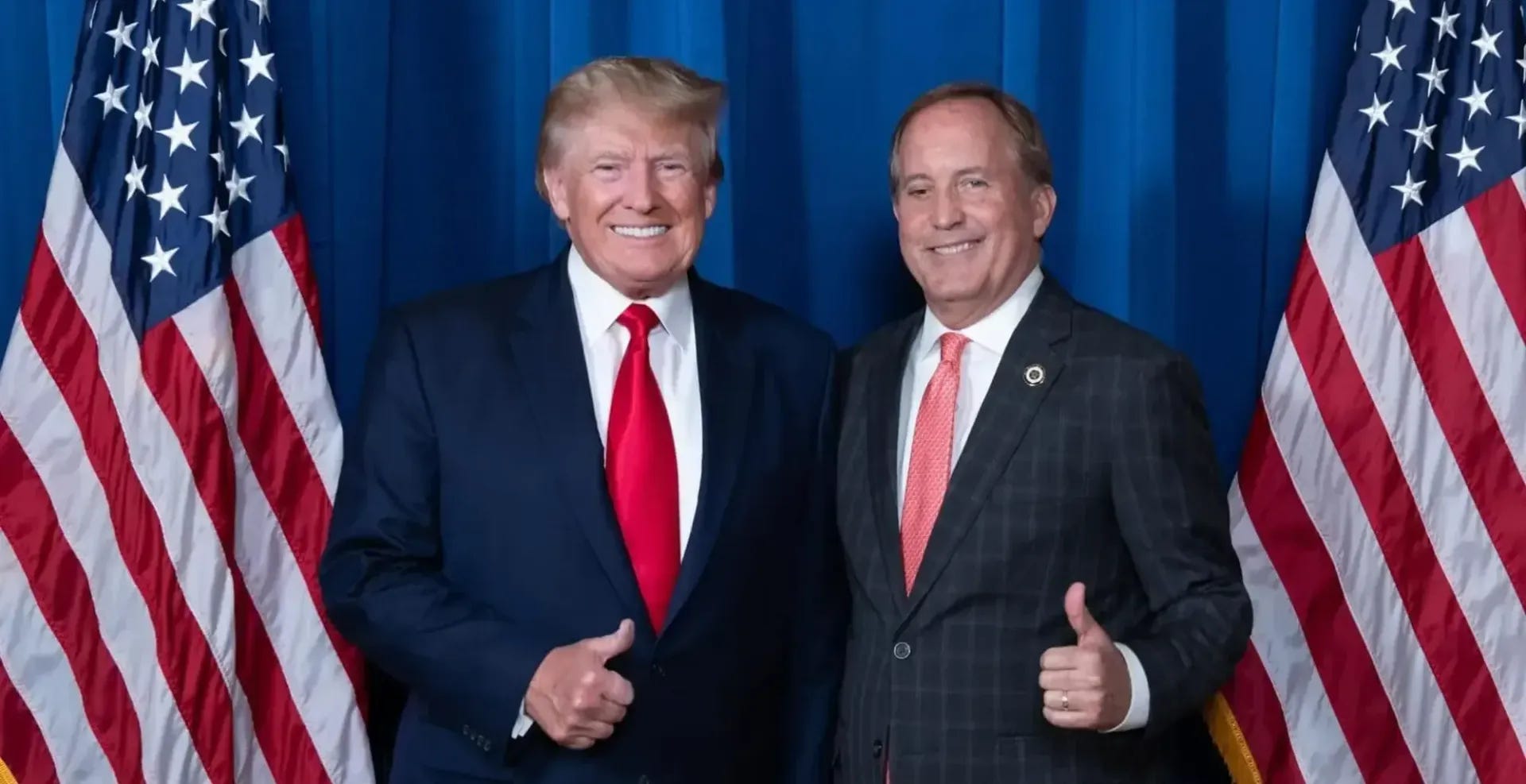
Donald Trump endorsed Texas Attorney General Ken Paxton on Tuesday, an announcement that came as dire news for both Sen. John Cornyn and for Senate Republicans who fear losing this seat in the fall.
“I think Paxton can win, yeah, but I think it’d be three times more expensive,” South Carolina Sen. Lindsey Graham told reporters after Trump backed Paxton ahead of next week’s Republican primary runoff. “[W]e’ve got to raise a lot more money now.”
Alaska Sen. Lisa Murkowski was far less sanguine about the scandal-plagued Paxton’s prospects against Democrat James Talarico.
“I think that this puts that seat in jeopardy,” Murkowski said. “And how does that help strengthen the president’s hand when we lose a state like Texas?”
Before Tuesday, Cornyn’s colleagues had reason to be at least cautiously optimistic that he could overcome his polling deficit and win renomination next week.
While an average of all public surveys released before Tuesday from the polling aggregator FiftyPlusOne gave Paxton a 47-42 lead, Cornyn’s allies remembered how he outperformed the polls in early March. The senator outpaced Paxton 42-41 in the first round of the primary after he appeared likely to take second place, with another 13% going to Rep. Wesley Hunt. (Hunt endorsed Paxton shortly after Trump chose sides.)
The senator’s backers, who spent massive amounts of money earlier this year to ensure that Cornyn edged out Hunt for a spot in the all-but-certain runoff, were determined to help him once again defy the naysayers. AdImpact reported Tuesday that Cornyn and his allies have spent or reserved close to $20 million on ads, roughly four times as much as Paxton’s side.
And just like in the first round, Paxton’s antagonists believed they could sink him by highlighting some of his many scandals—a list Texas Monthly has called “so numerous, so byzantine, and so wide-ranging that any full accounting would be tedious.”
“In office, Ken Paxton increased his net worth by up to 7,000%,” the narrator said in a recent ad from the pro-Cornyn Lonestar Victory Fund. “This man cheated on the mother of his children. And while being divorced on biblical grounds, Paxton said his wife didn’t deserve a dime of his ill-begotten fortune.”
Cornyn’s supporters, including Senate Majority Leader John Thune and National Republican Senatorial Committee chair Tim Scott, also remained determined to convince Trump to endorse the incumbent. And they seemed to be about to get what they wanted one day after the March primary when Trump said he would make an endorsement “soon.”
Just about everyone anticipated Cornyn, who had unexpectedly edged out Paxton for first place, would receive his blessing: One unnamed GOP operative told The Hill of Paxton, “President Trump was already disinclined to ever support him, and then you come in with an underperformance. Yeah, you’re kind of f—ed.”
Paxton, though, was anything but. After the news of the possible Cornyn endorsement broke, Paxton posted on social media that he “would consider dropping out of this race if Senate Leadership agrees to lift the filibuster and passes the SAVE America Act.”
The maneuver had its intended effect. Politico soon reported that Trump was deliberately holding off on backing Cornyn to pressure Senate Republicans to pass the SAVE Act, a harsh set of voting restrictions that Trump has grown obsessed with.
The bill, though, remained stalled as long as the filibuster remained in place. Cornyn tried to demonstrate his loyalty to Trump by abandoning his opposition to nuking the filibuster, but Thune refused to entertain such action.
Trump’s once-imminent Cornyn endorsement never came, and the senator acknowledged Monday, “I think that ship has finally sailed.” Trump took to Truth Social the very next day to endorse Paxton, whom he praised as “a Strong Supporter of TERMINATING THE FILIBUSTER and, very importantly, THE SAVE AMERICA ACT.”
Trump also had some choice words for Cornyn, a Texas GOP institution who has nevertheless long had an uneasy relationship with his party’s base.
“John Cornyn is a good man, and I worked well with him, but he was not supportive of me when times were tough,” MAGA’s master said. “John was very late in backing me in what turned out to be a Historic Run for the Republican Nomination, and then, the Presidency, itself.”
Cornyn responded by arguing he remained the best choice for conservatives who want to keep this Senate seat in GOP hands. He tweeted, “It is now time for Texas Republican voters to decide if they want a strong nominee to help our GOP candidates down ballot and defeat Talarico in November, or a weak nominee who jeopardizes everything we care about.”
Talarico, for his part, said in a statement that “it doesn’t matter who wins this runoff.”
“We already know who we’re running against: the billionaire mega-donors and their corrupt political system,” Talarico, who is trying to become the first Democrat elected statewide since 1994, declared. “For decades, John Cornyn and Ken Paxton have embodied a broken politics that enriches wealthy donors while costs skyrocket for the rest of us.”
Election Recaps
Below is a state-by-state summary of where things stood as of Wednesday morning in all of the major contests. You can also check out our cheat-sheet that summarizes the outcomes in every key race.
Defeated House Incumbents
KY-04 (R) (67-31 Trump)
Rep. Thomas Massie lost renomination to farmer Ed Gallrein, who had Donald Trump’s fervent support, in the most expensive House primary on record.
Gallrein outpaced Massie 55-45 in a race that AdImpact reports saw a combined $32 million in ad spending.
Massie, a libertarian-leaning politician who was first elected to represent northern Kentucky in 2012, spent his tenure casting lonely “no” votes against the GOP leadership’s priorities. But while Trump spent his first term ranting about the iconoclastic congressman—he even issued a call in 2020 to “throw Massie out of Republican Party” for holding up a COVID relief bill at the start of the pandemic—Massie always easily won renomination.
Trump, though, made it a priority to defeat Massie this cycle even before the Kentuckian sponsored a petition to require a vote on the release of files related to the investigation of Jeffrey Epstein. Trump’s network and other groups like AIPAC, which had long clashed with Massie over his ardent criticism of Israel’s government, spent huge amounts on ads hammering Massie as disloyal to the administration.
Massie and his backers fought back by arguing that Gallrein was anything but a reliable conservative, including with ads saying, “You can’t spell ‘Woke Eddie’ without ‘DEI.” The effort, though, proved to be far from enough to save a man Trump loudly and repeatedly called for Republicans to eject from office.
Alabama
AL-Sen (R) (65-34 Trump)
Rep. Barry Moore, a far-right conspiracy theorist who has Trump’s endorsement, advanced to the June 16 Republican primary runoff, but the second-place spot was still uncalled as of Wednesday morning.
Moore leads with 39%, which was well below the majority he needed to win outright. Navy SEAL veteran Jared Hudson holds a 25.6 to 24.5 edge over Attorney General Steve Marshall with most of the vote tabulated.
The GOP nominee will be in a strong position to replace Sen. Tommy Tuberville, who won the Republican primary for governor without any trouble. Tuberville’s general election opponent is former Sen. Doug Jones, the Democrat he unseated in 2020.
Georgia
GA Supreme Court (50-48 Trump) - nonpartisan general election
Justices Charlie Bethel and Sarah Warren both won reelection against liberal challengers in officially nonpartisan statewide races.
Bethel narrowly held off personal injury attorney Miracle Rankin 51-49, while Warren scored a much larger 59-41 victory against former Democratic state Sen. Jen Jordan. Both Bethel and Warren were appointed to the state’s highest court in 2018 by then-Republican Gov. Nathan Deal.
Rankin and Jordan campaigned as a team and ran ads urging voters to select both of them, but that pitch may not have reached voters who otherwise weren’t paying much attention to contests where no one’s party identification was listed. CNN says that the four candidates and their allies spent a total of $4 million on ads, with conservatives and liberals deploying about the same amount.
That sum is just a tiny fraction of the $115 million that went into last year’s crucial race for the Wisconsin Supreme Court, a contest where the candidates’ ideologies were front and center.
GA-Sen (R) (50-48 Trump)
Rep. Mike Collins will go up against Derek Dooley, the son of late University of Georgia coach Vince Dooley, in the June 16 Republican primary runoff for the right to take on Democratic Sen. Jon Ossoff.
Collins, who spent the entire race as the frontrunner, took first place with 41%. Dooley, a former University of Tennessee football coach backed by Georgia Gov. Brian Kemp, outpaced Rep. Buddy Carter 30-25 for the second runoff slot.
GA-Gov (D & R) (50-48 Trump)
Former Atlanta Mayor Keisha Lance Bottoms won the Democratic nomination for governor outright, while Lt. Gov. Burt Jones and billionaire Rick Jackson will spend the next four weeks fighting out the Republican runoff.
Bottoms defeated former state Sen. Jason Esteves 56-19, with three other Democrats trailing behind. Bottoms, who is campaigning to replace the termed-out Kemp, would become the first Democrat to win this office since 1998, as well as the first Black woman elected to lead any state.
Jones, who has Trump’s endorsement, took first place with 38%, while Jackson beat out Secretary of State Brad Raffensperger 33-15 for the second runoff spot. The opening round of the primary was a massively expensive and nasty contest, and just about everyone anticipates the runoff will be heated as well.
GA-01 (R) (58-42 Trump)
Insurance executive Jim Kingston scored an outright win in the GOP primary for the coastal Georgia seat that his father, former Rep. Jack Kingston, held from 1993 to 2015.
Kingston, who had Trump’s endorsement, took 52% of the vote, with Chatham County Commissioner Patrick Farrell a distant second with 17%. Kingston is favored to replace GOP Rep. Buddy Carter, who, like the elder Kingston more than a decade ago, left this House seat behind to wage a failed Senate campaign.
GA-09 (R) (67-33 Trump)
Rep. Andrew Clyde easily won renomination with 76% of the vote in northeastern Georgia. While both his opponents argued the hardline congressman failed to look out for his constituents, Clyde emphasized his endorsement from Trump.
GA-10 (R) (60-39 Trump)
State Rep. Houston Gaines scored a 67-18 victory against former film studio head Ryan Millsap in the primary for the seat that Rep. Mike Collins is giving up to run for Senate. Gaines had Trump’s backing for his campaign to represent the eastern Atlanta exurbs and the college town of Athens.
GA-11 (R) (61-38 Trump)
Physician John Cowan and former congressional aide Rob Adkerson will face off in the runoff for the seat that Rep. Barry Loudermilk, Adkerson’s biggest supporter and former boss, is not seeking reelection to.
Cowan, who lost to none other than Marjorie Taylor Greene in the 2020 runoff for another seat, took first with 43%. Adkerson outpaced Public Service Commissioner Tricia Pridemore 22-19 for the second runoff spot in this district, which is based in Atlanta’s northwestern suburbs and exurbs.
GA-13 (D) (71-28 Harris)
State Rep. Jasmine Clark won the Democratic nomination outright for the Atlanta-area district that longtime Rep. David Scott held until his death last month.
Clark, who benefited from over $4 million in outside help from a super PAC aligned with the crypto sector, scored a 56-22 victory against dentist Heavenly Kimes, a member of the cast of the reality TV show “Married to Medicine.”
Clark, though, will not be competing in the July 28 special election for the remaining months of Scott’s term.
Six other Democrats are running, including Everton Blair, a former Gwinnett County Board of Education chair who took third place in Tuesday’s primary with 12%, and Marcye Scott, the late congressman’s daughter. The younger Scott, who was not on the ballot this week, has not ruled out campaigning as an independent for a full term in November.
GA-AG (R & D) (50-48 Trump)
Republican state Sen. Brian Strickland and Democratic state Rep. Tanya Miller will compete in the general election for attorney general after overwhelmingly winning their respective primaries.
Strickland and Miller are running to replace Republican incumbent Chris Carr, who gave up this powerful post to wage an ill-fated campaign for governor. Miller would be the first Black woman to serve as attorney general, as well as the first Democrat to hold this office in 16 years.
GA-SoS (R & D) (50-48 Trump)
Both parties will hold primary runoffs for secretary of state, a post that Republican Brad Raffensperger gave up to mount an unsuccessful bid for governor.
State Rep. Tim Fleming took first place on the GOP side with 39%, while former state Rep. Vernon Jones outpaced businessman Kelvin King 27-16 for second. Gabriel Sterling, a former top deputy for Raffensperger, took fourth place with 12%.
Jones, a former conservative Democrat who switched parties in 2021, campaigned as an ardent election conspiracy theorist. Jones said at a recent debate, “I stand with those who believe there was election fraud” in 2020.
Fleming, a former chief of staff to Gov. Brian Kemp, likewise spoke about “irregularities” that year even as he insisted he was “not running on conspiracy theories.”
The Democratic runoff is a choice between former Judge Penny Brown Reynolds and Fulton County Commissioner Dana Barrett. Brown Reynolds finished in first place with 42%, while Barrett secured second with 35%.
The eventual Democratic nominee will try to flip an office that Republicans have controlled since the 2006 elections.
GA-LG (R & D) (50-48 Trump)
Both parties will also need runoffs to pick their nominees to replace Republican Burt Jones as lieutenant governor, a powerful post whose occupant is responsible for setting much of the agenda in the state Senate.
Former state Sen. John F. Kennedy (yes, he goes by that) was the top Republican with 27% of the vote. State Sen. Greg Dolezal, who has put Islamophobic front and center in his campaign, beat out colleague Blake Tillery 23-19 for second.
The Democratic runoff will be between state Sen. Josh McLaurin and former state Sen. Nabilah Parkes, who said she was motivated to run in part by her disgust with Dolezal’s messaging. McLaurin and Parkes took 41% and 40%, respectively, with accountant Richard Wright taking third with 19%.
GA Public Service Commission (R & D) (50-48 Trump)
Former Public Service Commissioner Fitz Johnson is clinging to a 50.2 to 49.8 lead against a little-known opponent named Brandon Martin as of Wednesday morning, and the Associated Press estimates that most of the vote has been counted in the Republican nomination contest.
The winner of this statewide primary will take on Democratic incumbent Peter Hubbard, who unseated Johnson in a 63-37 landslide in last year’s special election for a seat on the powerful five-person body that regulates utilities.
In the contest for the other Commission seat on the fall ballot, Shelia Edwards won the Democratic primary outright 56-26 against Angelia Pressley, a fellow businesswoman. Edwards is campaigning to replace Republican incumbent Tricia Pridemore, who gave up this seat to wage an ultimately unsuccessful campaign for Congress.
The Republican primary will need to be settled in a runoff. Power plant engineer Joshua Tolbert leads with 47%, while businessman Bobby Mehan beat out attorney Carolyn Roddy 31-22 for second place.
Victories for both Hubbard and Edwards this fall would give Democrats control of the Public Service Commission.
Kentucky
KY-Sen (R) (64-34 Trump)
Rep. Andy Barr defeated former Attorney General Daniel Cameron 60-31 in the primary for the Senate seat that Mitch McConnell is giving up after 42 years. The congressman all but secured victory three weeks ago when Trump pushed wealthy businessman Nate Morris out of the race, and both Trump and Morris quickly endorsed Barr.
Barr is the heavy favorite to defeat Democrat Charles Booker, a former state representative who lost to Sen. Rand Paul 62-38 in his 2022 campaign for Kentucky’s other seat.
KY-05 (R) (81-17 Trump)
Rep. Hal Rogers, the oldest voting member of the House, easily beat GOP operative Kevin Smith 77-12 in his primary for a 24th term. Rogers, 88, pointed to his prominent spot on the influential House Appropriations Committee and support from Trump to make his case that rural eastern Kentucky was well served by having him remain in Congress.
KY-06 (R & D) (57-42 Trump)
Former state Sen. Ralph Alvarado, who has Trump’s endorsement, defeated state Rep. Ryan Dotson 57-26 in the GOP primary for the central Kentucky seat that Republican Rep. Andy Barr is leaving behind to run for the Senate.
The Democrats are fielding federal prosecutor Zach Dembo, who beat former state Rep. Cherlynn Stevenson 40-31.
Alvarado is the favorite to defend this seat, but Dembo could have an opening in what’s shaping up to be a tough year for Republicans. Democratic Gov. Andy Beshear carried the 6th District in a 60-40 landslide during his 2023 reelection campaign, and the House Majority PAC, the top pro-Democratic House super PAC, last month reserved close to $700,000 in fall ad time for this race.
Louisville, KY Mayor (nonpartisan primary) (57-41 Harris)
Louisville Mayor Craig Greenberg will face a rematch this fall against Metro Councilwoman Shameka Parrish-Wright, a member of the city’s legislative body who unsuccessfully opposed him from the left in their 2022 Democratic primary contest.
This election, though, will be conducted using different electoral rules because of a bill the Republican-dominated legislature passed in 2024. Greenberg took first place in the nonpartisan primary with 53%, while Parrish-Wright beat out another candidate 26-10 for the second spot in the general election.
Oregon
OR-Gov (R) (55-41 Harris)
Republican state Sen. Christine Drazan convincingly defeated state Rep. Ed Diehl in the primary for the right to face Democratic Gov. Tina Kotek in the fall. Kotek beat Drazan in a close 2022 race, and political observers have long anticipated a rematch for this fall.
OR Ballot (55-41 Harris)
Oregon voters overwhelmingly repealed large parts of a new transportation funding plan Kotek signed last year.
Conservatives stopped the law, which included tax increases to provide what the Kotek administration said was vital revenue for the Oregon Department of Transportation, from ever going into effect when they submitted signatures last year to place the referendum on the ballot.
Pennsylvania
PA-01 (D) (49.7 to 49.4 Harris)
Bucks County Commissioner Bob Harvie defeated mathematician Lucia Simonelli 65-35 for the right to face Republican Rep. Brian Fitzpatrick. Fitzpatrick’s allies appeared to meddle in the primary to weaken Harvie, who has the support of influential state and national Democrats, but there was little question that the commissioner would secure his party’s nomination.
Democrats have tried in vain to flip this district outside Philadelphia for over a decade, and Fitzpatrick has more than $7 million stockpiled to defend it. Harvie, though, gives Democrats a nominee with experience winning tough races in Bucks County, which is home to 85% of the 1st District’s denizens. (The balance is located in Montgomery County.)
PA-03 (D) (88-11 Harris)
State Rep. Chris Rabb, who identifies as a democratic socialist, defeated state Sen. Sharif Street 44-29 in a closely watched primary for the most Democratic seat in the House. Pediatric surgeon Ala Stanford, who had the support of retiring Rep. Dwight Evans, took third place with 24% in this Philadelphia constituency.
PA-07 (D) (51-48 Trump)
Bob Brooks, the president of the Pennsylvania Professional Firefighters Association, will take on Republican Rep. Ryan Mackenzie in one of the most competitive House districts in the nation.
Brooks, who has the support of Gov. Josh Shapiro, the Democratic Congressional Campaign Committee, and Sen. Bernie Sanders of Vermont, led with 42%. Former Northampton County Executive Lamont McClure, who was the involuntary beneficiary of positive ads from an obscure group with links to Republicans, and former federal prosecutor Ryan Crosswell were well behind with about 21% each.
PA-10 (D) (52-47 Trump)
Former TV anchor Janelle Stelson beat Dauphin County Commissioner Justin Douglas 67-33 for the right to take on far-right Rep. Scott Perry again. Stelson two years ago held Perry, a former leader of the nihilistic House Freedom Caucus, to a 51-49 victory as Trump was carrying this central Pennsylvania constituency by a wider spread.
PA-17 (R) (52-47 Harris)
Beaver County Sheriff Tony Guy turned in an unimpressive 53-47 win over Jesse James Vodvarka, a businessman who raised little. Guy will be the underdog this fall against Democratic Rep. Chris Deluzio in this constituency based in Pittsburgh’s western and northern suburbs.
Special Elections
Republican George Margetas scored a 56-44 win over Democrat Ron Ruman with most votes tabulated in the special election for the 196th District in the Pennsylvania House of Representatives, a huge drop compared to Donald Trump’s margin of victory two years ago. Trump carried this York County seat 66-33, so Margetas’ showing represents a more than 20% underperformance.
Redistricting Roundup
MO Redistricting
The campaign to stop Missouri’s new congressional gerrymander from going into effect filed a lawsuit in state court on Monday seeking to force Republican Secretary of State Denny Hoskins to determine whether they’ve turned in enough signatures to block the map.
People Not Politicians’ suit argues Hoskins “has elected to abuse his statutory discretion by delaying issuance of a certificate as long as possible” to ensure that this year’s elections take place under the new map.
State law gives Hoskins until Aug. 4 to complete the signature certification process—the same day as the state’s primary. But while Hoskins has suggested he’ll use the maximum time allotted to him, plaintiffs say he has long had enough information to determine if there are enough valid signatures.
People Not Politicians last December submitted more than 300,000 signatures to qualify a veto referendum for the general election ballot—more than twice the required total—and organizers said in March that data they obtained from the state showed that a sufficient number of signatures had already passed muster.
But while longstanding practice in Missouri held that the action of turning in signatures should have paused the new map from taking effect until a vote could be held, the state Supreme Court disagreed. The justices instead ruled that the veto referendum would not suspend the new boundaries unless and until officials verify that organizers submitted enough signatures to qualify the measure for the ballot.
MS Redistricting
The U.S. Supreme Court on Monday vacated a lower court ruling that redrew several state House and Senate districts that the judges determined violated the Voting Rights Act. While the order did not strike down the new maps, the justices ordered new arguments to reflect their decision in Louisiana v. Callais.
Republican Gov. Tate Reeves, though, was already preparing to replace the new boundaries, as well as other maps that were protected by the VRA before last month. The governor said last week he wants lawmakers to revisit the state’s legislative, congressional, and Supreme Court maps “between now and 2027 elections.”
Mississippi Democrats last year flipped three legislative districts—two in the Senate and one in the House—that were redrawn following this lawsuit, which successfully argued the old maps discriminated against Black voters. While Republicans remained in firm control of state government, the contests deprived the GOP of its supermajority in the Senate.
Every seat in the legislature will be on the ballot next year. Those contests will take place on the same day as the election to succeed Reeves, who will be termed out.
Governors
ME-Gov
Maine Gov. Janet Mills on Tuesday backed former state House Speaker Hannah Pingree, who spent years in her administration, ahead of the June 9 Democratic primary for Mills’ job.
While Mills’ campaign for the Senate unceremoniously ended last month when she dropped out of the primary in the face of huge polling deficits against oyster farmer Graham Platner, her endorsement may still be an asset for Pingree.
That’s because Mills, who cannot seek a third term as governor, is still well-regarded by many Pine Tree State Democrats, including some who preferred Platner. One voter told the New York Times of the 78-year-old Mills, “She’s been a great governor for Maine, but new blood is needed and we need more progressives running who are not afraid to stand up to the current administration.”
Pingree, the daughter of longtime Rep. Chellie Pingree, is one of five Democrats running in next month’s ranked-choice primary.
Nirav Shah, who served as Maine’s health director during the COVID pandemic, has led in every publicly available poll, including a recent internal survey from Pingree. The Democratic field also includes Secretary of State Shenna Bellows, former state Senate President Troy Jackson, and businessman Angus King III, the son of Sen. Angus King.
Republicans also have a busy race, and attorney Bobby Charles leads in the few available surveys.
House
FL-22
Wealthy businessman Casey Askar announced Tuesday that he’ll seek the Republican nomination for Florida’s new 22nd District, where so far no incumbents are running.
Askar, the owner of numerous fast food franchises, campaigned for Congress in 2020 in a previous version of the 19th District in the Naples area. Askar loaned his campaign millions, but the investment didn’t quite pay off: State Rep. Byron Donalds defeated another candidate 22.6 to 21.9, while Askar was just behind with 20% of the vote.
Askar faces wealthy crypto businessman Michael Carbonara in the August Republican primary for the redrawn 22nd District, a constituency that has little in common with the old and reliably blue seat with that number.
The new GOP gerrymander created a South Florida district that stretches from inland Palm Beach and Broward counties west all the way to the Gulf Coast across deep-red areas. Donald Trump would have carried the new 22nd 55-44 in 2024, though Joe Biden would have taken it 51-48 four years earlier.
MI-13
Detroit City Councilwoman Mary Waters failed to turn in enough signatures to appear on the August Democratic primary ballot for the 13th Congressional District, Michigan election officials said Tuesday. Waters, who is challenging Rep. Shri Thanedar for renomination, informed the Detroit News that she would appeal.
State Rep. Donavan McKinney, though, would be more than content if Walters, whom the Michigan Chronicle reports fell less than 100 signatures short of the 1,500 required, remains disqualified. Candidates only need to win a plurality of the vote in August to earn their party’s nomination, and Thanedar would benefit from having two notable opponents rather than just one.
Indeed, Thanedar, who is Indian American, first won this safely Democratic constituency in 2022 after defeating several Black candidates in the primary, an outcome that guaranteed Detroit wouldn’t have a Black representative in Congress for the first time since the early 1950s. (Democratic Rep. Rashida Tlaib, the city’s other House member, is Palestinian American.)
Local Black leaders hoped to avoid a repeat by consolidating behind McKinney last year. Tlaib and Vermont Sen. Bernie Sanders are also backing the state representative.
McKinney, though, won’t quite be Thanedar’s only primary foe even if Waters is unable to make the ballot. John Goci, whom the Detroit News calls “a virtual unknown,” still submitted enough valid signatures to make the August ballot.
Poll Pile
TX-Sen (R): Global Strategy Group for GIFFORDS:
Ken Paxton: 52, John Cornyn (inc): 40.
The poll was conducted May 6-11. Trump endorsed Paxton on May 19.
CA-Gov (top-two primary): Evitarus for the California Democratic Party:
Steve Hilton (R): 22, Xavier Becerra (D): 21, Tom Steyer (D): 15, Chad Bianco (R): 10, Katie Porter (D): 7, Matt Mahan (D): 4, other candidates 1% or less.
Early May: Becerra (D): 18, Hilton (R): 18, Bianco (R): 14, Steyer (D): 12, Porter (D): 8, Mahan (D): 7.
MI-Gov (R): 1892 Polling for Perry Johnson:
John James: 24, Perry Johnson: 23, Mike Cox: 7, Aric Nesbitt: 7, undecided: 38.
March: James: 26, Johnson: 21, Cox: 6, Nesbitt: 4.
RI-Gov (D): Emerson College for WPRI:
Helena Foulkes: 40, Dan McKee (inc): 20, undecided: 37.
AZ-01 (R): Advanced Targeting Research for Joseph Chaplik:
Joseph Chaplik: 29, Jay Feely: 9, John Trobough: 5, undecided: 57.
MA-06 (D): Center For Strategic Politics for Beth Andres-Beck:
Beth Andres-Beck: 14, Jamie Belsito: 14, Tram Nguyen: 13, Mariah Lancaster: 10, Dan Koh: 9, John Beccia: 5, undecided: 35.
NJ-07 (D): Impact Research for Rebecca Bennett:
Rebecca Bennett: 36, Tina Shah: 15, Brian Varela: 13, Michael Roth: 12.
Re: GA Supreme Court races, I can assure you this was voters simply being unaware of the importance and partisan nature of these races. It was also a long ballot; while waiting in line to vote I had to look over a sheet with all of the folks in primaries I was going to vote for, and I'm someone who posts on the Downballot for crying out loud.
As for why Miracle outperformed Jordan by so much (they ran on a joint ticket and Jordan had the longer more high profile political history), the only explanation I can think of is folks name-code voting, just like when candidates with Hispanic last names do better in Latino-heavy districts in otherwise low-salience races. Something to consider when fielding candidates for non-partisan races like this.
I'm disappointed in Bottoms' easy victory but do think it's best we avoid a drawn out runoff if she was destined to win anyway. I hope her team develops strong responses to the many attacks that will commence over her time as Mayor.
Maine Senator Pan Atlantic poll:
Platner 48 Collins 41
https://x.com/anthonymemerson/status/2057106936978411988?s=46&t=sbdQQeYBqp0h_Zql717iTw