



Leading Off
IL-Sen
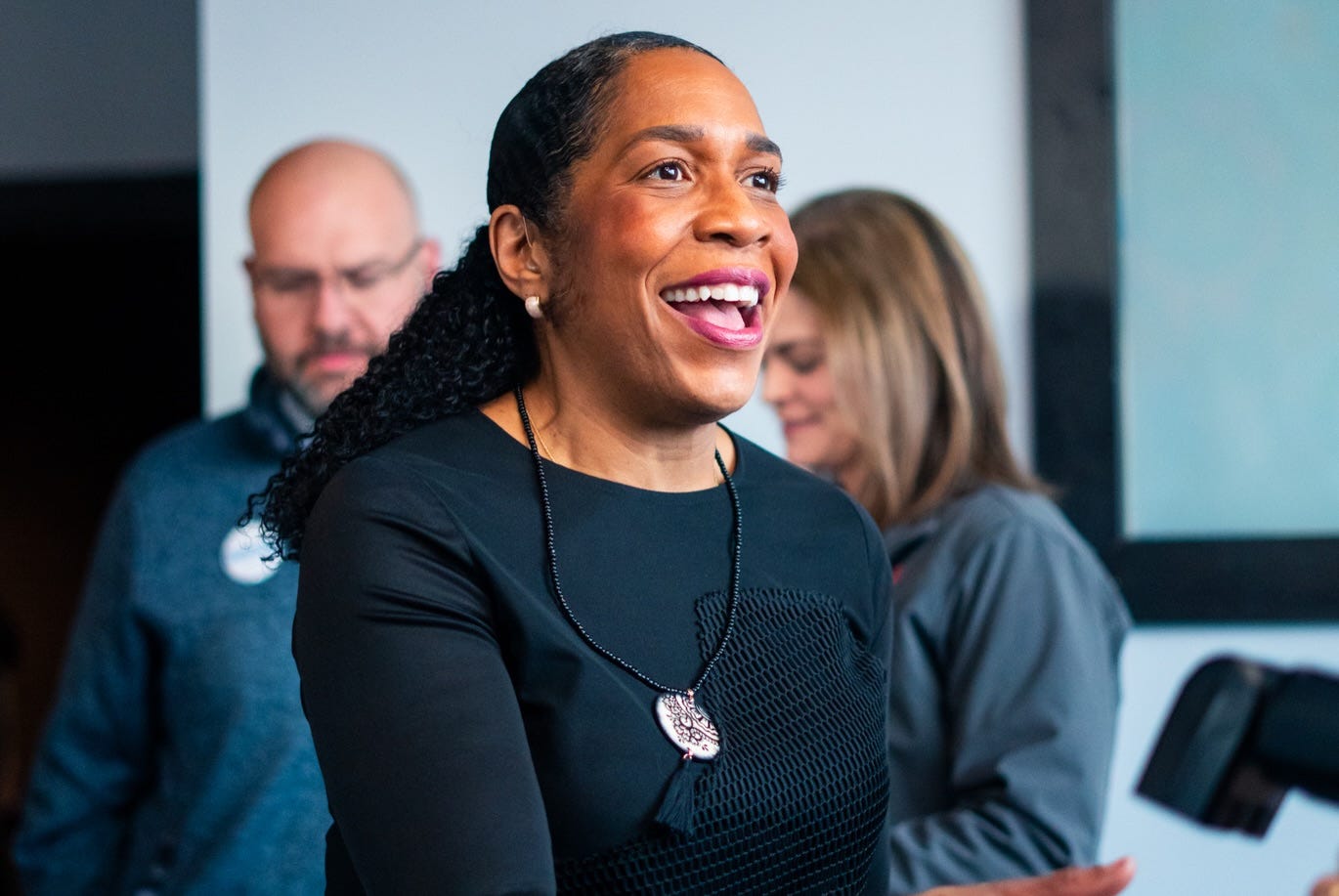
Illinois Lt. Gov. Juliana Stratton defeated Rep. Raja Krishnamoorthi 40-33 in a come-from-behind victory to win Tuesday’s Democratic primary for U.S. Senate, with Rep. Robin Kelly taking third place with 18%. The Associated Press estimates that 92% of the vote has been tabulated as of Wednesday morning so the margin could shift as more votes are counted, but Stratton’s victory is not in doubt.
Stratton is now all but certain to win the general election to succeed Sen. Dick Durbin, who is not seeking a sixth term.
Stratton is on course to become the second Black woman to represent Illinois in the upper chamber after Carol Moseley Braun, whose 1992 victory made her both the first Black woman and the first African American Democrat to ever serve in the Senate. (Moseley Braun endorsed the lieutenant governor last year.)
The Senate is also set to have three Black women serving simultaneously for the first time. Following the 2024 elections, Angela Alsobrooks’ victory in Maryland and Lisa Blunt Rochester’s win in Delaware made them the first two Black women to serve together in the Senate, and neither is up again until 2030.
Stratton, though, was anything but the favorite mere weeks ago.
Krishnamoorthi, who has long been one of the strongest fundraisers in the House, used his massive war chest to start running TV ads all the way back in July—a full eight months ahead of the primary—and he had the airwaves to himself through January.
That sustained TV monopoly helped the congressman spend most of the race as the undisputed frontrunner, and even Stratton’s allies released polls showing him far ahead. Stratton’s backers, though, argued she would pull ahead after voters learned more about her.
And that’s just what happened. A super PAC partially funded by Gov. JB Pritzker, who, along with Sen. Tammy Duckworth, was Stratton’s most prominent supporter, started airing ads two months before the primary, and its intervention came at just the right time for her. Kelly, meanwhile, struggled to raise money or convince well-funded outside groups to aid her.
The race turned negative during the final weeks as polls showed Stratton closing, or even overcoming, what had been a large deficit. Most notably, Krishnamoorthi and Stratton issued dueling charges accusing each other of benefiting from donations from ICE contractors.
Krishnamoorthi’s side also spent more than $1 million on ads ostensibly promoting Kelly, who, like Stratton, is Black—a move aimed at weakening the lieutenant governor. The tactic, though, wasn’t effective enough to prevent Stratton from prevailing on Tuesday.
Much of The Downballot’s revenues arrive once a year, at our anniversary each August. That makes for leaner times in between. If you’d like to help us even out our revenue flows and sustain our unique work, we’d be extremely grateful if you’d consider upgrading to a paid subscription.
Election Recaps
IL-Gov
Former state Sen. Darren Bailey easily won the Republican primary for governor, but he’ll face a difficult time in his rematch against Democratic incumbent JB Pritzker. The governor defeated him 55-42 in 2022, and there’s little reason to think Bailey will perform much better this time.
IL-02
Cook County Commissioner Donna Miller comfortably won the Democratic primary for Illinois’ open 2nd Congressional District, thanks in part to more than $4 million in spending from a super PAC reportedly linked to AIPAC.
Miller fended off former Rep. Jesse Jackson Jr., who was attempting a comeback a decade after completing a prison sentence on federal corruption charges, 40-29.
She’s now the overwhelming favorite to succeed Rep. Robin Kelly, whose Senate bid proved unsuccessful, in representing this deep blue district that includes part of Chicago’s South Side and suburban areas further south.
IL-07
State Rep. La Shawn Ford edged past a crowded field in Tuesday’s Democratic primary as he seeks to succeed retiring Rep. Danny Davis, who endorsed him last year.
Ford pulled off a 24-20 victory against Chicago Treasurer Melissa Conyears-Ervin, who benefited from $5 million in outside support from a super PAC affiliated with AIPAC and finished a close second. The rest of the pack was considerably further back.
Ford will have no problem holding Illinois’ 7th District in November, an overwhelmingly Democratic seat covering Chicago’s West Side and downtown.
IL-08
Former Rep. Melissa Bean completed the most difficult part of her comeback bid, defeating many rivals to capture the Democratic nomination for Illinois’ 8th District in Chicago’s western outer suburbs.
Her closest opponent was businessman Junaid Ahmed, who staked out turf well to the left of the centrist Bean. But the ex-congresswoman received $6.5 million in help from groups connected to AIPAC, the AI industry, and the crypto sector and outpaced Ahmed 32-27.
While the district Bean is now seeking looks quite different, both geographically and politically, compared to the one served in the 2000s, she should have little problem in the fall. The 8th, which Rep. Raja Krishnamoorthi gave up to wage a failed campaign for Senate, voted for Kamala Harris by a 53-46 margin in 2024.
IL-09
In Tuesday’s most closely watched Democratic primary for the House, Evanston Mayor Daniel Biss defeated political commentator Kat Abughazaleh 29-26 in Illinois’ 9th District, while state Sen. Laura Fine finished in third with 20%.
Abughazaleh was the most vocal in wanting to disrupt the status quo, calling on Democrats to “grow a fucking spine.” But Biss, a longtime elected official, was well-known as a progressive in the district and won the endorsement of retiring Rep. Jan Schakowsky.
Two different super PACs reportedly tied to AIPAC mounted a furious effort to push Fine past the goal line, spending an eye-popping $7 million to both boost her and damage Biss and Abughazaleh, but the campaign fell far short.
Biss is now on a glide path to succeed Schakowsky in the 9th, which takes in a portion of Chicago as well as communities to the north, including Evanston and Skokie.
Cook County Board of Commissioners President
Toni Preckwinkle, the president of the Cook County Board of Commissioners, easily defeated Chicago Alderman Brendan Reilly 69-31 in Tuesday’s Democratic primary and is now all but assured of winning a fifth term leading the nation’s second-most populous county in the fall.
Special Elections
Pennsylvania Democrats fell short in their hopes of flipping the deep-red 79th House District, but they overperformed by sizable margins in two special elections on Tuesday night.
In the Altoona-based 79th, Republican Andrea Verobish defeated Democrat Caleb McCoy 58-42, a 17-point improvement for Democrats from Donald Trump’s 66-33 margin in 2024.
Similarly, in the 193rd District in south-central Pennsylvania, Republican Catherine Wallen beat Democrat Todd Crawley 60-40, 18 points better for Democrats compared to Trump’s 69-31 score.
Democrats now hold a 102-100 edge in the House, with one other Republican seat vacant.
In a race for the Virginia House, however, Democrats ran behind the top of the ticket. Republican Andrew Rice topped Democrat Cheryl Smith 62-38 in the 98th District, outdoing Trump’s 57-42 showing by 10 points.
Democrats, though, still retain the sizable 64-36 majority they won in November.
Senate
KS-Sen
Army veteran Noah Taylor announced Tuesday that he was entering the Democratic primary to challenge Republican Sen. Roger Marshall.
Taylor, who is seeking to become the first Democrat to represent Kansas in the upper chamber since 1939, says in his announcement video, “I was an infantry grunt in Afghanistan. I know what forever wars cost.”
The newcomer goes on to decry Marshall’s performance at a town hall last year, where, in Taylor’s words, he “turned tail and ran out the back door when Kansans dared to ask some simple questions.”
Several other Democrats were already challenging Marshall, but none of them raised much money through the end of 2025.
Rep. Sharice Davids, for her part, has repeatedly threatened to run for Senate if Republican state legislators revive their stalled push to gerrymander her 3rd Congressional District. Davids, though, has indicated she’ll seek reelection as long as the current map remains in place.
We might not get a final answer for some time, though, as Kansas’ candidate filing is not until June 1, one of the latest in the nation.
ME-Sen
Gov. Janet Mills on Tuesday launched the first negative TV ad of Maine’s Democratic primary for Senate, a move that comes almost three months ahead of her June 9 showdown with Marine veteran Graham Platner.
Mills’ opening spot features a narrator quoting a Reddit post Platner wrote in 2013 saying that women who fear getting raped shouldn’t drink so much that “they wind up having sex with someone they don’t mean to.” The commercial goes on to feature several women saying that Platner “blamed the victim” and that he “gives off a vibe.”
These posts and others first became public in October, two months after Platner, an oyster farmer who had never sought office before, kicked off his campaign to take on Republican Sen. Susan Collins and almost immediately became a national sensation. Last fall, the candidate put out a video saying that he’d written these missives when he’d felt “very disillusioned, very alienated, and very isolated” after leaving the military.
Platner reshared that video on X following the release of Mills’ ad, along with a new message.
“I shared my thoughts and apologies here directly with Mainers,” he wrote. “I’m eternally grateful for the people of Maine who welcomed me home, made me the man I am today, and have now built this beautiful campaign alongside me.”
Platner’s campaign manager, however, offered a more hostile response.
“This is nothing more than a desperate attempt for relevance from the governor, who is trailing an oyster farmer in every recent poll,” Ben Chin said in a statement. “Despite what Janet Mills and DC think, Mainers know that Graham should not be defined by the worst thing he said on the internet over a decade ago.”
Platner debuted his own commercial on Tuesday, though he doesn’t mention Mills. His spot instead features a supporter who happens to be named Susan Collins praising Platner as a “Democrat with backbone” who will defeat “that Susan Collins.”
While Mills, who is completing her second and final term as governor, has the support of Democratic leadership in the Senate, Platner has far outspent her on the airwaves thus far. AdImpact reported Tuesday that Platner has devoted $3.9 million to advertising compared to $1.1 million for Mills.
The few polls that have been released this year have also shown Platner defeating Mills, though there’s no consensus on how far ahead he is.
Mills’ opening offensive came one day after the deadline passed for major-party candidates to file for the primary ballot.
The only other Democrat to put his name forward other than Platner was David Costello, a former USAID official who began running in June but has attracted little attention. Costello took a distant third place in 2024 as the Democratic nominee against Sen. Angus King, an independent who caucuses with the Democrats.
But while Costello is unlikely to secure his party’s nomination again, he could still have an impact on the race. Maine uses a ranked-choice ballot for primaries, and the second-choice preference of his supporters could make all the difference if neither Mills nor Platner initially secures a majority of the vote.
The general election will also be conducted using ranked choice voting. No notable independent candidates have stepped forward, though the deadline for unaffiliated contenders to submit signatures isn’t until June 1, which is just over a week before the state’s primaries.
NE-Sen
Nebraska Secretary of State Bob Evnen has removed Democrat Cindy Burbank from the ballot after the state GOP complained she was a “proxy” for independent Dan Osborn in his bid to unseat Republican Sen. Pete Ricketts.
Burbank was one of two candidates to file in the Democratic primary, along with pastor Bill Forbes, an anti-abortion activist whom Osborn has accused of being a “stooge” for Ricketts.
The state Democratic Party and Osborn supporters fear that if Forbes were to make the general election ballot, he’d harm Osborn’s chances by splitting the anti-GOP vote. Burbank, by contrast, has all but said she’d make way for Osborn if she wins the Democratic nomination.
“Dan Osborn is a good man, a working man, a strike leader, and someone we can trust. He deserves a fair shot against Ricketts,” her campaign site reads. “So vote for me – and I’ll support Dan Osborn and make sure we send Billionaire Pete Ricketts PACKING!”
According to the Nebraska Examiner, the state GOP filed a complaint with Evnen (himself a Republican) arguing that Burbank’s candidacy should be rejected on these grounds.
“Burbank’s statements are irreconcilable with her oath given under Nebraska law that, the only explanation appears to be that Burbank is not actually campaigning for herself, but is a proxy for Osborn to prevent another member from her party from passing through the primary,” the complaint read in part. (A complete version was not available.)
That “oath” appears to refer to the form all candidates must file that states, “I hereby swear that I will abide by the laws of the State of Nebraska regarding the results of the primary and general elections, that I am a registered voter and qualified to be elected, and that I will serve if elected.”
As Burbank’s attorneys noted in response, Burbank has never said “that she would refuse to serve in the United States Senate if elected” and said that Evnen’s conclusions could violate her First Amendment rights.
Burbank, the Nebraska Democrats, and Osborn do not appear to have commented on Evnen’s move, though a state law says that a ruling by a court overturning such a decision must be made by Wednesday.
Governors
IA-Gov
Julie Stauch, a longtime operative in Iowa Democratic politics, said on Friday—the day of the state’s candidate filing deadline—that she would not appear on the June 2 primary ballot for Iowa’s open governorship because she had not collected enough signatures.
State Auditor Rob Sand, who is the only Iowa Democrat to hold statewide elective office, now faces no intraparty opposition in his campaign to succeed Republican Gov. Kim Reynolds, who is not seeking reelection.
There were no last-minute surprises on the GOP side, where five candidates are set to face off in June. Rep. Randy Feenstra is the frontrunner, but unlike Sand, he can’t focus on the general election just yet.
Investor Zach Lahn, who is self-funding most of his effort, is hoping to give the congressman a tough fight. Adam Steen, a former high-level member of Reynolds’ administration, hasn’t brought in nearly as much money as his two opponents, but he secured an endorsement this week from The Family Leader, an influential Christian conservative group.
State Rep. Eddie Andrews and former state Rep. Brad Sherman are also seeking the GOP nod, but they’ve struggled to gain traction.
House
IA-04
Siouxland Chamber of Commerce head Chris McGowan was the only Republican who submitted the requisite number of signatures to appear on the June 2 primary ballot for Iowa’s 4th Congressional District, the secretary of state’s office confirmed Monday. As a result, McGowan is now all but assured of victory in a western Iowa constituency Donald Trump carried 65-34.
McGowan began last month as one of three notable Republicans running to succeed GOP Rep. Randy Feenstra, who is campaigning for governor. McGowan, though, quickly became the frontrunner after he received Trump’s endorsement, a move that prompted state Rep. Matt Windschitl to drop out two days later.
Ryan Rhodes, the former CEO of the far-right social media site Parler, ended his campaign on Friday, which was the final day for candidates to file.
ME-01
State Rep. Tiffany Roberts said Sunday that she’d failed to collect the requisite 2,000 signatures she needed to continue her long-shot primary campaign against Democratic Rep. Chellie Pingree. Candidate filing closed the following day, and Pingree has no intraparty opposition in Maine’s safely blue 1st Congressional District.
ME-02
Former Gov. Paul LePage learned Monday that he’d have the Republican primary to himself after Army veteran James Clark, who announced a campaign against him last year, did not file in Maine’s 2nd Congressional District.
Four Democrats, by contrast, are competing in the June 9 primary for the conservative seat that Democratic Rep. Jared Golden is giving up. The field consists of state Sen. Joe Baldacci; state Auditor Matt Dunlap; former congressional staffer Jordan Wood; and Paige Loud, a social worker who entered the race in late January.
Both the primary and general elections will be conducted using ranked-choice voting.
PA-03
Pablo McConnie-Saad, who served in the U.S. Treasury Department during the Biden administration, said last week that he was ending his campaign for Pennsylvania’s open 3rd District after concluding he lacked “a viable path to victory.”
Eight fellow Democrats, though, filed to run ahead of last week’s deadline in the race to succeed Rep. Dwight Evans, who is not seeking reelection in a safely blue district located entirely in Philadelphia.
Evans is backing physician Ala Stanford in the May 19 primary. Her main rivals are state Rep. Morgan Cephas, physician Dave Oxman, state Rep. Chris Rabb, and state Sen. Sharif Street, who was chair of the state Democratic Party from 2022 until stepping down last fall to focus on his campaign.
PA-07
Businessman Aiden Gonzalez said last week that he had failed to collect the requisite 1,000 signatures needed to appear on the Democratic primary ballot to oppose Republican Rep. Ryan Mackenzie in Pennsylvania’s 7th District.
Gonzalez instead threw his backing behind Bob Brooks, the president of the Pennsylvania Professional Firefighters Association, in the nomination contest for this swingy seat in the Lehigh Valley.
Brooks, who already had the support of Gov. Josh Shapiro, Sen. Bernie Sanders, and the SEIU, faces three fellow Democrats in the primary. The field consists of former federal prosecutor Ryan Crosswell, former Northampton County Executive Lamont McClure, and Carol Obando-Derstine, a former utility company supervisor who has the backing of the woman Mackenzie narrowly defeated in 2024, former Rep. Susan Wild.
PA-08
Scranton Mayor Paige Cognetti secured the Democratic nomination in Pennsylvania’s 8th District last week after no other candidates filed to run in the primary to take on Republican Rep. Rob Bresnahan.
The district, which is based in northeastern Pennsylvania, favored Donald Trump 54-45 in 2024. But Bresnahan, who narrowly flipped this constituency last cycle, has spent almost his entire term facing unwelcome and ongoing questions about his frequent stock trades.
PA-17
Beaver County Sheriff Tony Guy said last week that he would seek the Republican nomination to challenge Democratic Rep. Chris Deluzio in Pennsylvania’s 17th District, a constituency based in Pittsburgh’s western and northern suburbs.
Guy should have little trouble winning his primary against Jesse James Vodvarka, a businessman who launched campaigns for this seat in 2020 and 2024 but never appeared on the ballot in either cycle. He’ll have a far more difficult time, though, unseating Deluzio in a district that Kamala Harris carried 52-47.
Most voters will also be seeing Guy on their ballots for the first time. Over three-quarters of the 17th District’s residents live in Allegheny County, with Beaver County making up the balance.
TX-32
Pastor Ryan Binkley said Tuesday that he was dropping out of the Republican primary runoff, a decision that makes attorney Jace Yarbrough the GOP’s nominee for this newly gerrymandered seat.
Yarbrough, who led Binkley 49-22 in the first round of voting two weeks ago, is now the heavy favorite to flip Texas’ 32nd District, a previously Democratic constituency that Texas Republicans redrew beyond all recognition.
Democrats are fielding Dan Barrios, a member of the Richardson City Council, for a district that Donald Trump would have carried 58-40. Barrios reported raising just $45,000 through mid-February for his uphill campaign to defend this seat that merges part of the Dallas area with rural turf far to the east.
NRCC
The National Republican Congressional Committee launched the first installment of its program highlighting top candidates on Tuesday—with a rebranded name.
The committee’s MAGA Majority program, which is similar to the Democratic Congressional Campaign Committee’s Red to Blue list, included nine hopefuls on its initial roster.
This distinction may not mean quite as much as it once did, though, since all of these inductees already received an endorsement from Donald Trump before they earned the NRCC’s seal of approval:
AZ-01: Jay Feely
CA-13: Kevin Lincoln
IA-02: Joe Mitchell
ME-02: Paul LePage
NC-01: Laurie Buckhout
NY-03: Mike LiPetri
NY-19: Peter Oberacker
TX-28: Tano Tijerina
TX-34: Eric Flores
Buckhout, Tijerina, and Flores won their respective primaries two weeks ago, while most of the others face minimal, if any, intraparty opposition. Not everyone, however, has a clear path to the general election.
Jay Feely, a former kicker for the Arizona Cardinals, has to get past both former state Rep. Joseph Chaplik and wealthy businessman John Trobough before he can focus on defending Arizona’s swingy 1st District. Democrats also have a contested primary as they campaign to succeed GOP Rep. David Schweikert, who is running for governor.
Former state Rep. Joe Mitchell, likewise, is going up against state Sen. Charlie McClintock in Iowa’s 2nd District. Democrats likewise have a primary to resolve as they try to flip the seat that GOP Rep. Ashley Hinson is leaving behind as she campaigns for the Senate.
While the branding for the MAGA Majority list is new, it’s a continuation of the NRCC’s longtime Young Guns program that began during the 2010 election cycle. The committee kept that name through 2024 even after the three rising-star congressmen who popularized the term―Eric Cantor, Paul Ryan, and Kevin McCarthy―had all left office or were forced out (or in McCarthy’s case, both).
But while the new name leaves that pre-Trump era firmly in the past, not everyone running in swing seats may be happy to have the MAGA label attached to their name. A January poll from Marquette Law School found that only 35% of Americans had a favorable opinion of the “MAGA (Make America Great Again) movement,” while a far larger 60% viewed it unfavorably.
Attorneys General
MI-AG
The Detroit News reported Monday that attorney Kevin Kijewski was charged with domestic violence in 2020 after his then-wife allegedly confronted him over what a police report characterized as “a type of sex coupon book made by another woman.”
Kijewski, who is now seeking the Republican nomination for attorney general of Michigan, denied wrongdoing to police officers at the time and also rejected his spouse’s allegations that he’d harmed her on two previous occasions.
The Wayne County Prosecutor’s Office dismissed the charges later that same year, with a spokesperson recently explaining it did so because of “issues that arose that made us unable to prove the case beyond a reasonable doubt.”
Kijewski, who has since remarried, also told the News, “Voters prioritize someone fighting for their rights and how someone will improve their day-to-day life, not very old, long-resolved issues or matters from the past.”
But Eaton County Prosecutor Doug Lloyd, who is opposing Kijewski for the GOP nomination to replace termed-out Democratic incumbent Dana Nessel, believes that these “deeply troubling” allegations are far from resolved. He argued to the News, “Our party must nominate a candidate who can withstand scrutiny and keep the focus on protecting Michigan families.”
The paper’s report comes less than two weeks before the Republican nomination for attorney general will be effectively decided, though the decision will not be made by primary voters.
Kijewski and Lloyd will compete on March 28 at the GOP’s endorsement convention, at which the party will also designate candidates for secretary of state, state Supreme Court, and the State Board of Education. While nominees for these posts won’t officially be chosen until a separate convention takes place in August, whoever prevails later this month is all but certain to be on the general election ballot.
Democrats will hold their own endorsement convention on April 19.
Legislatures
NC State Senate
North Carolina Senate President Phil Berger, who trails Rockingham County Sheriff Sam Page by 23 votes in his bid to win renomination, requested a recount on Tuesday.
The Assembly’s Bryan Anderson writes that a machine recount needs to be finished by March 25, which is the date that election officials are set to hold their canvass of all results statewide. Anderson adds that it’s possible a second, or even a third, recount could be called, and a potential court battle looms as well.
WI State Senate
Republican Van Wanggaard announced Tuesday that he would not seek reelection to his competitive seat in the Wisconsin Senate, a decision he said he made due to health struggles both he and family members have experienced.
Wanggaard’s 21st District in the southeastern part of the state backed Kamala Harris by a single percentage point, and Democrats were sure to target it whether or not he ran for another term. Democrats need to net two seats this fall to take a majority in the upper chamber, which Republicans currently control 18-15.
Trevor Jung, who serves as transit director for the city of Racine, announced last year he would seek the Democratic nod. Wisconsin’s candidate filing deadline isn’t until June 1, so Republicans have some time to recruit a candidate to run in Wanggaard’s place.
Wanggaard is the second vulnerable Senate Republican to announce his retirement this year, following the same decision by Rob Hutton in January.
Poll Pile
LA-Sen (R): Fabrizio, Lee & Associates for Accountability Project (pro-Letlow):
Julia Letlow: 27, Bill Cassidy (inc): 26, John Fleming: 19, undecided: 28.
Head-to-head: Letlow: 46, Cassidy: 34.
SC-Gov (R): Stratus Intelligence for Nancy Mace:
Nancy Mace: 24, Alan Wilson: 18, Pamela Evette: 15, Ralph Norman: 14, undecided: 29. (Jan.: Mace: 23, Wilson: 19, Evette: 14, Norman: 11.)
SC-Gov (R): co/efficient:
Mace: 22, Evette: 21, Wilson: 19, Norman: 8, Josh Kimbrell: 1, undecided: 29. (Sept.: Mace: 19, Evette: 18, Wilson: 16, Norman: 10.)
The firm says this poll was “[n]ot sponsored by any candidate or candidate’s committee.”
Neither poll of the Republican primary for governor of South Carolina tested businessman Rom Reddy, who entered the race on Monday.
I didn’t have a dog in IL-Sen but I like Stratton and I think she’ll make a wonderful Senator. Speaks to Pritzker’s political instincts and heft that he stuck to his guns and help push her through with his organization when at one point it seemed like Raja had basically consolidated the race to himself.
I’m also very glad Biss won. I was unimpressed with Kat both as a carpetbagger and as an influencer, and Biss has always been a solid progressive.
The other big primaries, eh, mixed bag.
Illinois really has gone through a major changing of the guard these past 8 years, which makes sense with the passage of time of course - but after January of next year the dean of the delegation will be Bill Foster (who was first elected in 2008). It’s definitely a big shift from when people like Schakowsky, Davis, Rush, Gutierrez, Durbin, and Shimkus, who had been in office since the 90s, represented the state.