



Leading Off
OH Redistricting
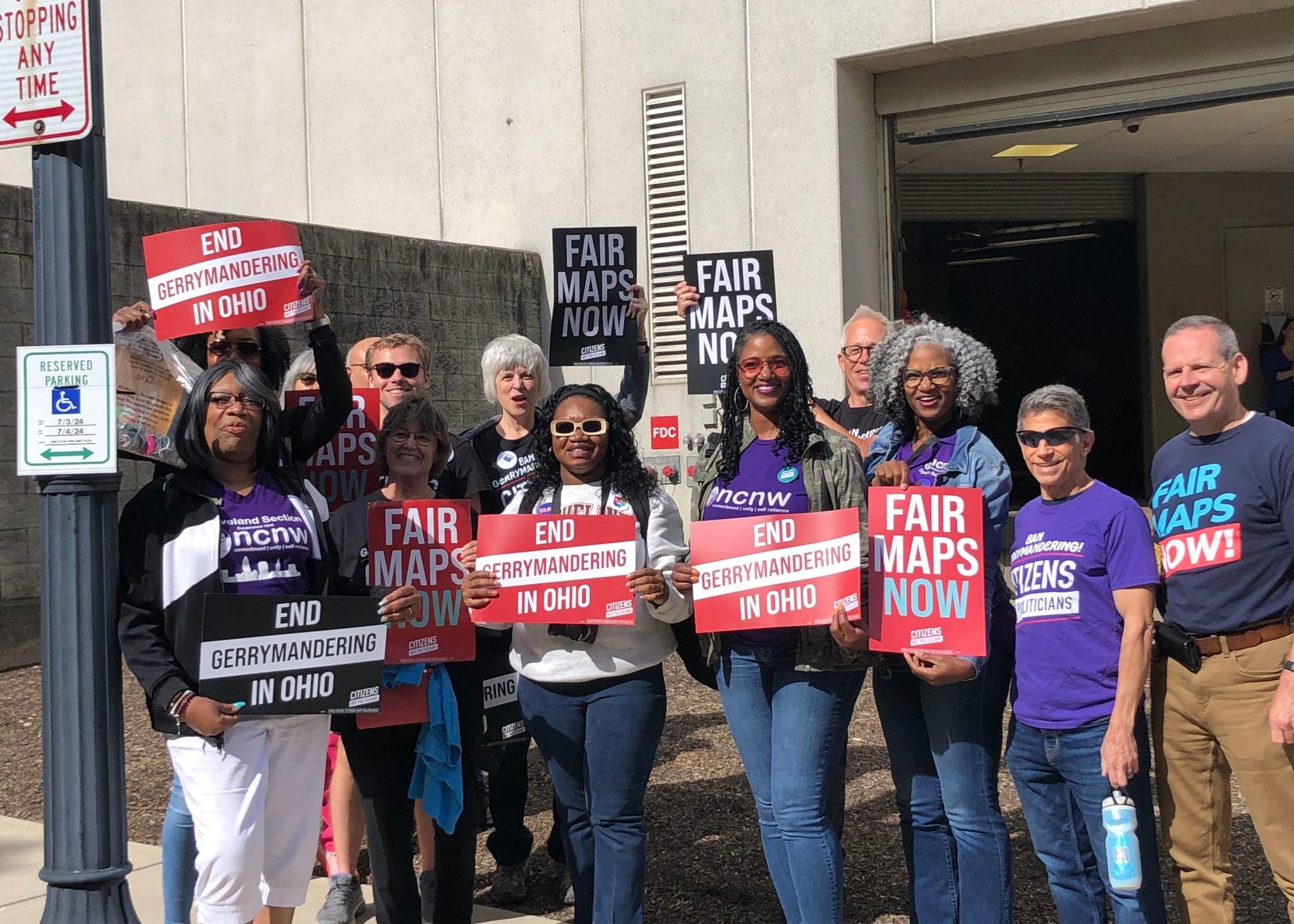
Ohio must pass a new congressional map this year, but Democrats are threatening to qualify a referendum for the ballot that could stop Republicans from further gerrymandering the state's already skewed districts.
As Andrew Tobias explains in Signal Ohio, such a maneuver would require a lot to go right for Democrats, especially now that the conservative-dominated state Supreme Court could bless a GOP tactic designed to prevent voters from getting a say.
The state's convoluted redistricting process gives the Republican-dominated legislature until Sept. 30 to pass a new map, but any such map must receive bipartisan support. Should legislators fail to do so, the seven-member Ohio Redistricting Commission then gets a crack at it until Oct. 31—but it, too, must obtain approval from Democrats.
In the likely event that Halloween comes and goes without Democrats signing onto anything, though, lawmakers will have another month to craft a new map—and this third and final time, they wouldn't need any bipartisan backing.
If Republican lawmakers forge ahead on their own, which just about everyone expects, Tobias says that opponents could collect signatures to put a repeal referendum on the ballot for November of next year.
Such a campaign would need to collect just over 248,000 valid signatures and hit targets in at least 44 of Ohio's 88 counties—a tough task for progressives in a state where liberal voters are largely concentrated in a few large urban counties.
It would also be an expensive undertaking, but one unnamed Democratic strategist predicted to Tobias that national donors would be interested in funding such an effort.
"We're trying to take back the House," said the operative. "I don't think national Dems would bat an eye at dropping a couple million in Ohio to fund a signature effort."
If opponents were to succeed in qualifying a referendum for the ballot, the new map would be blocked until voters weigh in. In such a scenario, it's not clear whether the map in use for the last two elections would get used again in 2026, so the question would likely wind up in court.
Tobias notes, though, that Republicans could attempt to thwart a referendum by adding some appropriations to their new map. That could get it classified as a spending bill, which would in turn make it immune to repeal at the ballot box. The state Supreme Court has rejected such ploys in the past, but the current hard-right GOP supermajority on the bench might be more inclined to greenlight such sleight-of-hand.
No one covers redistricting like The Downballot! If you love being able to stay on top of every twist and turn in the map-making process, please consider supporting us as a paid subscriber today. Thank you!

Senate
LA-Sen
Rep. Julia Letlow has said little publicly about her interest in challenging Sen. Bill Cassidy in next year's Republican primary, but NOLA.com's Tyler Bridges says that chatter about her future has become "the biggest question in Louisiana politics."
Cassidy, who already faces serious intraparty opposition, wound up in the MAGA doghouse after he voted to convict Donald Trump following the Jan. 6 riot, but there's no consensus whether the party's master wants Letlow to take him on.
Some unnamed sources, Bridges reports, say that Trump "has already met privately with Letlow and offered his support," but others say no such thing has happened. No one seems to be disputing, however, that Gov. Jeff Landry is pushing for Letlow to take on Cassidy.
But the congresswoman, who represents the safely red 5th District, may have a different career switch in mind.
There's been speculation for weeks that Letlow, who is a former university administrator, could be in line to become president of Louisiana State University—a prestigious and high-profile post that became vacant in May. The head of LSU's presidential search committee says the school hopes to pick someone by the end of the year.
NC-Sen
Lara Trump told reporters on Friday at the White House that she would decide by Thanksgiving whether to seek North Carolina's open U.S. Senate seat. Other prospective Republican candidates have said either publicly or privately that they'll defer to Trump, who is Donald Trump's daughter-in-law.
GOP Rep. Greg Murphy, though, has already decided to remain in the House rather than campaign to succeed departing GOP Sen. Thom Tillis, he tells WSOCTV.
Governors
ME-Gov
Democrats seeking Maine's open governorship are outraising their Republican counterparts, while one Democratic hopeful just earned a major new endorsement.
According to new financial disclosures assembled by WGAN, former state House Speaker Hannah Pingree leads the way, having raised $540,000 to date. Her three main rivals are not far behind, however: Secretary of State Shenna Bellows has taken in $530,000, while businessman Angus King III has raised $430,000 (and also self-funded another $50,000), and former state Senate President Troy Jackson has brought in $400,000.
Pingree's $500,000 war chest, though, is notably larger than the $340,000 that Bellows had left to spend at the end of June. Jackson was just behind with $320,000 in the bank, while King had $250,000.
Jackson, though, just secured the backing of the state AFL-CIO, which the Bangor Daily News identifies as Maine's "largest labor union," for the Democratic primary for governor. (More precisely, the AFL-CIO is a federation of unions.)
On the GOP side, the best-funded candidate is attorney Bobby Charles, who raised $260,000 and self-funded another $70,000. University of Maine Trustee Owen McCarthy and businessman David Jones had smaller six-figure hauls and finished June with $170,000 and $150,000 banked, respectively.
A fourth Republican, state Sen. James Libby, raised just $5,000, but that seemingly meager haul warrants more context. Libby, unlike his rivals in both parties, is seeking to qualify for public financing, which requires him to raise at least $5 from 3,200 eligible donors.
Finally, state Sen. Rick Bennett, a former Republican who is running as an independent, raised $200,000 and ended last month with $160,000 in the bank.
NY-Gov
New York Gov. Kathy Hochul enjoys a massive financial advantage over Lt. Gov. Antonio Delgado, but the challenger is hoping the state's new public financing system will help him narrow the gap ahead of next June's Democratic primary.
Hochul outraised Delgado, her former running mate turned rival, $4.4 million to $1.5 million during the first six months of the year. The governor's cash on hand lead was far wider: Hochul finished June with $17.5 million available, compared to just $1.4 million for her opponent.
Delgado, though, is seeking to qualify for the Empire State's new matching funds program—a program that came into existence the day after the Hochul-Delgado ticket won the general election in 2022. Hochul, for her part, has yet to say whether or not she'll participate.
The state Public Campaign Finance Board explains that to qualify, candidates for statewide office must raise a minimum of $500,000 from 5,000 eligible state residents who contribute at least $5. (The program, which is similar to New York City's older matching funds system, has separate requirements for legislative candidates.)
Politico's Bill Mahoney writes that only the first $250 from each donor counts toward the goal, and contributions over $1,050 can't be matched at all. (New York allows donors to contribute $9,000 each for the primary and general election, for a total of $18,000.)
Anyone who qualifies will receive $6 for every $1 raised. Candidates can unlock a maximum of $7 million in public financing for the primary and general election combined, and Delgado says he's already "on pace" to receive $3.5 million.
Mahoney, however, writes that the lieutenant governor still has a ways to go before he can receive any public funds. He reports that Delgado so far has raised $126,501 from 1,722 New York residents, which leaves him well under halfway toward his target.
The challenger is hoping that an influx of cash will help him make his case against Hochul, whom he's argued has failed to deliver "bold, decisive, transformational leadership."
Delgado will likely need such funding to convince Democratic primary voters to make a swap.
A late June poll from Siena College showed that a 62-27 majority of Democrats viewed Hochul favorably—not an especially strong showing for an incumbent with members of their own party, but also not a sign that a majority of Democrats want change. Delgado, by contrast, posted a 32-13 score among Democrats, while 55% said they didn't have an opinion about him.
That same survey showed Hochul defeating Delgado 49-12 in the primary, with another 10% going to Rep. Richie Torres. That poll was finished shortly before Torres said he was "unlikely" to run for governor, and we haven't seen any polls testing a straight-up duel between Hochul and Delgado.
House
WA-03
Republicans may finally land a viable candidate to take on Rep. Marie Gluesenkamp Perez, who is one of the most outspoken centrists in the Democratic caucus, in Washington's 3rd District.
State Senate Minority Leader John Braun is "expected to formally announce his campaign" as early as this week, Jerry Cornfield writes in the Washington State Standard.
Braun, whom Cornfield says the NRCC has worked to recruit, was noncommittal when contacted on Wednesday, saying only, "My wife and I are talking about it. We'll see."
State Rep. Jim Walsh, who leads the state Republican Party, also confirmed he was "looking at it," though he said he might defer to Braun.
Gluesenkamp Perez won this constituency in southern Washington by defeating far-right opponent Joe Kent in one of the biggest upsets of 2022. She won their subsequent rematch 52-48 even as Donald Trump, according to calculations by The Downballot, prevailed 50-47 here.
A third Gluesenkamp Perez-Kent matchup does not seem to be in store. In February, Trump nominated Kent, who spent both his campaigns facing questions about his connections to white nationalists, to lead the National Counterterrorism Center. Cornfield notes that Kent has yet to be confirmed by the Senate.
Attorneys General
VA-AG
Republican Attorney General Jason Miyares has launched his first TV ad attacking Democrat Jay Jones, and the Virginia Scope reports he's putting six figures behind it.
Miyares, who portrays his opponent as weak on crime, ended last month with a wide cash advantage over Jones even as his fellow Virginia Republicans struggled financially.
Mayors & County Leaders
Nassau County, NY Executive
Republican County Executive Bruce Blakeman has racked up a huge cash edge over Democrat Seth Koslow ahead of November's race to lead Long Island's populous Nassau County.

Blakeman outraised Koslow, who is a member of the county legislature, $2 million to $430,000 from Jan. 15 through July 15, Newsday reports. He also enjoys an even wider $3.3 million to $390,000 advantage in cash on hand.
Four years ago, Blakeman was the one trying to overcome a large fundraising deficit in his quest to unseat an incumbent. His subsequent upset victory was an early sign that Nassau County, which had become a Democratic stronghold in presidential elections, was in the process of shifting hard to the right.
Koslow, for his part, is hoping that unhappiness with the status quo will sink Blakeman. Should Koslow prevail, he would also likely end any hopes Blakeman has about running for governor of New York next year.
Obituaries
Bill Clay
Former Democratic Rep. Bill Clay, whose election in 1968 made him Missouri's first Black congressman, died Wednesday at the age of 94.
Clay retired in 2000 and was succeeded by his son, Lacy Clay, whose own long tenure representing St. Louis ended after his loss to Cori Bush in the 2020 Democratic primary.
The elder Clay, who was a co-founder of the Congressional Black Caucus, was a prominent political power player known for his sharp tongue. In 1974, the congressman responded to a false allegation that he'd hired a California assassin to murder an opponent by snarking, "With the high rate of unemployment for hit men in the First Congressional District, why would a gifted politician like myself give the job to someone from California?"
Clay, though, may be better remembered for one of his more serious comments: He memorably summed up his political philosophy the following year when he told a labor gathering, "You must start with the premise that you have no permanent friends, no permanent enemies, just permanent interests."
Gloria Ross has much more on Clay's rise and his time in office in her obituary for St. Louis Public Radio.
Former Virginia LG Bill Bolling thinks Dems will pick up at least 6 seats (likely more) in the House of Delegates this November.
https://bluevirginia.us/2025/07/fmr-va-lg-bill-bolling-a-trump-supporting-republican-says-dems-likely-to-pick-up-6-seats-perhaps-more-in-the-house-of-delegates-this-november/
CBS NEWS POLL: Trump's approval trends among ages 18-29
Early February
🟢 Approve: 55% (+10)
🟤 Disapprove: 45%
JULY
🟢 Approve: 28% (-44)
🟤 Disapprove: 72%
Net 54-point negative swing
https://x.com/IAPolls2022/status/1947397923999830321