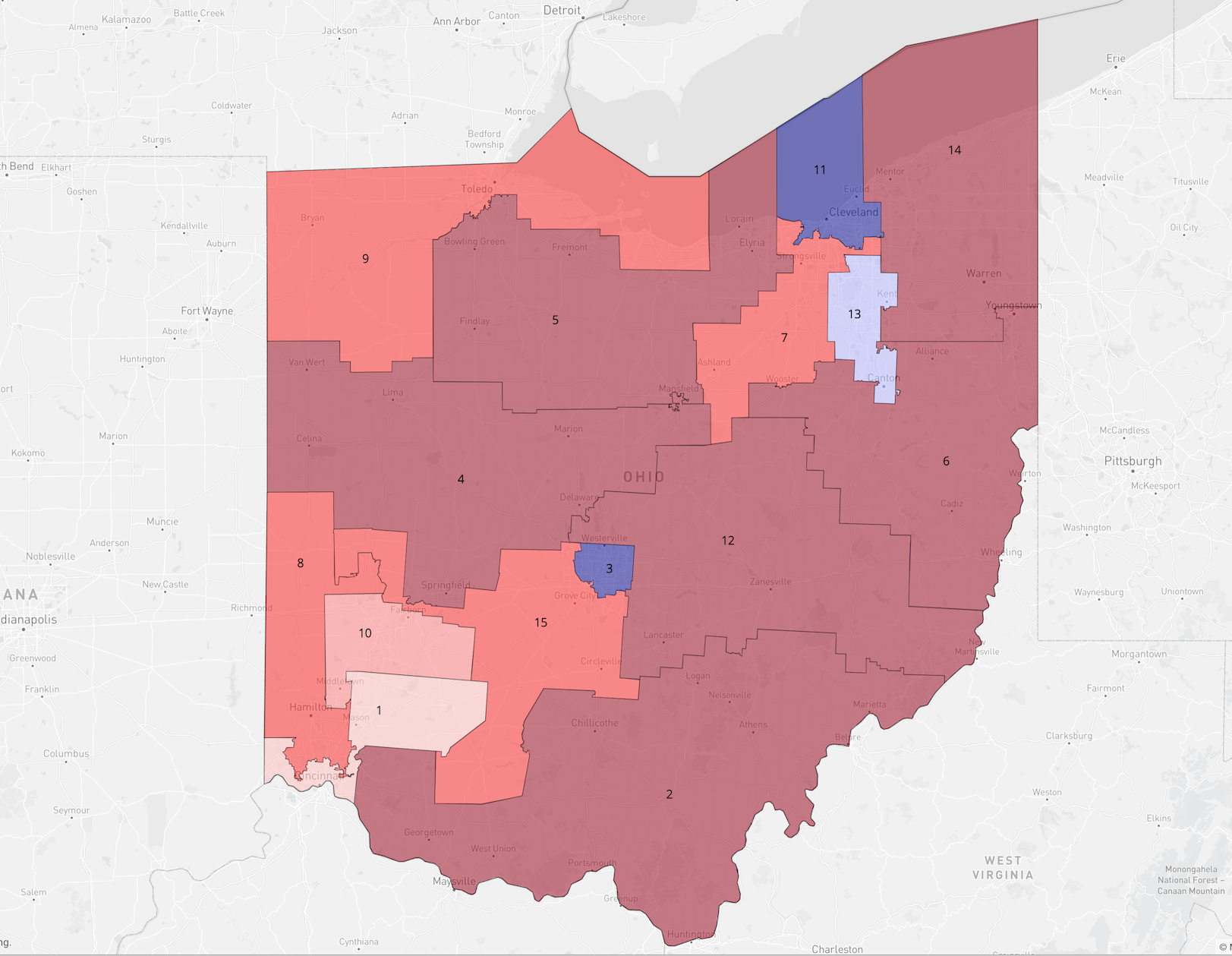
Ohio’s proposed congressional map, with districts shaded according to their performance in the 2024 presidential election (credit: Dave’s Redistricting App)
Leading Off
OH Redistricting
Republicans and Democrats on Ohio’s redistricting commission have reportedly reached an agreement on a new congressional map that would make two Democratic-held seats redder but fall short of the GOP’s dream gerrymander.
Under the deal, which was first reported by D.J. Byrnes of The Rooster on Wednesday night, Republicans could win as many as 13 of Ohio’s 15 seats in the House. Before it can take effect, though, the map must be approved by commissioners on a bipartisan basis at a meeting scheduled for Friday—the last day the panel can act before a key deadline.
A message from our sponsor, Ripple on Impact:
Ready to take control of your ROI?
This October, Ripple On Impact is doing something totally unique. We’re keeping our signature guarantee but putting the power in your hands. Choose your own return between 100% and 130%! If your team’s ready to grow and you need 120% back right now to make it happen, consider it done.
That may not happen. Gov. Mike DeWine, one of five Republicans on the seven-member body, said on Thursday that he supports the plan, and another Republican commissioner, state Rep. Brian Stewart, predicted it would pass. To do so, it will need votes from both Democratic members, Senate Minority Leader Nickie Antonio and House Minority Leader Dani Isaacsohn, and at least two Republicans.
But Andrew Tobias of Signal Ohio reported that the White House is “angry” about the deal, with one unnamed source calling it “shocking” and “terrible for Donald Trump.” Byrnes added that the NRCC is “super pissed,” relaying that an anonymous Republican source told him the accord “may not hold.”
Some Democrats have also expressed their displeasure, including party chairs in two counties in northwestern Ohio, who have called on Antonio and Isaacsohn to reject the proposal.
Democrats may nonetheless be inclined to back the new map because the alternative could be worse. If the commission fails to adopt a new plan by Friday, Ohio’s GOP-dominated legislature would take over the redistricting process. Republican lawmakers would then be able to pass a much more extreme gerrymander without any Democratic votes.
That approach, however, presents a risk for the GOP, too. Acts of the legislature are subject to veto referendums, meaning Democrats could gather approximately 250,000 signatures to place such a map on the ballot. Doing so would immediately suspend the new map until voters have the chance to weigh in. A map approved by the commission, however, appears to be immune from a referendum.
The referendum option, though, is fraught with pitfalls, with many opportunities for Republican officials—including the GOP majority on the state Supreme Court—to slow-walk or cripple the process.
As for the map itself, it would target the Cincinnati-based 1st District, held by Democrat Greg Landsman, and the Toledo-area 9th District, represented by Democrat Marcy Kaptur. (You can find an interactive version on Dave’s Redistricting App here.)
Landsman’s constituency would be the most affected. Under the current lines, Kamala Harris won it 53-46 in 2024, but the overhauled version would have given Trump a 51-48 edge. Landsman, who won a second term 55-45 last year, would still have a chance, however, particularly given that Joe Biden and Sherrod Brown would have narrowly carried the district in their most recent elections.
Kaptur’s district, which was already one of the reddest held by a Democrat anywhere in the country thanks to the GOP’s previous gerrymander, would face an even greater struggle to hang on. Her constituency, which backed Trump 53-46, would balloon to a 55-44 Trump edge. Kaptur, the longest-serving woman in congressional history, survived by just a 48.3 to 47.6 margin in 2024.
One other potentially vulnerable Democrat, Emilia Sykes, would actually see her chances improve slightly. Last year, her 13th District, which is based around Canton and Akron, was the most closely divided in the country at the presidential level, going for Harris by just 183 votes, or just 0.05 percentage points (Sykes won by a slightly larger 51-49 spread). The new iteration, by contrast, would have voted for Harris by a 51-48 margin.
Ohio’s remap is necessary because of a baroque constitutional amendment that voters approved in 2018. That amendment masqueraded as legitimate redistricting reform but was riddled with loopholes that Republicans eagerly exploited during the most recent round of redistricting following the 2020 census.
In particular, the amendment, while purporting to require bipartisan agreement to pass any maps, nonetheless allows the legislature to adopt new district lines on a purely partisan basis. That’s precisely what the GOP did, greenlighting a plan with just two safely blue seats.
The only drawback, such as it is, for maps passed without the support of both parties is that they’re only effective for two election cycles. But that ostensible penalty was, at least for Republicans, a feature rather than a bug, because it’s now given them the opportunity to fine-tune their gerrymander in the middle of a decade.
As we approach another Election Day, we hope you’ve found value in The Downballot’s coverage this year. If so, we’d be honored if you’d join the team as a paid subscriber to help sustain our work into next year and beyond.
Maryland Gov. Wes Moore is pushing back against a top fellow Democrat for refusing to move forward with a new congressional map, suggesting that a redraw might still be in the cards.
“The General Assembly is a large body, so while I have read the Senate President’s letter, I also know that one person cannot stop a process,” Moore told reporters on Wednesday, referring to a missive sent by Senate leader Bill Ferguson a day earlier explaining why he won’t pursue mid-decade redistricting.
“A special session is not off the table, regardless of what anyone else says,” he added. Moore, like all governors, has the power to convene the legislature for a special session —whether or not legislative leaders agree.
In the letter Moore cited, Ferguson advanced a series of specious arguments to defend his inaction. However, he was immediately questioned by his counterpart in the state House, Speaker Adrienne Jones, who warned that cutting off the possibility of drawing a new map “denies our constituents the opportunity to voice their opinion on an issue that goes far beyond their district lines.”
House
NE-02
EMILYs List has given its backing to political strategist Denise Powell as she pursues the Democratic nomination for Nebraska’s open 2nd District. Powell is one of several notable Democrats running to succeed retiring GOP Rep. Don Bacon and has so far led the field in fundraising.
Attorney Tony Box, a former federal prosecutor, FBI agent, and Army veteran, entered the race to succeed Texas Attorney General Ken Paxton on Thursday, making him the third notable Democrat to do so.
Box, a first-time candidate who served in Iraq and Afghanistan before his career in law enforcement, slammed the incumbent, who is running for Senate, as “corrupt” in an interview with the Dallas Morning News announcing his campaign.
“He’s been impeached. He got sued by his top deputies,” Box said. “That’s not a good look for the attorney general’s office, and I want to change that.”
Box joins former Galveston Mayor Joe Jaworski and state Sen. Nathan Johnson in the Democratic primary. Several Republicans are also running, including Rep. Chip Roy.
Poll Pile
IA-Gov: Z to A Research (D): Rob Sand (D): 45, Randy Feenstra (R): 43 (no client identified).
NJ-Gov: Emerson College for PIX11 and The Hill: Mikie Sherrill (D): 49, Jack Ciattarelli (R): 48 (Sept.: 43-43 tie).
VA-AG: Roanoke: Jason Miyares (R-inc): 46, Jay Jones (D): 38 (Aug.: 41-38 Jones).
CA Redistricting: UC Berkeley for the Los Angeles Times: Yes: 60, No: 38.
New York, NY Mayor: Marist University: Zohran Mamdani (D): 48, Andrew Cuomo (I): 32, Curtis Sliwa (R): 16. (Sept.: Mamdani: 45, Cuomo: 24, Sliwa: 17, Eric Adams: 9. The earlier poll was conducted before Adams dropped out.)
New York, NY Mayor: Emerson: Mamdani (D): 50, Cuomo (I): 25, Sliwa (R): 21. (Sept.: Mamdani: 43, Cuomo: 28, Sliwa: 10, Adams: 7. The earlier poll was conducted before Adams dropped out.)
New York, NY Mayor: Beacon and Shaw: Mamdani (D): 47, Cuomo (I): 31, Sliwa (R): 15 (mid-Oct.: Mamdani: 52, Cuomo: 28, Sliwa: 14).






Watch Marcy Kaptur win the new district by 0.03%
Ohio redistricting commission adopts "compromise" map.
https://www.news5cleveland.com/news/politics/ohio-politics/these-are-ohios-new-congressional-districts