

Morning Digest, sponsored by Grassroots Analytics: GOP convinces reluctant congressman to run again
But Bill Huizenga is still set to face the toughest race of his career


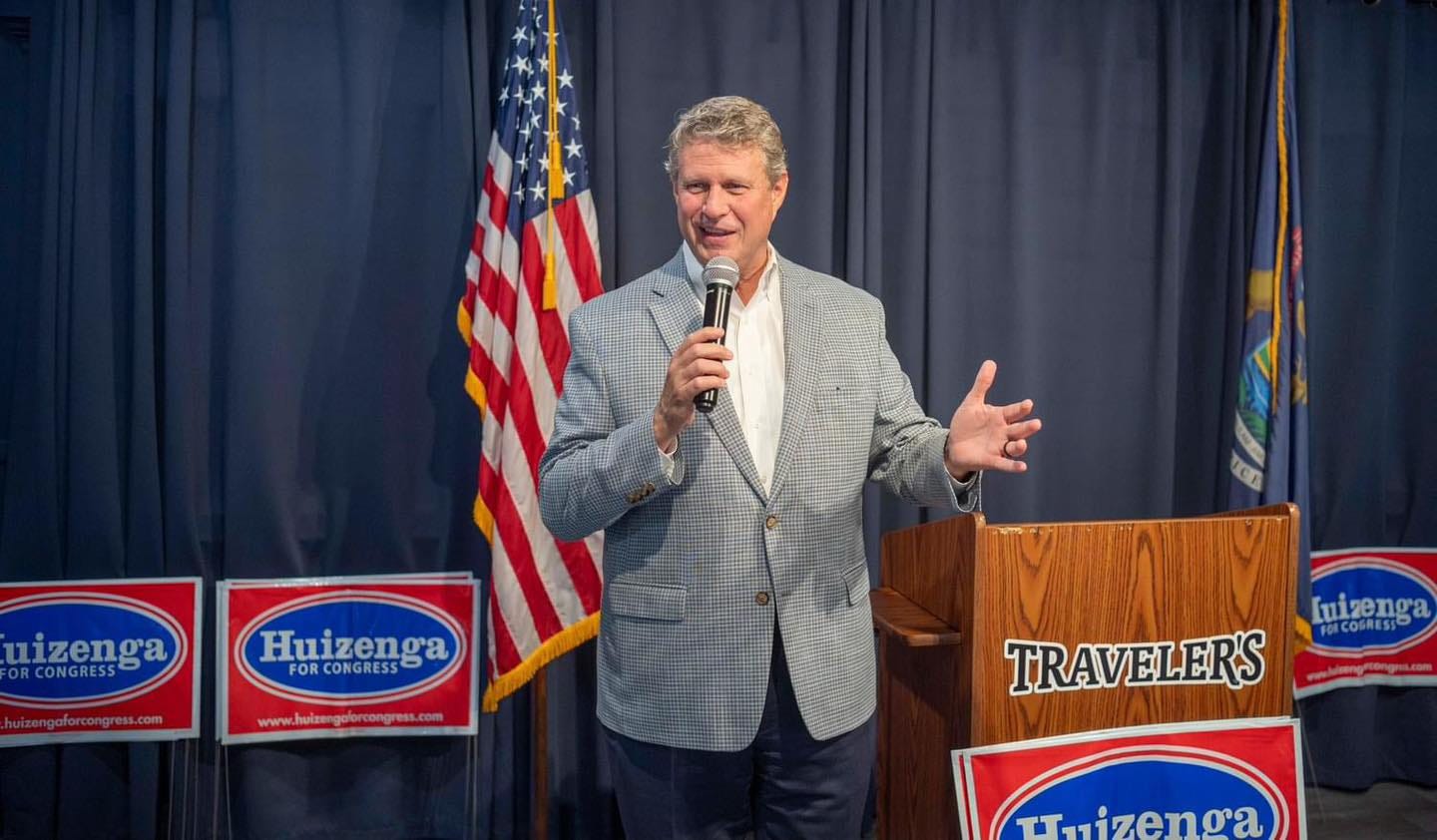
Leading Off
MI-04
Republican Rep. Bill Huizenga said Monday that he would seek reelection in Michigan’s 4th Congressional District, a competitive seat that would have grown even harder for the GOP to hold had he opted to retire.
After Donald Trump successfully pressured Huizenga to pass on a Senate bid in July, the congressman declined to specify whether he’d run for a ninth term next year. Instead, he kept his party waiting for nearly five months—and now faces what will likely be the toughest general election of his career.
A message from our sponsor, Grassroots Analytics:
Double the power, double the impact.
For half the cost.

Grassroots Analytics recently doubled the AI power behind Quiller, the AI writing co-pilot. In this key update, we’ve doubled the language power behind Quiller’s inner workings, without sacrificing any data privacy, quality, or value standards.
And now, an annual subscription to the platform is 50% if you sign up by December 31.
Last year, Trump carried the 4th District, which includes Kalamazoo and Battle Creek in the southwestern part of the state, by a relatively close 52-46 spread, according to calculations by The Downballot.
But that’s not the only reason Democrats are hopeful Huizenga might lose. Data from VEST and Dave’s Redistricting App shows that Gov. Gretchen Whitmer narrowly carried the 4th by a 49.6 to 48.8 spread during her decisive reelection win in 2022.
Two credible Democratic candidates began running to flip the 4th well before they knew whether or not they’d need to go up against Huizenga.
Attorney Jessica Swartz, who lost to the incumbent 55-43 last year, launched her second campaign in April. Swartz told the Detroit News in the spring that her first effort taught her “how to be a candidate,” adding that “this time, I have all that under my belt, and we’re ready to hit the ground running.”
State Sen. Sean McCann joined her in July and received Whitmer’s endorsement earlier this month. The primary is set for Aug. 4.
Until now, Huizenga never had to be too concerned about the Democrats running against him. After his slender victory in the 2010 GOP primary for what was then numbered the 2nd District left him as the overwhelming favorite in the general election, he quickly became entrenched in what was a reliably conservative seat along the western Michigan coast.
That state of affairs didn’t change much even after Michigan’s new independent redistricting commission implemented a map for the 2022 elections that made major changes to the lines. As a result of those changes, Huizenga sought reelection in the newly competitive 4th District but won comfortably, even though he only represented about a quarter of the revamped constituency.
Swartz, who volunteered for the group that passed the 2018 referendum to create the redistricting commission, distinguished herself from earlier Huizenga opponents by raising over $1 million, but the congressman still ran well ahead of Trump and prevailed by 12 points.
That strong showing, along with Senate GOP leaders’ preference for former Rep. Mike Rogers, incentivized prominent Republicans to do all they could to convince Huizenga to remain in the lower chamber rather than seek a promotion.
Huizenga loudly insisted that he’d be a stronger nominee than Rogers, who narrowly failed to flip the state’s other Senate seat last year even as Trump was carrying the state, but he was unable to win over the most powerful Republican in the country. The Associated Press reported in July that, even though Huizenga was “ready to launch” a Senate campaign, he backed down when Trump refused to provide his “blessing.”
But while Huizenga spent the five months after that humiliating climbdown keeping everyone guessing about his plans, he used his reelection announcement Monday to argue that voters should return him to the House on the strength of his efforts “[t]o combat record inflation and improve affordability.”
The congressman, though, may once again find that Trump has opposing ideas about the 2026 campaign.
“The word ‘affordability’ is a con job by the Democrats,” Trump told his cabinet earlier this month. “The word affordability is a Democrat scam.”
The Downballot only exists because of our readers.
We have no deep-pocketed corporate backers and no billionaire sugar daddies. That means we can always tell the truth without fear—something major media conglomerates increasingly refuse to do. But it also means we need as many people as possible to sign up as paid subscribers so that we can keep the lights on.
If you’re able to support our work, we hope you’ll upgrade today.

Election Night
Special Elections
Kentucky Democrats are defending a state Senate seat in the Louisville area in a special election on Tuesday night, one that saw a close race at the top of the ticket last year. Republicans, however, do not appear to be seriously contesting it.
The 37th District became vacant in October after its previous holder, Democratic Sen. David Yates, was appointed Jefferson County clerk. Yates defeated Republican Calvin Leach by a wide 60-40 margin last year, but Kamala Harris carried the district by a much smaller 52-47 spread, according to calculations from The Downballot. That also represented a considerable drop from Joe Biden’s 54-44 win four years earlier.
In the contest to succeed Yates, Democrats nominated Army veteran Gary Clemons, who is president of the local branch of the United Steelworkers union. Republicans once again went with Leach, who is also an Army veteran.
Shortly after Leach was selected, Kentucky Public Radio reported on an article he wrote in 2018 in which he described young women as “promiscuous skanks,” “coddled americunts,” and “party whores.” He defended the article in an interview with KPR but quickly deleted it, though as the outlet noted, he continued to make similar comments online as recently as this summer.
Despite the district’s trend, though, the fundraising and spending have been lopsided. Clemons had brought in more than $45,000 at the start of the month and has benefited from $28,000 in outside spending. Leach, by contrast, raised just $1,000 and hasn’t gotten any help from third-party groups. (A Libertarian candidate who’s also on the ballot, Wendy Higdon, took in almost $7,000.)
Republicans, however, retain an overwhelming advantage in the Kentucky Senate. They currently hold a 32-5 supermajority, with just this seat vacant. Stay on top of every special election by bookmarking The Downballot’s continually updated tracker.
Senate
AL-Sen, AL-05
Former Rep. Mo Brooks once again isn’t ruling out a bid for the U.S. Senate, though he’s also saying that he might instead run to reclaim his old 5th Congressional District, seek a seat in the Alabama state House, or keep his name off the ballot altogether.
“They’re all possibilities,” Brooks told the conservative site 1819 News. “The least likely one is that I would run for Congress of the four possibilities. I know [Rep.] Dale Strong personally, like him personally.”
Strong succeeded Brooks in the House following the latter’s unsuccessful bid for Alabama’s other Senate seat in 2022. Brooks told 1819 News that he’d make up his mind next month, when the state’s Jan. 23 filing deadline looms.
MN-Sen
Former sportscaster Michele Tafoya remains interested in seeking the Republican nomination for U.S. Senate, according to reports from the National Journal and Fluence Media. The latter anticipates that Tafoya, who first talked about running back in February, will finally reveal her plans after New Year’s Day.
Republicans have spent most of 2025 waiting for a viable candidate to emerge in the race to succeed retiring Democratic Sen. Tina Smith, and they’re still in a holding pattern. For now, the GOP contest remains a duel between two weak options: Adam Schwarze, a Navy SEAL veteran who has struggled to raise money, and far-right extremist Royce White, a one-time NBA player who badly lost a bid for the state’s other Senate seat last year.
The Democratic contest pits Rep. Angie Craig against Lt. Gov. Peggy Flanagan. Whoever wins the August primary will be favored in a state where Republicans last won a Senate contest in 2002.
WV-Sen
West Virginia Sen. Shelley Moore Capito confirmed Monday that she’d seek a third term in what’s become one of the reddest states in the nation, though Donald Trump’s decision to endorse her back in May made her announcement anticlimactic.
Capito faces opposition in the May 12 primary from state Sen. Tom Willis, who won his seat last year after defeating state Senate President Craig Blair for renomination. He has an even tougher task ahead of him this spring. Capito ended September with over $4 million in the bank, while Willis had less than $160,000 available.
Willis appears to be the only notable Republican hoping to take down Capito. While former Del. Derrick Evans, who served three months in prison for his participation in the Jan. 6 assault on the Capitol, initially announced his own campaign for Senate in November of last year, he said in June that he’d instead run for the 1st Congressional District.
Evans, however, has also struggled to raise money for his primary rematch with Rep. Carol Miller, who defeated him 62-37 last year. He’s similarly attracted little media attention in the six months following his launch, and he doesn’t appear interested in generating any. While Evans is a prolific X user, his profile doesn’t identify him as a candidate for any office, and his website still identifies him as a Senate candidate.
Governors
NM-Gov
Businessman Duke Rodriguez, who runs a large medical cannabis company, announced Sunday that he was joining the Republican primary for New Mexico’s open governorship.
Rodriguez, who has said he’s willing to self-fund up to $2 million, spent 15 months running the state’s Human Services Department in the mid-1990s. That brief tenure did not go well, however, with the Santa Fe New Mexican’s Milan Simonich writing in May that critics called Rodriguez “arrogant and a poor listener.”
Rodriguez is otherwise a newcomer to state politics—perhaps too much of one. Political reporter Joe Monahan wrote in June that Rodriguez only registered to vote in New Mexico in January after spending the prior two decades on the voter rolls in neighboring Arizona. Simonich subsequently reported last month that Rodriguez cast ballots in Arizona for more than two decades, including as recently as 2024.
That’s a potentially disqualifying problem because the state’s constitution requires that its governor “shall have resided continuously in New Mexico for five years next preceding his election.”
Rodriguez told both Monahan and Simonich in response that he was allowed to run to replace termed-out Democrat Michelle Lujan Grisham because he’s owned a home in Albuquerque since 1979, and he didn’t let the matter stop him from launching his campaign this week.
Rodriguez joins Rio Rancho Mayor Gregg Hull and state Sen. Steve Lanier in the June 2 primary. Other Republicans are also considering, though Monahan reports that state Rep. Mark Murphy has decided not to run.
The Democratic field, by contrast, fully formed this spring. Bernalillo County District Attorney Sam Bregman and former U.S. Secretary of the Interior Deb Haaland are the main candidates; a third contender, former Las Cruces Mayor Ken Miyagishima, is also running, but he had little money available when the most recent reporting period ended in October.
House
AZ-01
State Rep. Joseph Chaplik, who is a leader of Arizona’s branch of the far-right Freedom Caucus, announced Monday that he’d run to succeed Rep. David Schweikert, a fellow Republican who is giving up the swingy 1st Congressional District to run for governor.
Chaplik entered the Aug. 4 primary almost two months after Donald Trump endorsed Gina Swoboda, the chair of the Arizona Republican Party. But Chaplik, who has called Swoboda “a recent Hillary Clinton supporter,” is one of many hardliners who don’t believe that she should have any place in GOP politics.

Chaplik began his congressional campaign by touting endorsements from several current and former elected officials, including two would-be rivals: former state Sen. Michelle Ugenti-Rita, who expressed interest in running herself back in September, and state Rep. Alex Kolodin, whose plans were also the subject of speculation. The newcomer additionally lists Maricopa County Sheriff Jerry Sheridan, who holds one of the more prominent offices in the state, as a supporter.
Wealthy businessman John Trobough is also seeking the GOP nod to defend the 1st District, which Trump carried 51-48 four years after Joe Biden took it by an even narrower 50-49 margin.
Five notable Democrats are campaigning to flip this constituency in the Phoenix suburbs: former state Rep. Amish Shah, who lost a close race to Schweikert in 2024; former TV anchor Marlene Galan-Woods, who unsuccessfully sought the nomination last time; DNC member Mark Robert Gordon; and a pair of businessmen, Rick McCartney and Jonathan Treble.
MA-05
Former Waltham City Councilor Jonathan Paz on Monday announced a primary challenge to Rep. Katherine Clark, who, as minority whip, is the number-two Democrat in the lower chamber.
“Let’s just call it what it is: Our Democratic leaders are failing us,” Paz, who is running to represent a safely blue constituency that includes communities north and west of Boston, said in his launch video. “They’re not stopping Trump, they’re not making life more affordable, they’re not building a party for the working class.”
Paz, who is the son of immigrants from Bolivia, was last on the ballot in 2023 when his campaign to unseat Waltham’s mayor ended in a 59-41 defeat. He’s attracted national attention this year as the founder of a group that advocates for people impacted by ICE raids. In September, Paz was the subject of a piece in Mother Jones titled, “Inside the Scrappy Network of Volunteers Protecting Their Neighbors From ICE.”
Clark, for her part, has faced no serious intraparty opposition since she first won Massachusetts’ 5th Congressional District in a 2013 special election to succeed Ed Markey following Markey’s ascension to the Senate.
The incumbent, who became minority whip as a result of the Democratic leadership shakeup that followed the 2022 elections, finished September with $1.8 million in the bank. (Updated fundraising numbers covering the final quarter of the year are due on Jan. 31.)
The primary will take place on Sept. 1, which is one of the latest nomination contests in the country.
ME-02, ME-Gov
Former Maine Senate President Troy Jackson has been very coy about his intentions, but he seems to have finally foreclosed the possibility of dropping his bid for governor to run for the open 2nd District instead.
“I do understand this House seat could mean flipping control,” Jackson told Huffpost at a gathering of the Democratic Governors Association last week. “But I can’t change the state in D.C.”
Two other Democrats, former congressional staffer Jordan Wood and state Auditor Matt Dunlap, are running to succeed retiring Rep. Jared Golden, and more could join. State Sen. Joe Baldacci previously said he was interested, but only if Jackson were to pass on the race.
Last week, before Jackson’s latest comments, Punchbowl reported that Baldacci was “moving closer to a bid.” To that end, he released an internal poll last week showing former Gov. Paul LePage, the likely GOP nominee, leading him by just a 44-43 margin.
NJ-09
Perennial candidate Billy Prempeh, who held Democratic Rep. Nellie Pou to a shockingly close win last year, has abandoned his fourth bid to flip New Jersey’s 9th Congressional District.
Prempeh’s 51-46 loss to Pou mirrored the broader Democratic collapse in the 9th District, especially among Latino voters. Donald Trump carried the district 49-48 in 2024, a stunning outcome four years after Joe Biden easily won it 59-40, according to calculations from The Downballot. In 2020, Pou’s predecessor, the late Rep. Bill Pascrell, easily dispatched Prempeh 66-32.
This time around, Prempeh faced a much more credible opponent in the GOP primary, Clifton City Councilwoman Rosie Pino, though he was scathing in his assessment of his rival as he dropped out of the race.
“The party wants someone that they can control,” he said in a video posted on social media, “whether it be a candidate that parachutes from a completely different town, a carpetbagger from outside of the district, or it’s a councilperson that is well-hated within their own city—a total progressive Democrat who now claims to be a Republican, running to represent you.”
Prempeh had previously castigated Pino for leading a group called Latino Leaders for Clifton that endorsed Pou last year and called her “the best candidate to represent us in Washington, D.C.” Pino, however, might soon get some company from attorney Tiffany Burress, the wife of former New York Giants wide receiver Plaxico Burress who is reportedly eyeing the GOP nod.
Whoever wins the Republican nomination, though, likely won’t enjoy a political environment in the midterms that’s anywhere near as favorable as last year’s. According to the New Jersey Globe, Democratic Gov.-elect Mikie Sherrill won the 9th by the same 59-40 margin Biden put up five years ago, a reversal once again driven by Latino voters.
PA-07
Gov. Josh Shapiro has endorsed firefighter union chief Bob Brooks in his bid to take on Republican Rep. Ryan Mackenzie in Pennsylvania’s swingy 7th District.
Politico, which first reported the endorsement, adds that Shapiro “helped recruit Brooks into the race” and notes that he’s keynoting a fundraising event for him in Philadelphia this week. Despite the high-profile vote of confidence, though, Brooks still faces four other notable Democrats in next year’s primary.
VA-02, VA-05
Virginia’s two Democratic senators, Mark Warner and Tim Kaine, have endorsed comeback bids by a pair of former members of the House: Elaine Luria in the 2nd District and Tom Perriello in the 5th. Both candidates face opposition in their respective primaries but enjoy much greater name recognition and deeper ties to the political establishment than their rivals.
Attorneys General
NV-AG
Republican Gov. Joe Lombardo has endorsed attorney Adriana Guzman Fralick in her bid for Nevada’s open race for attorney general.
Guzman Fralick, who recently stepped down as chair of the state’s Cannabis Compliance Board, faces Douglas County Commissioner Danny Tarkanian, the most notorious perennial candidate in America, for the Republican nomination.
Democrats also have a contested primary between state Senate Majority Leader Nicole Cannizzaro and state Treasurer Zach Conine in the race to succeed incumbent Aaron Ford, who is challenging Lombardo.
Mayors & County Leaders
Tarrant County, TX Judge
Democratic Rep. Marc Veasey ended his campaign for Tarrant County judge on Monday, just one week after he stunned observers by entering the race moments before the close of candidate filing. The passage of that deadline means that Veasey, who was first elected to Congress in 2012, will not be on the March 3 Democratic primary ballot for any office.
Veasey’s departure leaves County Commissioner Alisa Simmons without any serious intraparty opposition in her quest to take on Judge Tim O’Hare, a far-right Republican serving his first term as leader of a populous county that’s home to Fort Worth and Arlington. (In Texas, the county judge is an executive rather than a judicial position.)
Both parties have a close interest in the general election to lead Tarrant County, a longtime GOP bastion that’s taken on a more purple shade in recent years. In 2020, Joe Biden became the first Democrat to win the county since Texan Lyndon Johnson when he scored a narrow 49.3 to 49.1 victory, but O’Hare still prevailed 53-47 two years later.
Democrats hoped for a breakthrough last year only to watch in frustration as Donald Trump reclaimed the county with a 52-47 win while far-right Sheriff Bill Waybourn won reelection by an even larger spread. Democrat Colin Allred, however, just barely edged out GOP Sen. Ted Cruz 48.9 to 48.7 even as he was losing statewide, a tight win that left Democrats with some reason for optimism for the future.
Republican map makers, though, did what they could to weaken Tarrant County Democrats through new gerrymanders. The GOP-dominated legislature passed a new congressional map that cut up Veasey’s 33rd District and left him without an obvious place to run, while O’Hare and his allies on the commission pushed through new boundaries that made Simmons’ district considerably redder.
Veasey, who is 54, is now leaving office—at least for now—after more than a decade as one of the most prominent Democrats in the Fort Worth area. At the age of just 33, Veasey first won a seat in the state House in 2004. Eight years later, reapportionment opened a path to Congress when Texas gained four new House seats following the 2010 census.
The competitive primary runoff for the safely blue 33rd District showcased the geographic and racial diversity of the new constituency. Veasey, a Black elected official from Fort Worth, faced former state Rep. Domingo Garcia, a Latino politician from Dallas.
Though the district was predominantly Latino, higher turnout among Black voters propelled Veasey to a 53-47 win, and his victory that fall made him the first African American to represent Tarrant County in Congress.
Veasey never struggled to win renomination during the ensuing decade, but everything changed after the GOP passed its new gerrymander this summer. The revamped boundaries left the three Democrats representing the Dallas-Fort Worth area—Veasey, Jasmine Crockett, and Julie Johnson—with just two Democratic-leaning seats to choose from.
Johnson, whose 32nd District was transfigured into a safely red constituency, opted to run for the new-look 33rd District, though she learned last week that she’ll face Allred in the primary.
Veasey seemed all but assured to seek reelection in the 30th less than two weeks ago after Crockett signaled she’d run for the Senate rather than remain in the House. But everything abruptly shifted the day of the filing deadline after minister Frederick Haynes, who is Crockett’s pastor, entered the race for the 30th District.
Veasey kicked off his brief campaign for county judge hours later rather than go up against Haynes, who faces little opposition on his path to Congress.
Poll Pile
PA-03 (D): Lake Research Partners (D) for Sharif Street: Sharif Street: 22, Chris Rabb: 17, Ala Stanford: 11, Morgan Cephas: 7, undecided: 36, others 2% or less. Poll was conducted Nov. 17-20.
"Candidate for US Senate in Texas James Talarico and candidate for US House #TX15 Bobby Pulido are planning a rally in South Texas on Thursday
Source: San Antonio Express-News"
Talarico going for Hispanics in the primary while Crockett is locking up AAs. I hope whoever loses doesn't have hard feelings and people stay home in the general...
Now that California has finally certified its election results, I've taken a look at some of the city-level results to see how they compare with 2024.
The pattern that becomes immediately evident is that wealthy, mostly-white suburban towns voted pretty much the same way as 2024, and in some cases even slightly worse, while cities with large Asian and especially Hispanic populations saw massive swings to the left. In many heavily Hispanic cities in Los Angeles County, Yes received 90% of Harris's votes while No received only 30-40% of Trump's votes. That happened at the same time that all four cities in the Palos Verdes area saw Yes do worse than Harris.
So far, the city I've found where Yes outperformed Harris the most is Mendota, a small, virtually all-Hispanic town in Fresno County that went from 57% Harris to 80% Yes. Meanwhile, the town that swung most in the other direction is Woodside, a small, ultra-rich town in San Mateo County, which went from 75% Harris to 67% Yes.
One thing is clear - 2026 is going to have significantly higher turnout than 2022 in California. Yes received more votes than Newsom did in 2022 almost everywhere, and by particularly large margins in cities with large Hispanic populations. And if that could happen in an off-year election where there was literally nothing else on the ballot, then it's clear that Hispanics now understand how horrible Trump is and that they erred in supporting him in 2024.