



Leading Off
CO-01
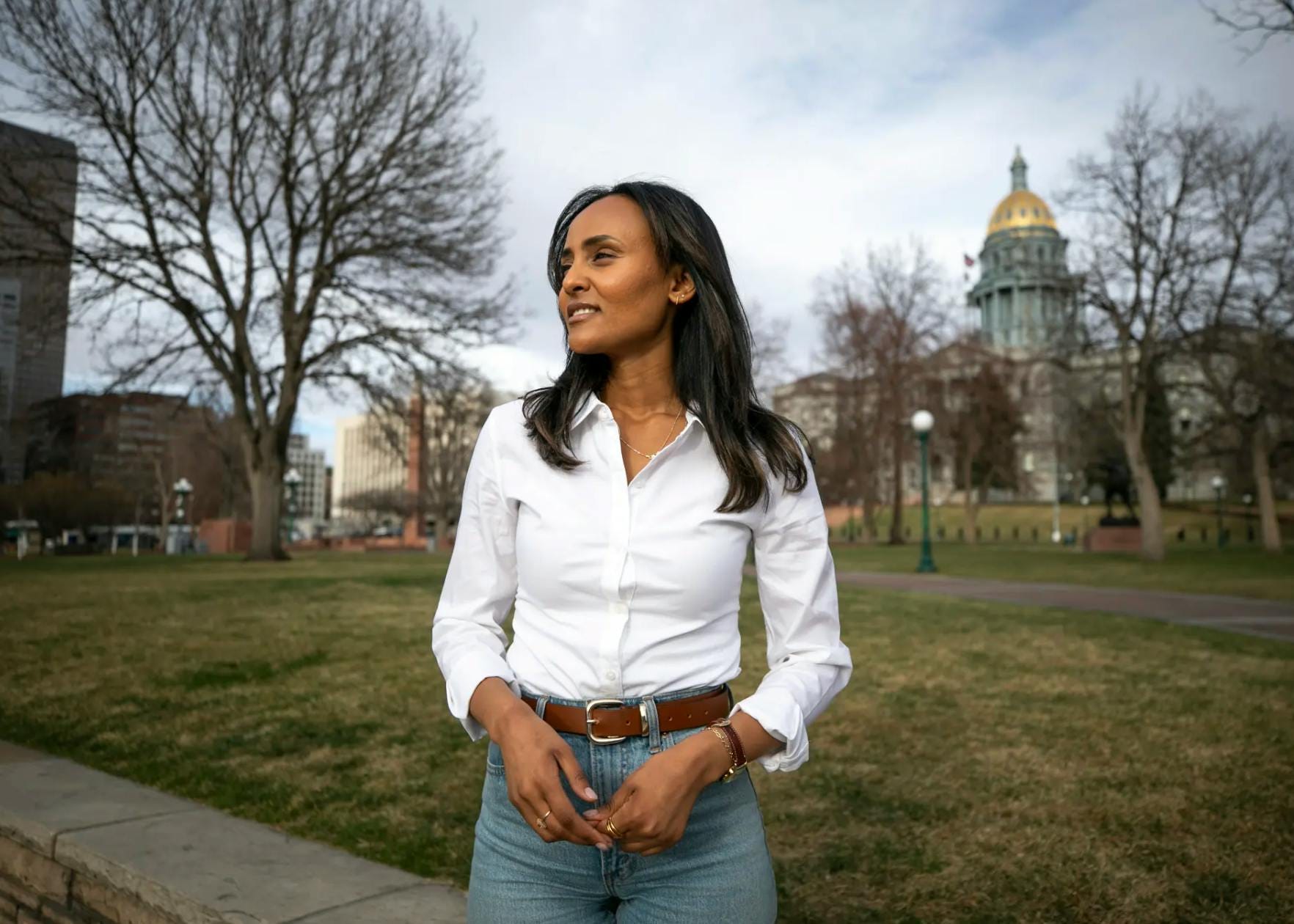
Melat Kiros, a 29-year-old former attorney and member of the Democratic Socialists of America, unseated longtime Colorado Rep. Diana DeGette in Tuesday’s Democratic primary, marking the seventh time a House incumbent has lost to an intra-party challenger this year.
Kiros leads DeGette 51-42 as of early Wednesday, with a third candidate, University of Colorado Regent Wanda James, taking 7%. The Associated Press estimates that 94% of the vote has been reported, but while the margin may shift as remaining ballots are tabulated, Kiros’ victory is not in doubt. She’s now the overwhelming favorite to win the general election in the dark-blue 1st District, which includes nearly all of Denver.
Kiros, who was born in Ethiopia and moved to the United States as an infant, kicked off a bid against DeGette nearly a year ago, saying in a launch video that she wanted to “be a part of a new generation of Democrats that won’t rest, won’t stop, until we finish the job.”
At the time, she praised DeGette in comments to Colorado Politics but expressed a desire for change.
“I think she’s done some really incredible work and meaningful work, and I’m so grateful for her service,” she said of the congresswoman, “but we are just not living in a time where the methods of the past are going to work with this administration.”
Kiros had never run for office before, but she made a splash in the wake of Hamas’ deadly Oct. 7 attacks on Israel when she was working at the New York office of Sidley Austin, a major Chicago-based law firm.
Following the attacks, Sidley Austin signed an open letter joined by more than 200 other prominent law firms that urged law school deans to take an “unequivocal stance” against antisemitism and prepare their students “to be an active part of workplace communities that have zero tolerance policies for any form of discrimination or harassment.”
Kiros, a junior associate, published a blog post in response, criticizing the letter for labeling calls for “elimination of the State of Israel” as antisemitic and saying that “conflat[ing] such bigotry with the geopolitical question of Israel’s legitimacy is one of the greatest travesties in this conflict.”
According to Kiros, after refusing to take down her post, she was fired. She returned to Denver, where she grew up, and now says she works as a barista and is pursuing a doctorate in public policy.
It was an unlikely bio for a giant-slayer. DeGette, 68, was a fixture of Colorado politics, serving in Congress for three decades. She first won an open seat in 1996 to replace the legendary Pat Schroeder, and before Kiros came along, she’d never faced trouble at the ballot box.
Indeed, she rarely drew primary opponents, and when she did, her closest race ended with a comfortable 68-32 victory over activist Saira Rao in 2018.
This time, though, the mood was different, both among Democratic voters nationally and in Denver. The deep unhappiness of the activist base manifested in a vivid warning sign for DeGette in March, when delegates favored Kiros by a 67-33 margin at a crucial local convention.
It was nearly a career-ending disaster for DeGette, since she finished just above the 30% threshold necessary to secure a spot in the primary. Still, she had reason to believe that the vastly larger primary electorate would look upon her more favorably than the small gathering of 235 delegates who almost sent her home early.
DeGette’s allies, though, did not behave as though she was vulnerable until very late in the race, after a group backing Kiros, the Justice Democrats, began spending on her behalf at the start of the month.
Super PACs aiding DeGette fired back with ads that cited a Denver Post column criticizing Kiros for “radical views laced with antisemitism.” That column referenced a video Kiros posted in March with text saying Democrats “fellate Israel” and “suck shit.” Kiros’ supporters retorted that the congresswoman was “bankrolled by ICE contractors and Big Pharma.”
Kiros also made headlines just days before the primary when she refused to describe a deadly attack on a rally by the Jewish community in Boulder last year as antisemitic, telling 9News’ Kyle Clark, “I don’t know what was in the heart of the perpetrator.” According to court documents reviewed by ABC News, the attacker told police “he wanted to kill all Zionist people and wished they were all dead.”
DeGette, though, stiff-armed Clark, one of the most prominent journalists in the state, and inexplicably refused to sit down for an interview with him, unlike her opponents.
In the end, outside groups spent more than $2.4 million to support DeGette, who outraised Kiros better than 2-to-1, while Kiros received just over $700,000 in third-party help. It wasn’t enough, though, to save her—and her stunning defeat may serve as a portent for her colleagues facing similar challenges.
Recently, our subscriber numbers have been dropping. You can help us turn these sagging numbers around by telling your friends, family, and coworkers about The Downballot. But even more important, you can upgrade your subscription today to support our unique work. We ask for just $7 a month or $60 a year, which comes out to just $5 monthly.

Election Recaps
CO-Sen (D) (54-43 Harris)
Sen. John Hickenlooper held off state Sen. Julie Gonzales by double digits, but his showing was anything but impressive for the man who has spent more than two decades as one of the leading Democrats in Colorado.
The incumbent holds a 56-44 lead over his opponent, who challenged him from the left, with the Associated Press estimating that 89% of the vote has been tallied.
But Hickenlooper, who previously served as mayor of Denver and governor, should have no trouble defeating Republican state Sen. Mark Baisley, who has brought in a meager amount of money, in the general election for what the 74-year-old senator says will be his final term.
CO-Gov (D & R) (54-43 Harris)
Attorney General Phil Weiser is the favorite to become Colorado’s next governor following his decisive victory in Tuesday’s Democratic primary over Sen. Michael Bennet, who spent most of the contest as the frontrunner. Weiser leads Bennet 56-44, with the AP estimating that 89% of the vote has been tabulated.
The AP, though, has not called a winner on the Republican side. State Sen. Barbara Kirkmeyer holds a narrow 40.2 to 39.4 edge over Victor Marx, a Christian ministry founder whose bizarre campaign has generated a huge amount of attention, with an estimated 88% reporting.
It may not matter much, though, which Republican advances to the general election in what’s become a strongly Democratic state. Either way, Weiser will be well-situated to defeat his eventual rival in the contest to succeed Democratic Gov. Jared Polis, who, to the relief of much of his party, cannot run again.
Bennet, for his part, has not said if he’ll seek reelection to the Senate in 2028.
CO-03 (R & D) (54-44 Trump)
Republican Rep. Jeff Hurd will face Democrat Dwayne Romero in the general election for this conservative constituency in western Colorado.
Hurd, who gained, lost, and regained Trump’s endorsement over a chaotic six-month stretch, turned back former state Rep. Ron Hanks, an election conspiracy theorist whom Hurd defeated two years ago. Hurd leads 67-33 with an estimated 88% in.
Romero, an Army veteran, meanwhile defeated private equity investor Alex Kelloff 55-45.
Republicans have held this seat, which includes Grand Junction, the Pueblo area, and the Western Slope, since the 2010 GOP wave, so Romero will be the underdog this fall. National Democrats, though, have signaled that they plan to target the 3rd.
The pro-Democratic House Majority PAC reserved almost $300,000 in fall ad time in Grand Junction earlier this year. The group also booked roughly $1.2 million in the Colorado Springs market that could be used either here or in the neighboring 5th District, another GOP-held seat where Democrats are looking to make a breakthrough.
CO-05 (D) (53-44 Trump)
Republican Rep. Jeff Crank will go up against Army veteran Jessica Killin, a one-time chief of staff to former second gentleman Doug Emhoff, as Democrats make a serious play to target this longtime GOP stronghold based in Colorado Springs. Killin is leading Joe Reagan, another Army veteran, 63-37 with an estimated 91% of the vote counted.
Democrats have never held the 5th District in the more than five decades since it came into existence following the 1970 census, but they have reason to be hopeful about making history this year.
While Colorado Springs, which makes up about two-thirds of the district, has long been known as the headquarters of the evangelical group Focus on the Family, the city isn’t as friendly to Republicans as it once was.
In 2023, for the first time since Colorado Springs began directly electing its mayors more than four decades earlier, Republicans failed to win the office when independent Yemi Mobolade, a Nigerian immigrant, cruised to a 58-42 victory.
The 5th District moved slightly to the left at the presidential level the next year even as the nation as a whole shifted to the right. Crank’s 55-41 victory to secure his first term was also the weakest-ever showing by a Republican in the district.
And while Crank’s Democratic opponent in 2024 never reported raising any money and received no serious outside support, this year’s contest is shaping up very differently. Killin has raised over $2 million, and her allies at HMP have booked millions in ad time that could be used to target the 5th.
CO-08 (D) (50-48 Trump)
State Rep. Manny Rutinel overwhelmingly won the Democratic nomination to take on Rep. Gabe Evans, a freshman Republican who is defending one of the swingiest House seats in the nation.
Rutinel, who has generally aligned with progressives, leads former state Rep. Shannon Bird 62-34 with an estimated 88% reporting in the 8th District, which takes in the northern Denver suburbs and the Greeley area.
The 8th only came into being after the 2020 census, but it’s known nothing but tight elections during its brief existence. Democrat Yadira Caraveo won the new seat 48.4 to 47.7 in 2022, while Evans unseated her 49-48 two years later. Both parties are preparing for another nail-biter this fall.
House
NJ-07
Republican Rep. Tom Kean, who disappeared from public view after casting votes in Congress on March 5, said that he’d been hospitalized for depression in a speech on the House floor on Tuesday.
Kean did not explain why he had previously declined to discuss his condition or his whereabouts, nor did he take questions from reporters in the Capitol hallways before his address, according to the New York Times.
Kean faces a difficult bid for reelection in November against former Navy helicopter pilot Rebecca Bennet, the Democratic nominee in New Jersey’s swingy 7th District.
Legislatures
WA State Senate
Seattle Mayor Katie Wilson announced over the weekend that she was supporting an intraparty challenge to Senate Majority Leader Jamie Pedersen, a fellow Democrat who is the upper chamber’s most powerful member.
Wilson is backing Hannah Sabio-Howell, a former legislative aide who argues that Pedersen has done too little to achieve progressive change.
The two Democrats will first compete in the Aug. 4 top-two primary for the 43rd Legislative District, where Kamala Harris won close to 90% of the vote, but that will almost certainly only be a warm-up for the confrontation to come.
It’s all but certain that Pedersen and Sabio-Howell will speed past Heather-Marie Wilson, an independent who has not reported raising any money, and face off again in the November general election.
Pedersen, who became majority leader last year, celebrated in March when the legislature passed what proponents have dubbed the “millionaire’s tax,” a law that will place a 9.9% tax on household income above $1 million. But while Pedersen called the plan “the most substantial progressive tax reform in our state’s history,” Sabio-Howell described it as insufficient.
The challenger, in a recent interview with the Seattle Times, acknowledged that it was “a really important piece of legislation” but said it should have gone much further. Sabio-Howell faulted the majority leader for abandoning an earlier and more expansive plan, arguing the move was “emblematic of the status quo approach to leadership that lets corporations set the agenda.”
Katie Wilson, a self-described socialist who unseated incumbent Bruce Harrell as mayor last year, also wants voters to oust Pedersen, who has represented the 43rd District around downtown Seattle since 2007.
“We’re at an inflection point in our city and our region,” she said in a statement. “Voters are feeling a warranted frustration with the status quo.”
Pedersen has defended his work passing the millionaire’s tax, a long-sought-after priority conservatives are seeking to reverse this fall—the campaign has until Thursday to turn in roughly 309,000 signatures to place a repeal question on the ballot—and other progressive priorities.
“For people who know Olympia and come from that perspective it’s kind of head-spinning to think that after 18 months in which we passed unemployment insurance for striking workers, rent stabilization, transgender protections and the ‘millionaires tax,’ …. Really?” the incumbent told the Seattle Times. “What do they want exactly?”
Election Law
Campaign Finance
The Supreme Court struck down a federal law limiting how much money political parties can spend in coordination with candidates in a new ruling on Tuesday, finding that the caps violate the First Amendment.
All six Republican-appointed justices joined the majority opinion, holding that the limits were not needed to check political corruption, while the court’s three liberal members dissented.
Previously, party organizations like the National Republican Senatorial Committee, which brought the case, were limited to spending from $130,000 to $4 million in direct concert with Senate candidates, depending on the size of the state. Groups like the Democratic Congressional Campaign Committee, meanwhile, could spend no more than $65,000 in coordinated expenditures for most House races.
These committees had, however, always been allowed to spend unlimited sums to benefit their preferred candidates as long as that spending was done independently of those campaigns. That led to the establishment of “walls” between the so-called “coordinated side” and “independent side” at these organizations.
Now, though, those walls will come down, as these committees will be free to spend as much as they like while working hand-in-hand with candidates and their campaigns.
As Justice Elena Kagan explained in her dissent, that opens the door for wealthy donors to treat party committees as “pass-through mechanisms” that circumvent normal campaign finance limits.
Under existing rules, donors can give no more than $3,500 directly to a candidate for each election, which typically amounts to a maximum of $7,000 per cycle because primaries and general elections are counted separately.
They’re also nominally limited to giving $44,300 to committees like the NRSC or DSCC each cycle, but as Kagan detailed, lax rules around “joint fundraising committees” make the actual cap more than 10 times higher.
These joint committees can include national parties as well as party organizations in all 50 states, which can accept as much as $10,000 each. A JFC including a campaign, a national party committee, and all 50 state committees could therefore accept $551,300 in total to benefit a single candidate. (In such arrangements, state parties typically transfer any funds they receive to the national party right away.)
“With no limits on coordinated expenditures, the party can serve as the candidate’s checking account,” Kagan wrote. “It does not take much imagination to see how that scheme circumvents the contribution limit for a candidate, and raises the risk of both actual and apparent quid pro quo corruption.”
In addition to opening the door to potential corruption, the new legal landscape will allow parties to take advantage of the cheaper advertising rates guaranteed to candidates by engaging in joint expenditures. Previously, they had to pay the same rates as all other advertisers.
While the ruling applies to both parties, the NRSC argued in a new memo released after the decision that “the practical impact is asymmetric” because GOP party committees have raised more than their Democratic counterparts this cycle. Collectively, the three main Republican committees have $152 million on hand versus $78 million for their Democratic equivalents.
“The NRSC has also spent years litigating this case and built its 2026 infrastructure around the anticipated ruling, a head start that compounds the fundraising edge,” the memo added.
For now, though, the new rules apply only to party committees. Super PACs, which can raise unlimited sums from individual donors, are still prohibited from coordinating with campaigns.
Poll Pile
MA-Sen (D): University of New Hampshire:
Ed Markey (inc): 41, Seth Moulton: 35.
April: 46-33 Markey.
MA-Sen: UNH:
Markey (D-inc): 50, John Deaton (R): 34. (April: 55-32 Markey.)
Moulton (D): 50, Deaton (R): 30. (April: 56-25 Moulton.)
ME-Sen: Beacon Research/Shaw & Company Research for Fox News:
Susan Collins (R-inc): 50, Graham Platner (D): 47.
MT-Sen: Grayhouse:
Kurt Alme (R): 41, Alani Bankhead (D): 25, Seth Bodnar (I): 17, Kyle Austin (L): 3.
NH-Sen (D): Saint Anselm College:
Chris Pappas: 62, Karishma Manzur: 20.
March: 71-9 Pappas.
NH-Sen (D): UNH:
Pappas: 53, Manzur: 29.
April: 61-18 Pappas.
NH-Sen (R): Saint Anselm:
John Sununu: 59, Scott Brown: 21.
March: 49-28 Sununu.
NH-Sen (R): UNH:
Sununu: 59, Brown: 20.
April: 56-19 Sununu.
NH-Sen: Saint Anselm:
Pappas (D): 47, Sununu (R): 41. (March: 46-43 Pappas.)
Pappas (D): 48, Brown (R): 36. (March: 47-38 Pappas.)
NH-Sen: UNH:
Pappas (D): 47, Sununu (R): 44. (April: 49-42 Pappas.)
Pappas (D): 52, Brown (R): 38. (April: 52-38 Pappas.)
RI-Sen (D): UNH:
Jack Reed (inc): 63, Connor Burbridge: 25.
April: 65-15 Reed.
RI-Sen: UNH:
Reed (D-inc): 52, Ray McKay (R): 35.
April: 52-34 Reed.
SC-Sen: Impact Research for Annie Andrews:
Lindsey Graham (R-inc): 48, Andrews (D): 45.
March: 47-42 Graham.
TX-Sen: Siena University for The New York Times:
James Talarico (D): 47, Ken Paxton (R): 47.
CT-Gov: UNH:
Ned Lamont (D-inc): 49, Ryan Fazio (R): 36.
MA-Gov: UNH:
Maura Healey (D-inc): 51, Michael Minogue (R): 32. (April: 52-32 Healey)
Healey (D-inc): 50, Brian Shortsleeve (R): 32. (April: 51-29 Healey)
ME-Gov: Siena for The New York Times and the Portland Press Herald:
Hannah Pingree (D): 50, Bobby Charles (R): 36, Rick Bennett (I): 8.
ME-Gov: Beacon/Shaw for Fox:
Pingree (D): 53, Charles (R): 42.
This poll did not include Bennett as an option.
NH-Gov: Saint Anselm:
Kelly Ayotte (R-inc): 45, Cinde Warmington (D): 37.
March: 46-39 Ayotte.
NH-Gov: UNH:
Ayotte (R-inc): 44, Warmington (D): 39.
April: 47-39 Ayotte.
RI-Gov (D): UNH:
Helena Foulkes: 42, Dan McKee (inc): 22, other candidates 1% each.
April: 45-11 Foulkes.
TX-Gov: Siena:
Greg Abbott (R-inc): 51, Gina Hinojosa (D): 44.
VT-Gov (D): UNH:
Amanda Janoo: 20, Aly Richards: 12, undecided: 64.
VT-Gov: UNH:
Phil Scott (R-inc): 42, Janoo (D): 27.
Scott (R-inc): 41, Richards (D): 25.
NH-01 (D): Saint Anselm:
Stefany Shaheen: 22, Maura Sullivan: 15, Heath Howard: 9, other candidates 3% or less, undecided: 47.
Nov: 26-6 Shaheen.
NH-01 (R): Saint Anselm:
Hollie Noveletsky: 16, Anthony DiLorenzo: 13, Brian Cole: 8, Melissa Bailey: 2, undecided: 61.
Nov: Cole: 5, Noveletsky: 5, DiLorenzo: 4, Bailey: 2.
NH-02 (D): Saint Anselm:
Maggie Goodlander (inc): 76, Paige Beauchemin: 9.
Nov: 62-6 Goodlander.
NH-02 (R): Saint Anselm:
Lily Tang Williams: 56, Victor Orlando: 7.
NH-02: Saint Anselm:
Goodlander (D-inc): 50, Williams (R): 31.
March: 48-36 Goodlander.
VT-AL: UNH:
Becca Balint (D-inc): 57, Gerald Malloy (R): 26.
Balint (D-inc): 57, Mark Coester (R): 26.
VT-LG (D): UNH:
Molly Gray: 39, Esther Charlestin: 11, Ryan McLaren: 7, undecided: 42.
VT-LG: UNH:
Gray (D): 45, John Rodgers (R-inc): 29.
Charlestin (D): 35, Rodgers (R-inc): 30.
McLaren (D): 32, Rodgers (R-inc): 30, undecided: 37.
Well, the timing couldn't be better. Received clearance from cardiologist to resume full activity after heart surgery earlier this year so am headed to Canadian Rockies for 3 weeks. Seems like too many folks here have renewed their lifetime membership in Chicken Little Society after the NYT/Siena poll. Now the consensus of opinion seems to be more negative than a few days ago. So, see you all in about 3-4 weeks if the world is still here.
And more!
Fox News (Beacon/Shaw) poll | 6/23-6/27 RV
Iowa statewide races 2026
US Senate
🟦Josh Turek 50%
🟥Ashley Hinson 46%
——
Iowa Governor
🟦Rob Sand 53%
🟥Zach Lahn 44%