

Morning Digest: Democratic congresswoman indicted for allegedly stealing $5 million in COVID funds
Prosecutors say Sheila Cherfilus-McCormick used the ill-gotten funds to finance her successful House bid


Leading Off
FL-20
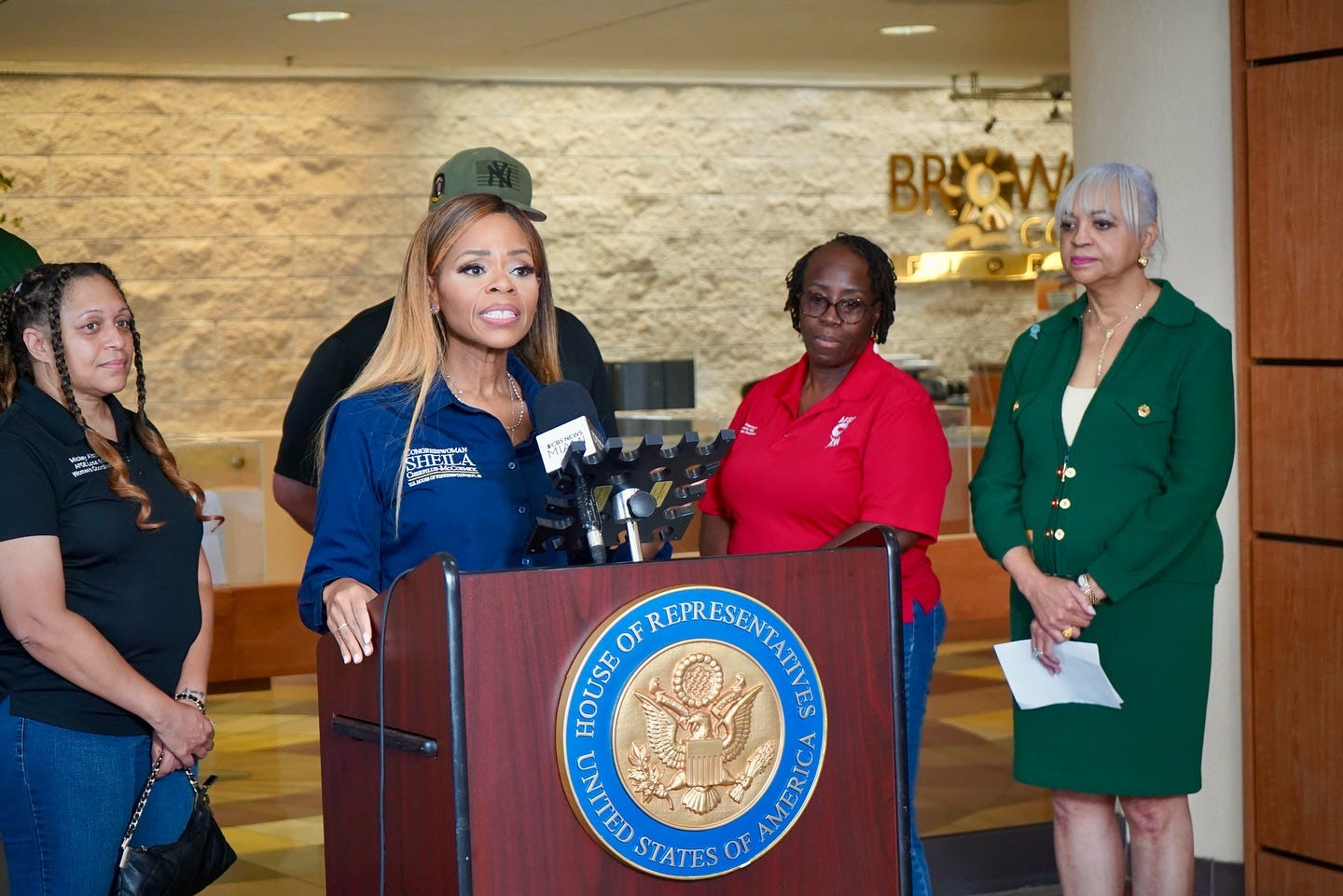
Federal prosecutors indicted Democratic Rep. Sheila Cherfilus-McCormick on Wednesday on charges that she stole $5 million in federal COVID funds and used the money to finance her successful bid for Congress in 2021.
In a brief statement, Cherfilus-McCormick said she was innocent and called the case “an unjust, baseless, sham indictment.” In addition to the congresswoman, her brother, chief of staff, and tax preparer were also indicted.
Late last year, a Florida government agency filed a lawsuit against a company run by Cherfilus-McCormick called Trinity Healthcare Service to recoup money it had mistakenly paid out.
According to the suit, the Division of Emergency Management had intended to pay Trinity $50,578.50 to assist with its COVID vaccination efforts but instead disbursed $5,057,850.00—100 times as much as it was supposed to.
Trinity nevertheless held on to the windfall, and according to the House Ethics Committee, Cherfilus-McCormick—who had unsuccessfully run for Congress in both 2018 and 2020—repurposed the funds and loaned her campaign $4.7 million.
She then won a five-vote upset over Broward County Commissioner Dale Holness in the Democratic primary for Florida’s safely blue 20th District, which had become vacant earlier that year with the death of longtime Rep. Alcee Hastings. The next year, she handily defeated Holness in a rematch.
According to the indictment, Cherfilus-McCormick also used some of the ill-gotten cash to orchestrate a straw donor scheme that netted her campaign at least $25,000. She was further charged with filing a false tax return.
In response to the news, House Minority Leader Hakeem Jeffries said Cherfilus-McCormick would be relieved of her role as chair of a Foreign Affairs subcommittee while the case is pending. Cherfilus-McCormick currently faces only minor opposition from a perennial candidate in next year’s primary, but Holness filed paperwork with the FEC this summer ahead of another potential bid.
The Downballot covers every important story about American elections below the presidency, regardless of whether the news is good or bad for a particular party. We’ve adhered to this philosophy since day one because you simply can’t understand elections unless you’re willing to confront the truth.
If you appreciate our commitment to candor, we hope you’ll consider supporting our work as a paid subscriber.

Redistricting Roundup
NJ Redistricting
Nick Scutari, the president of New Jersey’s Democratic-dominated state Senate, tells Politico that he does not think his state will pursue mid-decade redistricting.
“I don’t see that happening. Not in New Jersey. It requires a constitutional amendment, and we’re not in a position to do that,” he said this week.
Redistricting in the Garden State is handled by an evenly divided bipartisan commission enshrined in the constitution. Democrats, however, have three-fifths supermajorities in both chambers of the legislature, which would allow them to refer an amendment to voters with just a single vote. (With simple majorities, it would take two votes in successive legislative sessions.)
Were lawmakers to pass an amendment, voters would get to weigh in at the next general election, which in New Jersey will take place next November. It’s not clear whether the legislature could move that date up, but even if it cannot, an amendment could allow the state to pass a new congressional map before the 2028 elections.
Governors
CA-Gov
Democratic Rep. Eric Swalwell said Thursday evening that he was joining the packed race for governor of California, an announcement he made before a national audience on “Jimmy Kimmel Live!”
The congressman’s kickoff came one day after the entry of billionaire investor Tom Steyer, who, like Swalwell, unsuccessfully sought the Democratic presidential nomination in 2020.

Both men join several fellow Democrats who enjoy a head start of many months—and sometimes even years—over the newcomers in what will be an expensive top-two primary next June.
But while Steyer has the personal wealth to jump-start a campaign to lead America’s largest state, Swalwell, who is just one of California’s 52 U.S. House members, is hoping that the national profile he’s built up as a high-profile antagonist of Donald Trump will help him gain traction.
Swalwell first rose to prominence in 2012 when he scored an upset victory over veteran Democratic Rep. Pete Stark, an 81-year-old whose acerbic behavior on the campaign trail helped convince East Bay voters it was time for a change.
Swalwell, who quickly became secure in his new House seat, went on to use his position on the Intelligence and Judiciary Committees to establish himself as an outspoken Trump critic—as well as a familiar presence on social media and on late-night comedy shows.
In April of 2019, the congressman announced he would challenge Trump directly at the ballot box, but he struggled to gain traction in a field full of better-known hopefuls. Swalwell ended his campaign just three months later, but he had no trouble securing reelection after all the major candidates running to replace him in Congress dropped out.
Swalwell, who was a floor manager during Trump’s second impeachment in 2021, filed a still-pending civil suit against Trump and his allies that same year that accused them of “incitement to riot.” He’s continued to position himself as an outspoken MAGA foe following Trump’s return to the White House.
The congressman was in the news again last week when NBC reported that Bill Pulte, who leads the Federal Housing Finance Agency, told the Department of Justice that he may have committed mortgage fraud.
Swalwell responded by accusing Pulte, who had made similar allegations against other Trump antagonists like Sen. Adam Schiff, of trying to silence him. NBC went on to report Thursday that a federal grand jury was investigating how the DOJ handled the probe into Schiff, including Pulte’s role in it.
FL-Gov
An obscure nonprofit called Florida Fighters has booked $1.6 million in ads to promote Lt. Gov. Jay Collins ahead of his potential campaign for governor, Florida Politics reports. There is no word as to who is funding the group, which was officially formed last week in Delaware.
Collins, who has badly trailed Rep. Byron Donalds in every poll of the Aug. 18 Republican primary, has not yet committed to running, though that hasn’t stopped him from taking shots at the frontrunner. The lieutenant governor this week tweeted out an image that labeled himself “tough as nails” while casting Donalds as “soft as soy.”
Former state House Speaker Paul Renner is currently the only notable Republican trying to stop Donalds, though another hopeful is continuing to make noise about running. While businessman James Fishback did not announce a campaign on Monday despite previously pledging to, he said Thursday that he’d have something to say “next week that I can’t wait to share with you.”
IA-Gov
State Sen. Mike Bousselot said Thursday that he would seek reelection rather than run to succeed retiring Gov. Kim Reynolds, a fellow Republican. Bousselot, who served as chief of staff to then-Gov. Terry Branstad almost a decade ago, set up an exploratory committee in April, but he remained put even as other Iowa Republicans entered the race.
NM-Gov
Rio Rancho Mayor Gregg Hull said Tuesday that he would not seek reelection next year and would devote his energies solely to seeking the Republican nomination for governor of New Mexico. Last month, Hull expressed openness to running for both offices, a stance that political writer Joe Monahan believes left potential donors questioning his commitment to running statewide.
House
CA-11
San Francisco Supervisor Connie Chan announced Thursday that she would run to succeed retiring Rep. Nancy Pelosi in California’s safely blue 11th District. Chan, who was born in Hong Kong, would be the first Asian American to represent the city in the House.
Her entry comes after weeks of chatter that Pelosi was working to raise the supervisor’s profile, including by appearing with her at a “No Kings” rally in October. The speaker emerita, who announced her retirement earlier this month, has not publicly taken sides in the race to replace her, however.
Chan is the first major candidate to enter the race in the two weeks since Pelosi made her plans known. She joins activist Saikat Chakrabarti and state Sen. Scott Wiener, who both began running before Pelosi confirmed she would step down, in the June top-two primary.
Chakrabarti has not held office before, but Chan and Wiener hail from opposite sides of San Francisco’s long-running political divide. Chan affiliates with the city’s progressive faction, while Wiener is often identified as a moderate.
The battle lines between these opposing camps can be confounding to observers outside—and even inside—this heavily Democratic city, especially since most local elected officials would be considered ardent liberals almost anywhere else in America.
However, the San Francisco Chronicle sought to shed light on the divide in a 2018 article.
“Progressives push for more affordable housing, tighter restrictions on tech companies and higher taxes for corporations,” reporter Rachel Swan explained. “Moderates tend to be pro-development, pro-tech and pro-business.”
Some local observers, though, have argued that this rubric obscures more than it reveals, with Chronicle columnist Emily Hoeven calling the distinction “increasingly meaningless”—particularly on the issue of housing—in an essay last year.
CO-08
EMILYs List has endorsed state Rep. Shannon Bird, who is the only woman running a credible campaign to unseat Republican Rep. Gabe Evans in Colorado’s swingy 8th District, ahead of the June 30 Democratic primary.
EMILYs backed Bird after two other women, former Rep. Yadira Caraveo and former Colorado Education Association head Amie Baca-Oehlert, left the race. Three men are still waging serious efforts for the Democratic nod: Marine veteran Evan Munsing, state Rep. Manny Rutinel, and state Treasurer Dave Young next summer.
FL-07
The House Ethics Committee disclosed Wednesday evening that it was investigating Republican Rep. Cory Mills for a wide range of alleged wrongdoing, including claims that he “engaged in misconduct with respect to allegations of sexual misconduct and/or dating violence.”
The panel is also looking into allegations that Mills violated campaign finance laws and ethics rules, a probe that’s been underway for more than a year. The committee released a report in March saying Mills may have illegally entered into contracts with the federal government, receiving almost $1 million for providing weapons to prisons through a firm he owns.
Mills does not appear to have commented on the matter. Last month, a Florida judge awarded a restraining order against Mills to a former girlfriend he concluded was likely a “victim of dating violence.”
The announcement of the expansion of the Mills investigation came just hours before the House voted to refer a censure resolution sponsored by Republican Rep. Nancy Mace to the Ethics Committee rather than bring the measure to the floor as she wished.
In addition to highlighting the committee’s allegations, Mace’s resolution referenced a report from NOTUS earlier this year in which five soldiers who served with Mills in Iraq disputed that he’d saved the lives of two troops who’d come under fire—acts for which he was awarded a Bronze Star.
Mace, who is running for governor of South Carolina, joined seven other Republicans in voting “no,” while Democrats were about evenly divided. She responded to the vote by accusing the Ethics Committee of announcing its probe as part of a “naked attempt to kill my resolution.”
The day after the vote, Mills again made the news when journalist Roger Sollenberger and NOTUS’ Reese Gorman both reported that, en route to a highly publicized rescue mission to Afghanistan he undertook in 2021, he repeatedly engaged the services of sex workers.
At the time, Mills was a candidate for Congress, and he made great hay of the mission, which saw an American woman named Mariam and her three children return home amid the U.S. pullout from the country. Mills’ risky behavior, however, enraged other participants, according to Sollenberger, and jeopardized the evacuation.
He went on, though, to win election to the House that fall, securing an open seat in the Orlando area that Republicans in the state legislature had heavily gerrymandered.
Mills recently earned a primary challenge from businesswoman Sarah Ulrich, who called out the congressman’s “personal scandals” in her launch. Despite the 7th District’s red lean, two notable Democrats are also running, attorney Noah Widmann and former NASA official Bale Dalton.
NY-07
Democratic Rep. Nydia Velazquez announced Thursday that she would not seek an 18th term representing New York’s 7th District, a safely blue constituency based in northern Brooklyn and western Queens.
“I love this work and I love my district, but I believe now is the right moment to step aside and allow a new generation of leaders to step forward,” Velazquez, whose 1992 victory made her the first Puerto Rican woman to serve in Congress, told the New York Times.
The congresswoman, 72, added, “After devoting so much energy and so much time to help elect young leaders, I feel at ease.”
Velazquez, who had represented Puerto Rico’s government in the mainland U.S. as director of the Department of Puerto Rican Community Affairs, got the chance to run for the House in 1992 after the state’s new congressional map yielded a new, heavily Latino seat.
Her main opponent in the primary was Rep. Stephen Solarz, who was an influential figure in national Democratic politics as chair of the Foreign Relations Committee. But Solarz, as Steve Kornacki wrote in a detailed 2010 piece in Politico, had done little to maintain his ties to state legislators even as colleagues like Chuck Schumer had cultivated the connections necessary to ensure they wouldn’t be harmed by redistricting.
Solarz, after extensive deliberations, ended up campaigning for the revamped 12th District, which had little of his old turf but otherwise lacked an incumbent. Velazquez, however, defeated him 34-28 in a six-person race en route to an easy general election win. Rep. Jose Serrano explained her victory by saying, “While the other candidates may have guts and talent, she went about cementing relationships with everybody.”
Velazquez spent the ensuing decades establishing herself as a prominent voice in support of progressive candidates in caucuses. In April, she provided a high–profile early endorsement to Zohran Mamdani and two other candidates in the ranked-choice primary for mayor.
NY-13
Activist Darializa Avila Chevalier announced Thursday that she would challenge Rep. Adriano Espaillat in the June Democratic primary for New York’s 13th District, a safely blue seat based in northern Manhattan and the South Bronx.
Avila Chevalier, who at 31 is four decades younger than the 71-year-old incumbent, used her announcement video to argue that “overcoming the politics of the past takes action from all of us.”
She went on to take Espaillat to task for endorsing former Gov. Andrew Cuomo in this summer’s Democratic primary for mayor of New York City (he later backed Zohran Mamdani in the general election) and for taking contributions from the hawkish pro-Israel group AIPAC.
Avila Chevalier entered the race with the support of the Justice Democrats, a left-wing group that helped oust four House incumbents in primaries in 2018 and 2020. Two of the victorious candidates it supported, Alexandria Ocasio-Cortez and Jamaal Bowman, prevailed in constituencies that include part of the Bronx. (Bowman lost renomination last year to now-Rep. George Latimer.)
Espaillat narrowly won the Democratic primary for the 15th District in 2016 on his third attempt, a victory that set him up to become the first Dominican-American member of Congress. The congressman, who has not faced serious opposition in any subsequent campaigns, ended September with close to $1 million stockpiled to defend himself.
NY-21
Assemblymember Robert Smullen on Thursday became the first notable Republican to announce a campaign to replace Rep. Elise Stefanik, who is seeking the GOP nomination for governor of New York.
Smullen, who served in the Marines before winning a seat in the legislature in 2018, was one of several Republicans who were running in the special election that was supposed to take place before Donald Trump abandoned his plan to make Stefanik his ambassador to the United Nations. He’s likely to see some familiar faces in his new campaign for the conservative 21st District.
Wealthy sticker magnate Anthony Constantino, who also ran in that aborted contest, has an event scheduled for Monday that Politico anticipates will be his entry into the race. But Constantino, who is promising some “big surprises,” insists no one knows exactly what he’ll be announcing.
Meanwhile, former Newsmax host Joe Pinion, who was the GOP’s 2022 nominee against Democratic Sen. Chuck Schumer, tells Spectrum News he’s interested in running as well. Pinion, who also campaigned in the special election that never happened, would be the first Black Republican to represent New York in Congress.
Assemblymember Chris Tague, by contrast, appears to have another office in mind. Politico says he’s “expected” to run to replace state Sen. Peter Oberacker, a fellow Republican who is challenging Democratic Rep. Josh Riley in the 19th Congressional District.
TX-02
Fellow Republicans barred Rep. Dan Crenshaw from traveling overseas on official business for three months, Punchbowl News reported on Wednesday evening.
According to the publication, during a trip to Mexico in August, Crenshaw “toasted” what a source described as a “crude joke” made by a Mexican official that had made a woman present uncomfortable.
Rep. Rick Crawford, the Arkansas Republican who chairs the House Select Committee on Intelligence, reportedly responded to the “alcohol-related episode” by urging Speaker Mike Johnson to eject Crenshaw from his panel. Punchbowl says that, while Johnson refused to go that far, he agreed to end Crenshaw’s “cartel task force” and block him from using taxpayer funds to travel abroad for three months.
Crenshaw responded to the report by dismissing it as a “clickbait story,” saying that he was scheduled to travel in October before the government shutdown canceled his trip. Punchbowl, though, said that this trip would not have been a taxpayer-funded expedition.
Crenshaw faces state Rep. Steve Toth in the March Republican primary in Texas’ 2nd District, a conservative seat in the northern Houston area.
TX-19
Conservative activist Abraham Enriquez on Thursday joined the Republican primary for the open and dark red 19th District in West Texas.
Enriquez is the founder of Bienvenido, a right-wing national organization with the stated purpose of “uplifting Hispanic communities through classic American values.” Enriquez used his platform to become a prominent Latino surrogate for Donald Trump.
UT-01
Former state Sen. Derek Kitchen, who was the lead plaintiff in the successful lawsuit that overturned Utah’s same-sex marriage ban a decade ago, announced Thursday that he was entering the Democratic primary for the new and reliably blue 1st District.
Kitchen, who would be the state’s first LGBTQ member of Congress, used his kickoff to position himself as an ardent progressive.
“We have a real choice in this race,” he said. “We can send someone to Congress who plays it safe, or we can send someone who has spent his entire life fighting for justice, equality, and a better future for Utah families.”
Kitchen was last on the ballot in 2022 when he narrowly lost renomination to the state Senate following redistricting. Physician Jen Plumb, who had lost a close 2018 primary to Kitchen four years earlier, won this time after arguing he’d failed to achieve much for his constituents while saying she could work better with the legislature’s GOP supermajority.
Kitchen joins former Rep. Ben McAdams and state Sen. Kathleen Riebe in the June primary for Congress.

Ballot Measures
AR Ballot
A federal judge blocked several laws that make it harder for Arkansas citizens to qualify initiatives for the ballot in a ruling on Wednesday, handing a major win to pro-democracy organizers.
The rules in question, all authored by Republicans, imposed a wide variety of restrictions, including requirements that:
all signature collectors intend to permanently live in Arkansas—thereby excluding, for instance, college students;
ballot measure descriptions be written at an eighth-grade level, penalizing longer but simple words like “Constitution” and even “Arkansas”;
signature collectors warn voters that “petition fraud is a criminal offense” and inspect their IDs; and more.
These mandates, said the court, likely violate the First Amendment. However, it did not disturb one new hurdle that Republicans passed in 2023, which increased the number of counties in which signatures must be gathered from 15 to 50. That rule, though, is the subject of a separate challenge in state court.
The federal suit was brought by the League of Women Voters of Arkansas and a group called Save AR Democracy, which is seeking to place a measure on the ballot that would strengthen the initiative process and limit the ways in which politicians can interfere with initiatives.
MT Ballot
The Montana Supreme Court has rejected an attempt by Republican Attorney General Austin Knudsen to rewrite the description of a proposed constitutional amendment that would require judicial elections to remain nonpartisan, determining in a new opinion issued this week that his version was “misleading.”
In a separate ruling, the court said that a different ballot measure with similar aims did not pass legal muster because it violated a prohibition on amendments addressing multiple subjects. That proposal would have also mandated that judicial elections be nonpartisan, but it included a further requirement that any new courts established in the future have their members elected on a nonpartisan basis.
Montana Republicans have repeatedly sought to make judicial elections partisan in nature, believing that such a change would boost the chances of conservative candidates. While all of these efforts have run aground, activists have sought to forestall any such attempts in the future by enshrining nonpartisan judicial elections in the state constitution.
Plaintiffs argued that Knudsen’s rewrite of their summary of the first proposal, known as Constitutional Initiative 132, “obscures” the fact that Montana’s judicial elections are already nonpartisan. It also would have included a definition of the term “nonpartisan” that CI-132 supporters said “inaccurately implies all judicial candidates are partisans.”
The Supreme Court agreed on both counts, restoring CI-132’s original summary, which states simply that it “amends the Montana Constitution to require that judicial elections remain nonpartisan.”
NV-Gov: Memerson has Ford (D) and Lombardo (R)-inc. tied at 41-41. Trump at 39-54.
https://emersoncollegepolling.com/nevada-2026-poll/
So I've been looking at recent Republican gerrymanders of Virginia to see how well they would've held up in the Democratic wave this year. First is the notorious HoD gerrymander in the 2010s that gave Republicans 66 seats. That map would have significantly backfired, as it contains 65 Spanberger districts and only 35 Sears districts. Of those 65, two voted for Reid and four more voted for Miyares, so the map still has 59 Jones districts. I estimate Dems would've won 62 seats had that map been used this year, or just two fewer seats than we actually won. The swings from the 2010s to now are incredible - there are seats intended to elect Republicans that voted for Spanberger by 2-1 margins. Even the 27th in Chesterfield County, which Dems never actually won during the life of the map, voted 60-40 for Spanberger.
In addition, do you all remember the state Senate Republican gerrymander that they tried to ram through in 2013? I found a map of it on Virginia's redistricting website and drew it out in DRA. It's quite the gerrymander - that map went 25-15 for Spanberger, but only 22-18 Hashmi and 20-20 in the AG election. The map comprehensively cracked Roanoke, and attempted to do the same for Charlottesville although one of those districts just barely voted for Jones (and Harris). Three districts on that map that were intended to elect Republicans - the 7th, 12th, and 13th - voted for Harris and all three Dems this year. So the map wouldn't achieve its intended purpose of electing a 24R-16D state Senate, but it would limit Democratic gains in a way that the current map doesn't (Dems would've picked up 5 seats if the state Senate had been up for election this year).