



Leading Off
MT Supreme Court, MT Ballot
Conservatives in Montana are trying to increase their power on the state Supreme Court, which has long been dominated by a moderate majority, on the same day voters will decide on a constitutional amendment that would keep the state’s judicial elections nonpartisan.
This fall’s contest to replace two-term Justice Beth Baker, a swing vote on the seven-member court who has often sided with her more liberal colleagues, pits two judges from western Montana’s Flathead County against one another.
Conservatives are once again backing Dan Wilson, who received support from Republicans during his unsuccessful campaign for another Supreme Court seat two years ago. But while Wilson himself called for the body to remain an “independent and non-political decider” during that last race, which he lost 54-46, he’s struck more explicitly partisan notes this time.
Wilson has repeatedly touted himself as a “constitutional conservative” this year, including in a February speech before Montana Republicans. State GOP chair Art Wittich went further when introducing Wilson, saying, “The Republican Party has to do something and say something about the leftward tilt of our court.”
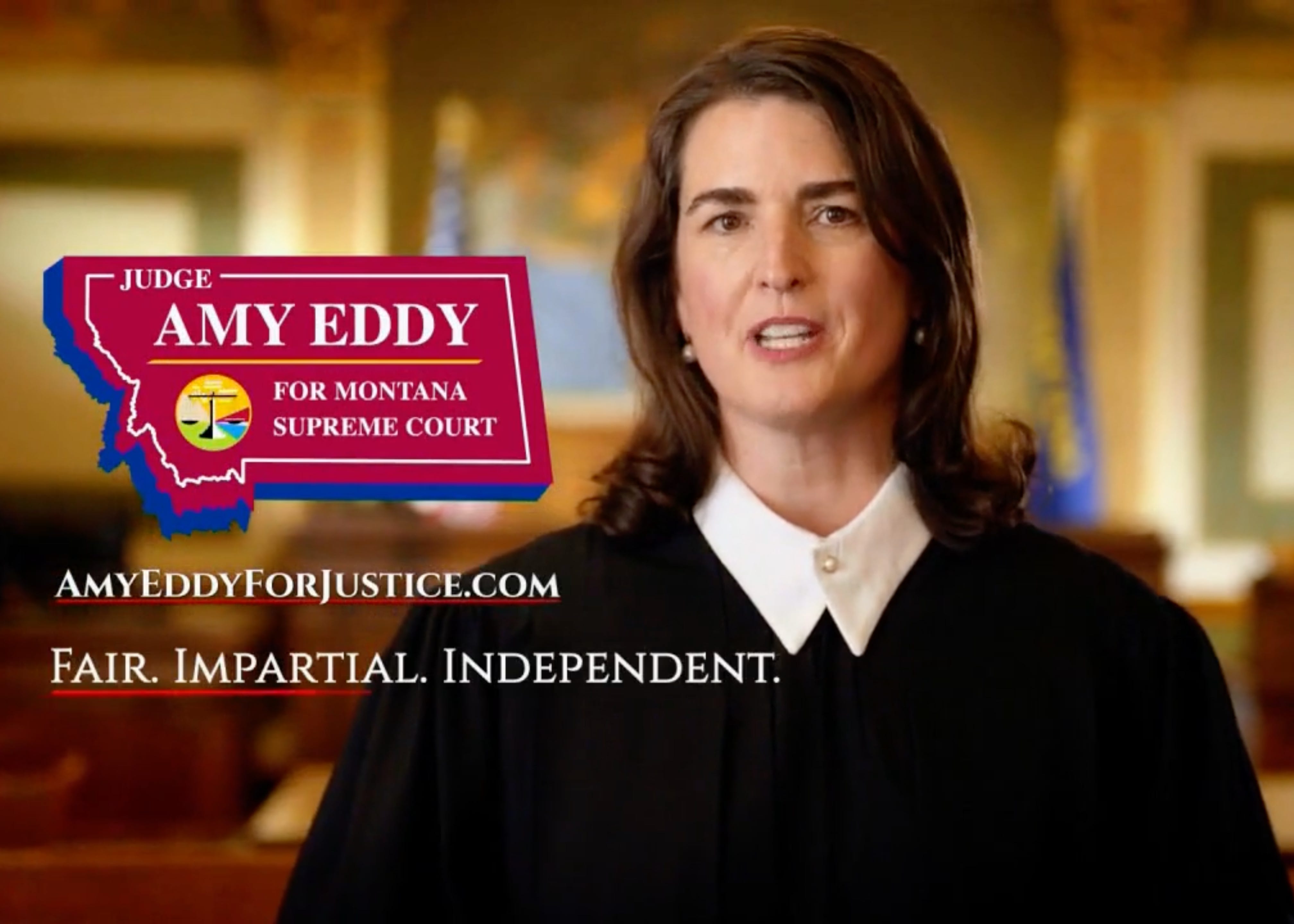
Wilson’s opponent is Amy Eddy, who was first appointed to the bench in 2015 by then-Gov. Steve Bullock, a Democrat. Eddy, though, has eschewed party or ideological labels. In an ad she began airing earlier this month, she told the audience, “On the Supreme Court you can count on me to be fair, impartial, and independent.”
But while Eddy did not mention her opponent in that spot, her allies aren’t holding back.
“Time and again, Wilson gave predators a second chance instead of protecting us,” declares the narrator in a spot for a group called Montanans for Freedom and Responsibility.
The Brennan Center for Justice reports that Eddy and her backers currently have the airwaves to themselves. As of Monday, the nonprofit has tracked about $1.8 million in spending for Eddy’s side, while it’s seen nothing yet from Wilson and his backers.
Conservative organizations, though, are unlikely to remain on the sidelines with so much at stake. While the court’s overall ideological leanings can be tough to pin down, a victory for Wilson would expand conservatives’ influence over a body that has acted as a regular check on Republican Gov. Greg Gianforte and his allies in the legislature.
Two of the court’s members, Chief Justice Cory Swanson and Justice James Rice, are conservative hardliners. A third justice, Laurie McKinnon, was first elected in 2012 with Republican support, and KTVQ wrote ahead of her successful 2020 reelection campaign that she “sometimes is seen as part of the court’s conservative wing.”
McKinnon, however, has not been a dependable right-wing vote. She wrote the majority opinion in a 2024 case striking down a law requiring parental consent for minors seeking abortions, and she again joined the majority the next year in invalidating more anti-abortion laws.
A victory for Wilson could make McKinnon the swing vote on a body where the other three seats are held by moderate-to-liberal members, but it’s possible she won’t be in office when her seat is up again in 2028.
State Sen. Barry Usher, the chair of the Senate Judiciary Committee, filed a trio of ethics complaints against McKinnon last summer with the Montana Judicial Standards Commission, which has the power to discipline or even remove judges.
While two of the complaints are identical to those the commission rejected in 2022—Steve Kennedy notes in Balls and Strikes that even a typo was duplicated—its membership is now very different thanks to a new law that gave Republicans more control over its composition.
However, the panel has not announced any action on this set of complaints from Usher, a Freedom Caucus member who lost his primary in June to a political newcomer.
Republicans have also mulled an even more dramatic change to the state’s court system. Last year, GOP leaders supported a bill to allow judicial candidates to run with party labels, with Gianforte calling Supreme Court races “nonpartisan in name only.”
But while lawmakers ultimately rejected the plan, supporters of the current system want to prevent them from trying again. Constitutional Initiative 132, which will appear on the fall ballot, would amend the state constitution to say, “Judicial elections shall remain nonpartisan.”
Eddy has expressed support for the status quo, saying at a recent forum, “For almost a century, it has been the policy of this state that judges be nonpartisan. We don’t want the judicial branch to be held captive by a political party or a political party platform.”
Wilson does not appear to have addressed the topic, but his allies are urging a “no” vote on the amendment. In April, the state GOP passed a resolution calling for voters to reject a plan it warned would “cement a progressive judiciary in the state by preventing judicial candidates from informing the public of their political affiliation.”
No matter what, though, the race between Eddy and Wilson will be an officially nonpartisan affair. The current system required the two judges to face off in a June primary even though, because they were the only candidates on the ballot, they were both guaranteed to advance to the fall. Eddy outpaced Wilson by a tight 51-49 spread ahead of their high-stakes rematch in November.

Governors
VT-Gov
Republican Gov. Phil Scott posts a 44-34 lead over Democrat Amanda Janoo in a new Braun Research poll of the race to lead Vermont, a contest that has attracted renewed attention in recent days.
This survey, conducted for Vermont Public Radio, was released less than a week after the University of New Hampshire unexpectedly showed Janoo with a 49-43 lead over Scott, who won reelection in a 73-22 landslide in 2024. No other pollsters have released numbers to assess whether Scott, who has spent a decade leading this heavily Democratic state, is finally falling to earth.
But while Braun and UNH diverge on who’s ahead, both pollsters agree Scott is in for his toughest contest since 2016, when he won his first term 53-44.
And it’s possible that this race, which features three minor candidates, won’t be resolved until the new year.
Vermont’s constitution has a unique provision requiring candidates for governor, lieutenant governor, or treasurer to receive a majority of the vote. If no one does, it would be up to the legislature to decide which of the top three vote-getters prevails. This rule came into play in the races for governor in 2002, 2010, and 2014, but lawmakers always picked the vote leader.
The same thing happened in the 2024 contest for lieutenant governor after Republican John Rodgers outpaced Democratic incumbent David Zuckerman 49-47. While Zuckerman suggested after his defeat that his fellow Democrats, who retained control of both chambers, could award him another two-year term, lawmakers overwhelmingly selected Rodgers two months later.
House
Independent Expenditures
The latest weekly installment of our House independent expenditure roundup shows the Congressional Leadership Fund maintaining a modest spending edge over the House Majority PAC, though the playing field tilts heavily toward Democrats.
Overall, the two influential super PACs have combined to spend $53 million across 26 Republican-held House districts, split almost perfectly in half. Meanwhile, the pair have spent $25.4 million to contest 11 Democratic seats, which is where CLF has racked up its advantage. The GOP group has spent almost $15.8 million on these races while its Democratic counterpart has spent just $9.7 million.
Some recent moves from both sides stand out. CLF has continued to invest in Michigan’s 8th District—pouring in another $400,000, for a total of $1.1 million so far—even though HMP began triaging the race last week, apparently feeling confident in Democratic Rep. Kristen McDonald Rivet’s chances against her no-name Republican challenger.
Meanwhile, for the first time, HMP has put resources toward Maine’s open 2nd District, a race that some observers thought might fall by the wayside after state Auditor Matt Dunlap defeated the DCCC’s preferred candidate in the Democratic primary. However, HMP just dropped more than $1 million on the contest, while CLF added another $700,000 and has spent almost $1.4 million to date to help elect former Gov. Paul LePage.
Ballot Measures
MT Ballot
In addition to the amendment on judicial elections detailed in our lead item, Montana voters will decide on two other high-profile ballot measures in November: a constitutional amendment to protect the power of initiative and referendum, and a statute aimed at preventing corporations and other entities from spending in elections.
Constitutional Initiative 133 would sharply restrict the legislature’s ability to interfere with citizen-backed ballot initiatives by amending the state’s Declaration of Rights to say that “[t]he people have a fundamental right to exercise their powers of initiative and referendum.”
The initiative also “guarantees impartial, predictable, transparent, and expeditious processes” for ballot measures. It further says the state government “may not deny or burden this right unless justified by a compelling government interest achieved by the least restrictive means.”
The plan, which is similar to a proposal on Missouri’s ballot, comes three years after Montana’s Republican-controlled legislature passed a bill making it harder to put initiatives before voters.
That legislation, among other things, allows the state attorney general to decide whether a proposal is constitutional before signature-gathering can even begin—a power that Republican Austin Knudsen has frequently used.
The state’s highest court, however, has repeatedly sided against Knudsen’s attempts to disqualify proposed ballot measures, including all three initiatives on this year’s ballot. CI-133’s proponents, though, argue that litigation-induced delays could prevent other efforts from getting off the ground.
“There’s been sort of this death by a thousand cuts strategy here in Montana and I think across the country,” a spokesperson for CI-133 told Bolts this month. “People are really frustrated with the government right now, and it is a really important time to protect the ways that voters can have a more direct say on the laws that impact their lives.”
Direct democracy advocates, including the state branch of Planned Parenthood, have also sought to attack the GOP’s bill making initiatives more difficult in court. The state Supreme Court heard oral arguments in April but has yet to issue a ruling.
A separate measure known as I-194, meanwhile, seeks to prohibit “artificial persons” from “contributing anything of value” to support or oppose candidates, political parties, or ballot measures.
The proposal, which is statutory in nature, includes “non-profits, trusts, partnerships, corporations, trade associations” and “unincorporated associations” in its definition of “artificial persons.” Entities that violate I-194 would lose their right to “do business” in the state and could only have it “restored upon disgorgement and certification of compliance with I-194.”
The initiative, known as “the Montana Plan,” would almost certainly be challenged in federal court should it pass. But its supporters, as the New York Times explained in a piece earlier this month, argue its focus on regulating corporations could see it pass muster with the conservative supermajority on the U.S. Supreme Court.
“I think it’s creative lawyering, and I don’t mean that in a negative way,” election expert Justin Levitt told the paper.
Poll Pile
All polls must comply with The Downballot’s requirements.
FL-Sen: Change Research for Freedom Project USA:
Ashley Moody (R-inc): 48, Angie Nixon (D): 47.
Early Sept.: 47-47 tie.
Freedom Project USA does not appear to have made an endorsement in any Florida contests, including the governor election polled below.
MI-Sen: GBAO for Senate Majority PAC:
Abdul El-Sayed (D): 48, Mike Rogers (R): 44.
Aug.: 50-44 El-Sayed.
MT-Sen: American Pulse Research & Polling for KULR-TV:
Kurt Alme (R): 45, Seth Bodnar (I): 26, Alani Bankhead (D): 19.
NC-Sen: Fabrizio Ward/Impact Research for the AARP:
Roy Cooper (D): 53, Michael Whatley (R): 42.
OH-Sen: Marist University:
Sherrod Brown (D): 51, Jon Husted (R-inc): 43.
TX-Sen: Status Intel for Texans United for a Conservative Majority:
James Talarico (D): 48, Ken Paxton (R): 48.
FL-Gov: Change:
David Jolly (D): 48, Byron Donalds (R): 46.
Early Sept.: 47-44 Jolly.
OH-Gov: Marist:
Amy Acton (D): 50, Vivek Ramaswamy (R): 44.
TX-Gov: Status:
Greg Abbott (R-inc): 50, Gina Hinojosa (D): 45.
MT-01: American Pulse:
Aaron Flint (R): 46, Sam Forstag (D): 45, Nick Sheedy (L): 5.
NY-23: Public Policy Polling for Aaron Gies:
Nick Langworthy (R-inc): 52, Gies (D): 35.
OH-09: DCCC Analytics:
Marcy Kaptur (D-inc): 48, Derek Merrin (R): 48.
OH-15: Hart Research Associates for House Majority PAC:
Don Leonard (D): 46, Mike Carey (R-inc): 45.
TX-AG: Status:
Mayes Middleton (R): 47, Nathan Johnson (D): 42.
TX Railroad Commissioner: Status:
Bo French (R): 46, Jon Rosenthal (D): 44.
TX-LG: Status:
Dan Patrick (R-inc): 49, Vikki Goodwin (D): 44.
TX Agriculture Commissioner: Status:
Nate Sheets (R): 47, Clayton Tucker (D): 41.
TX Comptroller: Status:
Don Huffines (R-inc): 49, Sarah Eckhardt (D): 43.
Ohio Marist poll:
Brown 51-43
Acton 50-44
https://maristpoll.marist.edu/polls/midterm-elections-in-ohio-september-2026/
NEWS FROM THE NORTH: Nanos Research, which does a four-week rolling poll of voting intentions, came out this morning with a stunning poll that has the Liberal Party on 49.9%, 22 points ahead of the Conservatives. https://nanos.co/carney-and-liberals-hit-new-long-term-high-liberals-at-50-percent-support-carney-at-62-on-preferred-pm-tracking-nanos/
Polling for the Alberta separation referendum shows an overwhelming majority want to remain, with one poll showing a 70-20 split (https://globalnews.ca/news/12072083/alberta-referendum-ipsos-september-2026/) and another showing a 72-23 split (https://www.planetjanet.ca/_files/ugd/586d9d_e50c5a6cc0f64152a81800f517d505ba.pdf, Janet Brown Research for CBC).