


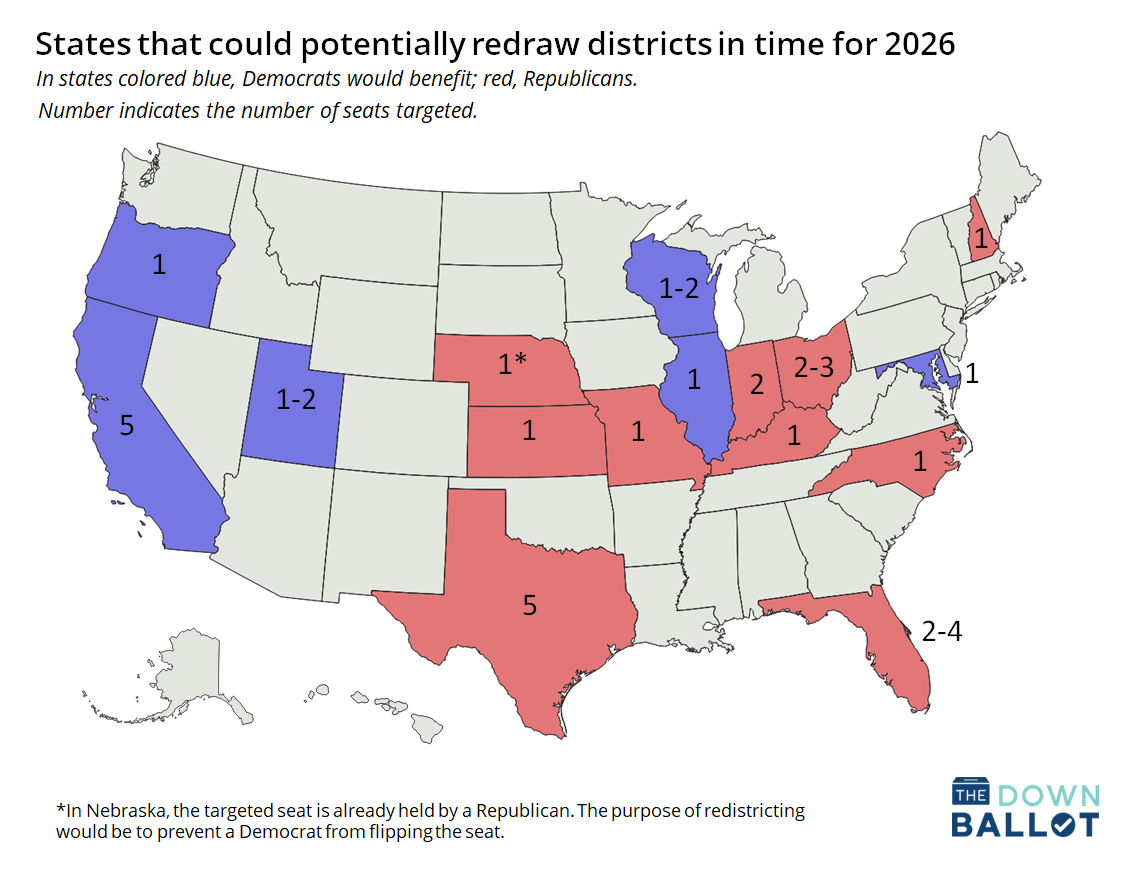
As Donald Trump continues to push Republicans to gerrymander their congressional maps—and Democrats strategize ways to respond—a great deal of confusion persists around exactly which states can draw new districts in time for the 2026 midterms.
In this special report, we lay out—in definitive fashion—all of the states that could actually put new maps into effect by next year, 16 in total.
There’s a wide range of reasons why the other 341 aren’t on the list, including:
Control of state government is divided between the parties.
One party has unified control of state government, but supermajorities are required to redistrict.
Redistricting is in the hands of a commission rather than lawmakers.
The state’s congressional delegation is already maxed out for one party.
Districts that might be targeted are protected by the Voting Rights Act.
The state has just a single congressional district.
One such example is New York, where Democrats would love to draw a counter-gerrymander to combat the extreme new maps Republicans in Texas and elsewhere are pursuing. But even though Democrats control state government, authority over redistricting belongs to a bipartisan commission enshrined in the state Constitution—and that document can’t be amended before 2026.
For every other state that doesn’t fall into one of these buckets, we assess the likelihood that it will pursue a redraw, or, if there’s already a new map, whether it will actually come into use; which districts might be targeted; and what obstacles, if any, stand in the way. And where appropriate, we address pending litigation that could result in new maps before the midterms.
Next to each state’s name, you’ll also find the breakdown of its current House delegation.
In a very unrealistic maximal scenario for Democrats, they could flip as many as 11 seats thanks to new maps, though six is a much more likely number, and even a gain of just one seat is possible. The potential upside for Republicans, by contrast, is much higher. The GOP could take around seven seats on the lower end and up to 18 seats on the high end, which is very plausible.
It also bears noting that not all gerrymandered districts are created equal. For instance, some of the revamped districts in Texas would be almost impossible for Democrats to hold; others are still winnable.
In the final analysis, though, Republicans are all but certain to come out ahead. The uncertainty is considerable, however, since so many variables are at play. Anything from a wash to a net advantage of around 16 seats for the GOP is possible.
One scenario this report does not address is the possibility that the Supreme Court might strike down the remaining pillar of the Voting Rights Act, which it could do in a case it’s hearing this fall.
Such a decision would represent a major reset of the redistricting landscape and could open the door to new Republican maps in several states not on this list, including Alabama, Georgia, Louisiana, Mississippi, South Carolina, and Tennessee. It could also turbocharge GOP gerrymandering elsewhere. However, we’ll wait to assess the potential fallout if and when that comes to pass.
In Democrats’ favor
California (43 D, 9 R)
Background: On Nov. 4, California will vote on a constitutional amendment called Proposition 50 that asks voters to temporarily replace the state’s current congressional districts—which were drawn by an independent redistricting commission—with a new map designed to favor Democrats.
Targets: Five Republican-held seats (CA-01, CA-03, CA-22, CA-41, and CA-48).
Obstacles: Republicans are waging an expensive campaign against the amendment, but Democrats have raised far more to promote its passage. The courts have already rejected several legal challenges, and none are likely to succeed.
Likelihood: Limited polling has indicated support for the amendment stands in the low 50s, though ballot measures can be difficult to poll. (A simple majority is needed for passage.)
Illinois (14 D, 3 R)
Background: Illinois is the only large state where Democrats face virtually no legal impediments to drawing a new map, but the party does not seem keen on redistricting again.
Targets: One Republican-held seat (IL-16).
Obstacles: Multiple Democratic leaders in Illinois have said they are not interested in pursuing a remap. A key problem is that Democrats already enacted an aggressive gerrymander in 2021 that leaves little room to go after the state’s three remaining Republican seats. In addition, petitioning is already underway for candidates seeking a spot on the March primary ballot.
Likelihood: Very low.
If you’d like to read the rest of this special report, we hope you’ll upgrade to a paid subscription today—it’s just $7 a month or $60 a year. Not only will you unlock subscriber-only content and features like this post, but you’ll also be helping to support independent journalism at a time when the First Amendment is under unprecedented attack.
