


Leading Off
AZ-01
The Democratic Congressional Campaign Committee just saw another of its preferred candidates lose a primary, marking the committee’s third unsuccessful intervention this cycle.
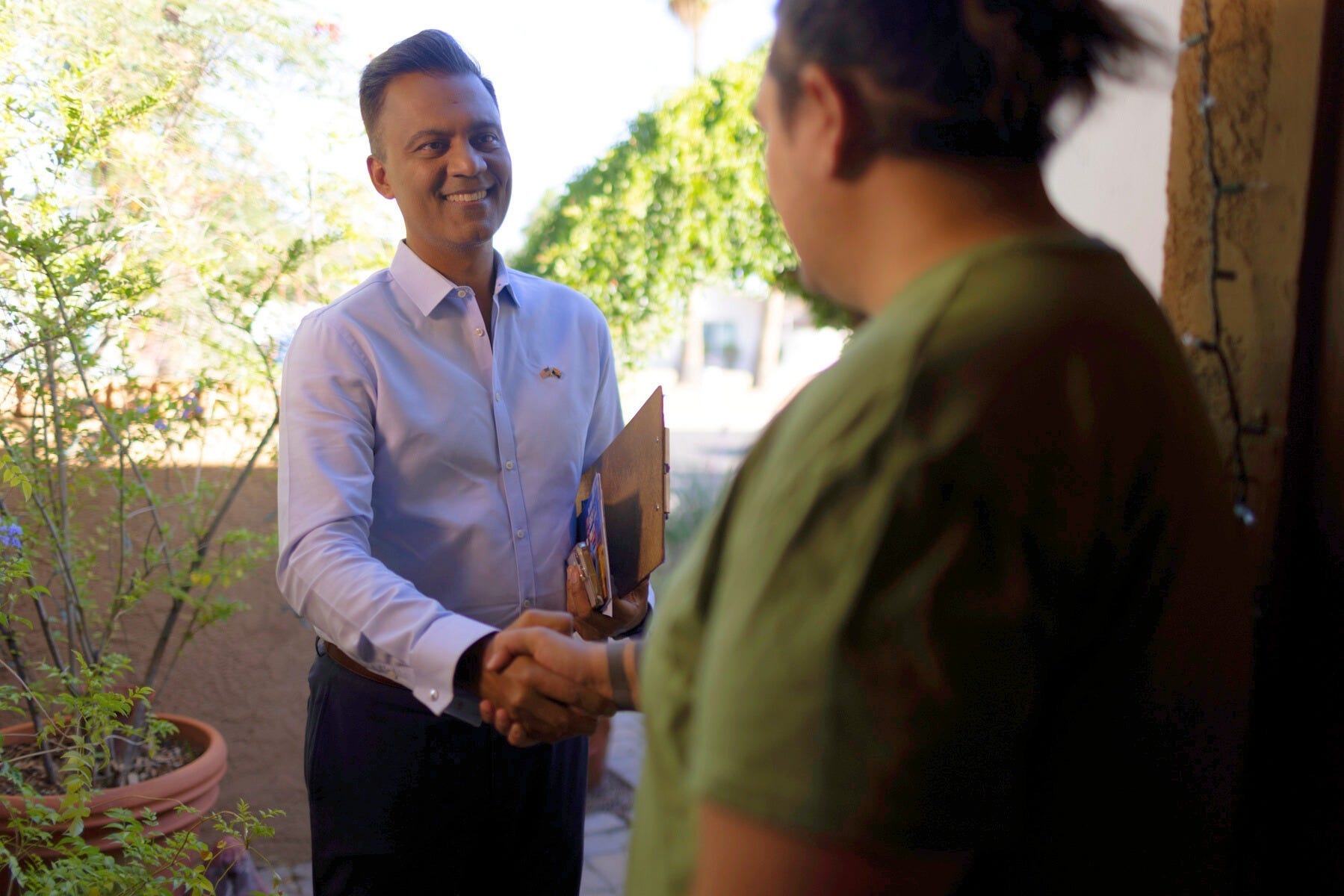
On Wednesday night, the Associated Press called the contest in Arizona’s 1st Congressional District for former state Rep. Amish Shah, who led former TV anchor Marlene Galan-Woods 40-34.
Shah, who is also an emergency room physician, ran for this same seat in 2024, narrowly winning the Democratic primary—in which Galan-Woods placed a close third—before losing to Republican Rep. Dave Schweikert by a tight 52-48 margin.
Following Shah’s near-miss, the DCCC’s decision to spend so heavily on Galan-Woods’ behalf perplexed and infuriated Democrats across the spectrum both before and after election night.
Telling Axios she was “frustrated” by the move earlier this month, progressive Arizona Rep. Adelita Grijalva said, “I get the argument that you want to back the person you think can beat the Republican, but unless the other candidate is a DINO, I think they need to stay out,” using a shorthand for “Democrat in name only.”
On Wednesday, Rep. Susie Lee, a moderate from neighboring Nevada, similarly questioned the wisdom of getting involved in primaries when Democrats are fighting to take back control of the House.
“I personally don’t think we should be investing against Democrats when we’ve got a big battleground,” she told Axios.
Unlike in some other contests where the DCCC has weighed in, though, there was little if any ideological gap between the two candidates. Rather, according to Axios, the committee found Shah “difficult to work with” during his last campaign, complaining that he preferred knocking doors to fundraising and did not want to air negative ads.
Shah, though, didn’t seem averse to raising money, as he brought in more than $6.3 million during the 2024 cycle, making him one of the strongest fundraisers among Democratic challengers.
He also ran almost neck-and-neck with the top of the ticket despite facing an incumbent: According to calculations by The Downballot, Donald Trump carried the 1st District 51-48, while Schweikert, who badly lost the GOP primary for governor on Tuesday, prevailed by just 4 points.
Thanks to a recent Supreme Court ruling, official party organizations like the DCCC can now freely coordinate spending with candidates, meaning they no longer need to file disclosures of independent expenditures. As a result, there are no readily traceable public records showing how much the committee spent to aid Galan-Woods, but data from AdImpact reported by Axios puts the figure at more than $500,000.
The Downballot is trying to hit 4,000 paid subscribers by the end of the year, which would put us on stable financial footing. If you’re able to consider upgrading your subscription, we’d be incredibly grateful.
That spending, though, only began at the start of July, barely three weeks ahead of Tuesday’s primary. Given Shah’s name recognition from his prior run, that left his detractors at the DCCC little time to put a dent in his standing.
Other efforts also unfolded late in the day. In California’s 22nd District, the committee waited until the week before the June 2 primary to try to boost moderate Assemblywoman Jasmeet Bains past her more progressive rival, school board trustee Randy Villegas, with a reported $135,000 ad buy. But it was Villegas who prevailed and will now take on Republican Rep. David Valadao in the fall.
The DCCC took a similar approach in Maine’s open 2nd District, where it unsuccessfully spent a reported $157,000 to help state Sen. Joe Baldacci defeat state Auditor Matt Dunlap just one week before they squared off on June 9. Dunlap will go up against former Gov. Paul LePage in November.
Both attempts rubbed many local Democrats the wrong way, with one county chair in California grousing to the Guardian, “These are some out of touch people … and they are reading things wrong.”
In all three cases, the DCCC didn’t act until the primary was close at hand, and in at least the first two races, it spent relatively little.
The committee does have two successes under its belt this cycle, but even one of these wins generated some hard feelings.
Not long before Pennsylvania’s primary in mid-May, the DCCC spent a reported $100,000 to help firefighter union chief Bob Brooks in the 7th District.
Earlier that month, though, after the DCCC added Brooks to its “Red to Blue” program for top candidates, some local Democrats complained about the move, including one county chair who told Lehigh Valley Public Media, “Let the people chose first in the primary, then the national party and the others can get behind the Democrat that’s been elected.”
The committee only entered the fray, though, after a Republican group began meddling on behalf of another Democrat. Brooks won the race easily, though, and will face off with freshman GOP Rep. Ryan McKenzie in the general election.
The DCCC’s one universally praised maneuver came in a runoff in Texas’ 35th District, where an antisemitic sex therapist named Maureen Galindo threatened to destroy whatever hopes Democrats might have of hanging onto this heavily gerrymandered open seat.
Republicans tried to help Galindo defeat Bexar County Sheriff’s deputy Johnny Garcia, but everyone from the Congressional Progressive Caucus to the centrist Blue Dog Coalition united to prevent that disaster. That included the DCCC, which spent a reported $35,000 to hammer Galindo, who lost the runoff in a 64-36 rout. Garcia will now do battle with Republican Carlos De La Cruz in November.
For all the sturm und drang, the DCCC has reconciled with at least one candidate it sought to thwart, placing Villegas on its Red to Blue list soon after he was declared the winner. It has yet to embrace Dunlap, but both sides have made positive comments about one another in recent weeks.
Shah, meanwhile, is certain to get lots of love from the committee, since the swingy 1st District is too tempting a target for the DCCC to possibly forgo. And even before the race was called, Punchbowl reported that “Democratic leadership is already coalescing” around the new nominee, who will face former NFL kicker Jay Feely for the right to succeed Schweikert.
The Downballot Podcast
Arizona primaries, Wisconsin drama, and Senate replacements
For the first time ever, we broadcast The Downballot’s weekly podcast as a video livestream this week and took questions from viewers!
Co-hosts David Nir and David Beard recapped Arizona’s primaries, including:
Rep. Dave Schweikert’s mysterious decision to get predictably crushed by fellow Rep. Andy Biggs in the GOP race for governor
Why the DCCC keeps losing when it intervenes in Democratic House primaries
How Democrats can flip two seats on the state’s powerful body that regulates utilities—and potentially take control in 2028
And several more contests. The Davids also explain the unfolding drama in Wisconsin’s Democratic primary for governor, where establishment forces are scrambling to halt the rise of a democratic socialist. Then they dive into the races to replace Senate nominees in Maine, where Democrats are in whatever the opposite of disarray is, and South Carolina, where Republicans are very much not deferring to Donald Trump’s pick to replace the late Lindsey Graham.
If you prefer to listen to the show as a traditional podcast, have no fear: We’ll continue to make it available on all apps, including Apple Podcasts and Spotify. And if you’d like to join us for future livestreams, the easiest way is to download the free Substack app.
Poll Pile
SC-Sen: Public Policy Polling for Annie Andrews:
Andrews (D): 41, Mark Lynch (R): 38
Andrews: 42, Russell Fry (R): 39
Andrews: 42, Ralph Norman (R): 43
Republican Sen. Darline Graham was not included.
NV-Gov: Public Policy Polling for the DGA:
Aaron Ford (D): 44, Joe Lombardo (R-inc): 44
RI-Gov (D): Tavern Research for Working Rhode Island Forward:
Helena Foulkes: 41, Dan McKee (inc): 36
The poll’s sponsor is supporting McKee.
WI-Gov: Marquette Law School:
Mandela Barnes (D): 47, Tom Tiffany (R): 42
Francesca Hong (D): 44, Tiffany: 44
Tiffany: 44, Joel Brennan (D): 43
Tiffany: 44, Kelda Roys (D): 42
The poll did not test Democrat David Crowley, who re-entered the race after it was fielded.
WI-Gov (D): Impact Research for Barnes:
Hong: 39, Barnes: 26, Crowley: 11, Roys: 7, Brennan: 6
WI-Gov (D): Public Policy Polling for Crowley:
Hong: 35, Barnes: 15, Crowley: 14, Roys: 5, Brennan: 3
WY-Gov (R): Pulse Decision Science for Eric Barlow:
Barlow: 42, Megan Degenfelder: 19, Brent Bien: 14
OH-10: FM3 for House Majority PAC:
Mike Turner (R-inc): 48, Kristina Knickerbocker (D): 41
MI-Sen: Outgoing Sen. Tina Smith (D-MN) endorses Abdul El-Sayed
GA:
Ossoff 52 Collins 43
Lance-Bottoms 48 Jackson 46
https://www.aarp.org/pri/topics/voter-research/politics/2026-midterm-election-poll-georgia/