



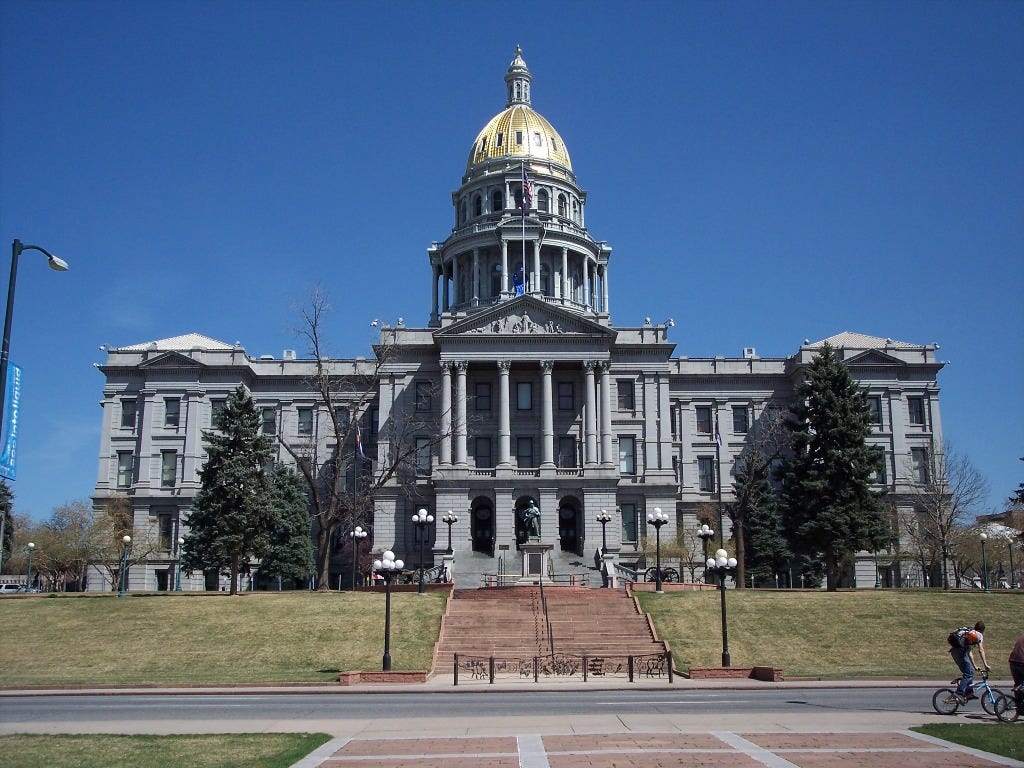
Leading Off
CO Ballot
Two initiatives targeting transgender people in Colorado will be on the November ballot, state election authorities announced this week.
One of these proposals would ban “surgery for minors for the purpose of altering the minor’s biological sex characteristics.” This measure, known as Ballot Initiative 110, would also ban the use of state and federal funding for such procedures.
Ballot Initiative 109, meanwhile, targets transgender student athletes at both the K-12 and college levels. The proposal would bar students from participating on a sports team designated for the gender they were not assigned at birth. The state’s commissioner of education would be directed to “take appropriate remedial action” against schools that do not follow these rules.
Both initiatives were spearheaded by Protect Kids Colorado, an outfit whose leadership includes former state Sen. Kevin Lundberg. Lundberg wrote earlier this year that his organization was spearheading a “significant fight to stop the transgender plague in Colorado.”
Lundberg and his allies are also behind a third measure, Initiative 108, which would increase penalties for people convicted of trafficking children. Election officials said earlier this month that this plan had also qualified for the ballot after organizers submitted the requisite 124,238 signatures, a number that represents 5% of the votes cast in the most recent election for secretary of state.
While Initiative 108 doesn’t include anti-trans policies, the Colorado Times Recorder’s Jamie O’Rourke has explained how the backers of all three measures have conflated them to advance their cause.
One megachurch pastor, Jim Burgen, urged his parishioners to sign petitions for all three initiatives last year in the same sermon in which he claimed without evidence that “your children are being made to sit through gender pronoun awareness puppet shows on the first day of kindergarten.” Burgen went on to declare that “the largest, fastest growing industry in the world is the sexual exploitation and sale of children.”
Supporters of LGBTQ rights are fighting all three proposals, warning that Initiative 108 is anything but benign. Families Not Politics, which was formed to combat the trio, has blasted the trafficking measure as “a Trojan horse using the language of child protection to advance a broader political agenda rather than reflect the best practices for supporting survivors.”
Because the initiatives are statutory in nature, they only need to win a simple majority of the vote to go into effect. (Colorado requires a 55% supermajority for any amendments that would add language to the state constitution.)
Pro-LGBTQ groups, though, are determined to keep these proposals from securing majority support in what’s become a reliably Democratic state.
Rocky Mountain Equality urged a “no” vote on Initiative 109 earlier this month, saying that prohibiting “transgender youth of any age from playing sports alongside their classmates … tells trans kids they don’t belong at an age when all kids need to feel included and supported.”
It likewise decried Initiative 110, the proposed ban on gender-affirming care for minors.
“In the coming months, we are going to hear intentional lies from anti-trans extremists about this ballot measure,” Rocky Mountain Equality said in a statement this week. “They aren’t being honest about their agenda to erode privacy and access to credible medical care they don’t agree with. Their next targets are care for trans adults and abortion services if we let them get away with this.”
Our lead item is a dismaying story for anyone concerned about the most vulnerable among us, but that’s precisely why we’re compelled to shine a spotlight on it.
At The Downballot, we’ve never shied away from writing about hard topics. It’s our mission to inform our readers about elections at every level of the ballot, whether the news is good or bad—especially when a race isn’t getting the attention it deserves.
If you appreciate our commitment to lifting up stories like these, then we hope you’ll consider becoming a paid subscriber to support our efforts.

Senate
NE-Sen
A Nebraska trial court judge dismissed Democrat Cindy Burbank’s lawsuit asking that she be reinstated to the ballot on Thursday, though her attorneys immediately filed an appeal with the state Supreme Court.
On Tuesday, Republican Secretary of State Bob Evnen removed Burbank’s name from the May 12 primary ballot. In a letter explaining his decision, he wrote that Burbank was not a “good faith candidate” because “she has no intention to serve” in office, contrary to an oath all Nebraska candidates must sign.
Burbank has rejected that characterization. She has been open about her intention to support independent Dan Osborn in the general election, but in a legal filing, she said she “would, indeed, serve if elected.”
Retired Lancaster County District Court Judge John Colborn did not accept Burbank’s arguments. In a terse two-page order, though, he offered little in the way of explanation before concluding that she had “not met her burden of proof.”
OK-Sen
Rep. Kevin Hern just earned the endorsement of Senate Majority Leader John Thune and the NRSC as he seeks to lock up the GOP nomination for Markwayne Mullin’s Senate seat long before the June 16 primary.
Last week, Donald Trump, the Club for Growth, and Oklahoma’s other senator, James Lankford, all got behind Hern, who faces no serious opposition for his party’s nod.
House
CO-05
Army veteran Matt Cavanaugh said Wednesday that he’d failed to collect the requisite 1,500 signatures he needed to appear on the June 30 Democratic primary ballot for Colorado’s 5th Congressional District, spelling the end of his campaign.
Cavanaugh, who initially announced that he would challenge Republican Rep. Jeff Crank as an independent, later said in January that he would instead seek the Democratic nod.
By that point, though, Jessica Killin, a fellow Army veteran and one-time chief of staff to former second gentleman Doug Emhoff, had already raised well over $1 million for her campaign to flip this constituency in the Colorado Springs area and had emerged as the undisputed frontrunner in the primary.
Cavanaugh involuntarily exited the race on the same day as Colorado’s candidate filing deadline, though Killin had already learned that she’d secured a place on the ballot. Under state law, candidates must either turn in the requisite number of signatures or take at least 30% of the vote at their party’s convention, known locally as an assembly. Killin successfully pursued both routes.
Election officials said last Wednesday that she’d submitted 1,500 valid signatures. A few days later, she outpaced Joe Reagan, who is also an Army veteran, 40-34 at the El Paso County assembly. The balance went to two little-known contenders who failed to advance. Cavanaugh put all his efforts into petitioning because party rules forbade him from participating in the assembly since he only became a Democrat a few months ago.
Now, though, Killin and Reagan are the only candidates who will appear on the June primary ballot. While Reagan only narrowly lost the 2024 primary, he’s brought in relatively little money for his second effort and has struggled to secure major support.
The 5th District has always elected a Republican since it came into existence after the 1970 census, but Democrats have reason to hope for a breakthrough this cycle.
While Donald Trump convincingly carried the 5th by a 53-44 margin in 2024, that represented a slight drop from his 2020 showing—even as the nation as a whole was moving to the right. Crank also scored a 55-41 win over River Gassen, the Democrat who had defeated Reagan in the primary, but his showing was the weakest by a Republican since the district was first created.
Wednesday was also a notable day in the 2026 election for another reason. Now that qualifying has ended in Colorado, the deadline to run as a Democrat or Republican has passed in 26 of the 50 states. The House candidate lineup has already largely taken shape, though, as those 26 states are home to 260 of the nation’s 435 congressional districts.
NY-17
Tech company CEO Peter Chatzky, one of half a dozen notable Democrats vying to take on Republican Rep. Mike Lawler, just earned a profile in the New York Times, but not the sort that any candidate wants.
Reporter Nicholas Fandos spotlights Chatzky’s “yearslong penchant for bawdy musings on Facebook,” which he sums up:
In posts over the past decade, Mr. Chatzky, 65, speculated about how much he would have to pay Melania Trump, the first lady, to have sex with him. He joked about hosting a sex party for swingers and sleeping with a hypothetical intern. And he boasted — evidently facetiously — about people paying to watch him masturbate.
Chatzky’s campaign, says Fandos, “declined to comment on the posts,” though his campaign manager said, “Peter is focused on defeating Mike Lawler in November so that we can abolish ICE and make life more affordable.”
Chatzky entered the race for New York’s swingy 17th District in the lower Hudson Valley last June, but he made his biggest splash at the very end of the year, when he plowed $5 million of his own money into his campaign. His top rivals include Rockland County Legislator Beth Davidson and former National Security Council official Cait Conley.
PA-03
Physician Dave Oxman, who had raised relatively little for his bid for Pennsylvania’s open 3rd District, dropped out of the race this week and instead endorsed another doctor in the Democratic primary, Ala Stanford. (Stanford is a pediatric surgeon while Oxman is an intensive care doctor.)
Stanford still faces several opponents, though she also has the support of retiring Rep. Dwight Evans, who has represented this deep blue district in Philadelphia since 2016.
Ballot Measures
OR Ballot
The Republican-backed campaign to partially repeal Oregon’s transportation funding package filed a lawsuit in federal court on Tuesday, asking that the referendum be held in November rather than May, as proponents had originally sought.
The new suit came the week after a state judge upheld the Democratic-led legislature’s decision to have the vote coincide with the state’s May primaries instead of the fall general election. Referendum supporters are once again arguing that Democrats acted too close to the March 12 deadline to place a statement about referendums on the pamphlet that goes out to voters.
Poll Pile
CA-01 (top-two primary): David Binder Research for Mike McGuire:
Mike McGuire (D): 33, James Gallagher (R): 30, Audrey Denney (D): 18, other candidates 4% or less.
NY-17 (D): Impact Research for Beth Davidson:
Beth Davidson: 23, Cait Conley: 17, Peter Chatzky: 8, Effie Phillips-Staley: 5, other candidates 1% each, undecided: 45.
About those anti-trans ballot measures: I think many people who are not anti-trans support a ban on elective gender reassignment surgery for minors, even if they don't support a ban on trans athletes competing with others of the gender they consider themselves to be. I would seriously consider supporting such a measure, and I genuinely have trans friends and vehemently oppose discrimination against them. As for increasing the penalties for child trafficking, whether it's presented as part of an anti-trans package or not, is there anything wrong with the measure itself that warrants opposition to what sounds like a very popular idea, purely based on who's advancing the measure and in what context? I'd like to know, because Democrats do themselves political harm by opposing common sense-sounding measures if there's no really good reason to do so.
I was going to wait until the weekly thread to say this, but I’m taking a break from posting for a bit. Don’t know how long. There is simply far too much drama and assorted shit happening in my personal life and I cannot comment calmly or rationally, as you can probably see from my posts today. I’ll be back when I am under better control of my emotions.