



Leading Off
CA Ballot
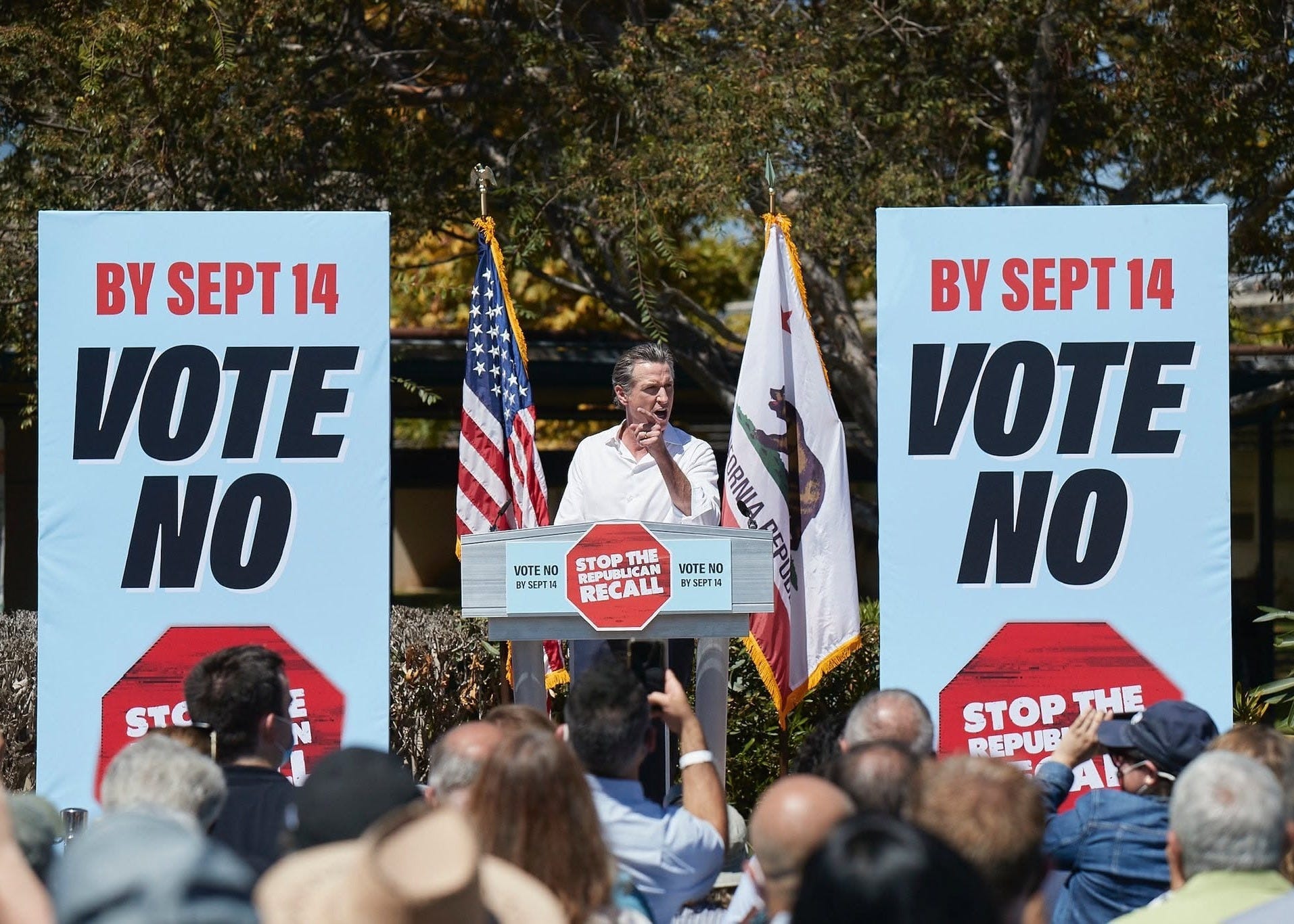
California voters will decide this fall whether to overhaul the state’s rules for recall elections—rules that helped end one governor’s career while potentially saving another’s.
In any recall election against state-level officials, including the governor and members of the legislature, ballots currently consist of two separate questions.
Voters are first asked a “yes” or “no” question about whether they want to remove the incumbent. They’re then asked to pick among the candidates vying to replace them—a contest that the incumbent cannot run in. These results, though, only matter if a majority votes “yes” on the first question.
If “yes” prevails, however, the successor could get elected with much less than a majority of the vote. That’s because all the candidates from all parties run on a single ballot without any primary or runoff to winnow the field.
But Proposition 5, which the state’s Democratic-led legislature voted to place on this year’s ballot back in 2024, would amend the state constitution to change this process.
Under the proposed amendment, voters would simply be asked whether or not they want to recall the incumbent. If the governor is ousted, the lieutenant governor would automatically take over. Other offices, according to the proposed amendment, would be “filled in accordance with this Constitution and statute.”
If the governor is removed, what happens next would depend on the political calendar.
If the removal were to happen during the first two years of a governor’s term and ahead of the filing deadline for the next statewide primary, an election for their permanent replacement would take place alongside that primary.
All candidates would compete on a single ballot as they do now, but under the new rules, a majority would be necessary to win outright. If no one were to clear that threshold, the top-two vote-getters, regardless of party, would advance to a runoff coinciding with the November general election. In addition, the ousted governor would be eligible to compete in this contest.
If a recall were to take place outside this period, though, the lieutenant governor would serve as governor for the remainder of the term.
Two governors, both Democrats, have faced recall elections during the 21st century, but their fates diverged.
In 2003, Republicans targeted Gov. Gray Davis, who had won a second term the previous year, as the state’s ongoing energy crisis left him unpopular. GOP Rep. Darrell Issa, one of the wealthiest members of Congress, bankrolled the recall campaign with the intention of running to replace the incumbent.
A far-better known Republican, though, took advantage of Issa’s efforts. Arnold Schwarzenegger, the “Terminator” star who had spent decades at the top of Hollywood’s A-list, announced his campaign on “The Tonight Show” and instantly gobbled up all the attention. Issa, who no longer saw a path to victory, tearfully announced he would stay out of the race.
The GOP, though, wasn’t Davis’ only problem. Lt. Gov. Cruz Bustamante, a fellow Democrat, initially said he would “absolutely, 100%” not run as a replacement candidate, but he soon went back on that pledge and became one of the 135 people who placed their name on the ballot.
The lieutenant governor and his allies tried to thread the needle by pushing the slogan “No on recall, Yes on Bustamante.” However, they struggled to sell that awkward pitch even before Bustamante started criticizing the incumbent in the evident hope that the recall would succeed and Bustamante would become his successor.
A 55-45 majority voted to remove Davis from office, but Californians didn’t want Bustamante as their new governor. Schwarzenegger instead prevailed over the massive field with 49% of the vote as Bustamante finished a distant second with 31%.
Gov. Gavin Newsom and his allies were determined to avoid a repeat of that debacle 18 years later when Republicans, who used the governor’s attendance at a high-end party during the COVID pandemic as a pretext, placed a recall on the 2021 ballot.
Newsom’s side successfully discouraged prominent Democrats from running as backup candidates and framed the race as a choice between the governor and far-right extremists.
Newsom’s argument became even easier when conservative radio host Larry Elder blew past more mainstream Republicans like former San Diego Mayor Kevin Faulconer when pollsters asked voters whom they favored on the second question.
Elder ultimately scored 48% of the vote, while a little-known Democrat took a distant second with just 10%. But unlike in Schwarzenegger’s contest, the question proved to be meaningless. Voters rejected the recall 62-38, and Newsom went on to handily secure a second term the following year.


Senate
AK-Sen
Both parties appear to be maneuvering to ensure that their preferred minor candidates make it to the November general election in Alaska’s Senate race alongside the two frontrunners, Republican Sen. Dan Sullivan and former Democratic Rep. Mary Peltola, according to FEC filings first flagged by CNN’s Patrick Svitek.
A super PAC formed just days ago called Fair Deal Alaska has already reported spending almost $420,000 on mailers, ads, and phone calls, a small portion of which is devoted to attacking Peltola. But the lion’s share is intended to boost two perennial candidates: Democrat Carol Hafner and Green Party member Richard Grayson.
Meanwhile, a different super PAC, Right for Alaska, has spent $515,000 on ads in the same contest. One half of that expenditure is getting used to go after Sullivan while the other is aimed at elevating Republican Jerry Heikes, another serial candidate, and Skip Southworth, a member of the Alaskan Party. That party is a successor to the far-right Alaska Independence Party, which dissolved last year but was reconstituted under a new name earlier this year.
The reason for these dueling efforts is Alaska’s unique primary that’s coming up on Aug. 18. All 16 candidates from all parties will run together on a single ballot, with the top four vote-getters advancing to the general election.
That fall contest will be decided by ranked-choice voting, so Republicans would almost certainly prefer that the third and fourth options lean to the left in the hopes that some voters will cast ballots for them while failing to rank Peltola. Democrats, meanwhile, would want the exact opposite.
Governors
KS-Gov
The Democratic primary in the race to succeed term-limited Kansas Gov. Laura Kelly has grown negative ahead of Tuesday’s election as the leading contenders clash over data centers and a stadium deal for the NFL’s Kansas City Chiefs.
Kelly’s preferred successor, state Sen. Ethan Corson, has dominated the field financially, according to new fundraising reports, but has faced sharp attacks from a fellow state senator, Cindy Holscher.
Both Corson and Holscher voted for a bill last year that gave hefty tax breaks to data center developers, but in June, Holscher reversed course and called for a moratorium on building new data centers in the state. Neither Corson nor the third candidate in the race, Overland Park Mayor Curt Skoog, has joined her, though at least three Republican contenders have.
A pro-Corson group, though, has been airing digital ads designed to make Holscher look like an advocate of data centers. In one spot, a narrator criticizes her by saying Holscher “says she doesn’t support data centers, but she actually voted to bring them to Kansas.” Veteran journalist Melinda Henneberger called the attacks “completely misleading” at Kansas City Stack.
Data centers have emerged as a major fault line in a number of Democratic primaries, as many insurgent candidates have risen in the polls by harnessing widespread anger over their proliferation. But another public subsidy for private business has also been a major topic in Kansas.
Last year, the Chiefs announced they would leave their longtime home in Missouri for a new site in Kansas after Kelly signed legislation that would commit $1.8 billion in taxpayer money to help build a new stadium—the largest such deal in American history, and one that’s been heavily criticized across the political spectrum.
Two years ago, Holscher and Corson both backed a bill to offer hefty incentives to the Chiefs, but this spring, Holscher voted against a separate bill creating a sports authority to oversee the building and management of the new stadium, while Corson supported it.
Polling has been extremely scarce, though the news site Capitol Bee commissioned a survey from Change Research in mid-June that found Holscher leading Corson 37-10, with Skoog at 7.
Meanwhile, half a dozen Republicans are competing for their party’s nod. State Senate President Ty Masterson is the only one with Donald Trump’s endorsement, but there have been zero public surveys of the GOP primary to indicate whether Trump’s blessing has made him the frontrunner.
KY-Gov
Republican Secretary of State Michael Adams announced Saturday that he would not run next year for Kentucky’s open governorship. Adams said he would instead back Rep. James Comer should he run to succeed Democratic incumbent Andy Beshear, who cannot seek a third term.
Comer, who is on a glide path this November in his campaign for a sixth term in Congress, responded to Adams’ decision by reiterating he would make up his mind “very soon” after this fall’s elections.
Mayors & County Leaders
Chicago, IL Mayor
Illinois Secretary of State Alexi Giannoulias on Sunday launched his long-awaited campaign to challenge Chicago Mayor Brandon Johnson, a fellow Democrat, in February’s officially nonpartisan contest.
Giannoulias was serving as state treasurer in 2010 when he narrowly lost a bid for Senate to Republican Rep. Mark Kirk, but he eventually recovered from that high-profile defeat. He was elected secretary of state in 2022 and has almost $22 million stockpiled ahead of an uncompetitive reelection contest this fall.
Giannoulias joins several other candidates in what will be a packed race for mayor. Johnson still has not announced whether he will seek a second term, but his allies have begun collecting signatures to place him on the ballot.
Poll Pile
MI-Sen (D): Mitchell Research & Communications:
Abdul El-Sayed: 52, Haley Stevens: 38.
MI-Sen (D): Zenith Research for Fighting For Michigan (pro-El-Sayed):
El-Sayed: 53, Stevens: 34.
MI-Sen: Mitchell:
El-Sayed (D): 45, Mike Rogers (R): 45. (June: 47-42 El-Sayed)
Rogers (R): 46, Stevens (D): 43. (June: 45-41 Rogers)
MI-Sen: EPIC-MRA for MIRS:
Rogers (R): 46, El-Sayed (D): 43,
Stevens (D): 44, Rogers (R): 42.
SC-Sen (R): co/efficient:
Darline Graham (inc): 30, Russell Fry: 16, Ralph Norman: 15, Mark Sanford: 9, Mark Lynch: 6, all others 3% or less.
Fry: 40, Graham (inc): 31.
Fry: 36, Norman: 28.
Graham (inc): 40, Norman: 35.
The pollster says this survey was “[n]ot sponsored by any candidate or candidate’s committee.”
SC-Sen: Public Policy Polling for Annie Andrews:
Andrews (D): 41, Lynch (R): 38.
Andrews (D): 42, Fry (R): 39.
Andrews (D): 41, Sanford (R): 40.
Norman (R): 43, Andrews (D): 42.
The release did not include numbers testing Andrews against appointed Sen. Darline Graham, who had not announced her campaign when the poll was conducted.
MI-Gov (R): Mitchell:
John James: 50, Perry Johnson: 22.
MI-Gov: Mitchell:
Jocelyn Benson (D): 46, James (R): 44. (June: 51-40 Benson.)
Benson (D): 48, Johnson (R): 43. (June: 50-42 Benson.)
MI-Gov: EPIC-MRA:
Benson (D): 47, James (R): 38.
Benson (D): 48, Johnson (R): 36.
SC-Gov: PPP for Andrews:
Alan Wilson (R): 45, Jermaine Johnson (D): 37.
TN-Gov (R): Fabrizio, Lee & Associates for Marsha Blackburn:
Blackburn: 42, John Rose: 25, Monty Fritts: 22.
June: Blackburn: 51, Rose: 20, Fritts: 12.
CA-11: Lake Research Partners for Connie Chan:
Scott Wiener (D): 45, Chan (D): 40.
FL-02 (R): Guidant Polling and Strategy for Austin Rogers:
Rogers: 21, Keith Gross: 17, Evan Power: 9, Jim Norton: 8, Luke Murphy: 5, all others 2% or less.
Unreleased March poll: Gross: 16, Norton: 9, Power: 4, Rogers: 3.
FL-25 (D): Beacon Insights:
Jared Moskowitz (inc): 56, Oliver Larkin: 20.
June: 51-19 Moskowitz.
SC-01: GQR for House Majority PAC:
Jenny Costa Honeycutt (R): 43, Nancy Lacore (D): 41, Bill Reeside (L): 5, Margo Ellis (Alliance Party): 2.
Honeycutt (R): 50, Lacore (D): 48.
St. Petersburg, FL Mayor (nonpartisan primary): St. Pete Polls for Florida Politics:
Charlie Crist: 34, Ken Welch (inc): 19, Brandi Gabbard: 15, Jim Large: 9, all other candidates 3% or less.
Mid-July: Crist: 35, Welch: 18, Gabbard: 12, Large: 9.
Crist, Welch, and Gabbard are Democrats, while Large is a Republican.
St. Petersburg, FL Mayor (general election): St. Pete Polls:
Crist: 45, Welch (inc): 30.
Mid-July: 44-28 Crist.
Woo Hoo Rs just cant keep it in. Edwards NC-11 to be charged by House Ethics for sexual harassment. https://x.com/JakeSherman/status/2084340516313825532?s=20
EsotericJoy, STOP spamming the comments section.