



Leading Off
ME Ballot
Republicans in Maine and nationally are seeking to pass a ballot measure this fall that would make it much tougher to vote by mail, a campaign that comes as Donald Trump is trying to ban it nationwide.
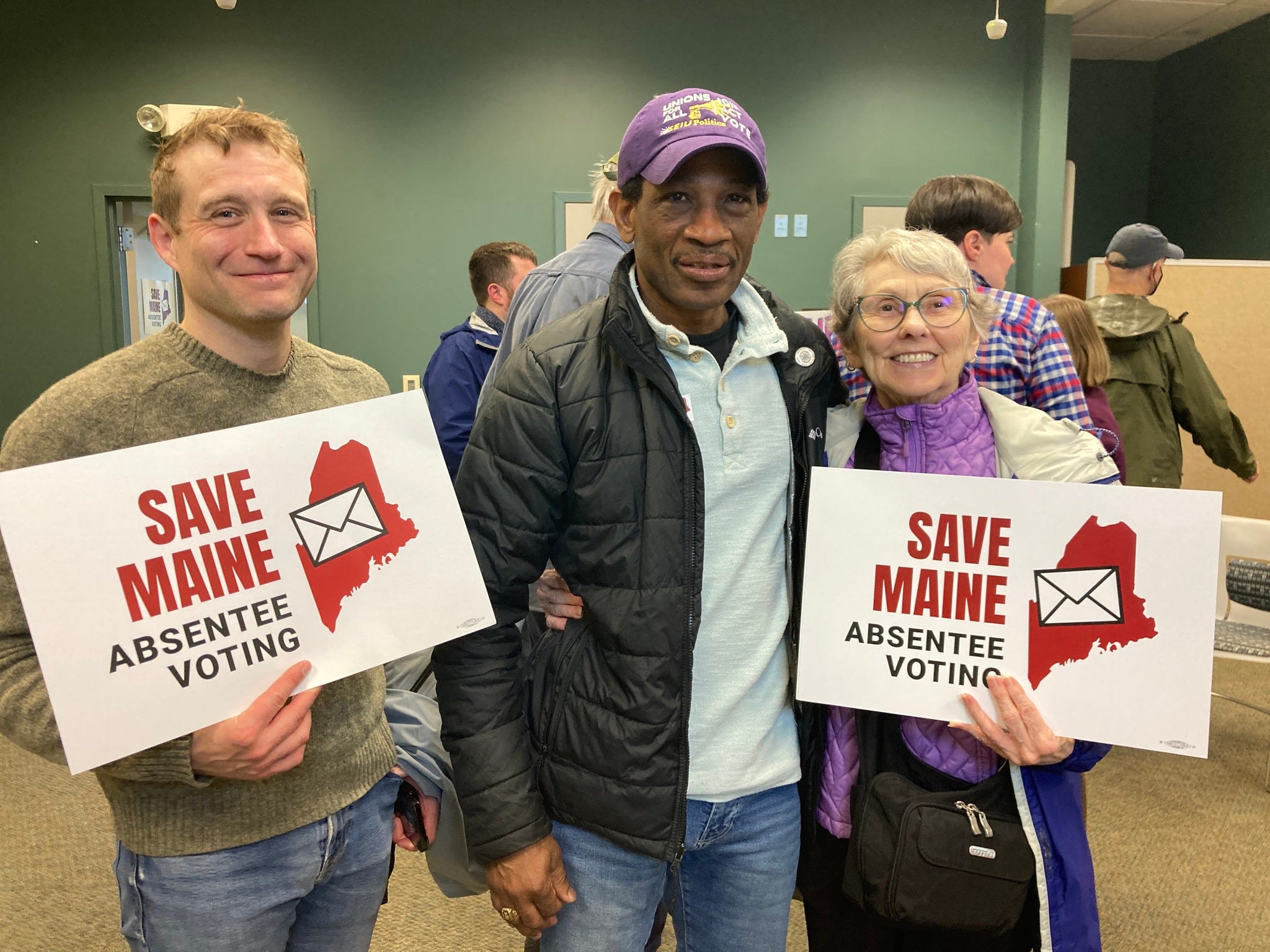
Bolt's Alex Burness explains that the measure, which will be identified as Question 1 on the Nov. 4 ballot, would forbid the state from automatically mailing absentee ballots every year to voters who request to be on such a list. He notes that 43% of the electorate voted by mail last year: This included 61% of seniors, according to an analysis by Question 1's opponents.
Mainers would instead have to fill out an application every single election, and they'd have to do so either in person or by mail—losing their ability to make requests by phone or online.
"What a pain, to have to do that every single time," a disabled voter named Sarah Trites lamented to Burness. "This would affect a lot of people. People who cannot drive, who are physically unable to read for whatever reason."
And that's not all. Question 1 would also shorten the timeframe to ask for a mail ballot; prevent cities and towns from providing more than one ballot drop box; and require voters to show identification before filling out a ballot.
The campaign to pass this measure, known as "Voter ID for ME," is focusing on that last piece as it urges a "yes" vote.
Republican state Rep. Laurel Libby, who is considering running for governor next year, told Burness, "My question to naysayers would be: What's the downside to ensuring our elections are as strong as they can possibly be and as secure as they can possibly be?"
Burness notes that Libby did not provide any evidence that the Pine Tree State's elections are not already secure.
Libby's side has gotten most of its support from national GOP groups outside the state—and one organization in particular. AnnMarie Hilton reported last month in the Maine Morning Star that the Republican State Leadership Committee was responsible for most of the roughly $560,000 that the "yes" campaign had raised through June 30, which marked the end of the most recent reporting period.
Data from Ballotpedia shows that the "no" side had brought in more than $800,000 through the end of June, with national Democratic groups contributing to the effort. The coalition assembled to defeat Question 1, called Save Maine Absentee Voting, warns that the measure's passage would especially harm "seniors, Mainers with a disability, and Mainers without reliable transportation."
State Democrats are also sounding the alarm about what it would do.
"Eliminating the convenience of absentee voting would make it far more difficult for working people, seniors, and people with disabilities to participate in our elections," Secretary of State Shenna Bellows said in an interview with Burness.
Bellows, who is campaigning for governor, further cast the measure as "a wolf in sheep's clothing." She said, "Reasonable people can agree to disagree on the merits of voter ID. But if Maine voters understand everything that this measure will do, they will reject it."
David Nir here, publisher of The Downballot! If you agree that the ballot box is our most important front in the battle to save our democracy, then I hope you’ll consider upgrading to a paid subscription. As a small independent media outlet, we answer only to our readers, and we will always tell you the truth.

Redistricting Roundup
UT Redistricting
Utah Republicans said Thursday that they would redraw the state's congressional map in response to a new court ruling concluding it had violated a voter-backed initiative cracking down on gerrymandering.
In a statement laced with bitter complaints about the decision, however, GOP leaders signaled they might still seek to defy the redistricting rules that voters adopted at the ballot box in 2018.
"We can and will continue to pursue the same goal we have had from the outset—for each member of Congress to represent both urban and rural voices," said Senate President J. Stuart Adams and House Speaker Mike Schultz. "This model provides a true statewide perspective, ensuring that all Utahns—whether they live in rural towns, suburban neighborhoods or our capital city—have four strong voices in Washington, D.C."
This "model," however, also undergirds the state's current (and now illegal) map. Following the 2020 census, Republicans split the blue bastion of Salt Lake County between all four of the state's congressional districts, ensuring that all would be safely red.
That approach likely runs afoul of the 2018 measure, known as Proposition 4, which mandates "minimizing the division" of cities and counties. A trio of nonpartisan maps proposed by the redistricting commission established by Proposition 4 all made fewer cuts to Salt Lake County, leading in each case to the creation of a solidly blue district.
Should Republicans pass a noncompliant map, though, the judge who just ordered the redraw signaled she would impose a new one herself.

Election Night
Special Elections
The Orlando area will host two special elections the day after Labor Day, both in solidly blue districts that overlap with one another.
The elections became necessary following the death of Democratic state Sen. Geraldine Thompson in February. Soon after, Democratic state Rep. LaVon Bracy Davis kicked off a campaign to succeed Thompson, requiring her to vacate her own seat thanks to Florida's resign-to-run law.
Thompson's 15th Senate District voted for Kamala Harris by a 61-38 margin last year after supporting Joe Biden 66-33 in 2020, according to calculations by The Downballot. Bracy Davis' 40th House District, which is located almost entirely within the 15th, likewise backed Harris 67-32 after going for Biden by a 71-28 margin.
Running for Bracy Davis' seat is RaShon Young, who was one of her top staffers before launching his bid. Both face little-known Republican opponents who've twice run against one another in GOP primaries for the safely blue 10th Congressional District.
Governors
GA-Gov
A federal judge has dismissed a lawsuit brought by Attorney General Chris Carr against Lt. Gov. Burt Jones over a state law that allows Jones—but not Carr—to raise unlimited sums of money before the two square off in the Republican primary for Georgia's open governorship in May.
In a 20-page opinion, District Judge Victoria Calvert agreed with Carr that he had been harmed by the law in question, which allows the sitting governor and lieutenant governor to create special committees that face no caps on donations. However, she said that the state of Georgia, not Jones, was the source of Carr's injury, concluding in essence that he had brought his suit against the wrong defendant.
Carr's team told the Atlanta Journal-Constitution that it's "reviewing all legal options," which could involve an appeal. Another option would be a new lawsuit naming the state as a defendant, an approach that has succeeded when others have challenged this law in the past.
OK-Gov
A Republican pollster continues to find Attorney General Gentner Drummond far ahead in next June's GOP primary for Oklahoma's open governorship as both his declared and would-be rivals struggle to break through.
Cole, Hargrave, Snodgrass & Associates, which regularly releases data on its home state, finds Drummond taking 43% of the vote as former state House Speaker Charles McCall and State Superintendent Ryan Walters are deadlocked at 8 apiece for the second spot in a potential runoff. (Candidates need to win a majority of the vote to avert a second round of voting.)
Three other Republicans—former state cabinet official Chip Keating and former state Sens. Jake Merrick and Mike Mazzei, are far behind with 4% or less. Merrick and Mazzei previously kicked off campaigns while Keating, who is the son of former Gov. Frank Keating, has yet to announce his plans.
Walters, unlike Drummond and McCall, also has yet to say if he'll run to succeed Gov. Kevin Stitt, a fellow Republican who cannot seek a third term. CHS, though, finds him sporting an ugly 31-44 favorable rating with his own party's voters.
Walters attracted nationwide attention last month after two members of the Board of Education said his office TV displayed footage of nude women during a meeting. An investigation for the state House concluded his device "automatically launched Samsung's free streaming service and began playing a film that contained explicit content" without anyone noticing in time. Law enforcement officials are still probing the incident.
CHS also tested a primary without Walters and showed Drummond leading McCall 48-10, which would put him tantalizingly close to the majority he needs to win outright.
This is the first poll we've seen of this contest since May, when CHS found Drummond defeating Walters 39-12. Oklahoma's candidate filing deadline isn't early April, so the GOP lineup may still change over the ensuing months.
Whoever wins the nomination will likely face House Minority Leader Cyndi Munson, who has no serious opposition in the Democratic primary, in this conservative state.
TN-Gov
Secretary of State Tre Hargett, who was the last major Republican still considering a bid for Tennessee's open governorship, has opted not to join the race.
Hargett's decision means the GOP primary will be a one-on-one battle between Rep. John Rose and Sen. Marsha Blackburn, who are vying to succeed term-limited Gov. Bill Lee. Limited polling has shown Blackburn with wide leads.
House
CA-13, CA-09
Former Stockton Mayor Kevin Lincoln, who's been pursuing a rematch against in California's 9th District, is considering a switch to the proposed 13th District should voters approve a new congressional map in a November special election. An unnamed source tells NOTUS' Tinashe Chingarande, who first reported the news, that Lincoln will not decide until after this fall's election.
The two neighboring districts Lincoln is reportedly eyeing would both get bluer under the new map, though the Stockton-based 9th would shift further to the left. Last year, it voted for Donald Trump by a 49-48 margin, though Democratic Rep. Josh Harder held off Lincoln 52-48. In its reconfigured version, it would have backed Kamala Harris 54-43.
Just to the south in the mid-Central Valley, the 13th District supported Trump by a wider 51-46 spread, but Gray managed to knock off GOP Rep. John Duarte by just 187 votes—the closest House race in the nation in 2024. The new-look 13th would have gone for Harris 49-48.
CA-22
A new survey conducted by supporters of Democratic Assemblywoman Jasmeet Bains finds her tied with Republican Rep. David Valadao at 42 apiece, the first public poll we've seen of the race for California's 22nd District.
Notably, the poll, which was paid for by ASPIRE PAC and the SEIU, was conducted by Public Policy Polling among voters who live in the current iteration of the 22nd, not the somewhat bluer version that Democrats are urging Californians to adopt in a special election this fall.
The lines would not shift dramatically, however: Under the proposed new map, the district would have backed Donald Trump by a 50-48 spread instead of the 52-46 margin he secured last year.
Bains was the sole Democrat in the legislature to vote against placing the map on the ballot, saying beforehand, "I will not sit by and watch two political parties destroy the concept of fair elections. This has become a race to the bottom where an eye for an eye will make the whole world blind."
One other Democrat, Visalia school board trustee Randy Villegas, is also in the race. Villegas, who has generally run to the left of the centrist Bains, has said he supports the new map.
"I'm proud to stand with Democratic leaders across the Central Valley and California as we refuse to be cheated out of fair representation, and do everything in our power to put working families first," he said in a statement following the vote.
IL-08
Sen. Dick Durbin endorsed Hanover Park Trustee Yasmeen Bankole, who worked for him as a staffer until earlier this year, in the packed Democratic primary for Illinois' open 8th District.
Bankole is running to replace Rep. Raja Krishnamoorthi, who is campaigning to succeed the retiring Durbin in the upper chamber. She also previously worked for Krishnamoorthi before joining the senator's team in 2019.
TX-21
Former All-Star first baseman Mark Teixeira, who broke in with the Texas Rangers in the mid-2000s, announced on Thursday that he was joining the GOP primary for Texas' newly open 21st Congressional District.
Teixeira is the first prominent Republican to enter the race to succeed Rep. Chip Roy, who recently kicked off a bid for state attorney general. However, a pair of established local politicians have also said they're considering bids, San Antonio City Council member Marc Whyte and Bexar County GOP Vice Chair Kyle Sinclair.
The depth of Teixeira's connections to local politics is unclear, though the Texas Tribune notes that he's worked with a conservative organization that promotes school vouchers. The slugging switch-hitter, originally from Maryland, was drafted by the Rangers in 2001 but is best known for the eight seasons he spent with the New York Yankees, with whom he won a World Series in 2009.
Teixeira says he moved back to Texas in 2021, though the district he's now seeking is a long bus ride from the major league ballpark where he first crushed homers and won Gold Gloves. The conservative 21st, which merges a slice of San Antonio with the Texas Hill Country, is around 200 miles away from the Rangers' home stadium in Arlington.
TX-35
Businessman Christopher Schuchardt on Thursday became the first notable Republican to announce a campaign for Texas' open 35th District, a constituency that GOP mapmakers just overhauled as part of their new gerrymander. Schuchardt's entry came one day after state Rep. John Lujan opened a fundraising committee for a likely campaign.
Schuchardt, who says he'll self-fund $250,000 for his new effort, has previously run for office twice in the San Antonio area. His first campaign, to unseat Mayor Ron Nirenberg in 2023, ended with a landslide 61-22 defeat. However, he fell short just 53-47 the next year when he challenged Bexar County Commissioner Grant Moody for renomination.
Schuchardt and Moody could be in for a rematch next year as the commissioner is one of several Republicans who are eyeing the 35th, which now includes part of San Antonio and rural areas to the east and south.
Lujan, for his part, did not commit to running for Congress when he filed with the FEC, though he doesn't sound like he has much left to consider. The state representative told the San Antonio Report, "You don't get an opportunity like this very often."
Lujan got an opportunity like this because he and his colleagues passed a new map that transforms the 35th District, which they previously gerrymandered to be deep blue, into a constituency that would have favored Donald Trump 55-44. Democratic Rep. Greg Casar, whose base is in Austin, is running in the 37th rather than defending a district that has little in common with the one he currently represents.
How touching is it that Utah Republicans have such deep concern about having mixed urban and rural districts. Be nice if they had the same concerns about adhering to the will of the voters.
Ernst reportedly not running for re-election.
https://www.reuters.com/world/us/us-republican-senator-joni-ernst-wont-run-re-election-cbs-news-reports-2025-08-29/