

Morning Digest: Republicans contemplate giving up on Cornyn
The senator's allies think a Ken Paxton win would be a catastrophe. Primary voters are unmoved.


Leading Off
TX-Sen
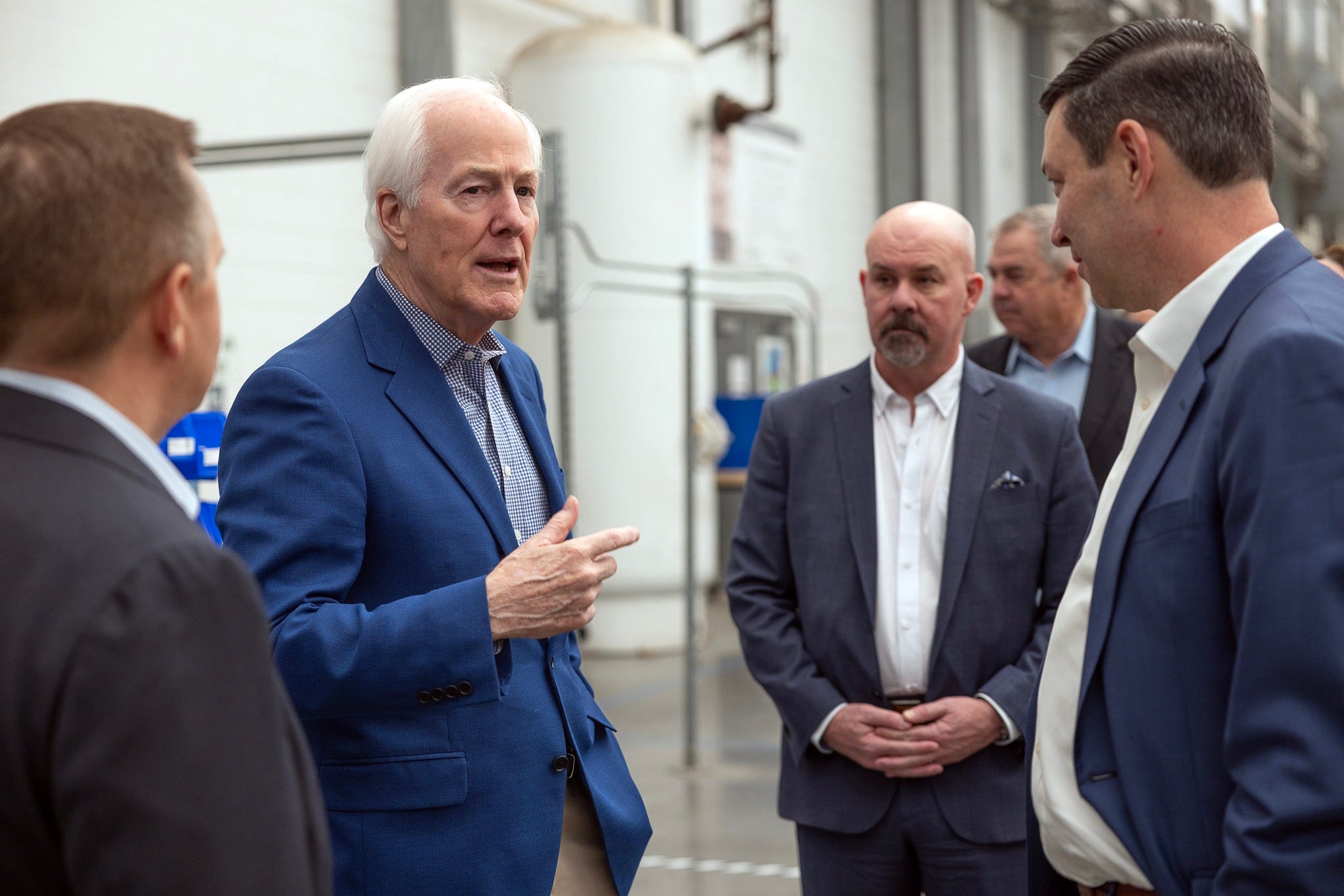
Major Republican donors have reportedly grown so pessimistic about Texas Sen. John Cornyn’s prospects of winning renomination that some are considering cutting him loose entirely and redirecting their money to other races, the New York Times reports.
Democrats, by contrast, see an opportunity to flip Cornyn’s seat no matter who emerges with the GOP nod, especially following their shock victory last weekend in a conservative state Senate district in Fort Worth.
First, though, they’ll host a heated primary of their own on March 3 between Rep. Jasmine Crockett and state Rep. James Talarico before they can focus on winning their first statewide victory in Texas since 1994.
But while Democratic leaders in the Senate have yet to take sides in this high-profile contest, their counterparts on the right are telling just about anyone who will listen that Republicans desperately need Cornyn as their standard-bearer.
Axios reports that an official from the GOP’s Senate campaign arm told donors on Tuesday that, while the National Republican Senatorial Committee’s polling shows Cornyn easily winning if he makes it to the general election, that’s not the case if either Attorney General Ken Paxton or Rep. Wesley Hunt snag the nomination.
The NRSC warned that a victory by either challenger would force Republicans to spend hundreds of millions of dollars to defend a seat they’ve held since 1961, when John Tower won a special election to replace Vice President Lyndon Johnson in the Senate.
Majority Leader John Thune, who defeated none other than Cornyn in a 2024 contest to succeed Mitch McConnell as the Senate’s top Republican, told Punchbowl News last month that the GOP could save money in the long run by helping his one-time rival now. So far, well-heeled Republicans have agreed with what Thune dubbed his “business proposition.”
AdImpact reported Friday that Cornyn and his allies have spent or reserved around $50 million on advertising, which is more than five times as much as Hunt’s side. Paxton, by contrast, has spent just about nothing on commercials and has received no major support from outside groups.
But while Texans have been inundated with ads promoting Cornyn as a MAGA ally, the four-term senator is still struggling to convince the base it can trust him. One unidentified former Cornyn adviser succinctly summed up the incumbent’s problems to Texas Monthly’s Eric Benson: “Can I be Mitch McConnell’s best friend for eighteen years and Donald Trump’s best friend for eighteen months?”
GOP voters have responded in the negative. Polls conducted throughout 2025 showed Cornyn nowhere close to taking the majority of the vote necessary to avert a second round of voting on May 26, and some of those surveys even showed Cornyn in danger of losing out on a runoff berth to Hunt.
The first, and so far only, survey released this year came from Emerson College last month, and it gave Cornyn some decidedly mixed news. The school placed Paxton in first with 27% as Cornyn outpaced Hunt 26-16 for second place.
But even if the incumbent gets the chance to fight on to May, some of his backers are down on his odds of winning. An unnamed Cornyn adviser told the Times that some powerful donors have become “fatalistic” about his prospects and have wondered whether it might be better to direct their money to help stronger candidates like Maine Sen. Susan Collins.
Cornyn and his allies, though, insist that such talk is premature, emphasizing that the GOP’s prospects of holding the Senate would take a major hit if he’s not the party’s nominee. Earlier this week, Cornyn pointed to Democrat Taylor Rehmet’s shock 57-43 win in Saturday’s special election for a Senate district that Trump had carried by a wide 58-41 margin to bolster his case for renomination.
“I think what we saw happen … reminded people that this is a challenging electoral environment for Republicans,” the senator told Punchbowl following that defeat, which intensified his party’s fears about its loss of support among the state’s large Latino electorate. “So we need to have the best players on the field we can.”
Cornyn’s allies have also sought to amplify fears that Paxton would be a disastrous nominee. While the attorney general’s political career has survived a seemingly never-ending series of scandals—Benson writes that the list is “so numerous, so byzantine, and so wide-ranging that any full accounting would be tedious”—only his most ardent admirers think he’d be the GOP’s strongest option.
Hunt, for his part, has tried to position himself as an alternative to the two frontrunners, but Republican leaders in both chambers of Congress are anything but enthusiastic about him.
Hunt, who launched his Senate bid in October despite a months-long pressure campaign by Cornyn supporters to deter him, has more recently earned unwelcome scrutiny for barely showing up to vote in the House this year.
The congressman attracted national attention last month when Speaker Mike Johnson dispatched the Capitol Police to escort Hunt from a nearby airport to the House chamber so he could supply the key vote necessary to defeat a Democratic-backed resolution that would have prevented Trump from unilaterally conducting military action in Venezuela. The New York Times summed up the episode with the headline, “Defending His Absence in House, Hunt Celebrates Casting a Vote.”
Donors, however, had begun souring on Hunt even before this incident. The once-prolific fundraiser took in less than $400,000 during his first three months as a Senate candidate, and he finished 2025 with just under $800,000 in the bank. Cornyn and Paxton, by contrast, went into the new year with $5.9 million and $3.7 million on hand, respectively.
The trajectory of the primary could change in an instant if Trump endorses any of the three candidates, but so far, he’s turned down all entreaties to wade in.
“I’m giving it very serious thought,” Trump told reporters on Sunday. “My problem is that I’m friendly with all of them. So those are the hard ones.”
The Democratic primary between Crockett and Talarico has also generated plenty of notice, including from Cornyn.
The senator celebrated Crockett’s entry into the race in December by telling Semafor, “Am I hiding my glee? I’ll try to wipe the smile off my face, I would say it’s a gift.”
Crockett, for her part, has pushed back on Republican hopes that she’d be a weak general election opponent by arguing she’d mobilize voters her party has failed to turn out in the past.
But while the Democratic contest has turned chippy on social media, there haven’t been any negative TV ads through Tuesday. Indeed, the airwaves have belonged almost exclusively to Talarico, who decisively outraised his opponent during the final three months of 2025. AdImpact reported last week that he’d spent or reserved $6.8 million, compared to just $500,000 for Crockett.
Talarico also learned this week that an allied super PAC is rushing in to aid him in the primary. AdImpact says that an outfit called Lone Star Rising has booked at least $3.8 million on ads to support the state lawmaker.
Crockett’s backers are also discussing how to assist her in the final four weeks of the primary, though they have yet to take action. One prominent ally, Democratic megadonor Karla Jurvetson, tells the Times she’s “continually thinking about how to help her.”
Polls conducted in January disagree about which candidate is leading in the primary, with one suggesting a deadlock. However, it’s possible that neither will emerge with the nomination on March 3. A little-known third candidate named Ahmed Hassan is also running, and his presence could prevent either Crockett or Talarico from securing enough support to avoid a runoff.
The Downballot just published another must-bookmark resource: our comprehensive calendar for the 2026 elections.
As you might imagine, though, tracking down every last date and detail requires a ton of effort. If you appreciate the sweat we put into creating freely available, non-paywalled resources like these, we’d love it if you’d support The Downballot by upgrading to a paid subscription. Thank you!
The Downballot Podcast
Why the GOP is right to freak out after Texas
While Democrats exulted after flipping a deep-red legislative seat in Texas on Saturday night, Republicans started panicking—and they should be. On this week’s episode of The Downballot podcast, co-hosts David Nir and David Beard go deep to explain the many ways in which Taylor Rehmet’s shocking win is scary for the GOP. The good news for Republicans? There isn’t any.
The Davids also break down the new fourth-quarter fundraising reports that House and Senate hopefuls just filed. On both fronts, Democrats are starting to bring races online that could expand the playing field, while lackadaisical GOP efforts risk doing the exact opposite. You can follow along with our newly published charts featuring data for more than 900 candidates.
The Downballot podcast comes out every Thursday morning everywhere you listen to podcasts. Click here to subscribe and to find a complete transcript!
Election Night
NJ-11
Democrats in New Jersey’s 11th Congressional District will pick their nominee on Thursday—yes, Thursday—in the crowded and expensive primary for the seat that Mikie Sherrill gave up following her election as governor last year.
The winner will be the favorite against Randolph Mayor Joe Hathaway, who has the Republican side to himself, in the April 16 special election for this reliably blue North Jersey constituency.
Of the 11 Democrats in the race, five have attracted the most attention from donors and prominent backers. Former Rep. Tom Malinowski, who lost reelection in 2022 in the neighboring 7th District, has outraised his opponents, but he’s also been the target of heavy attacks, including from the hawkish pro-Israel group AIPAC.
Essex County Commissioner Brendan Gill and venture capitalist Zach Beecher have also brought serious sums, while former Lt. Gov. Tahesha Way has benefited from considerable outside spending.
Progressive activist Analilia Mejia, finally, is at a financial disadvantage, but she’s hoping her allies—including the labor-backed Working Families Party and prominent figures on the left like Sen. Bernie Sanders—will help her stand out in this packed race.
Redistricting Roundup
CA Redistricting
The Supreme Court rejected a request by Republicans to block California’s new congressional map on Wednesday in a terse, unsigned order, allowing the new districts to be used in the November midterms.
A lower court previously ruled against the GOP, which had argued that the map was an impermissible racial gerrymander. However, U.S. District Judge Josephine Statton concluded that the plan was instead a partisan gerrymander designed to unseat Republican incumbents. In a 2019 case, the Supreme Court held that such gerrymanders could not be policed by the federal courts.
Senate
IL-Sen
A super PAC supporting Lt. Gov. Juliana Stratton has reserved an additional $7.1 million to help her in the March 17 Democratic primary for Illinois’ open Senate seat, AdImpact reports. The outfit, called Illinois Future PAC, is funded in part by Gov. JB Pritzker, who is one of Stratton’s most prominent allies.
Governors
AK-Gov
Former state Rep. Jonathan Kreiss-Tomkins, who helped Democrats forge a cross-partisan coalition that led the Alaska House for many years, joined the extremely crowded race for the state’s open governorship on Wednesday.
Kreiss-Tomkins first ran for the legislature in 2012 after his hometown of Sitka was drawn into a Republican-held seat. Just 23 at the time, he dropped out of college to campaign after no other Democrats filed to run and ultimately won by 32 votes following a recount.
Four years later, Kreiss-Tomkins was widely credited as one of the architects of an alliance of Democrats, independents, and Republican pragmatists that wrested control of the House away from hardline Republicans, despite the fact that Donald Trump carried the state that same election.
That alliance, which often backed independents in conservative districts while discouraging Democrats from running, lasted until the 2022 elections, when GOP hardliners finally won an outright majority. Kreiss-Tomkins declined to seek another term that year, but now he’s waging a comeback campaign with GOP Gov. Mike Dunleavy facing term limits.
Two other notable Democrats, though, were already running: state Sen. Matt Claman and former state Sen. Tom Begich. At least 10 Republicans are also in the race, though, which will have a major impact on the Aug. 18 primary. That’s because all candidates will run together on a single ballot, with the top four vote-getters advancing to a ranked-choice general election.
ME-Gov
A group backed by conservative megadonor Dick Uihlein is spending more than $400,000 on ads promoting former state Senate Majority Leader Garrett Mason, the Bangor Daily News reports. Mason is competing in the crowded June 9 Republican primary for governor of Maine, which will be conducted using a ranked-choice ballot.
NH-Gov
Physician Julia Williams, who had been weighing a bid against Republican Gov. Kelly Ayotte, announced on Wednesday that she would not run, citing “significant complications” from a recent surgery.
The Union Leader’s Kevin Landrigan notes, though, that a day earlier, the conservative New Hampshire Journal had questioned whether Williams, the daughter of former Democratic Gov. John Lynch, met the state’s seven-year eligibility requirement to run for governor. Democrats still lack a major name to take on Ayotte, though several are considering.
House
FL-13
Retired Army Brig. Gen. Leela Gray announced a campaign against Republican Rep. Anna Paulina Luna this week, giving Democrats their first major candidate in the race for Florida’s 13th Congressional District.
Gray served in uniform for 30 years, including a combat deployment to Iraq, before entering the private sector and earning a law degree. She also joined the race with an endorsement from Whitney Fox, who challenged Paulina in 2024. Fox lost 55-45 in her bid for the Pinellas County-based 13th District, which Donald Trump carried by a similar 55-44 spread.
Florida Democrats, though, finally have a ray of hope thanks in part to a shift to the left among Latino voters, which was most evident in the party’s victory in the Miami mayor’s race in November. Republicans may also further gerrymander the congressional map, though since their goal is to weaken Democratic incumbents, they’d be hard-pressed to also shore up potentially vulnerable GOP members like Luna.
GA-11
Republican Rep. Barry Loudermilk announced Wednesday that he would not seek a seventh term in Georgia’s 11th Congressional District, a reliably red constituency he first won in 2014.
Donald Trump, according to calculations by The Downballot, scored a 61-38 win in 2024 in the 11th, which is based in the northwestern suburbs and exurbs of Atlanta. The Peach State’s filing deadline is March 6, so would-be candidates have just over a month to decide whether to run. The primary will take place on May 19, but contenders need to win a majority to avert a runoff four weeks later on June 16.
Loudermilk, then in the state House, first ran for Congress in 2014 after Rep. Phil Gingrey announced that he would wage what would prove to be an unsuccessful campaign for the GOP nomination for U.S. Senate.
Loudermilk had more luck in his own race. He advanced to the primary runoff against Bob Barr, a former Republican congressman who had run for president in 2008 as the Libertarian Party’s nominee. While Barr had since returned to his old party, he struggled to convince GOP voters to send him back to the House.
Loudermilk defeated Barr in a 66-34 landslide, and he had no trouble winning the general election that fall or holding his seat over the next decade.
GA-14
Donald Trump on Wednesday endorsed Clayton Fuller, who serves four counties as district attorney for the Lookout Mountain Judicial Circuit, in the March 10 special election to replace former Rep. Marjorie Taylor Greene.
Fuller, who lost to Greene in 2020, faces 15 fellow Republicans, three Democrats, and two unaffiliated contenders in next month’s contest for Georgia’s dark-red 14th Congressional District.
All candidates will compete on one ballot rather than in separate party primaries. If no one wins a majority of the vote—a virtual certainty in a race with this many options—then the two candidates with the most votes, regardless of party, will advance to an April 7 runoff.
IL-02, IL-08, IL-09
A pair of obscure outside groups began airing ads this week in a trio of Democratic primaries for open House seats in Illinois, but Politico reports that the hawkish pro-Israel group AIPAC is behind both of them.
One of these organizations, Affordable Chicago Now, is supporting Cook County Board Commissioner Donna Miller in the 2nd Congressional District. Elect Chicago Women, meanwhile, is backing former Rep. Melissa Bean in the 8th District and state Rep. Laura Fine in the 9th. All three candidates are competing in busy contests for safely blue seats in the Chicago area.
NBC reports that the pro-Miller buy has at least $250,000 behind it, while another $300,000 is going to help Fine. Bean, meanwhile, is the beneficiary of $400,000 in spending.
Alex Harrison of the news site Evanston Roundtable has posted copies of all three spots. Each ad touts its candidate as an ardent progressive who will stand up to Donald Trump and avoids mentioning Israel or any related issues.
MD-05
Two new Democrats have entered the race to replace retiring Rep. Steny Hoyer in Maryland’s 5th District: Prince George’s County Councilmember Wala Blegay and former Capitol Police officer Harry Dunn.
Blegay, a civil rights attorney, was first elected to the County Council in 2022, winning a district-level race. Last year, she was appointed to one of two at-large positions on the body to fill a vacancy.
Dunn, meanwhile, earned national attention for defending the Capitol on Jan. 6 and sought the Democratic nomination in the neighboring 3rd District in 2024. However, despite his prodigious fundraising, he lost to state Sen. Sarah Elfreth 36-25.
Several other Democrats previously launched campaigns for the safely blue 5th, including Del. Adrian Boafo, who has Hoyer’s backing.
NJ-02
Cape May Mayor Zack Mullock is considering seeking the Democratic nomination to challenge Republican Rep. Jeff Van Drew, a former Democrat who switched parties in 2019 during his first year in Congress, the New Jersey Globe reports.
Since his defection, Van Drew has won reelection three times in New Jersey’s 2nd District, which includes the southern part of the Jersey Shore. The incumbent most recently prevailed 58-41 in 2024 as Donald Trump was carrying his constituency 56-43.
NJ-12
Redistricting expert Sam Wang announced Tuesday evening that he was joining the busy June 2 Democratic primary for New Jersey’s open 12th Congressional District. Wang, a prominent elections analyst on TV and social media for more than a decade, filed paperwork with the FEC last week to raise money for his bid to succeed Democratic Rep. Bonnie Watson Coleman, who is not seeking reelection to this safely blue seat.
Poll Pile
KY-Sen (R): Fabrizio, Lee & Associates (R) for Nate Morris: Daniel Cameron: 29, Andy Barr: 21, Nate Morris: 18, undecided: 29. (Unreleased August poll: Cameron: 40, Barr: 17, Morris: 5.)
MN-Sen (R): Peak Insights (R) for Michelle Tafoya: Michelle Tafoya: 41, Royce West: 11, Adam Schwarze: 4, David Hahn: 3, Tom Weiler: 1.
MN-Gov (R): Peak Insights (R) for Michelle Tafoya: Mike Lindell: 18, Lisa Demuth: 17, Scott Jensen: 12, Kendall Qualls: 11, Kristin Robbins: 3, others 1% or less, undecided: 32.
IL-09 (D): GBAO (D) for Laura Fine: Laura Fine: 21, Daniel Biss: 21, Kat Abughazaleh: 14, Mike Simmons: 7, Bushra Amiwala: 4, Phil Andrew: 4, Hoan Huynh: 2, undecided: 23. (Unreleased November poll: Biss: 20, Abughazaleh: 14, Fine: 13.)
TX-AG (R): The Strategy Group (R) for Mayes Middleton: Chip Roy: 22, Mayes Middleton: 22, Joan Huffman: 7, Aaron Reitz: 4. (Unreleased early January poll: Roy: 27, Middleton: 13, Huffman: 5, Reitz: 2.)
Toxic comment thread about AIPAC deleted. Yes, I know, it may feel frustrating that we clamp down on discussions of some topics that show up in the Morning Digest, but that's life.
Democrats in Virginia have agreed on a 10-1 map.
https://x.com/TylerEnglander/status/2019432110613000356?s=20