



Leading Off
ME-Gov
Republicans remain as hostile as ever to ranked-choice voting, but they’re almost certainly going to need it to pick a nominee for Maine’s open governorship on Tuesday.
Attorney Bobby Charles, a former drug enforcement officer at the State Department and a frequent Fox News guest, has posted a double-digit advantage over his six primary rivals in every available poll. All of those surveys, though, have found Charles far short of the majority he’d need to make the ranked-choice process irrelevant.
Two of Charles’ opponents are hoping the system will give them the boost they need to pull off a surprise: Real estate developer David Jones and fitness chain founder Ben Midgley have asked their respective supporters to rank the other as their second choice.
Jones has also tried to convince fellow conservatives that they need to embrace ranked-choice voting now so they can get rid of it later.
“I sued Janet Mills over Ranked-Choice Voting, believe me - I’m no fan,” he wrote last week on social media. “I will sign the bill to repeal RCV when it reaches my desk.” Jones, though, added, “Republicans need to actually understand how RCV works and beat the Democrats at their own game.”
The frontrunner, though, would prefer that Republican voters not rank anyone except their first choice.
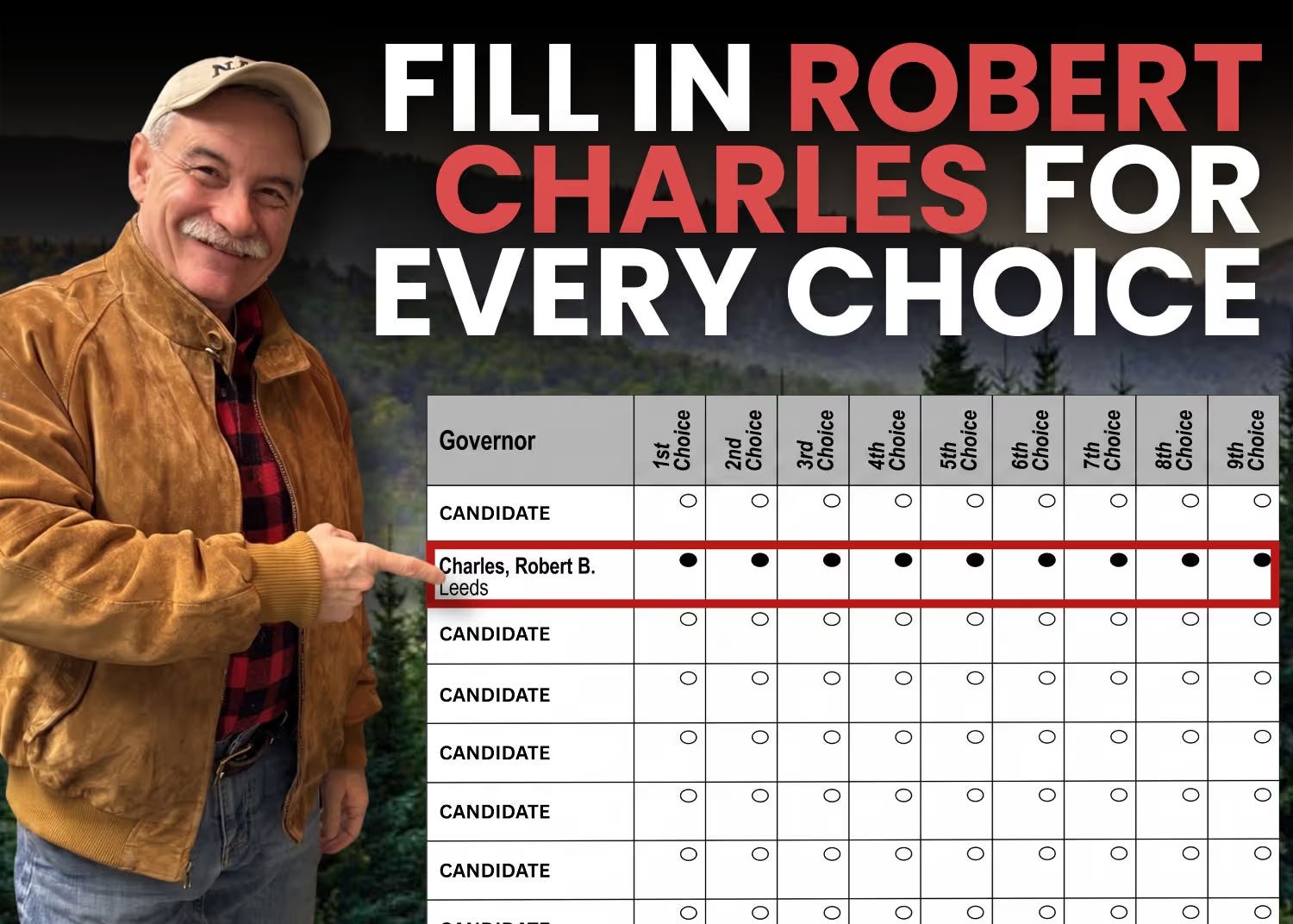
“I would never advocate that people use ranked choice voting, because I believe that it’s unconstitutional,” Charles told CBS13 on Wednesday. His website even features an unmissable splash screen urging voters to fill in the bubble next to his name for every slot on the ballot.
But Charles’ views haven’t exactly gained traction in the courts. While the Maine Supreme Court issued an advisory opinion in April reaffirming that the state constitution bars RCV from being used in general elections for state-level offices, the process is allowed for primaries. (Races for the U.S. Senate and House use RCV for both primaries and general elections.)
And after Republican Rep. Bruce Poliquin was defeated in his bid for reelection by Democrat Jared Golden thanks to RCV in 2018, the federal courts soundly rejected his arguments that the system violates the federal Constitution.
However, a recent poll suggests that many Republicans agree with Charles that they should select only a single candidate.
SurveyUSA, polling for the Bangor Daily News and FairVote, last week showed Charles leading among first-choice votes with 34%, with Jonathan Bush, a former health care executive and the nephew of the late President George H.W. Bush, a distant second at 17%. Two other Republicans, former state Senate Majority Leader Garrett Mason and Midgley, were at 10% apiece, while Jones and the remaining two candidates were stuck in the single digits.
The firm then asked the 466 respondents to rank their second choice, but only 381 did—an 18% drop off.
More and more Republicans checked out as SurveyUSA continued to quiz them about their next three choices, with only 120 expressing an opinion about who they’d rank as their fifth choice—scarcely a quarter of the original group.
And while the pollster stopped at five, Republicans will be able to rank up to nine options: One for each of the active candidates, plus James Libby, who dropped out in April but is still on the ballot, as well as a write-in slot.
SurveyUSA found that Charles remained the dominant frontrunner after simulating the RCV process, though the ultimate sample size was far below the minimum of 300 that The Downballot requires to report on polls.
Democrats will almost certainly also need to jump through the RCV hoop to determine their nominee, but the same poll showed far more of their voters plan to take part in the process. Of the 483 Democratic respondents who selected a first-choice candidate, 346—72%— continued to the fourth and final round.
And SurveyUSA found that, unlike on the GOP side, RCV may well lead to a different Democratic nominee on Tuesday than if candidates were required to secure only a plurality of the vote.
The poll initially showed former state health director Nirav Shah in front with 25%, with former Senate President Troy Jackson and former state House Speaker Hannah Pingree behind with 20% and 19%, respectively. Businessman Angus King III took fourth with 14%, while Secretary of State Shenna Bellows brought up the rear with 11%.
But Jackson, Pingree, and Bellows are all urging their voters to rank the other two, and SurveyUSA found they were listening. Pingree gradually picked up support and narrowly overtook Jackson before defeating Shah 52-48 in the last round.
But there’s plenty of uncertainty going into Tuesday, not least because this will likely be just the second time that Maine has used RCV in a statewide primary. The only prior instance came in the Democratic primary for governor in 2018, which was also the first year ranked-choice ballots were used. Mills ultimately prevailed in the fourth and final round when tabulations were completed eight days after the primary.
The Democrats and Republicans running to succeed Mills, who is now termed out, may be in for a similar wait. Election officials will start RCV tabulations on Friday for any races where no one captures a majority of the vote, and Bellows’ office anticipates being finished by “prior to the Juneteenth holiday” next week.
Be sure to check out our new preview of all of tonight’s top races, covering 20 contests across four states!

To unlock access to our full report—as well as every future primary preview we publish—we encourage you to upgrade to a paid subscription today:

.avif)
Election Recaps
Los Angeles, CA Mayor
Los Angeles Mayor Karen Bass will face City Councilmember Nithya Raman, a fellow Democrat, in the fall general election, the Associated Press projected on Monday evening.
The call came one day after updated vote totals placed Raman, a member of the Democratic Socialists of America, ahead of Republican Spencer Pratt in the contest for the crucial second-place spot in the June 2 nonpartisan primary. The newest tallies show Bass remains in front with 34% of the vote, while Raman holds a 29-26 advantage over Pratt.
The AP estimates 93% of the vote has been tabulated so these margins may still shift, but the general election is now set.
Governors
NH-Gov
Republican Gov. Kelly Ayotte is already going up with TV ads attacking her likely Democratic opponent, former Executive Councilor Cinde Warmington—though for New Hampshire voters, the spot might induce feelings of deja vu.
Ayotte’s ad begins with a portentous voiceover reading on-screen text that says, “The following is an unedited television ad from Cinde Warmington’s previous Democratic opponent.”
What follows is more than a dozen seconds of footage from a spot run by former Manchester Mayor Joyce Craig attacking Warmington’s work as a lobbyist for the pharmaceutical industry during the Democratic primary in 2024.
“As a lobbyist for Purdue Pharma, Warington was paid to defend OxyContin,” Craig’s narrator intoned. “Then Warmington worked for a disgraced pain clinic that made millions hooking people on opioids. Cindy Warmington works for them. She can’t be our governor.”
Ayotte’s narrator then returns to conclude, “Democrats know the truth. Cindy Warmington is an opioid lobbyist. She’s wrong for New Hampshire.”
The Ayotte version is edited in that it clips several bits from Craig’s ad, which was 30 seconds long, though the sum and substance remain unchanged.
In 2002, Warmington testified before the state legislature that OxyContin was a “miracle drug for many patients” that “has very few side effects” in an effort to thwart legislation cracking down on opioids. (The bill passed and became law.) She also later served as counsel for the troubled chain of pain clinics referenced in the ad, which ultimately collapsed under new ownership last year.
During her previous campaign, Warmington responded with ads arguing that her work on behalf of OxyContin came “long before Purdue Pharma’s lies were known.” But Craig prevailed 48-42 in the primary before losing to Ayotte 54-44 in the general election.
This time around, Warmington is the only Democrat running, and barring an unexpected last-minute entry ahead of Friday’s filing deadline, she’s likely to remain so.
House
FL-09
Republican Dan Green, a Navy veteran and former Defense Department official during the first Trump administration, has entered the race for Florida’s freshly gerrymandered 9th Congressional District.
According to Florida Politics, Green says he plans to self-fund $1 million. Several other Republicans are already running to take on Democratic Rep. Darren Soto in a radically overhauled district that the GOP’s new map made much redder. The filing deadline for House candidates is Friday.
FL-24
State Sen. Shevrin Jones announced a bid on Tuesday for Florida’s 24th District, a safely blue—and heavily Black—constituency in the Miami area that recently became open following Democratic Rep. Frederica Wilson’s decision to retire.
Jones, who was first elected to the legislature in 2012, would be the first openly gay person to represent Florida in Congress. His highest-profile opponent in the August Democratic primary is likely Miami-Dade County Commissioner Oliver Gilbert, who jumped in last week, though several others are running as well.
Anyone else interested in joining the contest, though, must act quickly, as the candidate filing deadline for House races is Friday.
MA-06
Two influential labor organizations have come down on different sides of the Democratic primary in Massachusetts’ open 6th District: The state branch of AFL-CIO, which represents more than 800 local unions, has endorsed former White House official Dan Koh, while the SEIU State Council, a coalition of four unions, is backing state Rep. Tram Nguyen.
Overall, though, Koh has cleaned up with organized labor, thanks in key part to his close relationship with former U.S. Labor Secretary Marty Walsh. Koh previously served as chief of staff to Walsh when he was Boston’s mayor in the previous decade, then followed him to Washington when he joined Joe Biden’s Cabinet.
Now, the Boston Globe reports, Walsh “has been leaning on local labor leaders” on Koh’s behalf. The effort appears to be paying dividends, as more than 30 unions have flocked to Koh’s banner, far more than any of his rivals.
NY-13
Rep. Adriano Espaillat, who faces a challenge from activist Darializa Avila Chevalier in the June 23 Democratic primary, is airing a new ad highlighting his opponent’s since-deleted tweets attacking prominent Democrats.
As a narrator charges that Avila Chevalier “won’t stand by Kamala Harris,” a censored version of a post reading “I have no nuance to add. Fuck Kamala Harris” is shown on screen. Similar messages appear regarding Joe Biden, whom Avila Chevalier said she would not vote for in 2020. Her final featured tweet attacks “Black men” and “Arab men” for “fetishizing ugly colonizer women.”
A super PAC called United for Progress that’s supporting Espaillat is also airing a similar spot, which Politico says is backed by a “six-figure buy.”
Meanwhile, allies of Avila Chevalier are striking back with a new ad starring Noor Abdalla, who discusses the Trump administration’s efforts to deport her husband, pro-Palestinian activist Mahmoud Khalil. When she sought help from her congressman, she says, “Espaillat left me in the dark.”
The group airing the ad, American Priorities, recently reported spending $500,000 to help Avila Chevalier—the latest foray in what has become an expensive battle. Latino advocacy groups, led by BOLD America, have deployed more than $2 million on behalf of Espaillat, while American Priorities and the Justice Democrats have combined to spend $1.2 million to boost his challenger, who has the endorsement of New York City Mayor Zohran Mamdani.
Obituaries
Bob Packwood
Oregon Sen. Bob Packwood, whose long career as a moderate Republican ended in disgrace in 1995, died on Saturday at the age of 93.
Shortly after he won a fifth term in 1992, the Washington Post reported that Packwood had a history of sexual misconduct targeting female aides. Three years later, the Senate voted to expel Packwood, prompting him to resign.
The Oregonian has much more on Packwood’s life and legacy in its obituary.
Poll Pile
IA-Sen: Public Policy Polling for the DSCC:
Ashley Hinson (R): 46, Josh Turek (D): 46.
MI-Sen: Tulchin Research for Fighting For Michigan (pro-Abdul El-Sayed):
Abdul El-Sayed: 41, Haley Stevens: 23, Mallory McMorrow: 18.
SD-Sen: Public Policy Polling for Brian Bengs:
Mike Rounds (R-inc): 43, Brian Bengs (I): 23, Julian Beaudion (D): 18.
Rounds (R-inc): 56, Beaudion (D): 31.
Rounds (R-inc): 44, Bengs (I): 40.
MI-04: GBAO for Sean McCann:
Sean McCann (D): 48, Bill Huizenga (R-inc): 45.
Strange situation involving that ReconMR/Siena University poll of Texas. They've posted a "REVISION" that now shows a 46-46 tie for TX-Sen and small changes in the GOP's favor in other races. The memo does not explain what was revised. https://bsky.app/profile/the-downballot.com/post/3mnv3p5dulk27
ME-Sen: This is so freaking funny.
TPSI poll | 6/8 LV
US Senate Maine 2026
🟥Susan Collins 43.7% (incumbent)
🟦Graham Platner 43.1%
Undecided 13.2%
—
When voters are informed of Graham Platner’s scandals
🟦Graham Platner 48.2%
🟥Susan Collins 40.1% (incumbent)
Undecided 11.7%
https://x.com/PollTracker2024/status/2064338493321466318
No, none of that is a typo