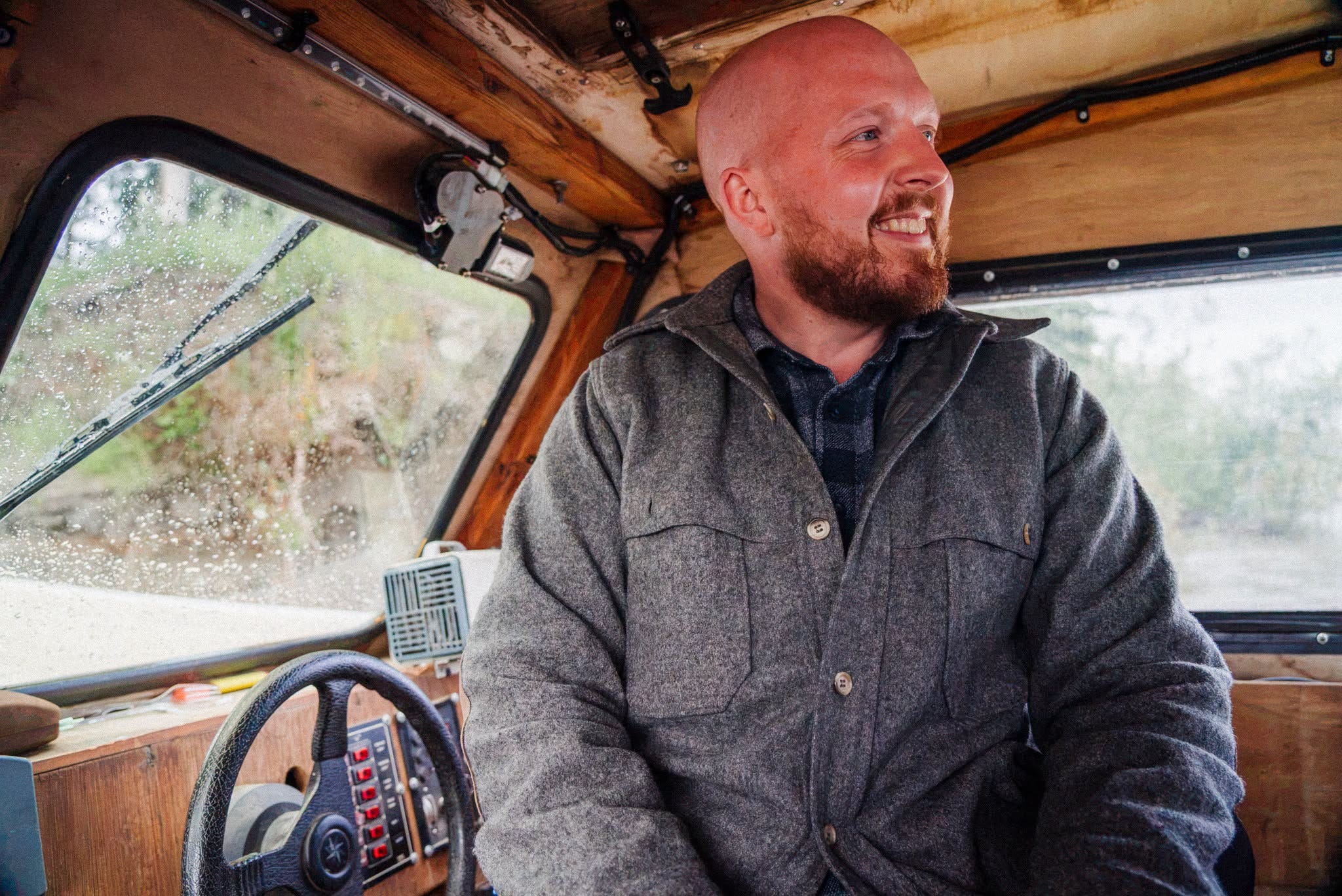
Former state Rep. Jonathan Kreiss-Tomkins, Democratic candidate for governor of Alaska. (Credit: Jonathan Kreiss-Tomkins Facebook)
Leading Off
AK-Gov, AK Ballot
Alaska voters on Tuesday will both winnow the field in a race for governor where none of the 17 candidates are subject to campaign contribution limits—and decide whether to reintroduce caps on political donations.
A total of 12 Republicans, two Democrats, and three independents are competing to replace Republican Mike Dunleavy, who is set to become the first governor to leave office because of term limits since 2002.
A message from our sponsor, the Michigan Creator Collaborative:
Support the Michigan Creator Collaborative
The way people access information has fundamentally changed.
Local news is fading, misinformation is rising, and audiences are turning to content creators for clarity, context, and connection.
Creators are no longer just entertainers — they are interpreters of the world around us.
All candidates will compete on a single ballot, with the top four vote-getters, regardless of party, advancing to a general election that will be conducted using ranked-choice voting.
It’s anyone’s guess which foursome will move forward, but a few candidates have stood out by raising considerably more money than the rest.
Democrat Jonathan Kreiss-Tomkins, a former member of the state House of Representatives, has brought in more than $2 million through Aug. 8, the end of the state’s most recent reporting period.
“I am not opposed to JKT as a candidate, only unfamiliar with his intentions on AI safety and data centers,” Maxim Ishchuk, who leads the group PauseAI Anchorage, wrote in an opinion piece in the Alaska Daily News.
“On his site, he mentions that he supports ‘a moratorium on all new data centers, similar to New York state, until the legislature can pass comprehensive regulation,’” Ishchuk continued. “This I appreciate, but what would he define as ‘comprehensive?’ I worry that this money buys influence over how that question gets answered.”
Kreiss-Tomkins responded in an essay of his own, saying, “All of our campaign’s AI-affiliated supporters are some of the country’s leading AI safety and regulation advocates.”
The candidate went on, “I am the first — and I believe still the only — candidate in the governor’s race to call for a moratorium on data center development in Alaska until the state can pass comprehensive regulation that protects the public interest.”
Kreiss-Tomkins has also called for voters next week to prohibit unlimited donations in future races by passing Ballot Measure 1, an initiative that would impose contribution limits for the first time in five years.
Should a majority vote “yes,” individuals would be permitted to give $2,000 to a candidate for state and local office each election, while groups would be limited to $4,000. These limits, which would go into effect after this year’s general elections, would be readjusted for inflation every decade.
In 2006, voters overwhelmingly approved a plan that capped individual contributions at $500, which the Alaska Beacon’s James Brooks said remained “some of America’s lowest limits on financial donations” through 2021. That year, though, a federal appeals court sided with Republicans in a long-running legal battle and invalidated the state’s donation limits.
The legislature’s subsequent attempts to introduce new rules failed to become law, as Dunleavy vetoed a bill last month that would have put in the same caps as Ballot Measure 1.
Former state Sen. Tom Begich, the other Democrat in the race, is also urging voters to approve the proposal next week.
Begich brought in about $1.2 million, a little more than half as much as Kreiss-Tomkins, through Aug. 8. Two contributors were responsible for about half of his haul: Justin Weaver, who has donated to candidates opposed to Dunleavy’s agenda, and attorney Robin Brena, who has called for raising taxes on state oil companies.
Begich, the son of the late Rep. Nick Begich and younger brother of former Sen. Mark Begich, could also benefit as a member of perhaps the state’s most prominent political family—even though it’s no longer an exclusively Democratic one.
The candidate’s nephew, Republican Rep. Nick Begich III, is seeking his second term as the state’s sole congressman. Tom Begich has slammed his relative’s conservative positions, writing in ADN last year, “My nephew may share my father’s name, but he does not share his values.”
Kreiss-Tomkins and Begich are hoping to become the first Democrat to win this office since 1998, when incumbent Tony Knowles secured his second and final term. Knowles is also the last governor to complete two full terms in office. Three of the four governors between him and Dunleavy failed to win reelection, while Republican Sarah Palin resigned in 2009, just months after her failed bid for vice president.
A dozen Republicans, meanwhile, are vying for this post. The two best-financed contenders each took in about $1.6 million through Sunday: podiatrist Matt Heilala, who has self-funded most of his effort, and former Attorney General Treg Taylor, who is also responsible for a large portion of his campaign’s fundraising.
Several other notable Republicans are in the hunt, though. The lineup includes former state Sen. Click Bishop; former Anchorage Mayor Dave Bronson; former Revenue Commissioner Adam Crum; Mat-Su Borough Mayor Edna DeVries; former state Sen. Shelley Hughes; former state Sen. Lesil McGuire; and conservative operative Bernadette Wilson.
A trio of independents is also hoping to gain a spot in the second round. The most prominent name belongs to former Gov. Bill Walker, whose upset 2014 victory makes him the only non-Republican to win since Knowles in 1998. Meda DeWitt, a leader in the unsuccessful effort to recall Dunleavy during his first term, and one little-known name round out the field.
The last publicly released survey of next week’s packed race was an internal poll conducted for Kreiss-Tomkins back in mid-July. Those numbers, from Change Research, showed Begich and Kreiss-Tomkins in front with 17% and 15%, respectively, while Wilson was the top Republican at 14%.
None of the other 14 contenders cracked double digits. Walker edged out Bronson 7-6 for fourth place, with Bishop and Crum at 4% each and the rest of the field further back.
The Democratic primary in Florida’s open 24th District has erupted into an expensive affair ahead of next week’s vote, with Miami-Dade County Commissioner Oliver Gilbert taking most of the incoming fire.
Protect Progress, a super PAC funded by the cryptocurrency industry, has spent almost $2 million to portray Gilbert as a MAGA-aligned supporter of ICE, sending out mailers that include made-up headlines falsely attributed to the Miami Herald.
One of Protect Progress’ top funders is the crypto firm Coinbase, whose Global Advisory Council, as the Herald notes, includes former Rep. Kendrick Meek Sr., the father of one of Gilbert’s opponents, attorney Kendrick Meek Jr.
A pro-Gilbert outfit called American Made PAC, however, is fighting back, with $1.1 million in spending, mostly on positive ads supporting the commissioner.
Meanwhile, a group called Save Democracy PAC, which has endorsed a large array of centrist Democrats, has spent $1.7 million to boost state Sen. Shevrin Jones. Save Democracy is also the parent of Crush MAGA PAC, which was most recently active in the Democratic primary in Michigan’s 7th District. There, it spent more than $900,000 in an unsuccessful attempt to stop William Lawrence, the most outspoken progressive in the race, from winning.
NY-17: Republican Rep. Mike Lawler has accepted a $10,000 donation from his colleague, the embattled Rep. Max Miller (R-OH), and says the allegations against Miller are a "media game".






https://www.nydailynews.com/2026/08/13/rep-mike-lawler-facing-tough-ny-reelection-battle-refuses-to-return-max-miller-donation/
NY-17: Republican Rep. Mike Lawler has accepted a $10,000 donation from his colleague, the embattled Rep. Max Miller (R-OH), and says the allegations against Miller are a "media game".
Not the *best* political instincts if you ask me.
Let’s go El—Sayed !!!!!! Time to close the gap…