


A recent Democratic poll of a House race in Ohio featured a remarkable finding. In the 15th District around Columbus, represented by Republican Mike Carey, the survey found Democratic challenger Don Leonard leading by a 46-45 margin.
What made the result so noteworthy is that Carey’s district voted for Donald Trump over Kamala Harris by a comfortable 10-point spread in 2024. If that poll is indeed accurate, it not only means Leonard could win but also that he’s doing 11 points better than you’d expect given the outcome of the most recent presidential election.
A political environment where Democrats are overperforming to this degree would be a very strong one indeed. But this is just one poll of one race. Alone, it can’t tell us anything about the broader state of the November midterms and whether Democrats do in fact have a mighty wind at their backs.
But what if we look at all the available House polling and compare it to the Trump-Harris numbers for each district? Thanks to a database assembled by FiftyPlusOne, as well as The Downballot’s calculations of the 2024 presidential results for all 435 congressional districts, we can do exactly that.
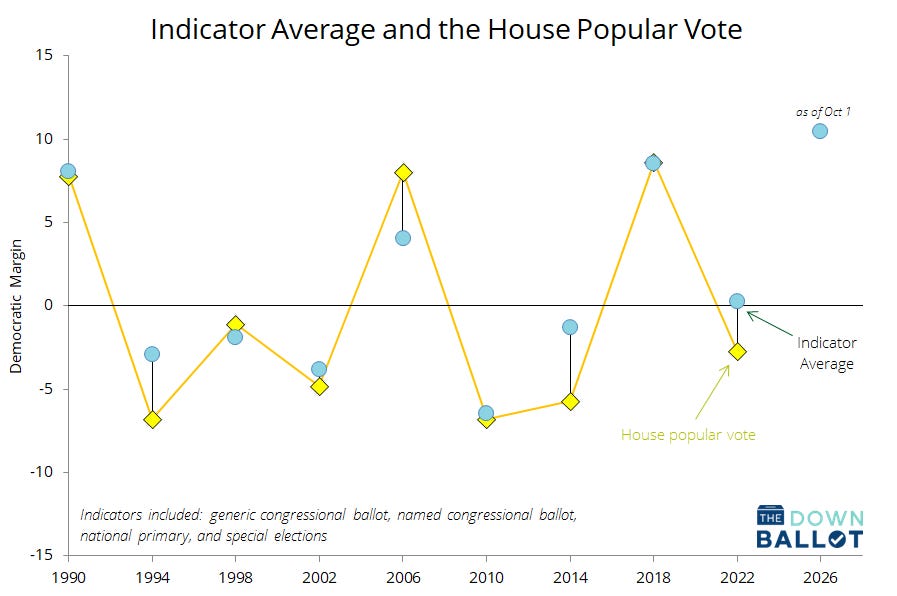
And when we do, we find that in polls in September of this year, Democrats overall are in fact doing as well as that Ohio survey implies. Compared to the presidential baselines, Democrats outperformed by an average of 11 points across 57 different polls last month. We call this the “named congressional ballot,” a cousin of the more familiar generic congressional ballot.
In early July, FiftyPlusOne performed a similar analysis, finding Democrats polling ahead of their benchmarks in congressional races by 7 points on average. But we can now extend this analysis much further, because our colleagues at FiftyPlusOne don’t just have data on recent polls. Their catalog stretches back decades.
That allows us to calculate the named congressional ballot for prior elections reaching back to 1998. And most importantly of all, these “back tests” let us see whether this approach offers any predictive value.
It does—when it’s evaluated in conjunction with other metrics.
