


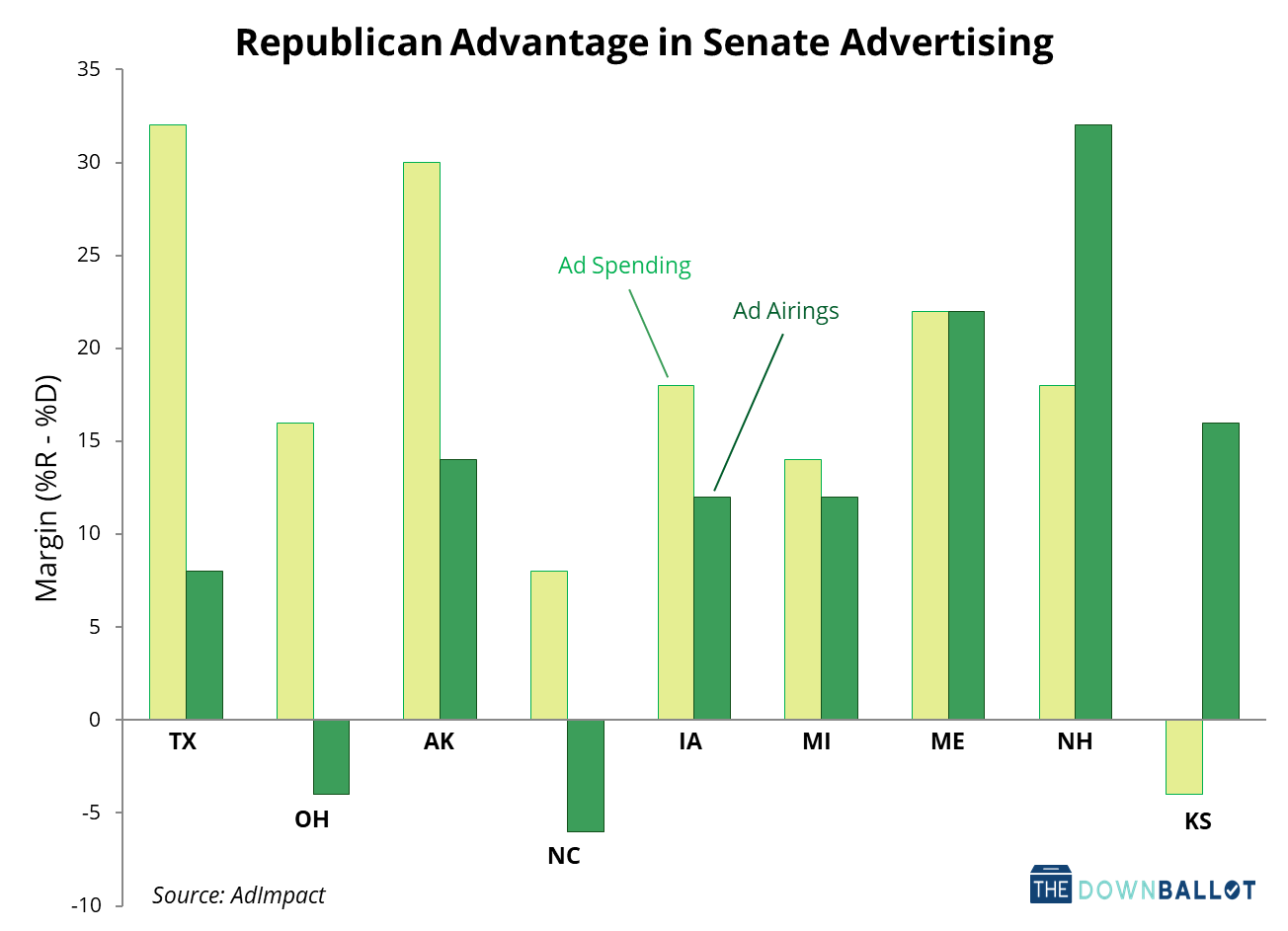
Democrats across the country have been worried about getting swamped by a late flood of Republican money, but a new report shows they have less to fear than the raw dollar totals might indicate.
That’s because even though Republicans have built up a massive spending advantage on the airwaves in key races, they aren’t getting anywhere near the bang for the buck that Democrats are.
New data from AdImpact shows that, across nine of the most competitive Senate contests, Republicans had spent $563 million on advertising through the end of September versus $375 million for Democrats—a gap of 60% to 40% in favor of the GOP.
If you appreciate The Downballot’s special reports like this one, then we’d be immensely grateful if you’d upgrade to a paid subscription to support our work.
But in terms of the actual number of ads aired, the difference is much smaller. In total, Republican ads have run roughly 290,000 times, while the Democrats’ have appeared approximately 250,000 times. That’s a much smaller difference of 54% to 46%.
We’ve illustrated this disparity race by race in the chart at the top of this piece created by Daniel Donner. In all but two states, the proportion of Republican ads is smaller than the proportion of Republican ad dollars. (And those two exceptions, New Hampshire and Kansas, have seen the lowest total spending among the nine featured contests.)
Why hasn’t the GOP spending spree translated into a comparable advertising edge? Because Republicans have heavily relied on third-party groups like super PACs, which have to pay prevailing market rates for ads. Candidates, by contrast, are entitled by law to the lowest rates that broadcasters offer, which greatly benefits strong fundraisers like James Talarico in Texas and Sherrod Brown in Ohio.
In many cases, the GOP’s cavalry has also been late to arrive. Organizations that book ad time early can obtain lower prices, because demand for airtime inevitably increases as an election draws closer and drives up rates. Latecomers will therefore find themselves paying a premium.
These two factors work in tandem as well. As Inside Elections’ Jacob Rubashkin noted last month, super PACs in Texas were already paying more than twice as much as candidates by the second week of September, and that multiplier is only going to grow.
In 2024, Rubashkin pointed out, that ratio was 3-to-1 by Election Day, but it’s already worse now. According to an unnamed Democrat who recently spoke with CNN, GOP super PACs in Texas are paying an “absolutely punishing premium” that’s as much as five times greater than what Talarico’s campaign is getting charged.
What's more, there’s little evidence so far that the GOP ad deluge is working. In Talarico’s case, his margin in the polls—a 3-point edge, according to FiftyPlusOne—hasn't shifted since the onslaught began, and Democratic operatives told CNN that their internal polling looks similar.
Still, many Democrats, including Talarico, are getting out-advertised by their opponents, and it’s understandable to be concerned about that gap. But as AdImpact’s report shows, it’s critical to look beyond the raw dollar numbers for a true understanding of the landscape.
Doesn't a massive media onslaught also have diminishing returns? Seeing ads 10 times a day vs once a day seems like it might not help the cause.
Really useful analysis; thanks. Isn’t an additional factor that Trump is holding on to many millions that could have been spent on Republican campaigns?