



Leading Off
CA-Gov
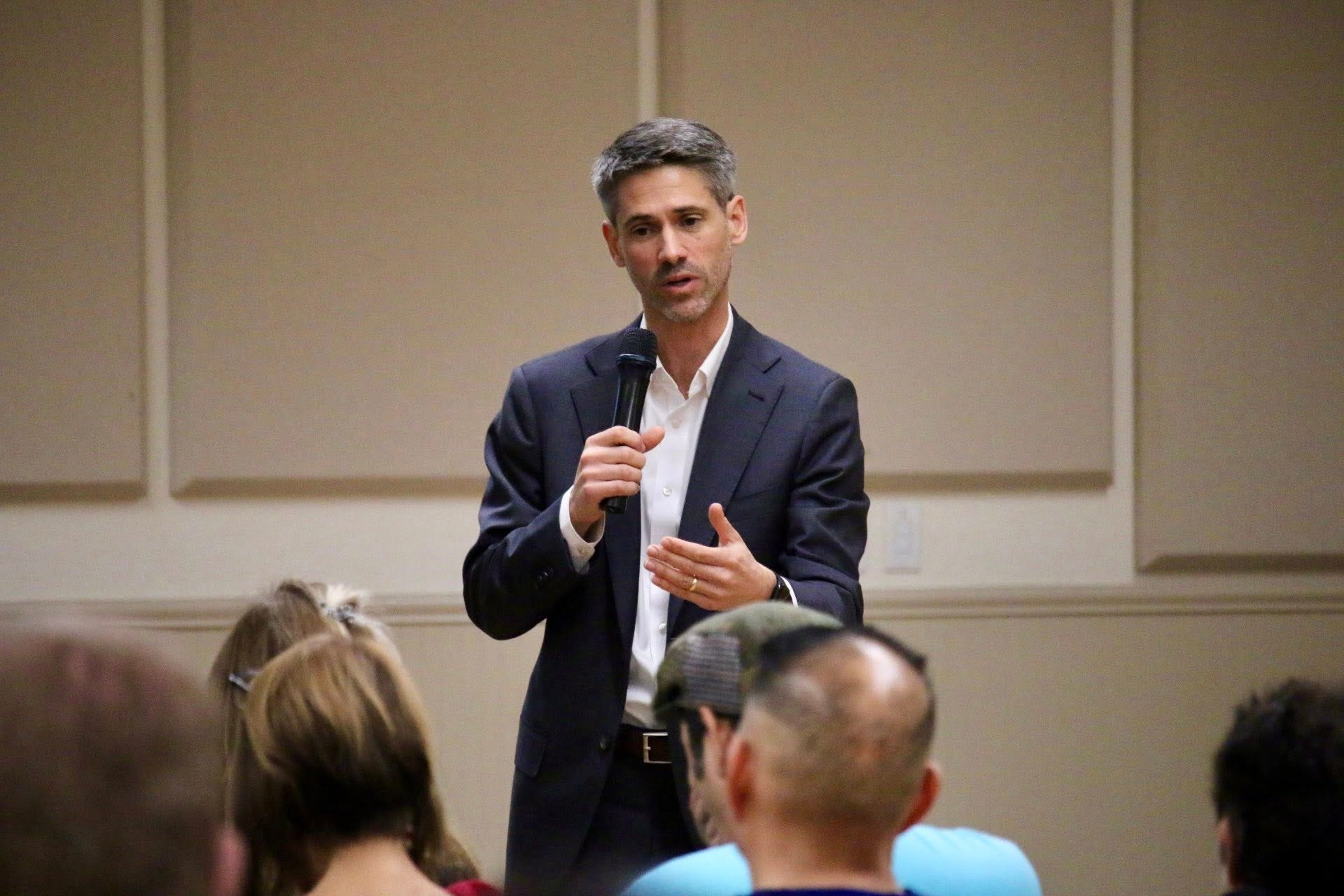
San Jose Mayor Matt Mahan announced Tuesday that he was entering the packed race to replace termed-out Gov. Gavin Newsom, a fellow Democrat whom Mahan has repeatedly come into conflict with.
Mahan, who was first elected in 2022 to lead the third-largest city in the state and the largest in Northern California, has just over four months to campaign ahead of the June 2 top-two primary.
He faces eight notable Democratic rivals, all of whom have had a months-long, and sometimes even years-long, head start. All candidates will run on a single ballot rather than in separate party primaries, with the two highest vote-getters advancing to the Nov. 3 general election.
But Mahan, whose city bears the motto “The Capital of Silicon Valley,” is hoping his extensive connections in the business world will help him jumpstart his late effort.
The newcomer, who says that Facebook founder Mark Zuckerberg persuaded him to enter the tech industry when they were classmates at Harvard, begins the race with two well-heeled donors in his corner: developer Rick Caruso, who considered running for governor himself, and venture capitalist Garry Tan.
Mahan has also worked to make a name for himself outside of San Jose by repeatedly criticizing Newsom from the right over his approach to crime and homelessness.
The mayor attracted attention in 2024 when he became one of the most prominent surrogates for a ballot measure to increase the punishment for several crimes related to drug possession and theft, the penalties for which were reduced a decade earlier. Newsom urged a “no” vote on Proposition 36, which Democratic legislative leaders called “draconian,” but voters approved it in a 68-32 landslide.
Tensions between Newsom and Mahan have not abated since then, especially when Mahan began eyeing the governor’s job.
“He comes from a long line of people who’ve tried to break out of San Jose,” an unnamed Newsom advisor told Politico in October. “He’s trying to get attention by contrasting in a way that alienates base Democrats. Running against Gavin Newsom as a Democrat only makes sense if you plan to become a Republican.”
But while the two officeholders remain members of the same party, Mahan’s entry may exacerbate fears that the crowded field of Democrats could allow a pair of Republicans to advance to the November general election, resulting in a catastrophic “lockout.”
The state’s unusual electoral system allows two contenders from the same party to face one another, and a handful of early polls showing Republicans Chad Bianco and Steve Hilton in the top two positions have sparked consternation that they could move forward and cause the GOP to take control of this reliably blue state.
However, simple math means the possibility remains remote. In statewide elections in recent decades—both primary and general—California Republicans have hit a ceiling of about 40% of the vote, and often take less. In 2018, for instance, during the only prior open governor’s race since California began using the top-two format in 2012, GOP candidates combined for just 36% in the primary.
A lockout would therefore require two unlikely events to play out simultaneously. First, even assuming Republicans can collectively reach 40% overall, their two candidates would have to split that pile of votes evenly—that is, they’d each have to take about 20% apiece. Second, every Democrat would have to wind up in the teens.
Neither has ever happened before in a high-salience, open statewide race during the top-two era, of which there’ve been just three. Newsom, in his first bid for governor in 2018, notched 34% in the primary, while Republican John Cox snagged 25% of the vote. The next-closest Republican, Travis Allen, finished far behind in fourth place with under 10%.
It was even more lopsided in the 2024 Senate race, which saw Democrat Adam Schiff and Republican Steve Garvey emerge from the primary with around 31.5% apiece. The only other remotely notable Republican, Eric Early, took just 3%. And in 2016, it was Republicans who got locked out of the general election for California’s other Senate seat, which Kamala Harris ultimately won over a fellow Democrat, Loretta Sanchez.
Democratic lockouts in winnable races have historically been very rare, in part because Democrats have long been vigilant after a humiliating debacle in the old 31st Congressional District during the very first year the top-two came into use.
Ever since, when a threat has loomed, deep-pocketed groups have always stepped in to elevate a single candidate in the primary, and it’s always worked.
The most notable examples all came in 2018 when Democrats took action in a trio of vulnerable GOP-held House districts in Southern California to prevent two Republicans from advancing. The expensive strategy paid off, as Democrats went on to unseat Rep. Dana Rohrabacher in the fall while winning races to replace retiring Reps. Ed Royce and Darrell Issa. (Issa later returned to Congress by winning a different seat in 2020.)
Such intervention has never been necessary in a statewide race, and for the reasons discussed above, it remains unlikely.
But should the polls in the late spring still resemble those from mid-winter, it’s a certainty that major Democratic organizations will do whatever is necessary to avoid a disaster. Powerful Democrats may also pressure some of the candidates who have struggled to raise money or secure much support in the polls to drop out.
Oh man, we are so close! Yesterday, we told you that we needed just 14 more paid subscribers to reach our next milestone of 2,900. Today, that number is down to five. We’d be ecstatic if we could hit that mark before the weekend. Thank you for considering!

Election Night
TX-18
After a nearly year-long wait, downtown Houston will finally have representation in the House again when the special election for Texas’ 18th Congressional District concludes.
The race to fill this safely blue constituency, which has been vacant since Democrat Sylvester Turner died in early March of last year, features a pair of Democrats, former Harris County Attorney Christian Menefee and former Houston City Councilwoman Amanda Edwards.
In the first round of voting in November, Menefee outpaced Edwards 29-26, but because neither secured a majority, the contest proceeded to a runoff. State Rep. Jolanda Jones, who finished third with 19% of the vote, endorsed Edwards the following month, but Menefee has consistently outraised and outspent his rival. He’s also received some outside help from the Congressional Progressive Caucus and Leaders We Deserve, the group founded by activist David Hogg.
The only public poll of the second round was a Menefee internal from mid-December that gave him a 43-30 lead. Whoever wins, though, will immediately be thrust into another competitive election for a full term.
That’s because, following the GOP’s radical gerrymander of Texas’ congressional map last summer, Democratic Rep. Al Green announced he’d seek reelection in the 18th rather than in his old district, the now-dismantled 9th. In fact, both Menefee and Edwards have filed paperwork to run in the regular primary on March 3, setting up the possibility that the nomination won’t be decided until a May 26 runoff.
Special Elections
Texas will also host a special election runoff for its vacant 9th District in the state Senate, a conservative seat in the Fort Worth area that Republicans have nonetheless spent heavily to defend.
The contest pits Democrat Taylor Rehmet, a machinist union leader and Air Force veteran, against Republican Leigh Wambsganss, who serves as chief communications officer for Patriot Mobile, which calls itself “America’s ONLY Christian conservative wireless provider.”
Rehmet came shockingly close to an outright win during the first round of voting in November, pulling in 48% of the vote while Wambsganss took 36% and another Republican the remaining 16%.
The result was stunning given the fact that Rehmet was badly outspent by both opponents—and given the 9th District’s typical lean. In 2024, according to calculations by The Downballot, Donald Trump prevailed by a wide 58-41 margin, while the seat’s previous occupant, Republican Kelly Hancock, won in a 60-40 blowout two years earlier. (Hancock was named acting state comptroller last year and is seeking a full term this year.)
Apparently spooked, Republicans have poured in resources to help save Wamsganss, who has continued to benefit from greater spending. Should Rehmet pull off the upset, though, he’d shave the GOP’s advantage in the Senate down to 18-12, with one other Republican seat vacant.
But no matter what happens Saturday, Rehmet and Wamsganss will face off again this fall for a full four-year term.
4Q Fundraising
Federal candidates are required to file financial disclosures for the second quarter of the year with the FEC on Saturday at midnight Eastern Time. As soon as those reports are available, The Downballot will bring you complete charts of fundraising data for all notable Senate and House candidates across the country.
AK-Sen: Dan Sullivan (R-inc): $1.4 million raised, $5.8 million cash on hand
MI-Sen: Haley Stevens (D): $2.1 million raised, $3 million cash on hand
NY-19: Josh Riley (D-inc): $930,000 raised, $2.5 million cash on hand
Senate
FL-Sen
Following former National Security Council advisor Alexander Vindman’s entry into Florida’s Senate race, former Brevard County School Board member Jennifer Jenkins dropped out on Thursday and endorsed the newcomer. The only other notable Democrat seeking to take on Republican Sen. Ashley Moody is state Rep. Angie Nixon.
Governors
GA-Gov
A federal court rejected a request by Secretary of State Brad Raffensperger that it allow his campaign for governor to raise and spend unlimited funds, explaining in a 16-page ruling that the candidate had challenged the wrong Georgia law.
The chief law at issue allows a handful of politicians, including the governor and lieutenant governor, to create “leadership committees” that face no limits on fundraising or spending.
One of Raffensperger’s top rivals in next year’s GOP primary for the state’s open governorship, Lt. Gov. Burt Jones, has access to such a committee by virtue of his current position.
District Judge Eleanor Ross agreed that the law in question is likely unconstitutional but noted that Raffensperger had instead asked that she block two other statutes, which would have barred the state from enforcing different campaign finance regulations against him. Raffensperger immediately appealed the ruling.
MI-Gov, MI-10
WLNS reported Wednesday evening that Donald Trump hopes Rep. John James will seek reelection to the House rather than remain in the race for Michigan’s open governorship—and that Trump has pledged to endorse wealthy businessman Perry Johnson’s gubernatorial campaign if he hits 20% in the polls.
Johnson, however, tweeted the next day that, while he agrees James should defend the 10th Congressional District rather than continue to run statewide, he had no such understanding with Trump about an endorsement.
James’ team, meanwhile, responded to WLNS’ report by saying the congressman wasn’t going anywhere and playing down any tensions with his party’s leader.
“John will lead all Republicans to statewide victory in November and looks forward to earning the President’s endorsement once again,” his spokesperson told the station.
MN-Gov
Democratic Sen. Amy Klobuchar, who has spent the last two decades as one of the most popular elected officials in Minnesota, announced Thursday that she would run for her state’s open governorship.
Klobuchar begins her campaign less than a month after Democratic Gov. Tim Walz abandoned his plans to seek a third term. In her launch video, she highlights the deaths of Renee Good and Alex Pretti amidst ICE’s ongoing operations in the state, as well as the assassination of state Rep. Melissa Hortman last year and the fatal shootings at Minneapolis’ Annunciation Catholic School.
“Minnesota, we’ve been through a lot,” she says. “A beloved leader and her husband murdered in their home. Little kids gunned down in a church. The killings of Renee Good, a mom of three, and Alex Pretti, a nurse who took care of our veterans. 3,000 ICE agents on our streets and in our towns, sent by an administration that relishes division.”
“We cannot sugarcoat how hard this is,” she continues. “But in these moments of enormous difficulty, we find strength in our Minnesota values of hard work, freedom, and simple decency and goodwill.”
While Walz’s unexpected decision could have sparked a wide-open Democratic primary, that’s unlikely now that Klobuchar, who would be the first woman to lead the North Star State, has joined the race.
Klobuchar was serving as the top prosecutor for Minneapolis’ Hennepin County in 2006 when she was elected to the Senate in a 58-38 landslide. That outsized win came the same night that Republican Gov. Tim Pawlenty was narrowly winning reelection in what remains the GOP’s most recent statewide victory.
While Republicans have made several determined but failed efforts since then to break that losing streak in this light-blue state, Klobuchar’s strong poll numbers have always dissuaded any strong candidates from challenging her.
The senator secured her most recent six-year term by a comfortable 56-41 margin in 2024, even as Kamala Harris was carrying the state by a much narrower 51-47 spread. While that was Klobuchar’s smallest margin of victory of any of her four Senate campaigns, it still reaffirmed her reputation as a proven vote-getter.
Several Republicans began running for governor back when they still thought they’d be facing Walz, whose reelection prospects took a hit after conservatives drew renewed attention to a long-running investigation into allegations of fraud in the state’s welfare system. Klobuchar, though, begins as the favorite to give Democrats, who narrowly won the 2010 race to replace Pawlenty, their fifth straight victory for this post.
If Klobuchar is successful, either she or Walz would appoint someone to replace her in the Senate. (The two Democrats would presumably come to an agreement about who would make the selection.) A special election would take place for the remaining years of her term, and it appears such a contest would occur in 2027 rather than the following year.
House
FL-02
Austin Rogers, who just stepped down as general counsel to Sen. Rick Scott, announced Thursday that he would enter August’s Republican primary for Florida’s open 2nd Congressional District.
Rogers is one of several candidates campaigning to replace GOP Rep. Neal Dunn, who announced that he would not seek a sixth term earlier this month, in this conservative constituency in the central Panhandle.
State GOP chair Evan Power and businessman Keith Gross, who waged a doomed primary challenge to Scott in 2024, both launched campaigns within a day of Dunn’s retirement announcement. Another Republican, insurance agent Nick Justin Lewis, entered the race last week, though he attracted relatively little attention.
Franklin County Sheriff A.J. “Tony” Smith, meanwhile, initially appeared to announce his own effort on Friday when he told WCTV that the district needed someone like him as its representative. Smith, though, informed the Apalachicola Times that the next day he was still “just kind of testing the waters, feeling things out.”
NJ-07
Somerset County Commissioner Sara Sooy has dropped out of the Democratic primary in New Jersey’s 7th District and has instead endorsed Navy veteran Rebecca Bennett. Bennett still faces half a dozen notable rivals in the race to take on Republican Rep. Tom Kean Jr.
NY-17
Former FBI official John Sullivan said Thursday he was leaving the packed Democratic primary to take on Republican Rep. Mike Lawler. He did not endorse any of his rivals.
Poll Pile
IL-Sen (D): GBAO (D) for Raja Krishnamoorthi: Raja Krishnamoorthi: 43, Juliana Stratton: 17, Robin Kelly: 13.
MI-Sen (D): Emerson College for Nexstar Media: Mallory McMorrow: 22, Haley Stevens: 17, Abdul El-Sayed: 16, Rachel Howard: 3, undecided: 38.
MI-Sen: Emerson:
Stevens (D): 47, Mike Rogers (R): 42.
McMorrow (D): 46, Rogers (R): 43.
Rogers (R): 43, El-Sayed (D): 43.
MN-Sen (D): Impact Research (D) for Angie Craig: Peggy Flanagan: 45, Angie Craig: 42.
TX-Sen (D): Slingshot Strategies (D) for Texas Public Opinion Research: Jasmine Crockett: 38, James Talarico: 37.
IL-Gov (R): Osage Research (R) for Darren Bailey: Darren Bailey: 57, Rick Heidner: 9, Ted Dabrowski: 8, James Mendrick: 4.
TX-Gov (D): Slingshot for TPOR: Gina Hinojosa: 29, Chris Bell: 4, Bobby Cole: 3, Zach Vance, 1, undecided: 59.
CA-40: Tulchin Research (D) for Esther Kim-Varet:
Esther Kim-Varet (D): 44, Ken Calvert (R-inc): 44.
Young Kim (R-inc): 44, Kim-Varet (D): 43.
The release did not include numbers testing any of the other Democrats running for this redrawn district, where two Republican incumbents, Young Kim and Ken Calvert, are both running.
MI-10: Public Policy Polling (D) for Christina Hines:
Christina Hines (D): 44, Mike Bouchard Jr. (R): 42.
Bouchard (R): 44, Tim Greimel (D): 42.
Bouchard (R): 43, Eric Chung (D): 41.
The release did not include numbers testing Robert Lulgjuraj, who is also seeking the Republican nomination, in a hypothetical general election.
TX-AG: (D): Slingshot for TPOR: Nathan Johnson: 10, Joe Jaworski: 5, Tony Box: 2, undecided: 78.
https://www.theintelligencer.net/news/top-headlines/2026/01/former-w-va-senate-president-jeff-kessler-announces-u-s-senate-bid/
WV-Sen: Former Lt. Gov Jeff Kessler is running as a Democrat against Sen. Shelley Moore Capito.
Regular downballot commentor RL Miller's Politico quote!
https://www.politico.com/newsletters/california-climate/2026/01/29/whos-the-greenest-of-them-all-00756682
“Big yawn. Meh,” RL Miller, president of the political action committee Climate Hawks Vote and chair of the California Democratic Party’s environmental caucus, said in reaction to Mahan’s entry.
Mahan’s campaign website, heavy on homelessness and public safety, is silent on climate and the environment (neither word appears) but proposes cutting regulations to increase housing construction.
“As a climate person, he has said absolutely nothing to interest me,” Miller said.
Miller said she was waiting for Steyer (and others) to reach out to her. “I’m going to be a princess,” she said. “I would want to sit down and talk with anyone before endorsing them.”