



Leading Off
MN-Sen
Minnesota Sen. Tina Smith endorsed Lt. Gov. Peggy Flanagan on Monday in the race to succeed her in the Senate, a move that comes six months ahead of Flanagan’s Democratic primary contest against a far better-funded rival.
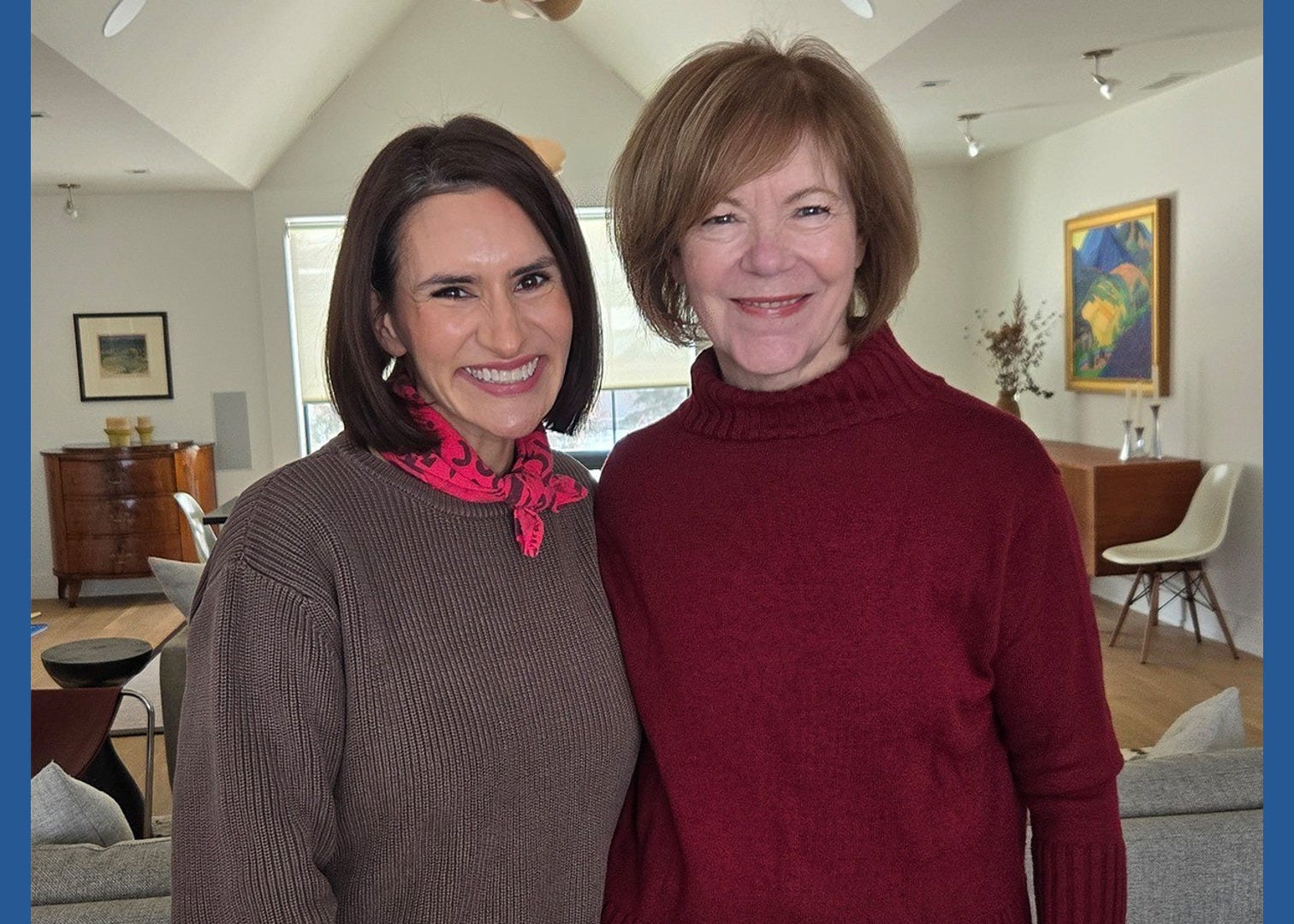
Smith made her choice known in a video that features her standing alongside the candidate. The senator, after highlighting the killing of Renee Good and Alex Pretti at the hands of ICE agents in Minneapolis, says that the nation is now paying close attention to Minnesota’s “courage and our resilience” in the ongoing crisis.
“So I know that right now there is no one that I trust more to stand with Minnesota than Lt. Gov. Peggy Flanagan,” Smith tells the audience. “[S]he understands that right now what we need are fierce fighters. People who are willing to stand up to the status quo.”
Flanagan, who pledges in the video to be a “progressive fighter,” is competing in a closely watched Aug. 11 primary against Rep. Angie Craig, who has embraced a more moderate image in her campaign to represent this light-blue state.
Either Democrat would make history: Flanagan, who is a member of the White Earth Band of Ojibwe, would be the first Native American woman to ever serve in the Senate, while Craig would be the first gay person to represent Minnesota in the upper chamber.
Unusually, both sides recently released data that showed Flanagan ahead, though they disagree on just how big a lead she has.
Flanagan and her allies were the first to go public, sharing a pair of polls conducted in mid-January. A GQR poll conducted for the lieutenant governor found her ahead 49-36, while a Public Policy Polling survey for a pro-Flanagan group gave her a comparable 40-28 advantage.
Craig’s team responded by publicizing an internal poll from Impact Research, also taken in the middle of last month, that showed Flanagan ahead by a smaller 45-42 spread. The memo, though, argued that Craig would pull ahead once voters learned more about both women.
And the congresswoman has the resources to get her preferred message out over the next six months.
Craig took in over $2 million during the final three months of last year, compared to about $1 million for Flanagan. Craig ended last year with an even wider advantage in cash on hand, $3.8 million to $800,000.
Either Democrat, however, will be the favorite in the general election in a state that Donald Trump lost in all three of his campaigns, though the GOP is still hoping to score an upset.
Former sportscaster Michele Tafoya became the GOP’s most prominent candidate last month when she launched her campaign with the National Republican Senatorial Committee’s support.

Because Tafoya entered the race after the start of the new year, she won’t need to file her opening fundraising report until April 15, when first-quarter disclosures are due with the FEC.
Years ago, The Downballot pioneered comparing special election results with presidential results—something that was only possible because we painstakingly calculated those presidential numbers, district by district. No one had released that data publicly before, and because of that, no one had aggregated special election over- and underperformances before.
Now almost everyone takes our approach, and almost everyone relies on our calculations, too. But we must tell you that it’s extremely hard work to prepare these results. If you treasure having access to this kind of insight, then I hope you’ll upgrade to a paid subscription so that we can keep bringing you data like this.

Election Night
Special Elections
Five legislative special general elections are on tap for Tuesday, though the most interesting contest may be the one that doesn’t even have a Republican on the ballot.
That contest is the general election featuring a trio of members of the Democratic Socialists of America who are all running to replace New York City Mayor Zohran Mamdani in New York’s 36th Assembly District, a heavily Democratic constituency based in Queens.
Mamdani is supporting Diana Moreno, a former immigration nonprofit employee whom local Democratic leaders nominated last month. (New York does not hold primaries for special elections.) Two of her rivals for the nomination, though, responded to being passed over by announcing that they would run as independent candidates.
One of those contenders is Rana Abdelhamid, who founded a nonprofit to help Muslim women learn self-defense. Abdelhamid has the endorsement of Rep. Nydia Velazquez and a few other local elected officials.
The third candidate is Mary Jobaida, who unsuccessfully challenged an incumbent in the 2020 primary for another Assembly seat. Jobaida, who also works as an organizer, has state Sen. John Liu in her corner.
There’s less drama in a trio of other Democratic-held legislative seats elsewhere in New York. Kamala Harris carried the 61st Senate District in Buffalo 60-38, according to calculations from The Downballot based on data compiled by Ben Rosenblatt. She also scored more than 80% of the vote in both the 47th Senate District, located on the West Side of Manhattan, and the 74th Assembly District, based in Manhattan’s East Village.
Down in Alabama, meanwhile, the GOP is defending the 38th House District. This constituency favored Donald Trump 71-28.
Finally, there’s a closely watched Democratic primary in Michigan where Republicans are trying to pick their opponent. The Downballot recently took a look at both parties’ nomination battles for the 35th Senate District, and why the stakes are so high ahead of the May 5 special general election.

Redistricting Roundup
MD Redistricting
Maryland’s Democratic-led House of Delegates approved a new congressional map on Monday that would make the state’s lone Republican district much bluer. Senate President Bill Ferguson and his allies, however, remain opposed to the plan.
Senate
NH-Sen
Donald Trump on Sunday endorsed former Sen. John Sununu, who is running to return to the upper chamber after an 18-year absence, in New Hampshire’s Sept. 8 GOP primary.

Scott Brown, a former Massachusetts senator who later served as ambassador to New Zealand and Samoa during the first Trump administration, responded by saying he wouldn’t let his old boss force him out of the race.
Brown instead told a local radio station that he remains the most pro-Trump candidate in the race while arguing that Sununu’s “independence is gone.” Brown added, “I don’t have to squirm and go into machinations to support the president on a whole host of things, and John does.”
But Rep. Chris Pappas, who is the favorite to win the Democratic nomination, was only too happy to tie Sununu to Trump, who failed to carry the Granite State’s electoral votes in any of his three presidential campaigns. Pappas took to social media to share Trump’s endorsement of Sununu, whom MAGA’s master pledged would “work tirelessly to advance our America First Agenda.”
“I’m Chris Pappas, and I approve this message,” the Democrat wrote.
Governors
GA-Gov
A mysterious outfit called Georgians for Integrity has now spent a hefty $13.5 million on ads attacking Lt. Gov. Burt Jones well ahead of the May 19 GOP primary for governor, the Atlanta Journal-Constitution reports. The group, which began airing commercials around Thanksgiving, is continuing to argue that Jones has been “using his office to make himself rich.”
Jones, who has Donald Trump’s endorsement, last month called on the Federal Communications Commission to either require GFI to reveal its donors or to prohibit the aids from airing. But while the lieutenant governor hasn’t succeeded in either goal yet, the AJC has uncovered the first clue about whom the ads may be intended to benefit.
The paper reported Friday that an aide to Attorney General Chris Carr, who is one of Jones’ primary opponents, sent a copy of the ad to a party activist two days before it began airing.
“We have consistently said we have no involvement with these ads,” Carr’s campaign responded, “but the serious allegations of Burt Jones’s self-dealing are widely known and deserve attention.”
MD-Gov
Former Del. Dan Cox, an election conspiracy theorist who waged a disastrous campaign for governor of Maryland in 2022, filed paperwork with state authorities on Friday for a potential rematch against Democratic incumbent Wes Moore. Cox, who took second place in the 2024 GOP primary for the 6th Congressional District, did not respond to questions from the Washington Post about his plans.
House
NY-07
New York City Council Member Julie Won told the New York Times on Monday that she would run to replace Rep. Nydia Velazquez, a fellow Democrat who is not seeking reelection.
Won joins two well-connected candidates in the June 23 primary for New York’s safely blue 7th District. Brooklyn Borough President Antonio Reynoso has Velazquez’s endorsement, while Assemblymember Claire Valdez has New York City Mayor Zohran Mamdani in her corner.
TX-34
Texas Gov. Greg Abbott has backed Army veteran Eric Flores, who received Donald Trump’s endorsement in December, in the March 3 GOP primary to face Democratic Rep. Vicente Gonzalez. Former Rep. Mayra Flores, who is not related to Eric Flores, is also seeking the GOP nomination for the 34th Congressional District.
WV-01
Candidate filing closed Saturday in West Virginia, and the state has a list of candidates available here. One notable name not on the list, though, belongs to Derrick Evans, a former state House member who served three months in prison for his participation in the Jan. 6 assault on the Capitol.
Evans announced in June that he would seek a rematch against Rep. Carol Miller, who defeated him 62-37 in the 2024 Republican primary for the 1st Congressional District. It is not clear whether Evans, a prolific X user whose profile doesn’t identify him as a candidate for any office, decided against running, or if the information on the secretary of state’s website is not yet fully up to date.
Judges
UT Supreme Court
Republicans in the Utah legislature, furious about a string of court rulings that have not gone their way, passed a bill on Friday to expand the state Supreme Court from five to seven members and add more judges to several lower courts.
Gov. Spencer Cox, who quickly signed the legislation, will be tasked with choosing two justices from a list devised by the Appellate Court Nominating Commission—a body whose members are chosen by the governor.
Election law expert Quinn Yeargain notes that the bill, which took immediate effect, could be repealed at the ballot box. It’s not clear yet, though, if the legislation’s opponents plan to launch such an effort. The Utah House Democratic Caucus, in a statement noting its “serious concerns” about the measure, did not mention the possibility of a repeal campaign.
Poll Pile
LA-Sen (R): BPDC for Advanced Strategies (pro-Julia Letlow): Julia Letlow: 27, Bill Cassidy (inc): 21, John Fleming: 14, Blake Miguez: 5.
LA-Sen (R): Public Opinion Strategies (R) for Bill Cassidy: Cassidy (inc): 32, Letlow: 21, Fleming: 16, Miguez: 9, Kathy Seiden: 1.
LA-Sen (R runoff): POS for Cassidy: Letlow: 46, Cassidy (inc): 40.
Correction: This Digest incorrectly described the Republican primary runoff results of Public Opinion Strategies’ poll for Louisiana Sen. Bill Cassidy. The poll shows Julia Letlow ahead 46-40, not Cassidy.
Would Wellstone Have Won?
As promised, here's my essay speculating on a 2002 Minnesota Senate race counterfactual, coincidentally on a morning where another Minnesota Senate race is the headline topic of today's page. I welcome alternative opinions challenging my conclusion, and I especially welcome any polling data that backed up Wellstone's reported lead above and beyond what I found.
Simple question: if Paul Wellstone hadn't died in a plane crash 11 days before the election, would he have won a third term?
The conventional wisdom about this election has endured for nearly a quarter century, particularly in the minds of Democrats. The general breakdown of the CW is that Wellstone and Republican challenger Norm Coleman had been effectively tied for most of the year, but when Wellstone cast his vote against the resolution for military force in Iraq in October, Minnesotans respected his integrity and migrated in his direction. Wellstone was poised to win before he died, but when voters perceived his televised memorial service to have turned into a tasteless campaign rally, they recoiled in disgust and censured the Democratic Party by voting for Coleman.
I've never fully bought this conventional wisdom for a number of reasons. Foremost among them, I'm skeptical of the weight of individual events in generating wholesale transformations in voters' decisions. My skepticism about campaign missteps and media-fueled controversies moving voters in meaningful numbers has only hardened in the Trump era, but I suspect it was quite relevant in 2002 as well. The polling suggested Wellstone got a five-point bounce after casting his vote against military action in Iraq....and the election night tally suggested Coleman got a five-point bounce in the closing days of the election. Few people seemed to consider that the common denominator may have been questionable polling samples rather than dithering voters.
And far as I can tell, most of the narrative surrounding the momentum shifts was tied to a single Mason Dixon poll released by the Minneapolis Star Tribune in mid-October. Previous samples had shown Wellstone and Coleman deadlocked, but the poll released after Wellstone's Iraq vote showed him leading by 6 points. It was a relief to those of us on Team Wellstone but there was scant polling data beyond that backing up the premise of Wellstone pulling away.
Following the exasperated responses of local and national media, as well as then-Governor Jesse Ventura, to the tone of Wellstone's October 29 memorial service, Democrats were nervous that there would be fallout. They were relieved when the poll released the Sunday before the election, taken entirely after the memorial, had replacement Democratic nominee Walter Mondale leading by 5 points. The only problem: it was the same pollster (Mason Dixon on behalf of the Star Tribune). If there was additional reliable public polling backing up Mason Dixon's findings, I wasn't aware of it then and am struggling to discover any record of it now. The only other poll on my radar that late in the cycle was from the St. Paul Pioneer Press and showed the opposite outcome, with a 6-point lead for Coleman.
So were Minnesota voters really this fickle in October and early November 2002? Did they really flock to Wellstone to reward his courageous vote against invading Iraq only to do a heel turn back to Coleman in response to Wellstone's memorial service? That seems less likely to me than Mason Dixon simply having polling samples that were too friendly to Wellstone (in October) and Mondale (in November).
No shade is intended to Mason Dixon if they did because it was a hard race to poll, with an unusually dynamic Minnesota electorate diverging in unpredictable ways. Wellstone's campaign was upfront that the only reason they were hanging in there against Coleman was Wellstone's strength in rural Minnesota. The Coleman campaign telegraphed the same dynamic as they were on the airwaves with ads lobbying hard to cut Wellstone's rural advantage and were funding full-page color ads about the "death tax" in weekly rural newspapers to further land a foothold among voters who were ambivalent toward him.
Anecdotally, I was observing the same thing working at the time as a farm reporter in southwestern Minnesota. Wellstone's decades of advocacy on behalf of farmers and workers had broken through and he won considerable crossover support from otherwise rock-ribbed conservatives in farm country in a race against the former mayor of St. Paul. Given the trajectory of ideological loyalties in the generation since, it seems all the more remarkable that a Senator as unapologetically progressive as Paul Wellstone put together such a comprehensive downscale coalition in a Midwestern state.
Every indication is that this rural advantage transferred to Mondale, who also punched above the DFL's weight in the majority of farm and factory towns throughout the state and across media markets. Mondale's coalition looked very similar to what Wellstone's campaign teased that they expected their own coalition to look like. There's no way of knowing if the familiar Mondale name increased that outstate Minnesota advantage by a tick or if Wellstone's absence on the ballot compelled some pro-Wellstone Republicans back to the GOP, but it's reasonable to assume the difference was negligible.
Whatever the case, the real action was going on in the metro area, which saw a massive swing to Coleman. The Minneapolis-St. Paul suburbs and exurbs experienced both blistering population growth and a political realignment in the late 90s and early 2000s. It was hard to get a good read on this realignment in 1998 because of the third-party factor with Jesse Ventura, but it was harder to ignore when George W. Bush managed double-digit gains in nearly all of the Twin Cities collar counties. Senator Rod Grams scored margins nearly identical to Bush that cycle, prevailing in every suburban and exurban county even while losing decisively statewide. It was a worrying pattern for Democrats that seemed likely to persist in 2002, but the magnitude of the GOP suburban advantage come election night was genuinely shocking even to those expecting the worst.
The double-digit swing toward the GOP in suburban Minnesota in 2000 was matched by another double-digit swing in 2002. And this one wasn't limited to the collar counties. It touched every corner of the metro area, with wimpy margins (slightly less than 2-1 Mondale) even in the city of Minneapolis. And all this in a midterm with a Republican President! What in the hell was going on in Minnesota in 2002?
Whatever it was, it seemed significantly bigger than backlash to Paul Wellstone's memorial service. The arithmetic was fuzzy because Wellstone had already banked thousands of votes before he died and it's not clear how many of his absentee voters cast another ballot, but the final outcome was by no means extremely close. Coleman beat Mondale by nearly 50,000 votes and a margin of 2.2%. Furthermore, turnout was high at 64.9%. That's a higher turnout percentage than any of the five midterm cycles since then.
Does it seem credible that Wellstone's memorial had THAT big of an impact? Did it promote a metro-specific turnout surge that went overwhelmingly to Coleman, a surge that didn't touch adjacent outstate counties in the same media market where Mondale outperformed Gore, and in most cases outperformed Dayton, two years earlier?
I mean...maybe. But it seems more likely that this cake was baked before Wellstone died and the polls showing him with a comfortable mid-single-digit lead three weeks before the election were just as wrong as the polls that showed Mondale with a mid-single-digit lead three days before the election. It seems more likely that polling models weren't accurately gauging the magnitude of suburban shift toward Coleman and the GOP that year. It seems more likely that Minnesota was on the tipping point of becoming a red-tilting state until Bush's misadventures in Iraq triggered a reversion to the Democrats beginning in the 2004 cycle.
I have 23 additional years of election nights and poll-watching under my belt since 2002, and they've led me to conclude that Norm Coleman would more likely than not have won this election against Wellstone just as he did against Mondale. The notion that backlash to the Wellstone memorial alone cost the Democratic Senate nominee scores of thousands of votes--almost all of them specific to a dozen counties in the Minneapolis-St. Paul metro area--is too far-fetched to accept in retrospect. The far more believable scenario is that those massive Coleman margins in the suburbs were gonna happen anyway.
I noticed that WV Democrats did a great job of fielding candidates for state legislature races this year.
https://www.wvdemocrats.com/news/historic-slate-2026